
 1,1,2,3,4,1,5,7
- 1Astronomical Institute of CAS, Interplanetary Matter, Ondrejov, Czechia (petr.scheirich@gmail.com)
- 2Université Côte d'Azur, Observatoire de la Côte d'Azur, CNRS, Laboratoire Lagrange, Nice, France
- 3Florida Space Institute, University of Central Florida, 12354 Research Parkway, Orlando, FL, 32828, USA
- 4University of Colorado, Boulder, CO, USA
- 5Las Cumbres Observatory, 6740 Cortona Drive Suite 102, Goleta, CA 93117, USA
- 6NSF's NOIRLab/Department of Astronomy and the DIRAC Institute, University of Washington, USA
- 7Laboratory of Astrophysics of Marseille, University of Aix Marseille, CNRS, CNES, Marseille, France
Using thorough photometric observations taken from 1994 to 2024, we derived physical and dynamical properties of two binary near-Earth asteroids (175706) 1996 FG3 and (385186) 1994 AW1.
For 1996 FG3, we obtained a unique solution with a quadratic drift of the mean anomaly of the satellite of 0.018 ± 0.040 deg/yr2 (all quoted uncertainties correspond to 3 σ), i.e., consistent with zero. This means that the drift of the semimajor axis of the mutual orbit is also consistent with zero, specifically, it is −0.026 ± 0.06 cm/yr. The zero drift for this system was already observed by Scheirich et al. (2015), but our new data constrain it with less uncertainty.
For 1994 AW1, we determined that the quadratic drift of the mean anomaly is 0.034 ± 0.021 deg/yr2, implying a small, but non-zero inward drift in semimajor axis of −0.063 ± 0.05 cm/yr.
The zero drift of 1996 FG3 suggests that the system is in a state of stable equilibrium between the BYORP effect (Jacobson & Scheeres, 2011), binary Yarkovsky effect (Zhou, 2024) and mutual tides.
The inward drift of 1994 AW1 indicates that either BYORP or the binary Yarkovsky effect must be acting on the system, as this cannot be attributed to tidal expansion. The small value of the drift with a near-zero 3σ uncertainty suggests that if the BYORP is causing the drift, the system is very close to the tidal-BYORP equilibrium.
We will present the implications for the two systems dynamics and the BYORP and binary Yarkovsky effects.
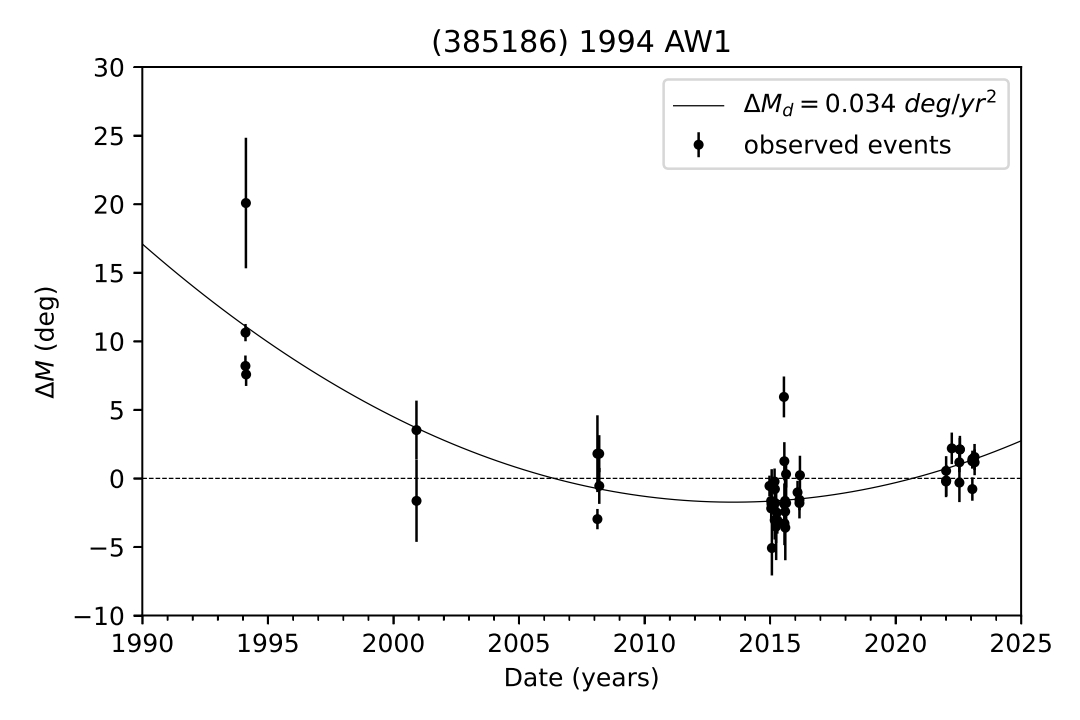
Figure: Time evolution of the mean anomaly difference ΔM with respect to the reference solution of 1994 AW1 with no drift in mean anomaly. Black symbols correspond to lightcurve mutual events covered by the observed data. Vertical error bars represent estimated 1σ uncertainties of the event times, expressed in the mean anomaly. A quadratic fit to the data points, represented by the black curve, gives the quadratic term of 0.034 deg/yr2. The plot was constructed as follows. We generated a synthetic lightcurve using a model with mean anomaly drift fixed at zero. Then, for each light-curve event separately, we fitted the mean anomaly of the model in order to obtain the best match between its synthetic lightcurve and the observed data. ΔM is the difference between the mean anomaly of the original model and the fitted one.
Acknowledgments
The work by the authors from [1] was supported by the Grant Agency of the Czech Republic, Grant 23-04946S.
References
Scheirich, P., et al., 2015. Icarus 245, 56–63.
Jacobson, S.A., Scheeres, D.J., 2011. The Astrophysical Journal Letters 736, L19.
Zhou, W.H., 2024. A&A 692, L2.
How to cite: Scheirich, P., Pravec, P., Zhou, W.-H., Ferrais, M., Scheeres, D., McMahon, J., Hornoch, K., Kušnirák, P., Kučáková, H., Fatka, P., Lister, T., Gomez, E., Chatelain, J., Greenstreet, S., and Jehin, E.: Minor orbital drifts in binary near-Earth asteroids (175706) 1996 FG3 and (385186) 1994 AW1: Implications for their orbital dynamics, EPSC-DPS Joint Meeting 2025, Helsinki, Finland, 7–12 Sep 2025, EPSC-DPS2025-69, https://doi.org/10.5194/epsc-dps2025-69, 2025.


