

- The University of Tokyo, Graduate School of Science, Department of Earth and Planetary Science, Tokyo, Japan (g-kinoshita20686@g.ecc.u-tokyo.ac.jp)
Understanding Mercury's evolution requires disentangling the effects of space weathering from remote sensing observations of the planetary surface. Space weathering processes fall into two broad categories: (i) stochastic micrometeoroid impacts and (ii) radiation effects from the solar wind and galactic cosmic rays (GCRs) (Mesick et al., 2018). This study focuses on the latter and aims to quantitatively evaluate GCR-induced space weathering using Geant4 radiation transport simulations (Allison et al., 2016).
GCRs consist mainly of protons with energies ranging from several hundred MeV to several GeV, originating from outside the solar system and accelerated by supernova explosions (Simpson, 1983). Previous work by Gurtner et al. (2004) explored GCR interactions with Mercury’s surface using Geant4, but relied heavily on assumptions due to limited observational data from Mariner 10. With the advancements brought by MESSENGER and BepiColombo, a reassessment based on updated environmental and surface composition data is now necessary.
This study addresses two main objectives: (1) characterization of the near-Mercury GCR environment based on models and observations, and (2) simulation-based estimation of energy deposition by cosmic-ray protons into Mercury’s surface. For (1), we assessed the effect of Mercury’s magnetosphere on GCR penetration using the KT17 magnetic field model (Korth et al., 2017). We calculated Larmor radii and particle rigidity to estimate the shielding effect. We also analyzed high-energy particle data from the “SPM” radiation housekeeping monitor (Kinoshita et al., 2025) onboard BepiColombo/MMO (Murakami et al., 2020). The SPM continuously observes galactic cosmic rays (GCRs) during BepiColombo’s cruise phase; in this study, we focus on measurements obtained during the Mercury swing-by.
For (2), we constructed a model of Mercury-analog material in Geant4 and simulated incident proton trajectories (see Fig. 1). We recorded parameters such as incident energy, deposited energy, angle of incidence, and maximum penetration depth to examine their interdependencies. These results provide key insights for interpreting upcoming observations of Mercury’s surface by X-ray, gamma-ray, and neutron spectrometers following BepiColombo’s orbital insertion at the end of 2026.
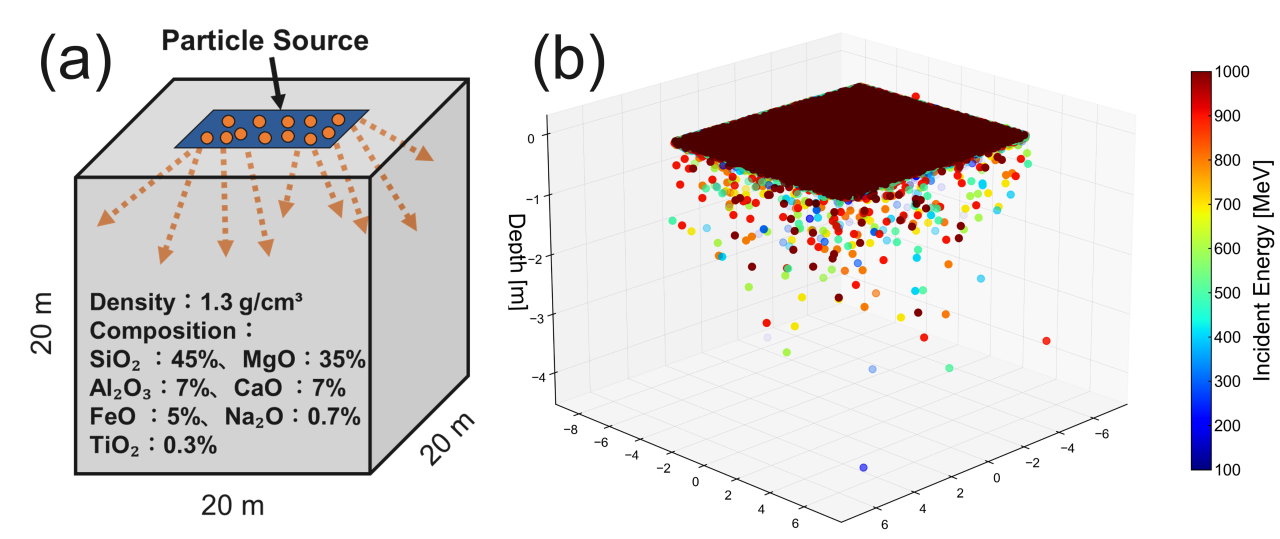
Figure 1. (a) Mercury surface simulant constructed in the Geant4 model environment. (b) Relationship between the incident energy of protons and their penetration depth into the simulated surface. (This is a preliminary result; future work will further refine simulation settings.)
References
[1] Allison, J., Amako, K., Apostolakis, J., Arce, P., Asai, M., Aso, T., et al. (2016). Recent developments in Geant4. Nuclear Instruments and Methods in Physics Research Section A: Accelerators, Spectrometers, Detectors and Associated Equipment, 835, 186–225. https://doi.org/10.1016/j.nima.2016.06.125
[2] Gurtner, M., Desorgher, L., Flückiger, E. O., & Moser, M. R. (2006). A Geant4 application to simulate the interaction of space radiation with the Mercurian environment. Advances in Space Research, 37(9), 1759–1763.
[3] Kinoshita, G., Ueno, H., Murakami, G., Pinto, M., Yoshioka, K., & Miyoshi, Y. (2025). Simulation for the calibration of radiation housekeeping monitor onboard BepiColombo/MMO and application to the inner heliosphere exploration. Journal of Geophysical Research: Space Physics, 130, e2024JA033147. https://doi.org/10.1029/2024JA033147
[4] Korth, H., Johnson, C. L., Philpott, L., Tsyganenko, N. A., & Anderson, B. J. (2017). A dynamic model of Mercury’s magnetospheric magnetic field. Geophysical Research Letters, 44, 10,147–10,154. https://doi.org/10.1002/2017GL074699
[5] Mesick, K. E., Feldman, W. C., Coupland, D. D. S., & Stonehill, L. C. (2018). Benchmarking Geant4 for simulating galactic cosmic ray interactions within planetary bodies. Earth and Space Science, 5, 324–338. https://doi.org/10.1029/2018EA000400
[6] Murakami, G., Hiroyuki, O., Shoya, M., Taeko, S., Yasumasa, K., Yoshifumi, S., et al. (2020). Mio—First comprehensive exploration of Mercury’s space environment: Mission overview. Space Science Reviews, 216(7), 113. https://doi.org/10.1007/s11214‐020‐00733‐3
[7] Pieters, C. M., & Noble, S. K. (2016). Space weathering on airless bodies. Journal of Geophysical Research: Planets, 121, 1865–1884. https://doi.org/10.1002/2016JE005128
How to cite: Kinoshita, G.: Assessment of Cosmic-Ray-Induced Space Weathering on Mercury’s Surface Using Geant4 Simulations, EPSC-DPS Joint Meeting 2025, Helsinki, Finland, 7–12 Sep 2025, EPSC-DPS2025-712, https://doi.org/10.5194/epsc-dps2025-712, 2025.


