
 1,1,1,
- 1Swedish Institute for Space Physics, solar system physics and space technology, Kiruna, Sweden (romain.canu-blot@irf.se)
- 2European Space Agency
- 3National Space Science Center, Chinese Academy of Sciences, No.1 Nanertiao, Zhongguancun, Haidian district, Beijing, 100190, China
- 4University of Chinese Academy of Sciences, No. 1 Yanqihu East Road, Huairou district, Beijing, 101408, China
The Negative Ions at the Lunar Surface (NILS) instrument [1] is the first instrument to measure negative ions directly on the lunar surface. Carried onboard the Chang’e-6 mission to the lunar far-side (South Pole-Aitken basin) in June 2024, the instrument produced 346 minutes of data. The instrument uses an electrostatic elevation scanning system and energy analyzer to measure the direction- and energy-resolved negative ion flux. The instrument field-of-view spans from the surface to space in 16 linearly-spaced angular steps. The instrument response, integrated over the 8 steps viewing the surface, is shown in Fig. 1 alongside the scattering function for energetic neutral hydrogen atoms (ENAs) previously derived from orbital observations [2].
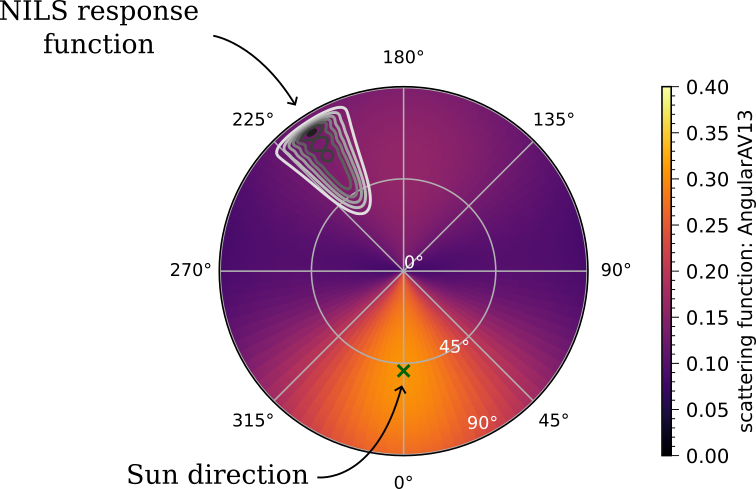
Figure 1: Hydrogen ENA scattering function from Schaufelberger et al., 2011 along with the projected summed NILS response function.
NILS data provide direct constraints—at the emission source—on the energy and angular distributions of scattered and sputtered negative hydrogen ions. A detailed mathematical model of the instrument is used within a Bayesian inference framework to retrieve the scattering and sputtering functions. Finally, these NILS-derived functions are compared with orbital measurements of scattered solar wind protons and hydrogen ENAs.
[1] Canu-Blot, R., Wieser, M., Kérényi, M. et al. The Negative Ions at the Lunar Surface (NILS) Instrument on the Chang’E-6 Mission. Space Sci Rev 221, 38 (2025). https://doi.org/10.1007/s11214-025-01162-w
[2] A. Schaufelberger et al., “Scattering function for energetic neutral hydrogen atoms off the lunar surface,” Geophysical Research Letters, vol. 38, Art. no. 22, Nov. 2011.
How to cite: Canu-Blot, R., Wieser, M., Barabash, S., Stenberg Wieser, G., Kérényi, M., Wang, X.-D., Melville, N., and Zhang, A.: Scattering and Sputtering of Negative Hydrogen Ions from the Lunar Surface: Inference from NILS Observations on Chang’e-6, EPSC-DPS Joint Meeting 2025, Helsinki, Finland, 7–12 Sep 2025, EPSC-DPS2025-714, https://doi.org/10.5194/epsc-dps2025-714, 2025.


