
 1,
1,- 1McDonnell Center for the Space Sciences, Department of Earth, Environmental, and Planetary Science, Washington University in St. Louis, St. Louis, United States (vanbommel@wustl.edu)
- 2Amentum at NASA Johnson Space Center, Houston, United States
- 3Australian National University, Canberra, Australia
- 4University of California Berkeley, Berkeley, United States
- 5University of Michigan, Ann Arbor, United States
- 6University of Guelph, Guelph, Canada
X-ray fluorescence (XRF) spectroscopy has long served as a cornerstone analytical technique in planetary surface exploration, enabling high-precision compositional analyses of planetary materials in situ. On Mars, two prominent XRF instruments — the Alpha Particle X-ray Spectrometer (APXS) aboard Curiosity and the Planetary Instrument for X-ray Lithochemistry (PIXL) aboard Perseverance — have demonstrated that the capabilities of landed XRF instruments extend beyond the quantification of bulk chemistry.
Native Sulfur on Mars
APXS has performed ~1700 compositional analyses since Curiosity landed in Gale crater in 2012. While APXS traditionally derives bulk rock and soil compositions, systematic advancements have been made that enable the assessment of distinct features on the sub-cm scale, smaller than the APXS field of view (e.g., [1]). This advancement, combined with the capability to characterize light‑element (i.e., Z<11) enrichment and depletion via backscattered X-ray intensities, played an important role in the recent discovery of a localized deposit of native sulfur (S0) within a canyon on Mars (Figure 1). Native sulfur has not previously been identified in any martian material, including meteorites, and its discovery provides evidence of a stable and dry environment for the past several billion years. Terrestrially, native sulfur is commonly formed through high‑temperature processes or in association with biology. There is an absence of any clear indication of high-temperature processes in Gale crater, especially in the vicinity of the deposit, and a lack of evidence of past biology on Mars. The apparent purity of the S0 characterized by APXS, the absence of entrained dust and debris, and the geomorphology of the area are found to be consistent with the degassing of H2S-rich fluids from clathrates coinciding with sedimentary unloading [2-4].
Figure 1. APXS X-ray scatter analyses (i.e., Compton/Rayleigh intensity, C/R) of a deposit of light-toned stones in Gediz Vallis demonstrated a significant depletion in light elements, such as oxygen, compared to anticipated X-ray scatter intensities based on the assumed oxides (e.g., SO3 not S), providing important evidence that supported the determination of native sulfur. This oxygen depletion is similar to that observed in Fe-Ni metal meteorites (i.e., Fe not FeO) and differs from light-element enrichments observed by the Opportunity APXS in Marquette Island where carbonate cement was inferred. When the oxide species present parallel those assumed, the ratio of observed to modeled (or expected) is approximately unity (e.g., Mars soil).
Mars Hadley Cells
Curiosity’s APXS has been routinely measuring the martian atmosphere, paralleling similar assessments made by predecessor instruments on the twin rovers Spirit and Opportunity [5]. No APXS flown to date has been designed or calibrated for atmospheric analyses. Yet, the collective span of these three missions – with over 11,000 martian sols between them – and the frequency at which atmospheric measurements were acquired has enabled an unparalleled look into the modern environment of Mars. In addition to tracing condensation flow, recent campaigns by Curiosity have focused on characterizing the variation in Ar partial pressure in the atmosphere around Ls 45 and Ls 150, annual timeframes where punctuated deviations from smooth periodic trends are observed. These data, particularly when contrasting ~antipodal results from Opportunity and Curiosity, provide insights into potential Hadley Cell circulation (Figure 2).
Figure 2. Argon partial pressure (pAr) variation observed at Meridiani Planum (blue) and Gale crater (red). Data have been reduced across multiple Mars years to improve statistics. A short-lived pAr enrichment is observed around solar longitude (Ls) 140-180, occurring roughly 30 (Earth) days earlier at Meridiani Planum (1.9°S, 354.5°E) than at Gale crater (4.6°S, 137.4°E).
Ultrafine Mars Dust
At Jezero crater, Perseverance has been deploying PIXL, a micro-focused X-ray spectrometer, to produce compositional maps with 100-µm scale spatial resolution, including in support of Mars Sample Return (MSR) sample characterization efforts. Prior to flight, PIXL’s ability to assess thin coatings was not characterized. Coatings on the scale of ~100 µm to sub-µm produce non-linear effects in acquired X-ray spectra (e.g., [6]). Perseverance’s landed hardware also includes a vertically mounted calibration target specifically tailored for PIXL. This calibration target includes four distinct pucks, including one basaltic glass and one composed of polytetrafluoroethylene (PTFE, Teflon™), a “spectral blank”. Since landing, dust has adhered to the PIXL calibration target pucks. PIXL analyses of the PTFE puck provide the first ever XRF analyses of strictly Mars dust. Compositionally, this dust was found to be in alignment with existing literature [7] and to have a noted enrichment in phosphorus as well as volatile and moderately volatile elements; the observed 1:1 Ca:S ratio over time is evidence of Ca-sulfate. Dust was characterized to be below ~PM1 (i.e., ~1 µm) on the PTFE puck and below ~PM0.1 (i.e., ~100 nm) on the basaltic glass puck, suggestive of electrostatic sorting. Dust – which is silica-rich, iron-rich, and potentially perchlorate-bearing – at this scale has not been previously characterized on Mars (Figure 3). The size and composition of dust observed presents concerns for future crewed missions to the surface of Mars given the high potential for adverse health effects including neurotoxicity from particles that are sufficiently small enough to enter the bloodstream and possibly pass through the blood‑brain barrier.
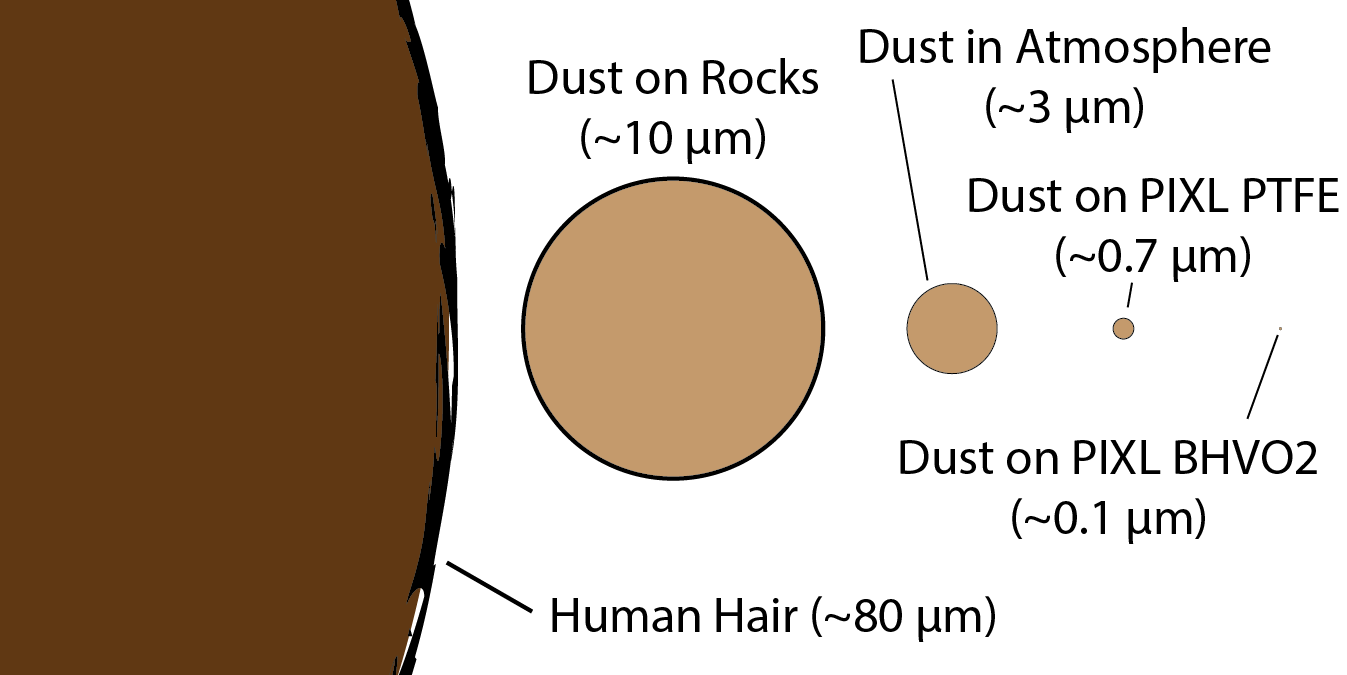
Figure 3. Scale of dust characterized on Mars compared to an average human hair. Prior work characterized Mars dust diameters on rock surfaces to be ~10 µm [8] and in the atmosphere to be ~3 µm (e.g., [9]). Recent characterizations of fine (PM1) and ultrafine (PM0.1) dust particles are a first for Mars.
References
[1] VanBommel et al. (2023). Icarus, 392.
[2] Berger et al. (2025). LPSC, 1208.
[3] King et al. (2025). LPSC, 1949.
[4] Dietrich et al. (2025). LPSC, 1366.
[5] VanBommel et al. (2018). JGR: Planets, 132, 2.
[6] VanBommel et al. (2022). Spec. Acta. B, 191.
[7] Berger et al. (2016). GRL, 43, 1.
[8] Schmidt et al. (2018). JGR: Planets, 123, 7.
[9] Clancy et al. (2003). JGR: Planets, 108, E9.
How to cite: VanBommel, S., Berger, J., Knight, A., King, P., Dietrich, W., Lo, D., and Gellert, R.: Beyond Bulk Chemistry: Enhancing the Science Return of Landed In Situ X-ray Spectrometers, EPSC-DPS Joint Meeting 2025, Helsinki, Finland, 7–12 Sep 2025, EPSC-DPS2025-717, https://doi.org/10.5194/epsc-dps2025-717, 2025.


