
 1,1,1
1,1,1- 1Laboratoire de Planétologie et de Géosciences, UMR-6112, Nantes Université, Université d'Angers, Le Mans Université, France (maeva.levesque@univ-nantes.fr)
- 2CNES-Space Geodesy Office, Toulouse, France
Venus has a long and retrograde rotation period compared to other planets in the Solar System. Its rotation period of 243 days has been measured using different methods from Earth or from the Venus’ orbit. However, this value remains poorly constrained with a large variability of about 7 minutes. Currently, models that take into account various factors influencing the Length-of-Day (LOD) can explain only 3 minutes of the observed variation. These effects include the tidal torque exerted by the Sun on Venus or the coupling between the atmosphere and the surface. Accurately tracking the Venus’ rotation period could therefore help us to better understand these processes [1].
In this study, we investigate navigation tracking data from the Venus Express (VEX) spacecraft, in order to derive a new solution for the rotation period of Venus. We use a method called Precise Orbit Determination (POD). It consists of performing a least squares adjustment of the difference between collected and generated Doppler data. Collected Doppler data correspond to the Doppler effect on the radio-link carrier frequency between the spacecraft and a ground-based antenna, and due to the motion of the spacecraft around the planet. Generated Doppler data are derived from the trajectory computed by numerical integration of the forces governing the spacecraft’s motion. The least-squares adjustment is performed over successive arcs of 7 days in the case of Venus Express and uses the GINS (Géodésie par Intégrations Numériques Simultanées) software.
We determined a rotation period for Venus of 243.0202 ± 0.0008 days using these tracking data from Venus Express over the 8 years of the mission. As shown in Figure 1, this result aligns well with previous estimates obtained through different methods and datasets. However, the associated uncertainty is relatively large compared to earlier measurements using Magellan and Pioneer Venus Orbiter (PVO) tracking data [3]. This uncertainty reflects the influence of the atmospheric model employed in our POD computations (such as Hedin, Venus-GRAM, or Venus Climate Database) and the difficulty in accurately resolving velocity anomalies introduced by the spacecraft’s daily desaturation maneuvers.
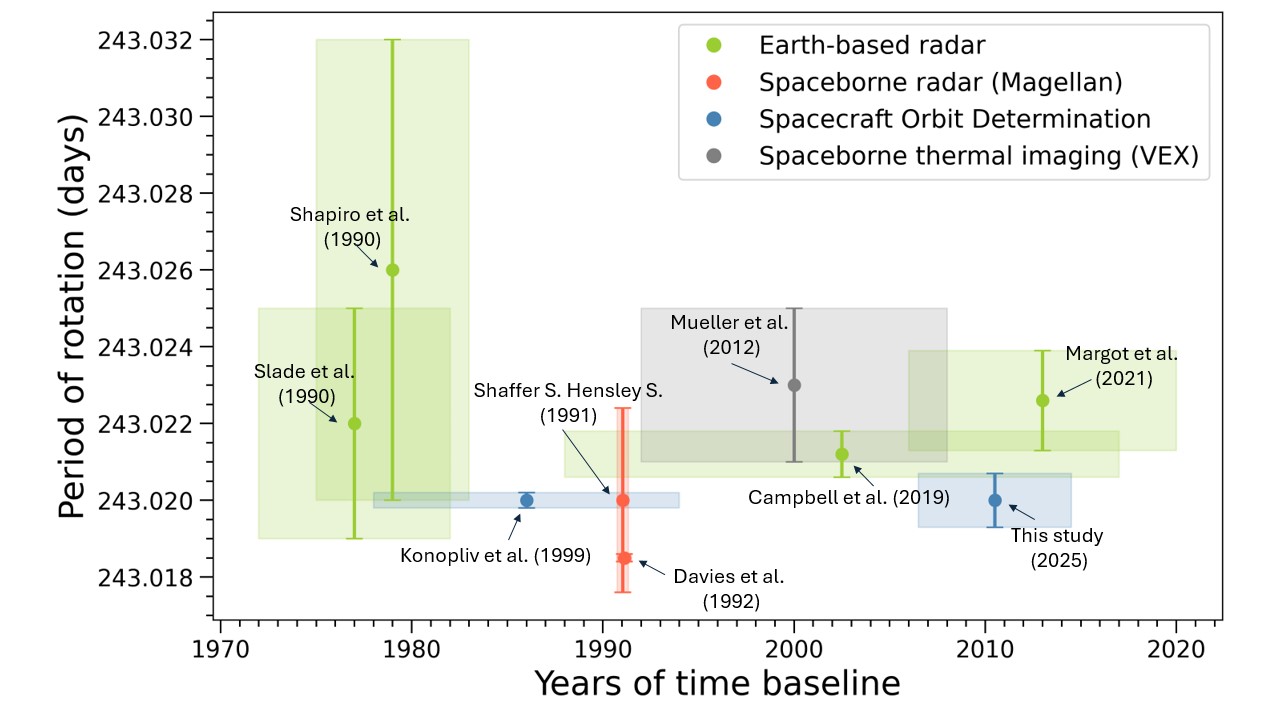
Figure 1: Estimates of Venus' rotation period, along with their measurement time baseline and corresponding error-bars at 1-sigma (Lévesque et al. (2025), under review).
In Figure 1, the different estimates of Venus’s rotation period are generally averaged over one year or more. To investigate potential shorter variations in our results, we computed a separate estimate of the rotation period every 12 arcs, corresponding to approximately three months of data (shown in black in Figure 2). Values in red represents the measurements of instantaneous periods obtained by Margot et al. (2021) [4] relative to the operating period of VEX. A comparison of the median values shows that these two independent methods yield consistent results over the same time span. In both studies the dispersion is too large to see a variation in the Length of Day or a clear periodic signal. Therefore, more precise measurements are needed in order to see possible variations in the LOD.

Figure 2: Time series of Venus's rotation period, with one value reported for every 12 arcs. The results of our study are shown in black, while the findings from Margot et al. (2021) covering the period from mid-2006 to 2014 are displayed in red. In grey, the 3 minutes amplitude predicted by the theory (Lévesque et al. (2025), under review).
The rotation period estimate from our study was determined simultaneously with the orientation of Venus’s rotation axis, defined by its right ascension and declination. Figure 3, adapted from Margot et al. (2021) [4], presents results from various studies along with their 1-sigma uncertainties. In our case, the uncertainties are relatively large, preventing us from determining the precession rate.
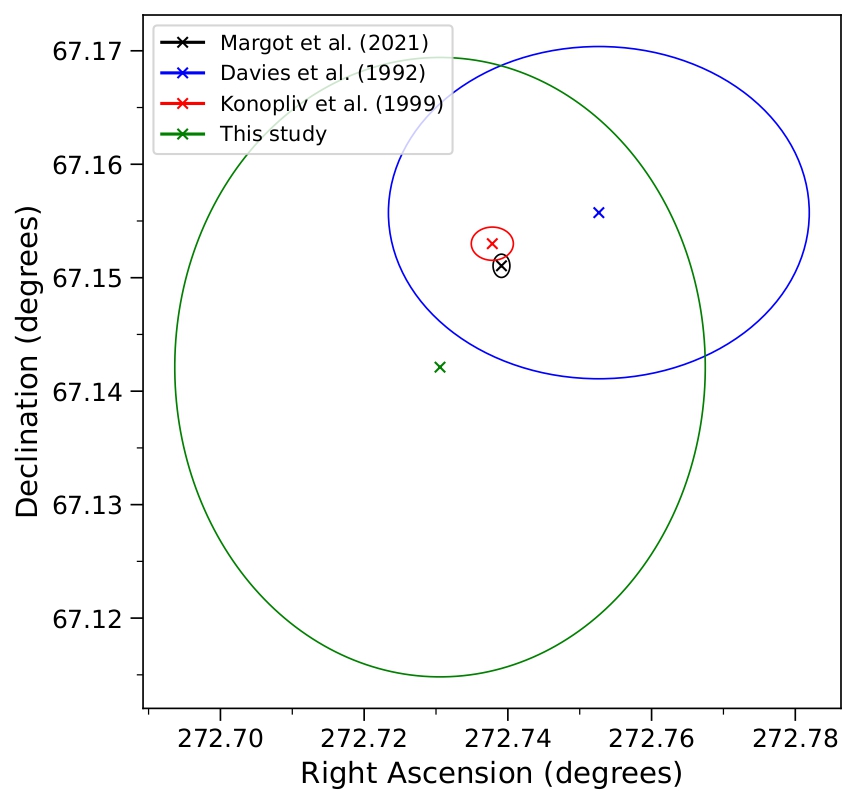
Figure 3: Spin axis orientation of Venus with 1 sigma uncertainties, i.e. 2D confidence intervals at 68.3 % levels. Modified from Margot et al. (2021) (Lévesque et al. (2025), under review)
Our ability to accurately estimate Venus’s geophysical parameters using Venus Express tracking data remains limited. Upcoming missions like NASA’s VERITAS and ESA’s EnVision are expected to provide crucial new data to improve this estimation. Scheduled for launch in 2031, EnVision will study Venus from its deep interior to the upper atmosphere. Thanks to its near-polar, low-eccentricity orbit, the mission will provide greater sensitivity to the planet's gravity field and rotational state. We carried out simulations to predict EnVision’s performances [5]. The predicted 3-sigma uncertainty in the rotation period is 1,3 seconds, compared to the uncertainty of more than 1 minute obtained with VEX. For the precession rate, the 3-sigma uncertainty is 1.2%, compared to 7% obtained with ground-based radar data [4].
[1] Cottereau, L. et al.: The various contributions in Venus rotation rate and LOD, Astron.Astrophys. 531, A45, 2011
[2] Konopliv A. S. et al.: Venus Gravity: 180th Degree and Order Model. Icarus 139, 3–18, 1999
[3] Margot, J. L. et al.: Spin state and moment of inertia of Venus, Nat Astron 5:676–683, 2021
[4] Rosenblatt, P. et al.: EnVision gravity experiment: Joint inversion of Doppler tracking data and tie-points monitoring from SAR images. Vol. 17, EPSC2024-410, 2024
How to cite: Lévesque, M., Rosenblatt, P., Marty, J.-C., and Dumoulin, C.: Measurement of the spin of Venus using radio tracking data from Venus Express and expected outcomes from EnVision, EPSC-DPS Joint Meeting 2025, Helsinki, Finland, 7–13 Sep 2025, EPSC-DPS2025-718, https://doi.org/10.5194/epsc-dps2025-718, 2025.


