
 2
2- 1Laboratoire de Météorologie Dynamique, Institut Pierre-Simon Laplace (LMD/IPSL), Sorbonne Université, Centre National de la Recherche Scientifique (CNRS), École Polytechnique, École Normale Supérieure (ENS), Paris, France
- 2Laboratoire d'études spatiales et d'instrumentation en astrophysique (LESIA) - Observatoire de Paris, France
Introduction : Dust storms strongly influence the current Martian climate, yet their seasonal cycle and the interannual variability of Global Dust Storms (GDS) remain poorly understood. General circulation models (GCMs) often fail to reproduce both solsticial and equinoctial GDS, as well as the recurring seasonal pattern of regional Z, A, B and C storms (Montabone et al. (2015), Kass et al. (2016)). We present an offline dust model based on Mars Planetary Climate Model (Mars PCM) (Forget et al. (1999)) simulations with prescribed opacity and subgrid-scale parameterizations informed by high-resolution models. This approach captures key features of the dust cycle, including both types of GDS, while enabling multi-decadal simulations at low computational cost.
Preliminary GCM simulations : We perform six simulations of one Martian year with the Mars PCM, varying visible dust opacity from τ=0.05 to τ=5, kept constant throughout the year. The surface wind stress in the offline model is computed by interpolating wind data from these GCM simulations, adjusted for the mean dust opacity in the offline model and weighted by large zonal dust gradients, as strong zonal dust contrasts can enhance surface winds.
Dust Lifting, Transport, and Deposition : Dust lifting on Mars is driven by two main mechanisms: saltation by surface wind stress, dominant during the storm season (late northern summer to winter), and dust devils, active in spring and early summer. The offline model uses two tracers (mass and number) to represent dust, allowing diagnosis of loading and particle size under a log-normal distribution. Saltation flux is computed from surface wind stress and a lifting threshold, with subgrid wind variability captured using a Weibull distribution, following Lorenz (1996). Dust devil lifting is also included, with the flux computed as a function of vertical wind variance, based on insights from LES simulations. Advection is handled using a mass-conserving Van Leer scheme, while sedimentation is computed by discretizing the dust size distribution into 12 bins and applying mean fall speeds from Rossow (1978).
Dust sinks and sources : A key challenge in dust cycle modeling is the formation of dust sinks, where dust accumulates in low-wind or high-threshold regions, leading to a gradual depletion of atmospheric dust. To counter this, erosion is introduced: empty reservoirs can still lift dust if the wind exceeds a fixed erosion threshold.
Baroclinic waves : Baroclinic waves are included in the offline model's wind fields, but the coarse resolution limits the proper resolution of wave fronts. High-resolution GCMs show stronger winds and sharper contrasts during high baroclinic activity. Parameterizing these features is crucial to improve the dust cycle simulation, especially for capturing A and C storms.
Storm edge lifting : Dust storms often evolve as fronts with sharp opacity contrasts over short distances, which can enhance winds and trigger additional lifting, creating a positive feedback loop (Wu et al., (2021); Spiga and Lewis, (2010)). Due to model resolution limitations, these strong winds at storm edges must be parameterized.
Cap Edge Lifting: Strong winds near the polar cap edge, driven by temperature contrasts between Martian soil and CO2 ice caps, are better captured in mesoscale models (Smith and Spiga, (2018)). To simulate this in our model, we add a surface wind stress term proportional to the thermal contrast between adjacent grid cells, accurately representing the B storm near the South polar cap.
Wind stress thresholds : In the offline model, we use a distribution of wind stress thresholds instead of a single value per grid cell. Each cell contains subgrid reservoirs with unique lifting thresholds and limited dust supplies, which are replenished equally by sedimentation, allowing rapid recovery of low-threshold reservoirs. This setup introduces interannual variability in GDS activity by modulating local dust availability over time.
Results : The offline model reproduces both solstitial and equinoctial GDS with a realistic interannual variability, some years producing GDS, others not, as observed (see Figure 2). In the absence of GDS, the model captures the main features of the seasonal dust cycle, with recurring regional storms matching the observed pattern of the Z, A, B, and C storms, as illustrated in Figure 1. On average, the simulated dust cycle closely resembles the climatology derived from observations, supporting the model's capacity to represent the baseline seasonal behavior of Martian dust.
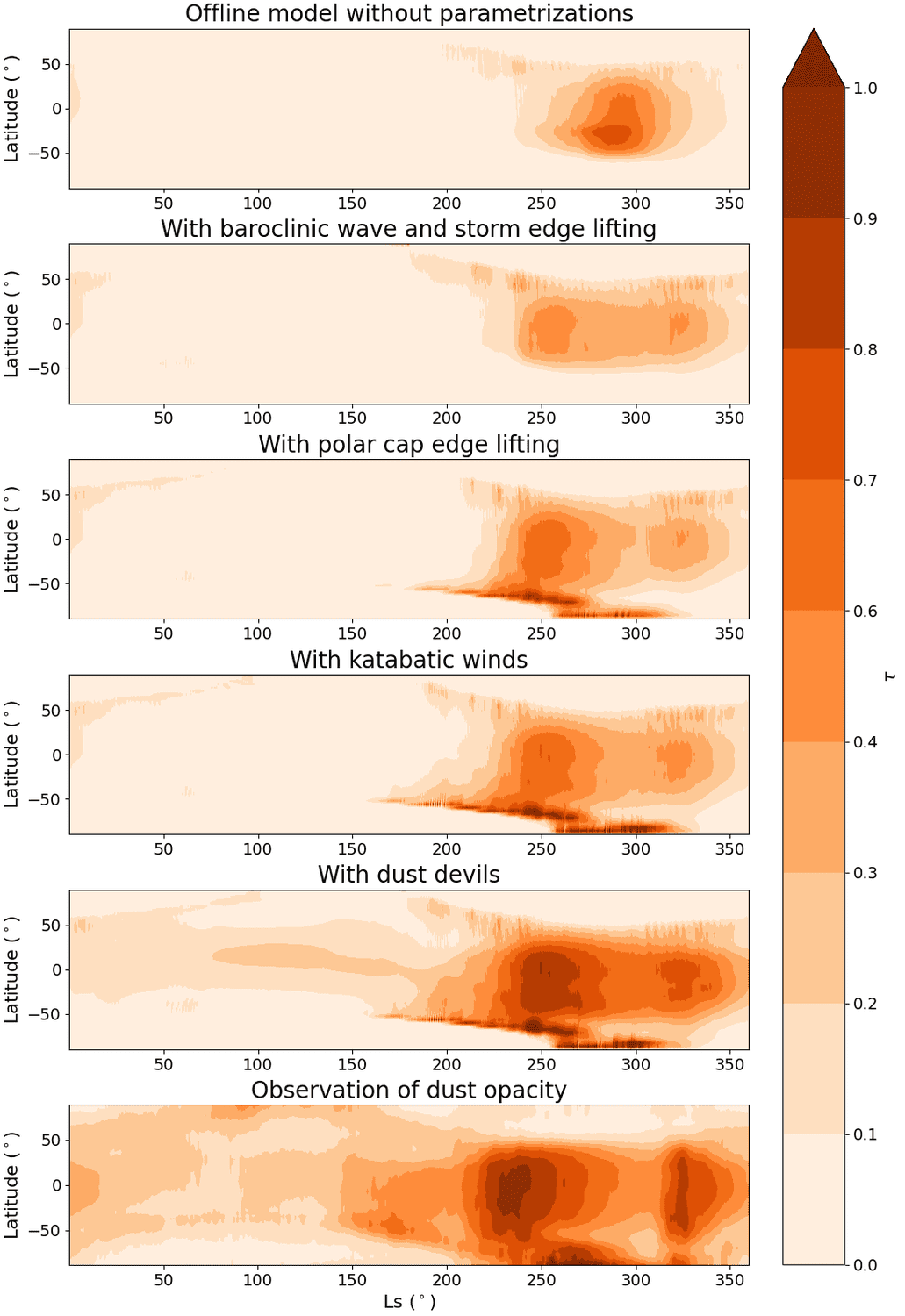
Figure 1: Effect of different parameterizations in the offline model compared to observations (last panel)
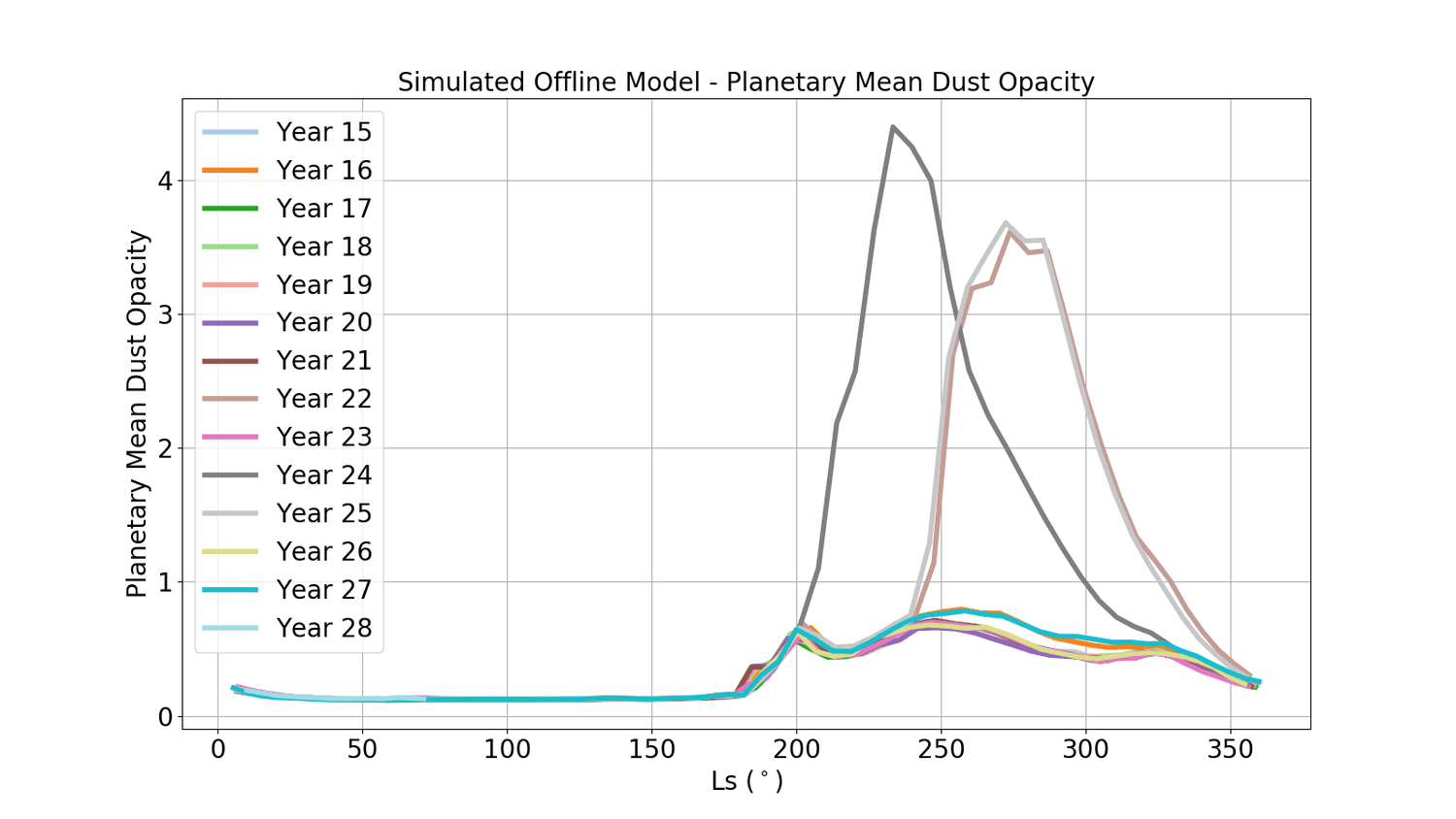
Figure 2: Planetary mean of visible dust column optical depth in the offline model as a function of season.
References :
Montabone, L., Forget, F., Millour, E., Wilson, R. J., Lewis, S. R., Cantor, B., Kass, D.Kleinböhl, A., Lemmon, M.T., Smith, M.D & Wolff, M. J. (2015). Icarus, 251, 65-95.
Kass, D. M., Kleinböhl, A., McCleese, D. J., Schofield, J. T., & Smith, M. D. (2016). Geophysical Research Letters, 43(12), 6111-6118
Forget, F., Hourdin, F., Fournier, R., Hourdin, C., Talagrand, O., Collins, M., Lewis, S.R., Read, P.L. & Huot, J. P. (1999). Journal of Geophysical Research: Planets, 104(E10), 24155-24175.
Lorenz, R. D. (1996). Journal of Spacecraft and Rockets, 33(5), 754-756
Rossow, W. B. (1978). icarus, 36(1), 1-50.
Wu et al. (2021). Journal of Geophysical Research: Planets, 126(9), e2020JE00675
Spiga, A., & Lewis, S. R. (2010). Mars, 5, 146-158.
Smith, I. B., & Spiga, A. (2018). Icarus, 308, 188-196.
How to cite: Pierron, T., Forget, F., and Bertrand, T.: An Offline Model for long-term Martian Dust Storm Simulations and Interannual Variability, EPSC-DPS Joint Meeting 2025, Helsinki, Finland, 7–12 Sep 2025, EPSC-DPS2025-724, https://doi.org/10.5194/epsc-dps2025-724, 2025.


