
 1,2,2,2,2,2,3,
- 1Centro di Ateneo di Studi e Attività Spaziali "Giuseppe Colombo" - CISAS, Via Venezia 15, 35131, Padova, Italy
- 2INAF-Astronomical Observatory of Padua, Vic. Osservatorio 5, 35122, Padova, Italy
- 3Department of Physics, University of Padua, Via Marzolo 8, 35131, Padova, Italy
- 4Agenzia Spaziale Italiana, Via del Politecnico, 00133, Roma, Italy
Water ice plays a fundamental role in the geological history of Mars, making the planet a primary target for supporting human activities and the search for life. Its distribution is a key constraint for the interpretation of the paleo-martian climate, while the amount of sub-surface ice (in terms of pore filling towards excess ice) provides essential information about deposition processes [1] [2].
Although surface water ice is easy to observe, detecting and studying underground ice is much more challenging. In this context, impact craters become a valuable tool for investigating deeper surface layers. Their morphology reflects the mechanical properties of the target material and can reveal variations in density, strength, water content, porosity, and composition.
Craters formed in ice-rich substrates tend to exhibit lower depth/diameter (d/D) ratios than those formed in dry regolith. This feature is attributed to the different resistance between ice and rock, as well as post-formative processes such as viscous relaxation and slumping [3]. A lower d/D ratio is particularly evident in small craters, which are more sensitive to the local properties of the substrate [6].
In addition, recent numerical modelling studies [5] showed that the formation of double terraces in craters of Arcadia Planitia can be explained by the presence of relatively pure ice layers with different cohesion and porosity. These observations suggest a possible ice stratification and offer new perspectives on the past Martian climate.
The goal of this study is to extend the analysis of the terraced craters catalog published by Bramson et al. [2], focused on the area of Arcadia Planitia (Figure 1). The database includes 187 craters, with diameters ranging from 125 meters to 2 kilometers. Among these, 62 have a single well-defined terrace, 35 show two distinct terraces, while the remaining 90 were classified as uncertain due to the presence of poorly distinguishable or difficult to interpret terraced morphologies.
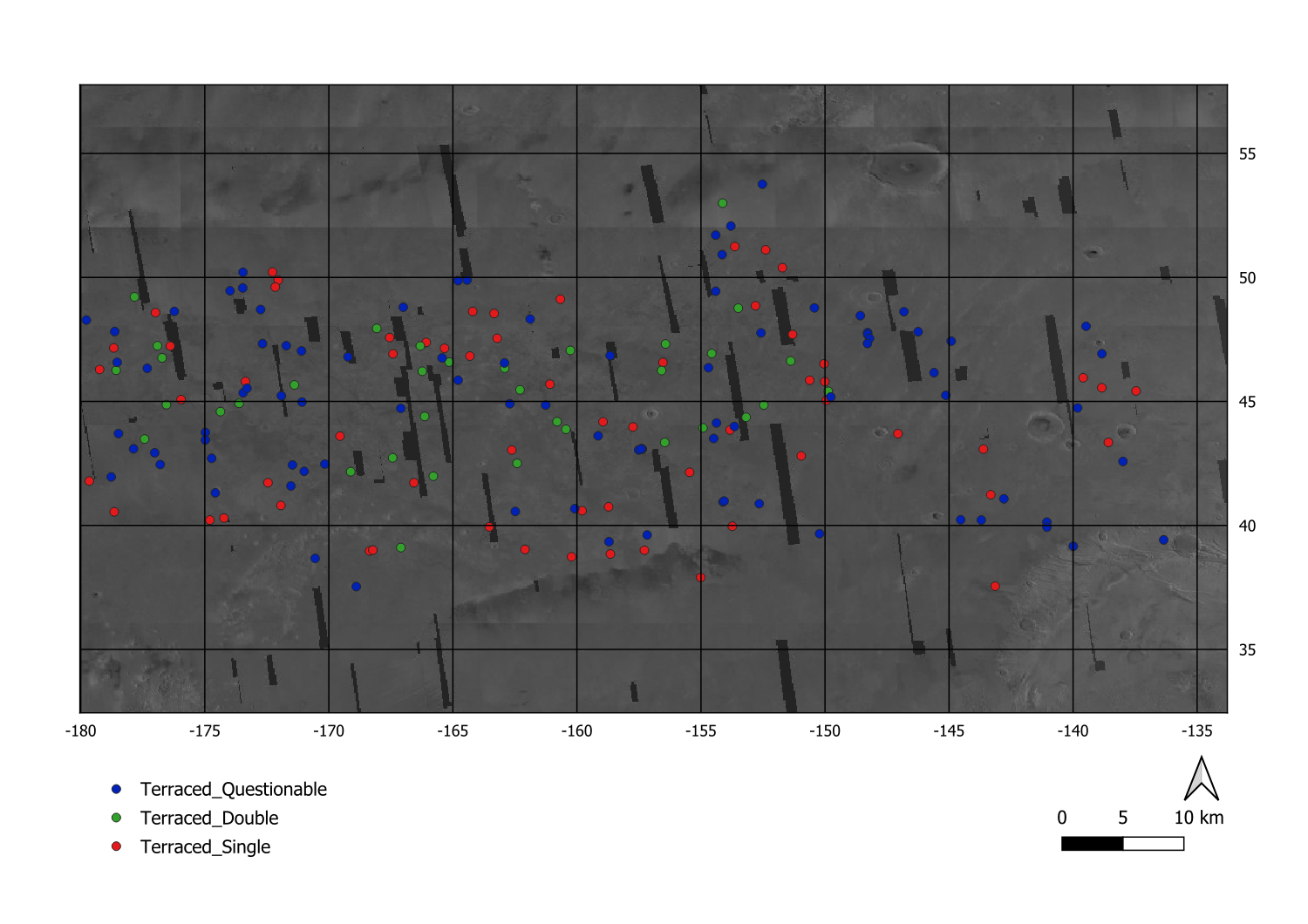
Figure 1: Spatial distribution of terraced craters in Arcadia Planitia.
The analysis was carried out using the open-source QGIS software, integrated with custom Python scripts. Based on the previous work [2], a detailed morphometric analysis was conducted using 14 high-resolution Digital Terrain Models (DTMs) from the HiRISE archive [4]. Among these, 10 had already been used in the original study, while 4 were added in the present work. Using the QGIS "Profile Tool", the elevation profiles of craters were analyzed, allowing the measurement of the depth of terraces, dip, and slope between different levels. The results obtained confirm and extend what has already been reported in the literature [2].
In a second step, an additional analysis was carried out, in which 20 radial profiles were extracted from each HiRISE DTM to calculate the crater d/D ratio and its associated uncertainties. The craters analyzed are located in the region of Arcadia Planitia, between longitudes 180°E and 225°E. For comparative purposes, a sample of 16 simple craters in the same longitudinal band was selected. The results were displayed in a three-dimensional plot d/D versus longitude and latitude (Figure 2).
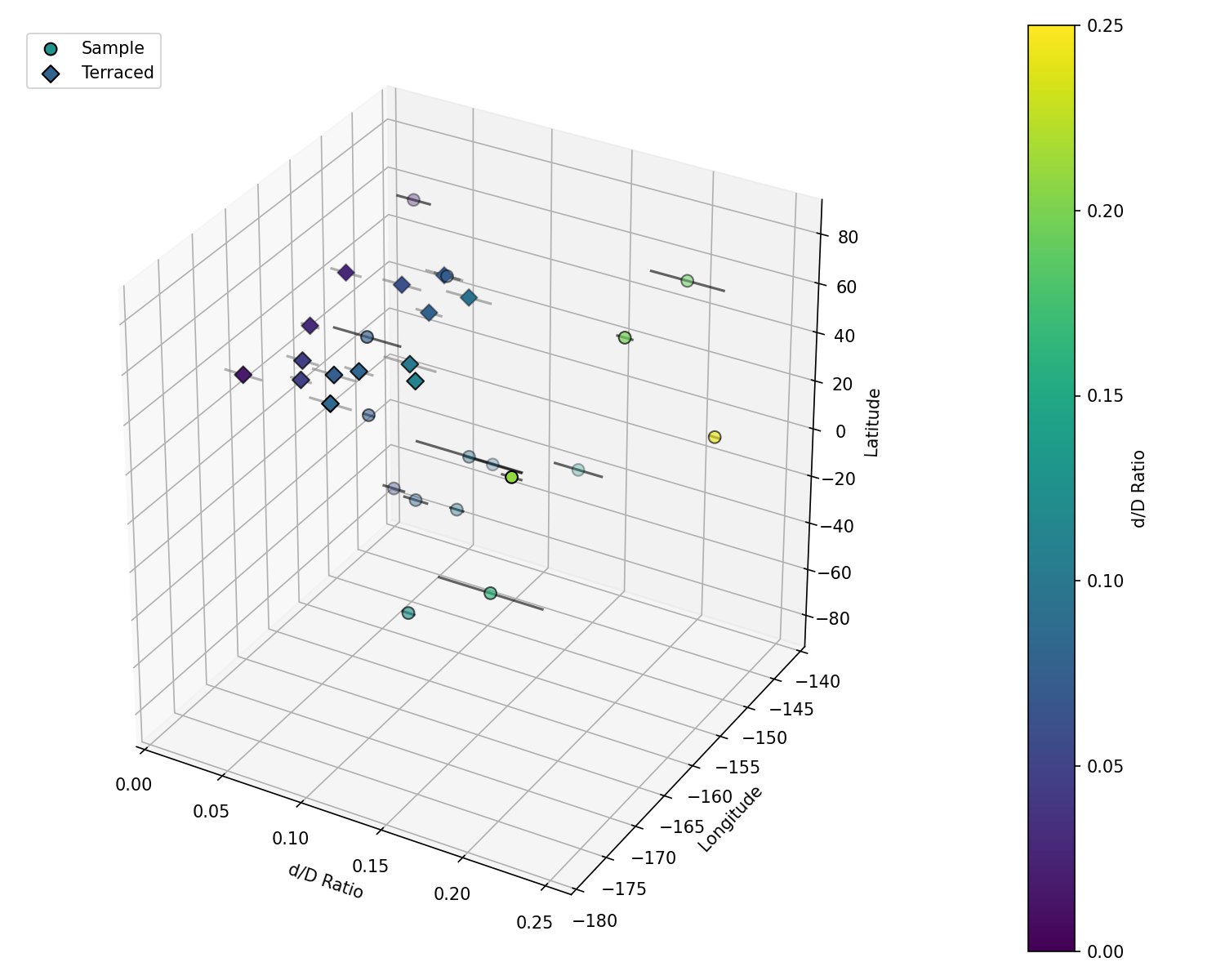
Figure 2: Three-dimensional distribution of the crater dataset as a function of d/D ratio, longitude, and latitude. Circles represent simple craters, rhombuses terraced ones. Marker color shows the d/D ratio, as indicated by the colorbar. Horizontal lines show d/D measurement error bars.
Referring to this plot, the analysis of the d/D ratio shows systematically lower values in terraced craters (rhombuses) than simple ones (circles), supporting the hypothesis that the presence of ice in the substrate reduces the resistance of the target material at the time of impact. The different gradients and
elevation variations observed within the terraces could provide further indications on the mechanical and stratigraphic properties of the subsurface, supporting the hypothesis of stratified deposits of relatively pure ice in Arcadia Planitia.
In conclusion, the results obtained seem to confirm that the presence of ice in the subsoil at the moment of impact may cause the formation of shallower craters, characterized by lower d/D ratios than those developed in ice-free substrates. Furthermore, the internal morphology of craters, in particular the presence, number and arrangement of terraces, shows a significant variability, potentially related to the stratified structure and composition of the subsoil.
It is currently planned to generate additional terraced crater DTMs located in the same area, using stereoscopic pairs of HiRISE images available from the public archive. In parallel, new DTMs will be produced using stereo pairs acquired from the CaSSIS imaging system [7]. Expanding the dataset will enable further refinement of the analysis and help verify the robustness of the results obtained so far.
Acknowledgments
This work has been developed under the ASI-INAF agreement n. 2024-40-HH.0
References
[1] Ali M Bramson, Shane Byrne, Nathaniel E Putzig, Sarah Sutton, Jeffrey J Plaut, T Charles Brothers, and John W Holt. Widespread excess ice in arcadia planitia, mars. Geophysical Research Letters, 42(16):6566–6574, 2015.
[2] AM Bramson, Shane Byrne, and J Bapst. Preservation of midlatitude ice sheets on mars. Journal of Geophysical Research: Planets, 122(11):2250–2266, 2017.
[3] B. S. Douglass and J. F. Bell III. Using impact crater depth/diameter ratios to search for evidence of subsurface ice on mars, 2025. 56th LPSC.
[4] HiRISE Team. Dtm map browser, 2025. University of Arizona, Lunar and Planetary Laboratory.
[5] E Martellato, AM Bramson, G Cremonese, A Lucchetti, F Marzari, M Massironi, C Re, and S Byrne. Martian ice revealed by modeling of simple terraced crater formation. Journal of Geophysical Research: Planets, 125(10):e2019JE006108, 2020.
[6] Stuart J Robbins and Brian M Hynek. A new global database of mars impact craters≥ 1 km: 2.global crater properties and regional variations of the simple-to-complex transition diameter. Journal of Geophysical Research: Planets, 117(E6), 2012.
[7] N Thomas, G Cremonese, R Ziethe, M Gerber, M Brndli, G Bruno, M Erismann, L Gambicorti, T Gerber, K Ghose, et al. snd markiewicz. W., Massironi, M., McEwen, A., Okubo, C., Tornabene, L., Wajer, P., and Wray, J, page 18971944, 2017.
How to cite: Faletti, M., Cremonese, G., Martellato, E., Tullo, A., Bertoli, S., Munaretto, G., Marzari, F., and Zinzi, A.: Analysis of terraced craters in Arcadia Planitia, EPSC-DPS Joint Meeting 2025, Helsinki, Finland, 7–13 Sep 2025, EPSC-DPS2025-729, https://doi.org/10.5194/epsc-dps2025-729, 2025.


