
 2,
2,- 1Mathematics Research Centre, Tampere University, Tampere, Finland (topi.pajala@tuni.fi)
- 2Aix Marseille University, CNRS, Centrale Marseille, Institut Fresnel, Marseille, France
The European Space Agency (ESA) Hera mission is the second part of the international Asteroid Impact & Deflection Assessment (AIDA) collaboration, following NASA’s successful double asteroid redirection test (DART) impact on the binary asteroid system 65803 Didymos. Hera’s primary target is Dimorphos, the Didymos asteroid moonlet, whose structural and dynamical properties are being investigated to understand the results of kinetic impact deflection strategies. One of the mission’s core objectives is to reveal the internal composition and porosity distribution of Dimorphos through radar tomography, offering unprecedented insights into the mechanics of rubble-pile asteroids. Two CubeSats, Juventas Radar (JuRa) carrying low-frequency monostatic radar, a gravimeter and an accelometer, and Milani carrying near-infrared imager and a microthermogravimeter will be deployed near Dimorphos and send the gathered information back to Hera through Intersatellite Link (ISL) [3]. Rubble piles, which consist of loosely bound aggregates of rock held together by gravity and weak cohesive forces, pose a modeling challenge due to their granular heterogeneity and complex internal geometry. Recent works, including direct observations of the interior of the asteroid and the structure of the regolith [4], underscore the importance of validating radar-based inversion methods against known analogs. To this end, physical models with controllable structure and material properties offer a practical route for calibration and benchmarking.
In this study, we present a complete pipeline for generating, printing, and validating analogue models of Dimorphos. Using MATLAB, a synthetic rubble-pile interior was generated procedurally on the basis of a combination of stochastic field generation, ellipsoidal particle packing (EPP), and surface conformity to topographic models derived from the optic mea surements done by Didymos Reconnaissance and Asteroid Camera for OpNav (DRACO) scientific camera involved in NASA’s DART mission. These internal geometries were exported to STL format and printed using the fused filament fabrication (FFF) method [2,5],
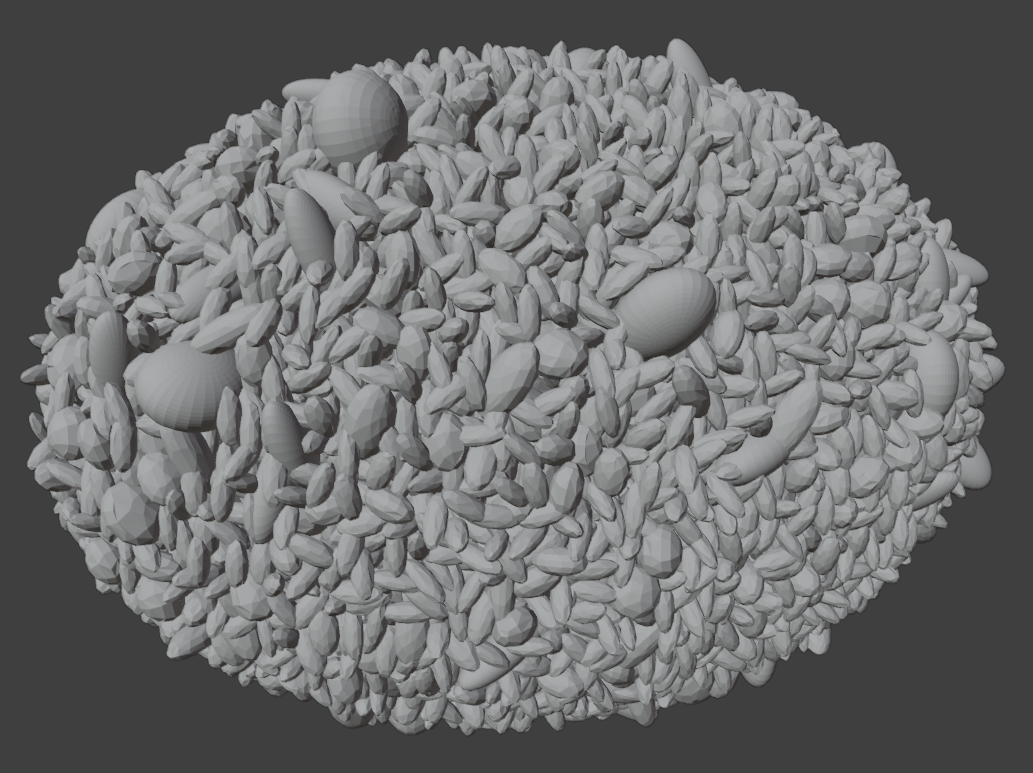
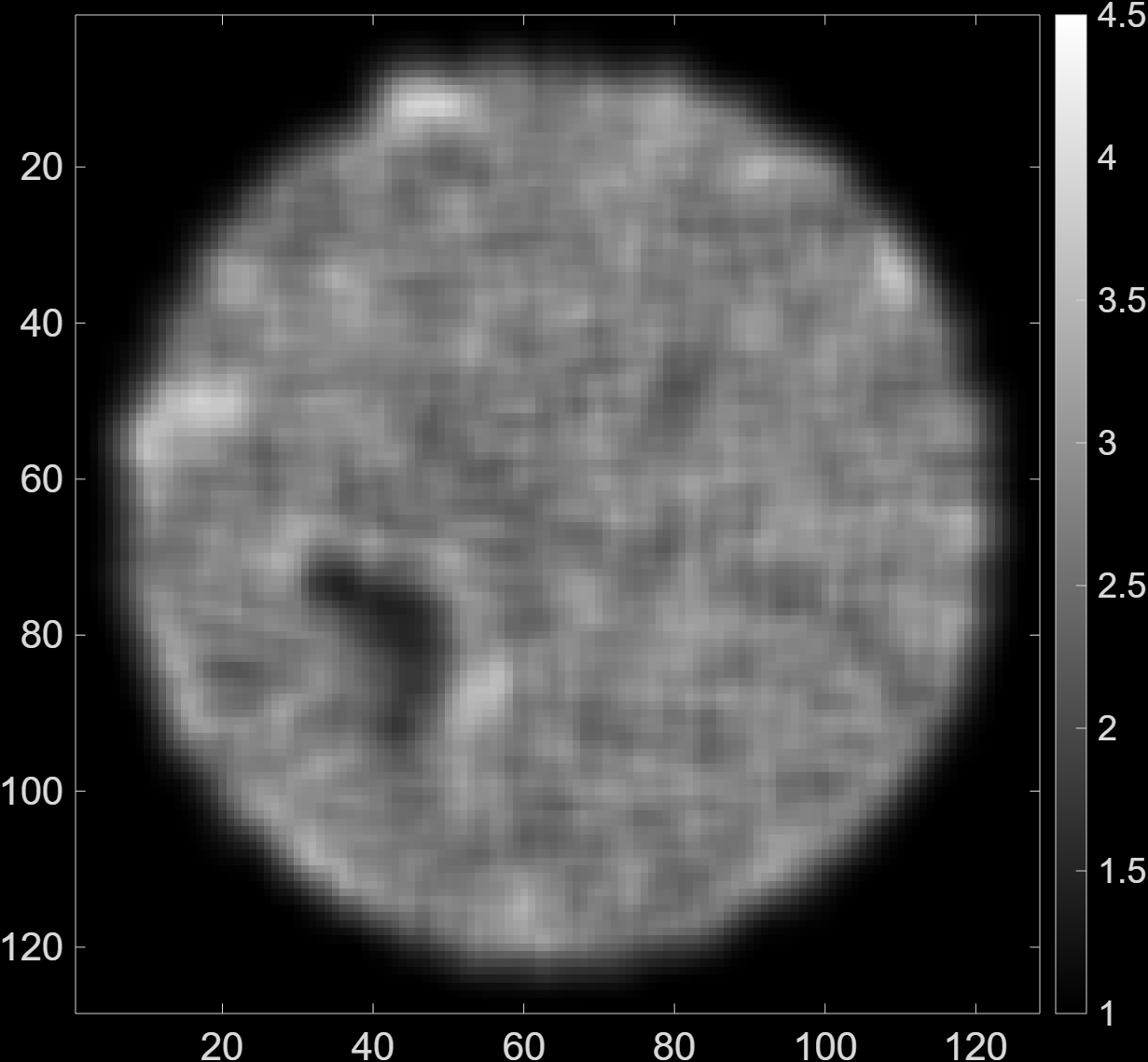
combined with permittivity-controlled ABS filament, ensuring mechanical robustness, accurate electrical properties and radar transparency. In this context, FFF has recently gained attention in radio frequency and microwave engineering applications, owing to advances in permittivity-controlled plastic filaments [2, 5]. This development has enabled the fabrication of complex microwave-transparent structures with tunable dielectric constants, making FFF an attractive candidate for producing radar-interrogatable analogue asteroids [2, 5]. By modulating the volume fraction between filament and air both between individual boulders and inside some of them, effective permittivity can be engineered to approximate that of asteroid minerals. This presentation describes a 18 cm diameter analogue for Dimorphos which simulates the actual rubble pile structure via EPP, taking into account the granular convection and the power-law for particle size found by examining the optical data of Dimorphos [4]. The total number of ellipsoids in this model is 18.084 with the ellipsoid diameter varying between 8-16 mm following the boulder size frequency distribution (SFD) observed in [4]. Figure 1, shows the external structure of the EPP-based analogue together with a cross-sectional slice demonstrating the actual and effective internal real relative permittivity of the body. The latter one of these corresponds to 8 GHz signal bandwidth [1] for which the average effective real relative permittivity is about 2.7 and the signal envelope wavelength inside the body about 4.6 cm (3.9 diameter-to-wavelength ratio).
References:
[1] A Dufaure et al. “Imaging of the internal structure of an asteroid analogue from quasi-monostatic microwave measurement data-I. The frequency domain approach”. In: Astronomy & Astrophysics 674 (2023), A72.
[2] A. Lingua, F. Sosa-Rey, N. Piccirelli, et al. “X-Ray Tomography-Based Characterization of the Porosity Evolution in Composites Manufactured by Fused Filament Fabrication”. In: Experimental Mechanics (2024). doi: 10.1007/s11340-024-01124-3. url: https://doi.org/10.1007/s11340-024-01124-3.
[3] P. Michel, M. K¨uppers, A. Bagatin, et al. “The ESA Hera Mission: Detailed Characterization of the DART Impact Outcome and of the Binary Asteroid (65803) Didymos”. In: The Planetary Science Journal 3 (2022), p. 160. doi: 10.3847/PSJ/ac6f52. url:https://doi.org/10.3847/PSJ/ac6f52.
[4] M. Pajola, F. Tusberti, A. Lucchetti, et al. “Evidence for multi-fragmentation and mass shedding for boulders on rubble-pile binary asteroid system (65803) Didymos”. In: Nature Communications 6205 (2024), p. 12. doi: 10.1038/s41467-024-50148-9. url: https://doi.org/10.1038/s41467-024-50148-9.
[5] Liisa-Ida Sorsa et al. “Complex-structured 3D-printed wireframes as asteroid analogues for tomographic microwave radar measurements”. In: Materials & Design 198 (2021), p. 109364.

How to cite: Pajala, T., Eyraud, C., Geffrin, J.-M., and Pursiainen, S.: Rubble pile asteroid model for Dimorphos --- 65803 Didymos I, EPSC-DPS Joint Meeting 2025, Helsinki, Finland, 7–12 Sep 2025, EPSC-DPS2025-732, https://doi.org/10.5194/epsc-dps2025-732, 2025.


