
 1,1
1,1- 1Università degli studi Roma Tre, Mathematics and Physics Dept., Roma Tre, Roma, Italy (gabriele.turchetti@uniroma3.it)
- 2INAF-IAPS, Rome, Italy
Introduction Jovian icy moons, Ganymede, Europa, and Callisto, due to the presence of liquid water oceans beneath their icy crusts [1] are extremely interesting for astrobiological and geological studies. Since radio echo sounding technique (RES) has proven to be very effective in the search for liquid water evidence on Earth [2] and in the Solar System [3] it will be employed in the analysis of these icy satellites. Two radars, RIME [4] and REASON [5], onboard JUICE and Europa Clipper missions respectively, will probe their interior to search for possible habitable environments. Radar data are affected by electromagnetic properties of the materials that the radio signals penetrate, then the knowledge of these properties is fundamental to analyse data and prevent incorrect interpretations. The goal of this work is to use laboratory measurements of dielectric properties of icy crust analogues and to simulate the signals propagation to reproduce future radars data.
Methods Radio waves could easily pass through pure ice, but the presence of impurities attenuates the signals, and the penetration decrease significantly. Among the salts found in Jovian icy moons crust, the sodium chloride [6], doping the ice, has the most problematic effects on radar propagation [7]. These effects depend on the temperature of the ice and on the concentration of the NaCl along the crust. Moreover, the freezing point of liquid water and sodium chloride solutions is 251K and possible brines in the shallower part of the crust could be detected with RES. In our measurements and simulations, we considered the condition of temperature and concentration hypothesized by the literature on Europa [8][9] at radar frequencies (9MHz for RIME, 9MHz and 60MHz for REASON) to investigate the signals attenuation and the possible detection of liquid water solutions.
Measurements We investigated the complex dielectric permittivity of various NaCl doped ice samples across a frequency spectrum from 1MHz to 100MHz, as a function of sodium chloride concentration and temperature. Previous findings indicate that the method of ice formation affects its overall electrical properties [10], necessitating a rigorous approach to sample preparation and growth: for this reason, we formed the samples with NaCl concentrations ranging from 100μM to 4M by means of an ultra-freezer whose working temperature is -80°C, creating fast-grown ices representative of the first kilometers of Europa’s icy crust [11]. The electromagnetic measurements were carried out with a two port Vector Network Analyzer (VNA), employing a cage coaxial cell [12] and complex permittivity was estimated employing the Nicolson-Ross-Weir (NRW) algorithm [13]. Fig.1 shows frequency spectra of the real part of permittivity ε’ and conductivity σ of two ice samples (one doped with 20mM and the other with 1M sodium chloride). Gray areas in the plots show values that can be considered less reliable due to instrumental limit; moreover, in the conductivity vs frequency plot the values of the air permittivity obtained with the empty coaxial cell are reported, as they represent values that cannot be considered reliable due to the NRW algorithm divergence (above 60MHz) caused by the cell resonance [12]. Electrical properties exhibit a dependence on the NaCl concentration; nevertheless, they are fairly constant in the frequency range 1-20MHz.
Simulations The simulations are performed with 9MHz data. The temperature profile in a conductive regime [14] depends on the heat dissipation of the icy crust [15]. We simulated the signals propagation in the first kilometres of the crust using both constant concentration and concentration profiles [8] of sodium chloride. We computed the attenuation of the signals and the echo power that a liquid water body would cause in function of its depth (fig.2) for different temperatures profiles (fig.3).
Conclusions These results would contribute significantly to radar data analysis and to the determination of the habitability of Europa and of the other Jovian icy satellites. These results will also be useful for future missions to ocean worlds with icy crusts.
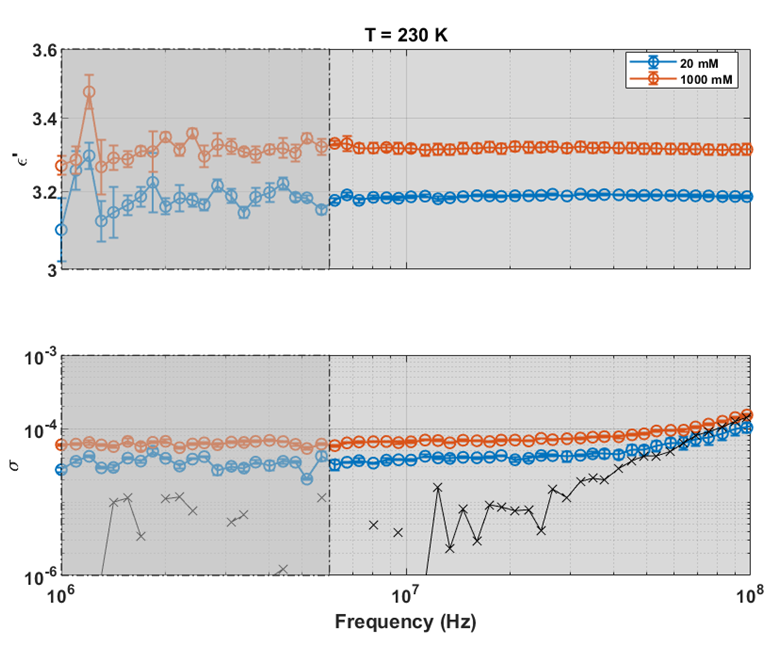
Figure 1: ε’ and σ of two doped ice samples in the frequency range 1MHz – 100MHz.

Figure2: The ratio of the power of the emitted and received signal corresponding to a discontinuity solid ice-brine at different depth (0.5km - 6km) for two possible temperature profiles (fig.3). The simulation propagates the signals through a crust with constant salinity (20mM). The expected noise for RIME is represented by the dashed line.

Figure3: Two possible temperature profiles hypothesizing an icy crust of 5km with a surface temperature of 100K a salty mushy solution at the temperature of 260K. The blue line is the linear profile proposed by [8] and the red line is a power low proposed by [16].
How to cite: Turchetti, G., Brin, A., Lauro, S., Cosciotti, B., Mattei, E., and Pettinelli, E.: The radar investigation of Jovian moons: dielectric measurements and signals propagation, EPSC-DPS Joint Meeting 2025, Helsinki, Finland, 7–13 Sep 2025, EPSC-DPS2025-75, https://doi.org/10.5194/epsc-dps2025-75, 2025.


