
 1,1,2,1,4,5
- 1Laboratoire Temps Espace, Observatoire de Paris-PSL, CNRS, Paris, France
- 2Institute of Astronomy, V.N. Karazin National University, Kharkiv, Ukraine
- 3University of Washington, Seattle, WA
- 4Ulugh Beg Astronomical Institute, Tashkent, Uzbekistan
- 5Korea Astronomy and Space Science Institute, Daejeon, Korea
Gaia observed a certains of known binary asteroids, and thanks to its precision, it is possible to update the mutual orbits of several of them using Gaia astrometry. These refined orbits enable the prediction of potential mutual occultations and eclipses within these systems, which is useful for planning observations.
Photometric observations of mutual events in binary asteroids can first help to better determine the position of the secondary, thereby improving the mutual orbit. Additionally, analysing the flux drop during these events allows us to constrain the relative sizes of the components, then to determine their composition. Finally, with certain assumptions, it is possible to directly derive the bulk density of the system. (See [1] and [2] for more details)
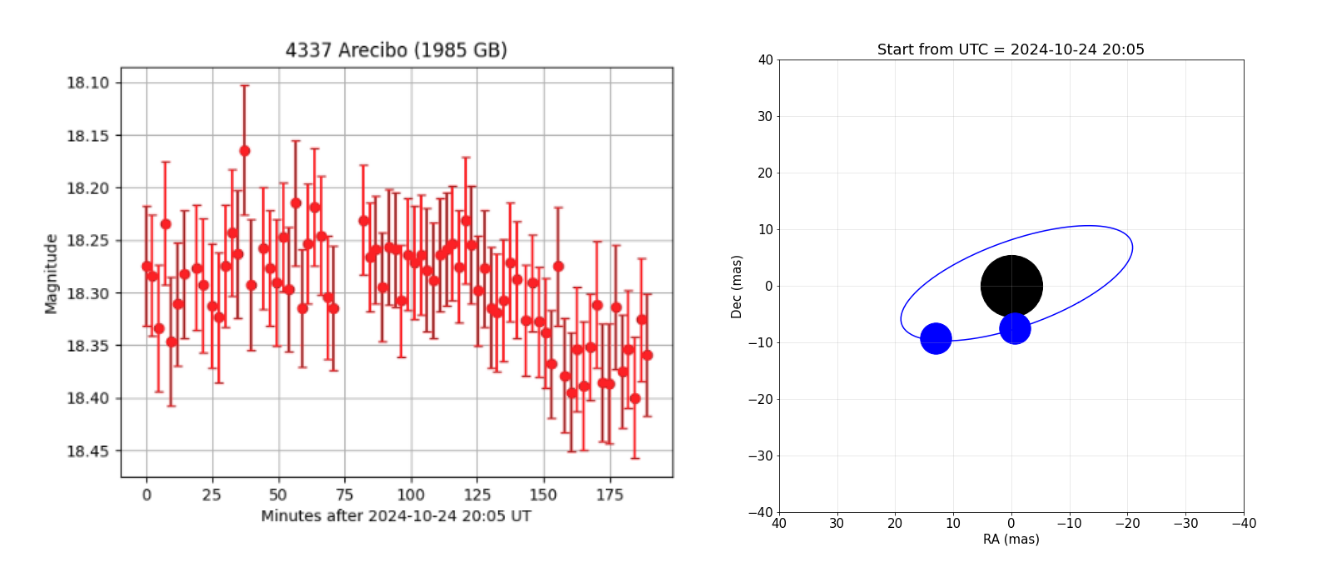
Comparison of observed photometry (left) and predicted relative position (right) of (4337) Arecibo at 2024-10-24 20:05 UT
In our study, we present photometric data collected during partial mutual events of the (4337) Arecibo system, utilising the orbit derived from Gaia and ground based observations [3]. The figure 1 illustrates the comparison between our observations and the predicted events. The event prediction of this system is put in service at Paris observatory for public usage. Furthermore, we applied a program to reconstruct synthetic light curves for comparison with our observations. By searching for the parameters that yield the optimal observed-minus-calculated (O-C) fit, we can further constrain the physical properties of this system. This approach is planned to apply to other known binary systems.
[1] Emelyanov, N. V., Kovalev, M. Y., & Varfolomeev, M. I. 2023, MNRAS, 522,165
[2] Scheirich, P., & Pravec, P. 2022, The Planetary Science Journal, 3, 163
[3] Liu, Z., Hestroffer, D., Desmars, J., and David, P. 2024, A&A, 688, L23.
How to cite: Liu, Z., Krugly, Y., Hestroffer, D., Vavilov, D., Ergashev, K., Burkhonov, O., and Kim, H.: Mutual events observation of binary asteroids , EPSC-DPS Joint Meeting 2025, Helsinki, Finland, 7–13 Sep 2025, EPSC-DPS2025-767, https://doi.org/10.5194/epsc-dps2025-767, 2025.


