
 1,3,2,2,3,2,1
- 1Instituto de Astrofísica de Andalucía (IAA-CSIC), Granada, Spain
- 2LATMOS, CNRS, Sorbonne Université, Université Versailles St Quentin, Paris, France
- 3Laboratoire de Météorologie Dynamique (LMD/IPSL), CNRS, Paris, France
Higher loss rate in the “recent” Mars history
Mars was not always as dry as it is today, as several geologic and mineralogical observations indicate the evidence for past liquid water [1]. Atmospheric loss to space appears to explain why the Mars atmosphere evolved from an early, warmer climate to the cold, dry climate that we see today. Substantial amounts of water could have escaped into the interplanetary medium in the form of atomic hydrogen [2]. Furthermore, observations indicate that the amount of exosphere hydrogen at Mars has important seasonal variations, with significant increases of both the water abundance in the mesosphere and the H escape rate during dust storms [3, 4, 5]. By analysing observations by SPICAM on board Mars Express and simulations with the Mars Planetary Climate Model (Mars-PCM), [6] suggested that episodic dust storms and associated enhancement at high altitude near the perihelion, averaged over one Martian year or longer period, are a major factor in the H escape estimates.
However, present-day H-loss rates (~3x1026 s-1 on average) cannot explain the geological evidence of the presence of large volumes of liquid water on ancient Mars. Both the dust and the water content of the atmosphere are expected to vary with the obliquity of the planet. Thus, the loss rate is not expected to have been constant with time and may vary significantly during Martian history.
We have used an updated and improved version of the Mars-PCM to show that H-loss rates could have increased up to more than one order of magnitude (6x1027s-1) during higher spin axis obliquity periods [7] (see Fig. 1), notably in the last millions of years when Mars’s obliquity was about 35° on average [8]. The resulting accumulated H escape over Mars history translates into ~80 m Global Equivalent Layer, which is close to the lower limit of geological estimates and confirm the important role of atmospheric H loss to remove a large fraction of Mars’ initial water.
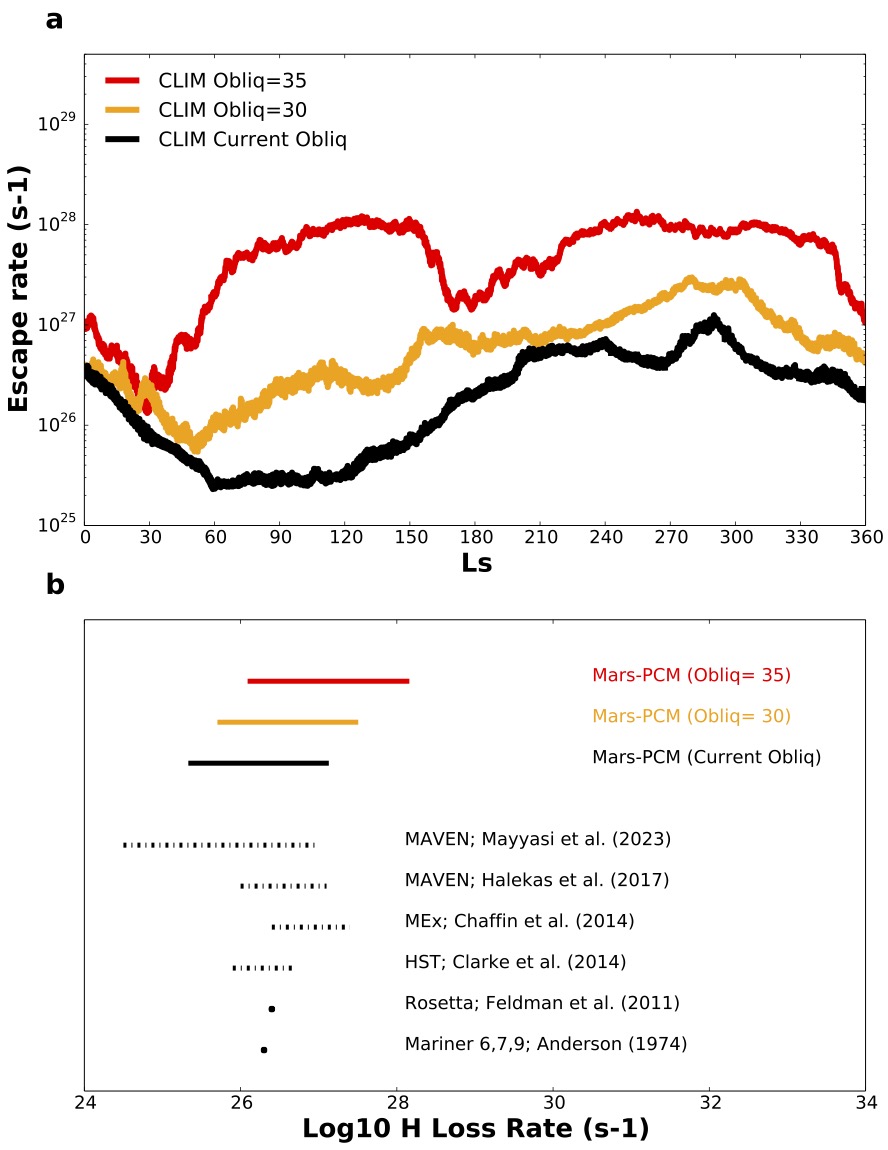
Fig 1: Panel a: Globally integrated escape rate (atoms/s) simulated with the Mars-PCM. A climatological dust scenario is used with current obliquity (black), obliquity of 30º(orange), obliquity of 35º (red). Panel b: Comparison of Mars-PCM H escape rates with H-loss rates estimated for current obliquity from different spacecrafts [3,4,5, 9,10,11, 12, 13]. Figure after [7].
Processes leading to larger H-escape
In current obliquity conditions (25.2º) the water ice in the polar caps sublimes in Summer, and then it is recycled back in Winter. Large dust load in the lower atmosphere facilitates the transport of water to the upper atmosphere, where it is chemically converted into atomic H that can easily escape to space (panel A, Fig. 2). In the last 20 million year, when the obliquity of Mars was higher than today (panel B, Fig. 2), larger north pole insolation induced a more intense water cycle: the amount of sublimated water vapour in the atmosphere of Mars was much larger than today, and localised surface water ice reservoirs were created after precipitation in tropics and mid-latitudes [14]. In addition, the formation of thick clouds warmed the middle atmosphere (up to 50 K at 45 km) by absorbing both solar radiation and IR radiation emitted by the surface, inducing positive feedback. All this favoured water penetration into the mesosphere (e.g. with up to 5 order of magnitude increased water abundances at about 45 km, near the aphelion), resulting in larger H escape rate. Other processes not accounted for in our study could also contribute to further changes in the H escape rate. Buried deposits of CO2 ice within the south polar layer could have been released in the atmosphere at the time of high obliquity, producing an atmosphere with double its current pressure [15]. With higher pressure and warmer temperature conditions, is uncertain if the seasonal dust activity was more (or less) intense than today, due to higher water content and changes in the circulation patterns.
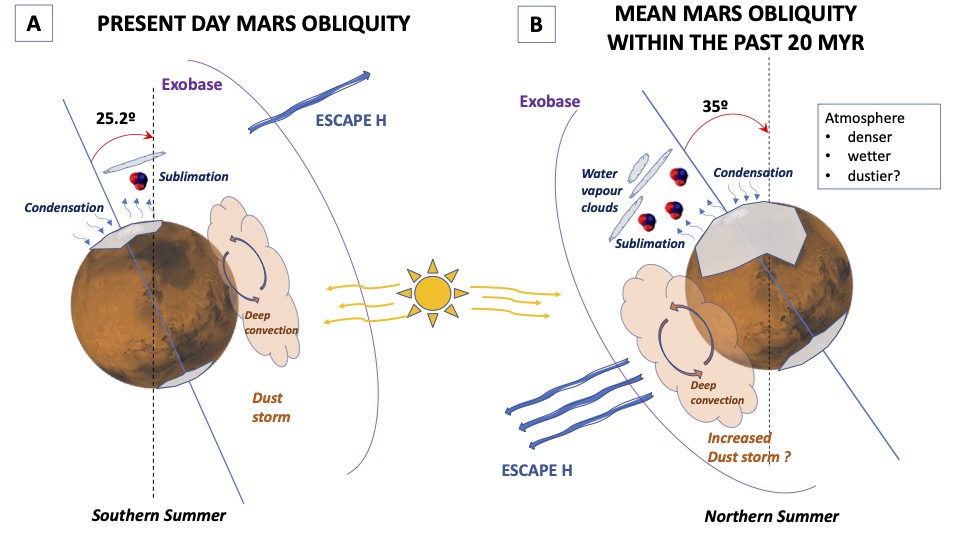
Fig.2: The H loss rate is not expected to have been constant with time and may vary significantly during Martian history. The processes that may have led higher H-escape will be discussed in the talk. Figure after [7].
Keywords: Mars, Atmosphere, Hydrogen loss, General Circulation Model
References:
[1] Bibring et al. (2004), Nature, 428(6983):627–630
[2] Jakosky et al. (2018), Icarus, 315:146–157
[3] Chaffin et al. (2014), GRL, 41(2):314–320
[4] Clarke et al, (2014), GRL, 1(22):8013–8020
[5] Mayyasi et al. (2023), 393, 115293
[6] Chaufray et al. (2021), Icarus, 353, 113498
[7] Gilli et al. (2025), Nature Astronomy, in press, https://doi.org/10.1038/s41550-025-02561-3
[8] Laskar et al. (2004), Icarus, 170(2):343–364
[9] Clarke et al. (2018), Nature Astronomy, 2, 114-115
[10] Heavens et al. (2018), Nature Astronomy, 2, 126–13
[11] Helekas et al. (2017), JGR, 122 (5), 901–91
[12] Anderson et al. (1974), JGR, 79 (10), 1513–1518
[13] Feldman et al. (2011), Icarus, 214 (2), 394–39
[14] Madeleine et al. (2009), GRL, 41 (14), 4873–487
[15] Kurokawa et al (2014), Earth and Planetary Science Letters, 394
Acknowledgements
G.G. acknowledge financial support from Junta de Andalucía through the program EMERGIA 2021 (EMC21 00249). IAA-team also acknowledges financial support from the Severo Ochoa grant CEX2021-001131-S funded by MCIN/AEI/ 10.13039/501100011033.
How to cite: Gilli, G., González-Galindo, F., Chaufray, J.-Y., Millour, E., Forget, F., Montmessin, F., Lefèvre, F., Naar, J., Luo, Y., Vals, M., Rossi, L., López-Valverde, M. A., and Brines, A.: Increased Hydrogen escape from Mars atmosphere during periods of high obliquity, EPSC-DPS Joint Meeting 2025, Helsinki, Finland, 7–12 Sep 2025, EPSC-DPS2025-780, https://doi.org/10.5194/epsc-dps2025-780, 2025.


