
 1,2,4,2,2
- 1LIRA, Observatoire de Paris, Université PSL, CNRS, Sorbonne Université, Université Paris Cité, 5 place Jules Janssen, 92195 Meudon, France (vladimir.zakharov@obspm.fr)
- 2Università degli Studi di Napoli Parthenope, Dip. di Scienze e Tecnologie, CDN IC4, 80143 Naples, Italy
- 3Peter the Great St. Petersburg Polytechnic University, Polytechnicheskaya str., 29, St.Petersburg, 195251, Russia
- 4INAF - Osservatorio Astronomico, Via Tiepolo 11, 34143, Trieste, Italy
- 5INAF - OACN (Osservatorio Astronomico di Capodimonte), Salita Moiariello 16, 80131, Napoli, Italy
Comets are thought to be icy leftovers from planet formation, either planetesimals themselves or direct descendants of the former. These small bodies have undergone very few global changes since their formation in the proto-planetary disc. For that reason, they are widely considered to have retained information about the early Solar System and can inform our understanding of planet formation.
According to the current understanding, the nucleus of a comet consists of a mixture of diverse ices, minerals and organics. The atmosphere of a comet is formed by the sublimation products of ices and the dust particles ejected from the nucleus and entrained by the gas flow.
In the absence of a direct exploration of the nucleus, the observations of cometary atmosphere allow us to deduce parameters of the nucleus – its composition, structure etc. and, in this way, to get information about the Solar System formation.
Once ejected in the coma, cometary dust particles are anisotropic scatterers of incident sunlight, and their nature can be studied by remote sensing. Among them, the measurement of the phase function curve is of key importance in a number of scientific aspects. It can be inverted by theoretical and laboratory studies to provide clues about the intrinsic nature of the emitted dust. It is also useful for space instrument planning because it provides a baseline for optimal exposure times for remote sensing sensors that observe coma over a large range of phase angles during close approaches. This will be especially valuable for the future ESA Comet Interceptor mission, which will fly-by a dynamically new comet entering the Inner Solar System for the first time, and will carry instruments that will image the coma with different observational geometries and phase angles in a short time.
To interpret the phase function shape numerical modelling and laboratory experiments of light scattering by single particles have been conducted (Moreno et al. 2018, 2021, Munoz et al. 2020, Markkanen et al. 2018, Levasseur-Regourd et al. 2019). The results of these studies have shown that reproducing the phase function of a real comet (e.g. 67P/Churyumov-Gerasimenko obtained by OSIRIS camera onboard the Rosetta probe) is a non-trivial task.
In essence, the phase function is the result of scattering and propagation of solar radiance in the space filled by dust particles i.e. it is a combination of an optical properties (single/multiple scattering of photons in the coma, scattering properties of dust grains etc.) and dust dynamics (which defines spatial distribution of dust grains). It is of interest to reveal the contribution of pure dust dynamics (omitting optical properties of grains) on the phase function. This contribution is determined by the column values of the dust coma parameters, i.e., the integrals of the parameters along the line of sight from the camera through the coma.
We report the results of the study of the column area density dependence on the phase angle as it follows from the dust coma model used as a base for the Engineering Dust Coma Model in the ESA Comet Interceptor project.
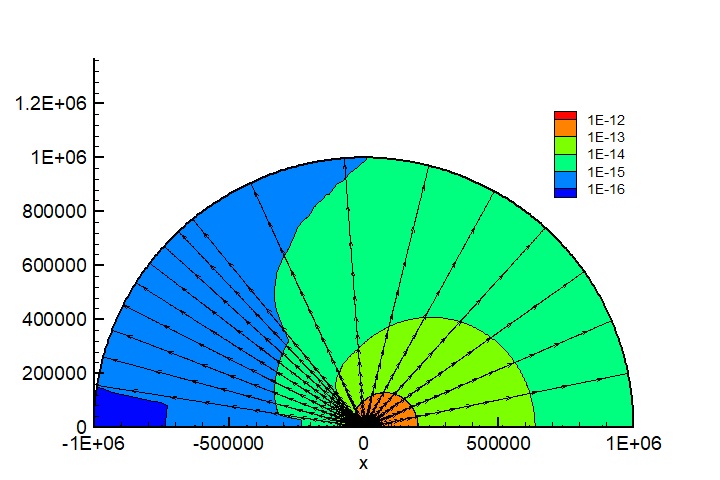
The model of cometary environment assumes that the dusty-gas coma is formed by the gas sublimating from the nucleus (from the surface and/or from the interior) and solid particles (mineral or/and icy) released from the nucleus with zero initial velocity and entrained by the gas flow. The gas distribution is computed according to the model Zakharov et al. 2021a (see example in Fig.1). It is assumed that the dusty-gas flow is coupled in one way only -- the gas drags the dust (i.e. the presence of dust in the coma does not affect the gas motion), and that the dust particles do not collide with each other. The model of dust dynamics follows Zakharov et al. 2021b and accounts for gas drag, nucleus gravity, and solar gravity and radiation pressure (see example in Fig.2).
For a wide variety of gas and dust coma model parameters (heliocentric distances, surface gas production distributions, sizes and mass of the nucleus and dust grains) we compute the column values of dust environment along the line of sight (LOS) from the spacecraft (SC) for different phase angles (φ) and cometocentric distances (RSC) (see Fig.3). An example of the column area density dependence on the phase angle is shown in Fig.4.
 |
 |
| Fig.1 Gas density isocontours and flowlines (Sun on the right). | Fig.2 Dust (ad = 1 μm) density isocontours (Sun on the right). |
 |
 |
| Fig.3 The geometry of observations. | Fig.4 The normalized dust column area density as a function of phase angle (for two dust sizes and two cases of dust size distribution). |
Acknowledgments
This research was financially supported by the Russian Science Foundation, Agreement N 24-12-00299, https://rscf.ru/en/project/24-12-00299/.
Contribution of I. Bertini, A. Rotundi, V. Della Corte and L. Inno was supported by the ASI-INAF agreement 2023-14-HH.0 project number.
References
Bertini et al. 2017, MNRAS, 469, S404
Levasseur-Regourd et al. 2019, A&A, 630, A20
Markkanen et al. 2018, ApJ, 868, L16
Moreno et al. 2018, AJ, 156, 237
Moreno et al. 2021, MNRAS, 510, 5142
Munoz et al. 2020, ApJS, 247, 19
Zakharov et al. 2021a, Icarus 354, 114091
Zakharov et al. 2021b, Icarus 364, 114476
How to cite: Zakharov, V., Bertini, I., Bykov, N., Ivanovski, S., Rotundi, A., Rodionov, A., Della Corte, V., and Inno, L.: Variation of dust column properties as a function of phase angle as it follows from the dust coma model., EPSC-DPS Joint Meeting 2025, Helsinki, Finland, 7–12 Sep 2025, EPSC-DPS2025-783, https://doi.org/10.5194/epsc-dps2025-783, 2025.


