
 1,
1,- 1Department of Astronomy, Observatoire de Genève, Chemin Pegasi, 51, 1290 Versoix, Switzerland
- 2Université Paris-Saclay, Université Paris Cité, CEA, CNRS, AIM, 91191, Gif-sur-Yvette, France
- 3Department of Applied Mathematics, School of Mathematics, University of Leeds, Leeds LS2 9JT, UK
- 4Laboratoire d’Astrophysique de Bordeaux, CNRS and Université de Bordeaux, Allée Geoffroy St. Hilaire, 33165 Pessac, France
One of the open questions in exoplanet research is the lack of mean-motion resonances (MMRs) in observed planetary systems, even though planet formation models predict that disk-driven migration should create resonant chains. This suggests that some physical process may be breaking these resonances after formation. In this project, we explore whether stellar dynamical tides could play a role in this process.
To model dynamical tides more accurately, we implemented the frequency-dependent Kaula model into the N-body code Posidonius, using Love number spectra provided by a collaborator. Unlike the constant time lag (CTL) model—which smooths out the tidal response by averaging over frequencies—the Kaula approach accounts for how the star responds to each individual tidal frequency.
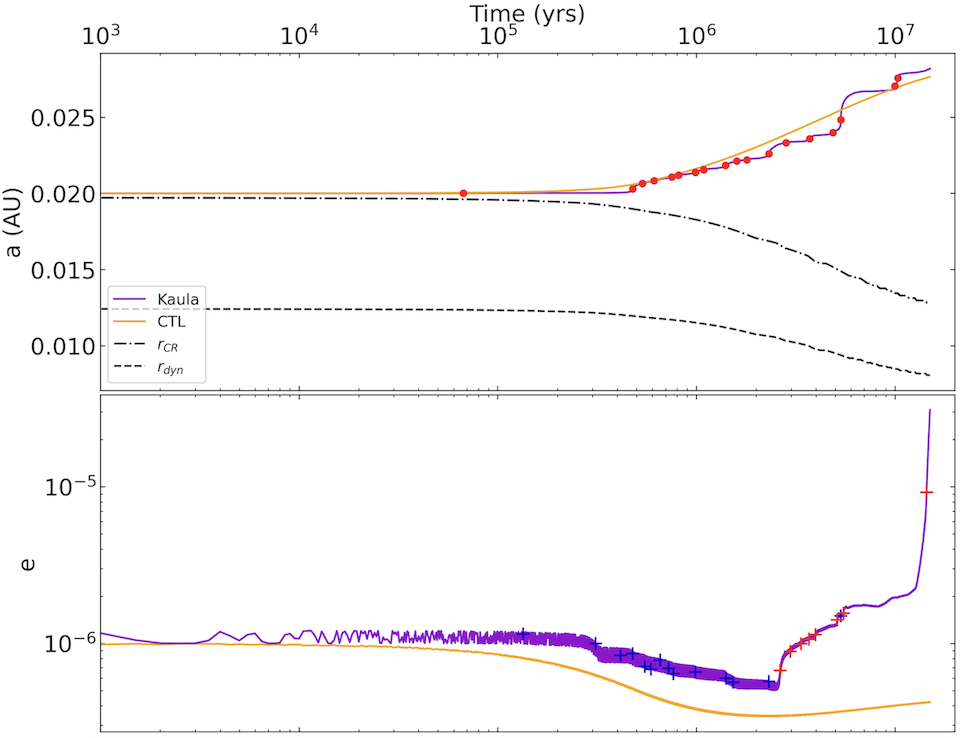
Fig. 1 shows the orbital evolution of a 5 M⊕ super-Earth under both tidal models. Although both lead to similar final semi-major axes, their evolution is quite different. The CTL model produces a smooth migration path, while the Kaula model shows multiple outward migration boosts, causing the semi-major axis to oscillate around that of the CTL case. The eccentricity also evolves differently: CTL is dominated by the main tidal frequency (ω2200), while Kaula includes contributions from additional frequencies like (ω220-1), which can excite the eccentricity. This highlights the importance of using a frequency-dependent model to capture the full behavior of tidal interactions.
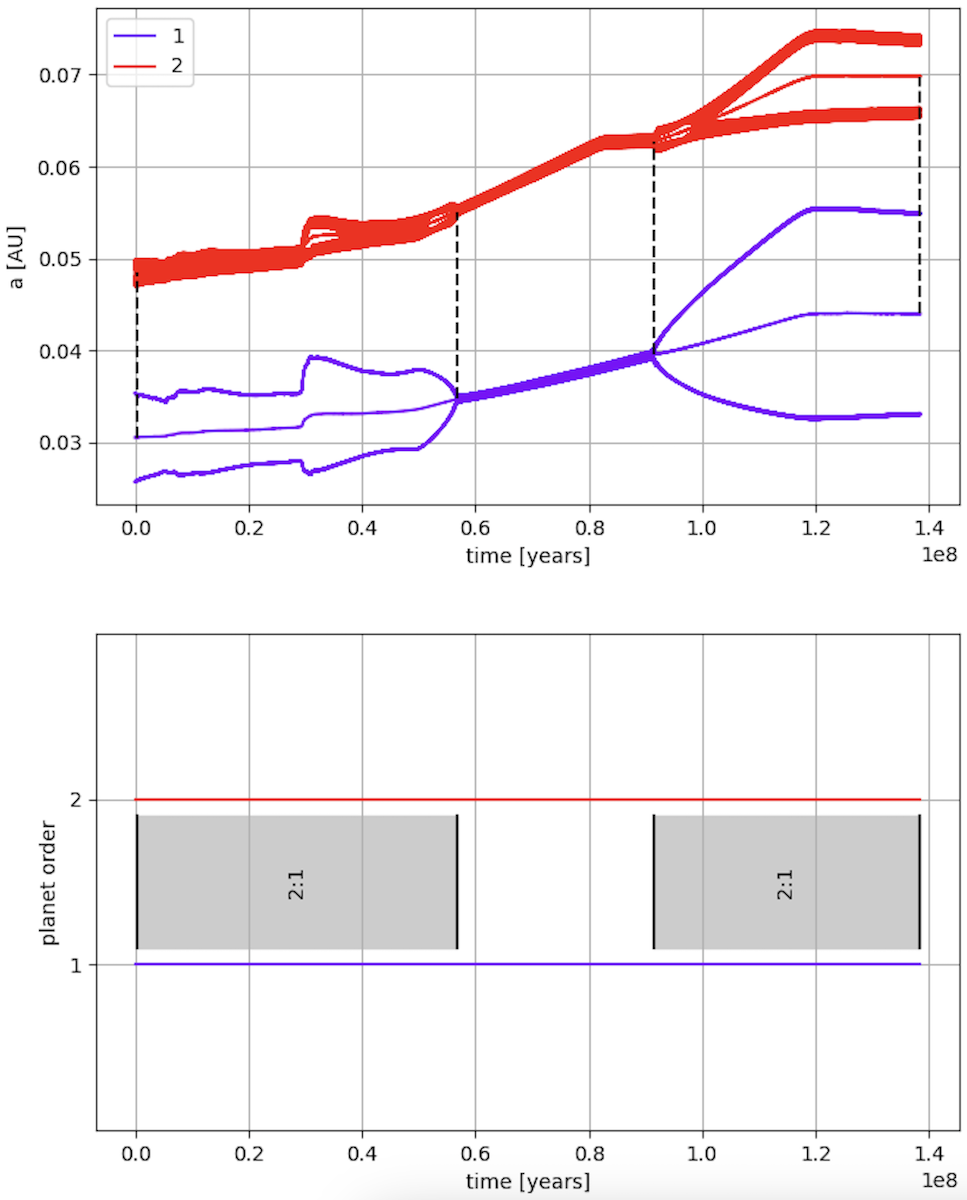
We also applied the model to a two-planet system near the 2:1 MMR. Fig. 2 shows the evolution of the semi-major axes and the mean-motion resonance (MMR) states. In the top panel, the split between the upper and lower lines for each planet indicates the evolution of its apastron and periastron distances. In the Kaula model, the outer planet experiences strong tidal interactions despite being farther from the star, due to higher Love numbers at certain frequencies. With additional eccentricity damping from planetary tides (modeled by CTL), the system temporarily leaves the 2:1 resonance and later re-enters it as the inner planet undergoes stronger tidal effects. This result shows that dynamical tides can break and restore resonances, and may contribute to the dynamical evolution that leads to the absence of resonances in some systems.
These early results suggest that stellar tides may influence the long-term architecture of planetary systems, but a more complete picture will require studying additional resonances.
How to cite: Kwok, L. K.-W., Bolmont, E., Revol, A., Mathis, S., Astoul, A., Charbonnel, C., and Raymond, S.: Impact of Dynamical Tides on Planetary System Stability: Evolution of Multi-Planet Systems, EPSC-DPS Joint Meeting 2025, Helsinki, Finland, 7–12 Sep 2025, EPSC-DPS2025-784, https://doi.org/10.5194/epsc-dps2025-784, 2025.


