
 ,,,
,,,- Freie Universität Berlin, Institute for Geological Sciences, Planetology and Remote Sensing, Berlin, Germany (a.ovchinnikova@fu-berlin.de)
Introduction:
Understanding the relationship between the western and northern deltas in the Jezero crater on Mars is crucial for the reconstruction of the water history in this region. The northern delta appears to be more eroded and older than the western delta; however, contemporaneous northern and western fan building was also recently proposed ([1], [2]). In our study, we explore the origin of the LCP (low-calcium pyroxene)/smectite and olivine/carbonate spectral units, which were found in both deltas and which may record the interaction between them in the past [2] (Fig. 1). We use topographic and compositional data to model potential deposition of the sediments from the western inlet on the northern delta. Our results shed light on the interconnection between the western and northern deltas, establish their relative age and suggest that Neretva Vallis (western inlet) could be the source of the LCP/smectite unit on both deltas in Jezero.
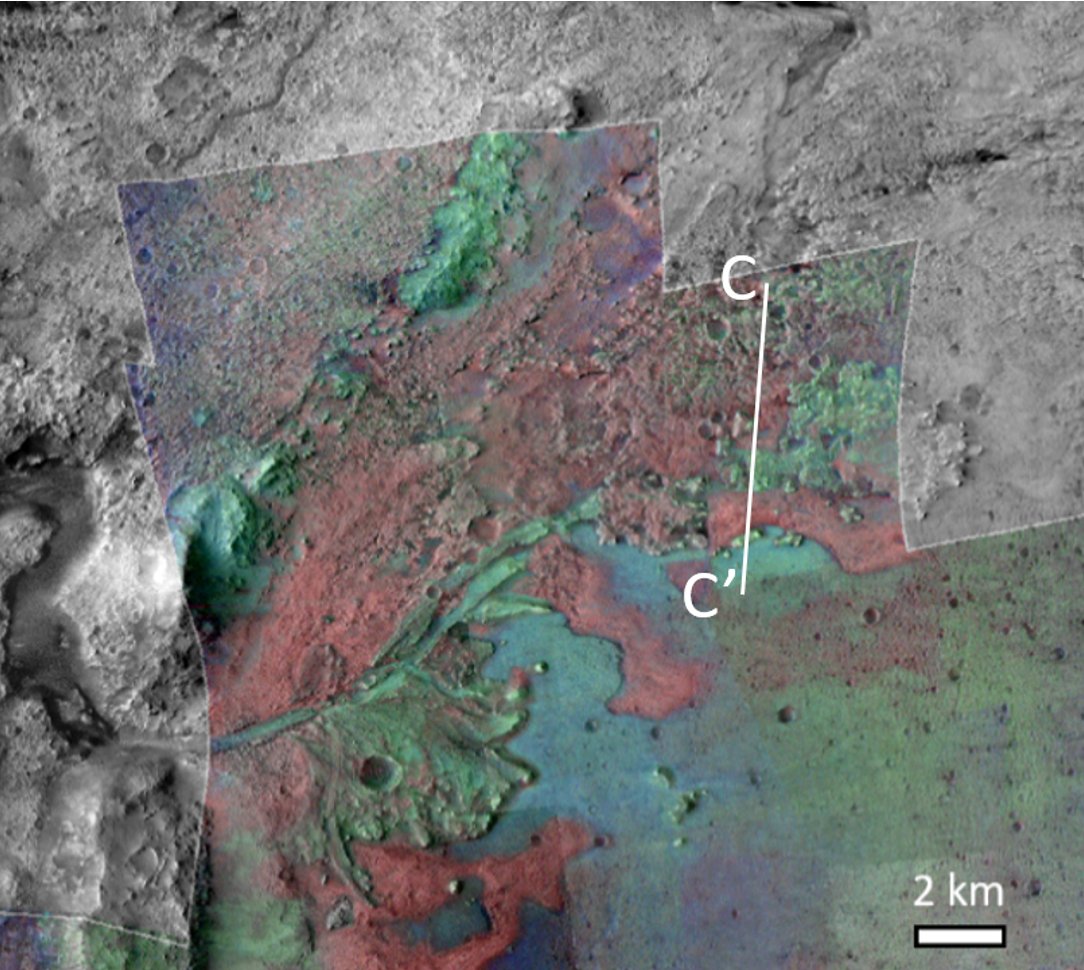
Fig. 1. CRISM Mafic map, adapted from [1]; Green – LCP/smectite; red – olivine/carbonate; blue – High-calcium pyroxene. CC’ profile is shown in Fig.2.
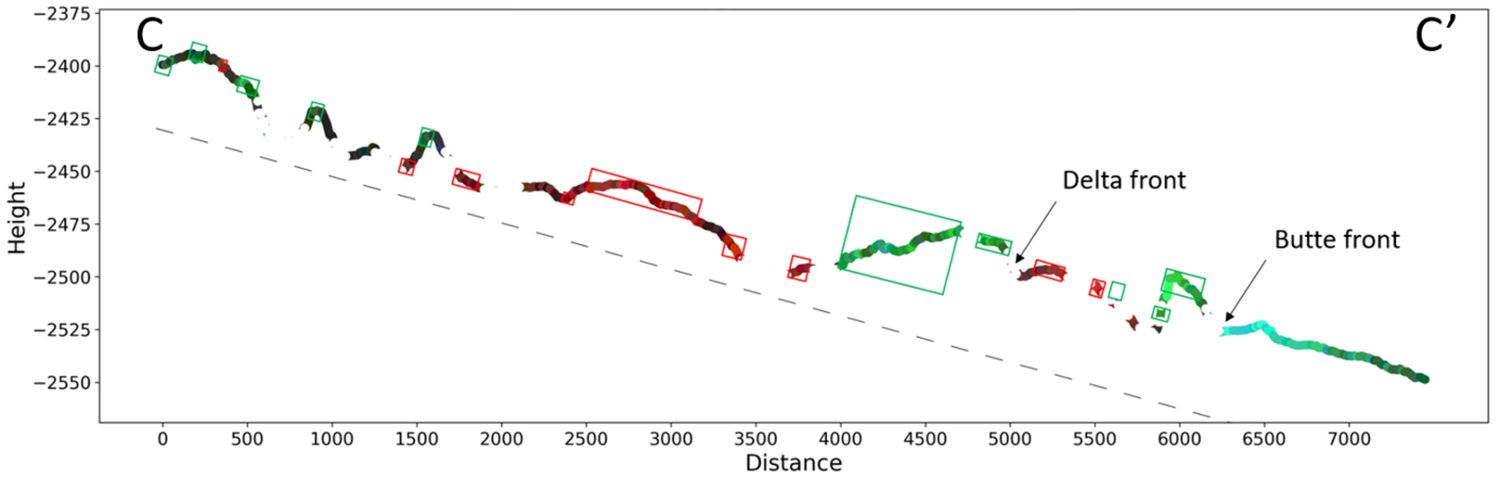
Fig. 2. Example of the topographic-compositional profile (profile line is on Fig. 1).
Data:
CRISM spectral data [2] and the Mars 2020 Science Investigation CTX DEM Mosaic (20 m/pixel) and its corresponding ortho-mosaic (5 m/pixel, [3], [4]) were used.
Methodology:
Based on topographic and compositional data we plotted topographic-compositional profiles that show changes in topography and composition simultaneously (Fig. 2).
To model the hypothesized deposition of the sediments coming from the western inlet through the northernmost channel located within the western delta (Fig.3a), we combined two equations: 1) sediment settling velocity [5] – for the vertical movement of sediment particles and 2) conservation of volumetric flow rate before and after the river enters the lake – for the horizontal movement of the sediment particles. Using the sediment transport equations of [6], we determined that particles up to 5 mm in size are transported in suspension through the above-mentioned channel. Therefore, we used a grain size range from 5 mm (small pebble) to 0.0039 mm (clay) for our model calculating the distance at which sediments transported by the northernmost channel of the western delta can be deposited on the northern delta.
Results:
Topographic-compositional profiles show that the LCP/smectite unit is stratigraphically higher than the olivine/carbonate unit, but does not reveal prominent correlations between separate delta outcrops that would represent the parallel layering typical of Gilbert-type deltas. Therefore, the LCP/smectite unit had to overlie the olivine/carbonate unit when the northern delta was already eroded to its present topography. According to the CRISM data, the closest possible source of the LCP/smectite unit is the western delta and the watershed of the western inlet. At the same time, the CTX DTM shows that a scenario where the northernmost channel of the western delta is subaerial (above the shoreline), while the northern delta is subaqueous could be possible (Fig.3a). Therefore, we hypothesize that the LCP/smectite unit consists of material transported by the northernmost channel of the western delta which is connected to the western inlet. Our model shows that fine silt can be deposited at a distance of 5,000 – 10,000 m from the end of the channel – at this distance the LCP/smectite unit is indeed found on the northern delta (Fig. 3b).
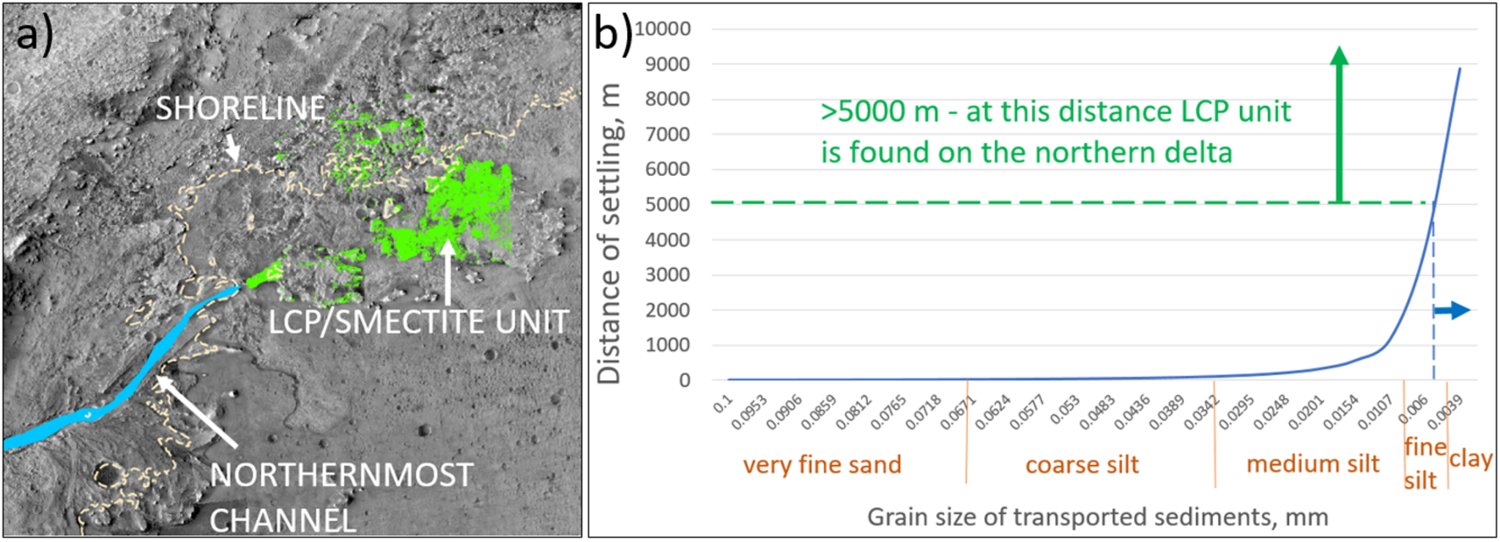
Fig. 3. a) Overview map with studied features; b) Results of modeling, showing that fine silt will be deposited on the southern part of the northern delta, which coincides with the appearance of the LCP/Smectite units.
Discussion:
We validated the model using information about the minimum grain size of the western delta provided by the Perseverance rover results (in bottomsets – “<0.02 mm” for M2020-575-16 Shuyak sample [7]) and RIMFAX data, which show that the length (projected to the crater floor) of the one “topset-foreset-bottomset” sequence is approximately 135-200 m [8]. We modeled the case of deposition of western delta material only and found that sediments with the grain size “0.02 mm” form bottomsets at a distance of 192 m, agreeing with the RIMFAX data. In addition, THEMIS data [9] show low thermal inertia in the southern part of the northern delta (where LCP/smectite is located) consistent with loose fine-grained material (such as silt).
Conclusion:
We interpret the uppermost LCP/smectite unit within the northern delta as material from the western inlet deposited over already existing topography of the northern delta. This implies that there was a period when the active western inlet provided sediment to cover the already eroded northern delta. We therefore conclude that the main body of Jezero Crater's northern delta is older than the western delta but covered with the relatively thin and younger layer of silt deposits from the western inlet.
References:
[1] M. J. Jodhpurkar, et al., J. Geophys. Res. Planets, 129 (2024)
[2] B. H. N. Horgan, R. B. Anderson, G. Dromart, E. S. Amador, and M. S. Rice, Icarus, 339 (2020)
[3] F. Calef, Planetary Data System, USGS Astrogeology Science Center (2021) https://astrogeology.usgs.gov/search/map/mars_2020_science_investigation_ctx_dem_mosaic
[4] M. C. Malin, et al., J. Geophys. Res. Planets, 112(5) (2007)
[5] R. I. Ferguson, and M. Church, Journal of Sedimentary Research, 74(6), 933–937 (2004)
[6] M. G. Kleinhans, J. Geophys. Res. Planets, 110(12), 1–23 (2005)
[7] K. Farley, and K. Stack, Mars 2020 reports, Volume 2, Delta Front Campaign (2023) https://mars.nasa.gov/internal_resources/1656/
[8] S.-E. Hamran, D. Paige, F. Andersson, T. Berger, E. Cardarelli, L. Carter, H. Dypvik, P. Russell, M. Mellon, D. Nunes, and D. Plettemeier, Europlanet Science Congress 2024, EPSC2024-403 (2024). https://doi.org/10.5194/epsc2024-403
[9] C. S. Edwards, K. J. Nowicki, P. R. Christensen, J. Hill, N. Gorelick, and K. Murray, J. Geophys. Res. Planets, 116(10) (2011). https://doi.org/10.1029/2010JE003755
How to cite: Ovchinnikova, A., Jaumann, R., Walter, S. H. G., Gross, C., Zuschneid, W., and Postberg, F.: Exploring the connection of the Northern and the Western Deltas in Jezero Crater on Mars, EPSC-DPS Joint Meeting 2025, Helsinki, Finland, 7–12 Sep 2025, EPSC-DPS2025-795, https://doi.org/10.5194/epsc-dps2025-795, 2025.


