
 1,
1,- 1Southwest Research Institute, Boulder, CO, United States of America
- 2Rice University, Houston, TX, United States of America
- 3Observatorio Nacional, Rio de Janeiro, RJ, Brazil
Introduction: The main asteroid belt (MAB) is known for having a very small total mass (5x10⁻⁴ Earth masses) and for being primarily composed of S- and C-complex bodies [1]. Isotopic measurements on meteorites suggest C-complex bodies, many which are water/volatile-rich, are likely to have originated exterior to Jupiter’s orbit, whereas S-complex bodies, most which are water/volatile-poor, come from within it [2].
The MAB’s low mass and taxonomical mixing can potentially be explained if the MAB was either originally empty [2] or never had much mass [3]. In this case, the currently observed MAB would result from limited implantation of S- and C-complex asteroids that were scattered from their source regions [2]. This proposition is in agreement with models suggesting that the solar system building blocks formed in concentric rings at various radial distances around the Sun [4] (models which were partly motivated by cosmochemical constraints [5]). This would naturally form a primordial MAB depleted in or devoid of mass [3].
What remains to be explored is whether the size-frequency distribution (SFD) of the MAB could potentially be explained by the implantation of S- and C-complex asteroids. The power law slope (q) for MAB’s SFD for objects 100 km ≤ D ≤ 400 km in diameter is probably unchanged over solar system history [6]. Thus, the implanted asteroids in this size range should have a slope comparable to the MAB’s current slope. Here we focus on the implantation from S-complex asteroids originating in the terrestrial planet region.
Methods: We conducted terrestrial planet formation simulations starting from planetesimal-sized objects that were tracked over 5 Myr within the solar nebula [7]. We assumed the gas disk exponentially dispersed over timescales τgas of 0.5, 1, and 2 Myr. We gave our initial planetesimal population a cumulative SFD following N(>D)∝ D-q, with q = 0 (D = 100 km), 3.5, and 5 (100 km ≤ D ≤ 1,000 km). The total mass was 2.5 Earth masses. Planetesimals were radially distributed according to Σ ∝ r-x with x = 1 and 5.5 in the semi-major axis range 0.7 au ≤ a ≤ 1.5 au [4].
The evolution of the planetesimals’ SFD was tracked with the code LIPAD [8] during their accretion phase; some eventually grow to become planetary embryos. Given that S-complex planetesimals are only expected to be implanted in the MAB after the solar nebula has dispersed [2], we compared our evolved SFD at the end of the simulation with that from S-complex asteroids in the current MAB [6, 9].
Results: A compilation of our results is shown in Fig. 1. A large concentration of mass is needed near 1 au to form terrestrial planets and reproduce their orbits [4], so collisional evolution there is intense. As a result, our SFDs, regardless of x, q and τgas, rapidly reaches collisional equilibrium. In this state, the slope of our evolved SFDs broadly match that of the current MAB SFD in the range 100 km < D < 400 km.
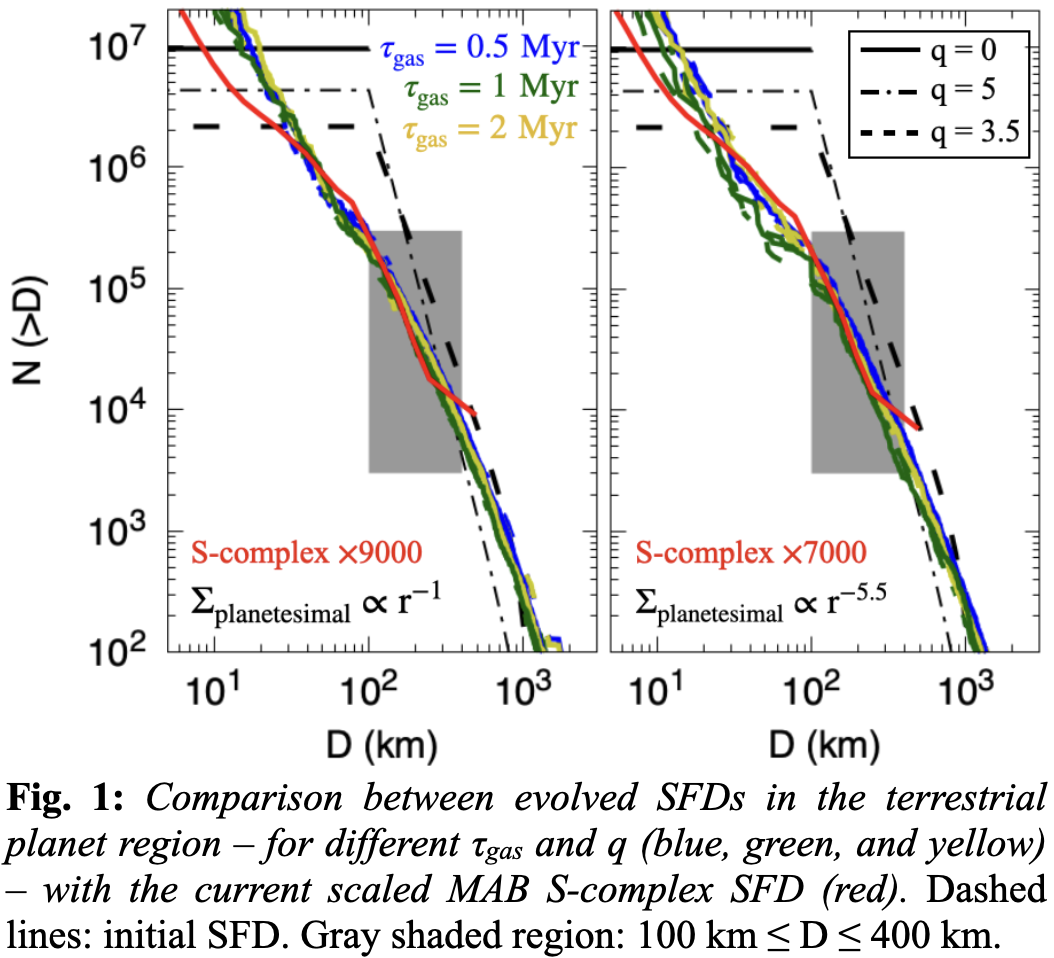
Conclusions: Assuming that the evolved SFDs stay in collisional equilibrium after gas disk dispersal, and that implantation in the MAB is size-independent, we conclude that S-complex asteroids may indeed be objects that formed in the terrestrial planet region, i.e., within 1.5 au. That includes asteroid (4) Vesta [3].
Additionally, we find that implantation efficiency is likely to be <10-3. Higher efficiencies would potentially overpopulate the MAB with S-complex objects larger than asteroid (4) Vesta [3].
References: [1] DeMeo & Carry (2014) Nature, 505, 629. [2] Raymond & Izidoro (2017) Sci Adv, 3. [3] Deienno et al. (2024) PSJ 5, 5, 110. [4] Izidoro et al. (2022) Nat Ast, 6, 357. [5] Kruijer T. S., et al., (2020), Nat Ast, 4, 32. [6] Bottke et al. (2005) Icarus, 175, 111. [7] Weiss et al. (2021) Sci Adv, 7. [8] Levison et al. (2012) AJ, 144, 119. [9] Delbo et al. (2017) Sci, 357, 1026.
How to cite: Deienno, R., Izidoro, A., Nesvorny, D., Bottke, W., Roig, F., and Marchi, S.: Size-Frequency Distribution of S-complex Implanted Asteroids., EPSC-DPS Joint Meeting 2025, Helsinki, Finland, 7–12 Sep 2025, EPSC-DPS2025-803, https://doi.org/10.5194/epsc-dps2025-803, 2025.


