
 1,1,3,4,2,
- 1School of Physics and Astronomy, University of Leicester, University Road, Leicester, UK (oliver.king@leicester.ac.uk)
- 2Center for Space Physics, Boston University, Boston, USA
- 3Department of Astronomy, University of California, Berkeley, USA
- 4Department of Mathematics, Physics and Electrical Engineering, Northumbria University, Newcastle-upon-Tyne, UK
- 5Space Environment Laboratory, National Institute of Information and Communications Technology, Koganei, Japan
H3+ is one of the key components of the auroral emissions from the Solar System’s giant planets. Produced from auroral precipitation ionising neutral hydrogen molecules, H3+ can have lifetimes ~100 s in the Jovian ionosphere, leading to highly variable emission in active regions. H3+ radiates strongly in the near infrared with a temperature and density dependent spectrum, providing a significant source of cooling for the upper atmosphere of Jupiter.
We present spatially and temporally resolved JWST/NIRCam and JWST/NIRSpec observations of Jupiter’s north polar auroral H3+ emissions. In December 2023, NIRCam observed Jupiter using the F335M filter with a ~3 s time resolution and ~190 km spatial resolution (Figure 1). This filter, centred at 3.35 µm measures the broadband H3+ emission, and can be used to measure the time variability and spatial structure of the H3+ aurora across the entire polar region (Nichols+2025). Subsequently, in January 2024, NIRSpec acquired 3 – 5 µm spectra with a ~30 s time resolution and ~300 km spatial resolution (Figure 2). This spectral range includes the bright H3+ emissions around 3.5 µm and 4 µm, which we can use to probe the H3+ density and temperature in the Jovian ionosphere. The high sensitivity, spectral, spatial and temporal resolutions offered by these two JWST instruments offers an unprecedented window into the evolution and time variability of H3+ at Jupiter.
We have developed a custom Monte Carlo wrapper of the h3ppy Python package to fit and model the observed H3+ NIRSpec spectra and study the evolution of temperature and number density during transient events. We show that during transient brightening events column density rapidly increases (over ~30s) while the temperature decreases, suggesting that brightening is caused by the production of a cooler layer of H3+.
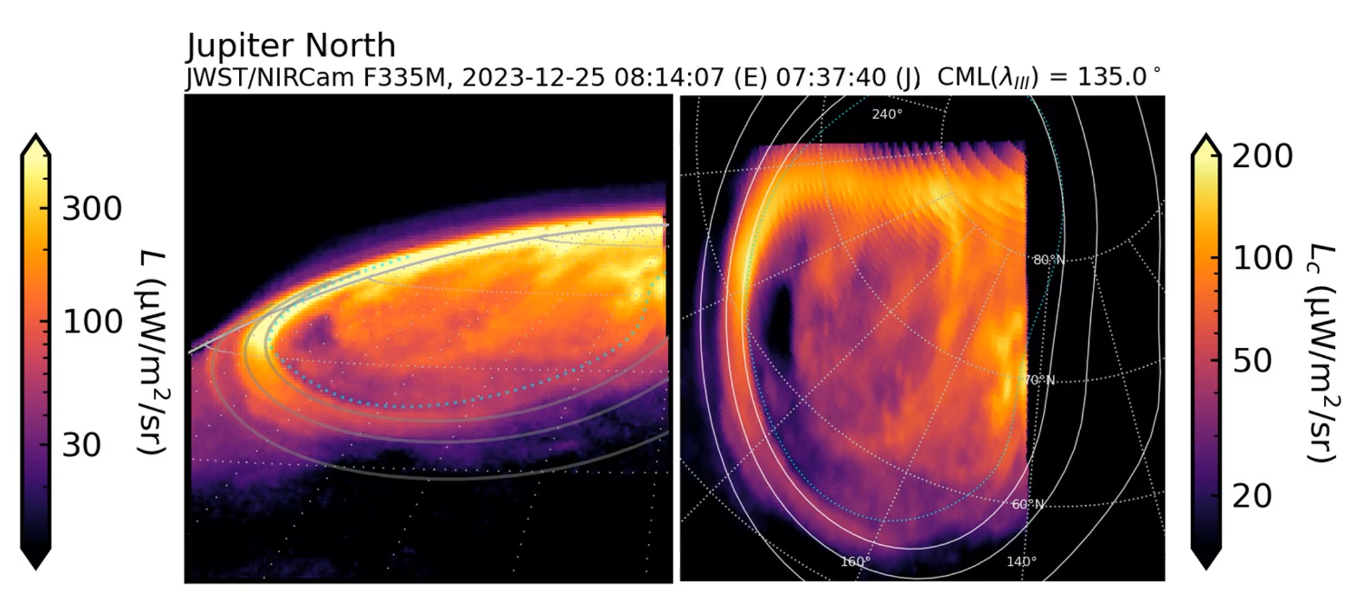
Figure 1: JWST/NIRCam observations of Jupiter’s north polar aurora (Nichols+2025). The ~3 second time resolution allows us to the measure rapid variation and morphological changes of the H3+ intensity over the entire auroral region.
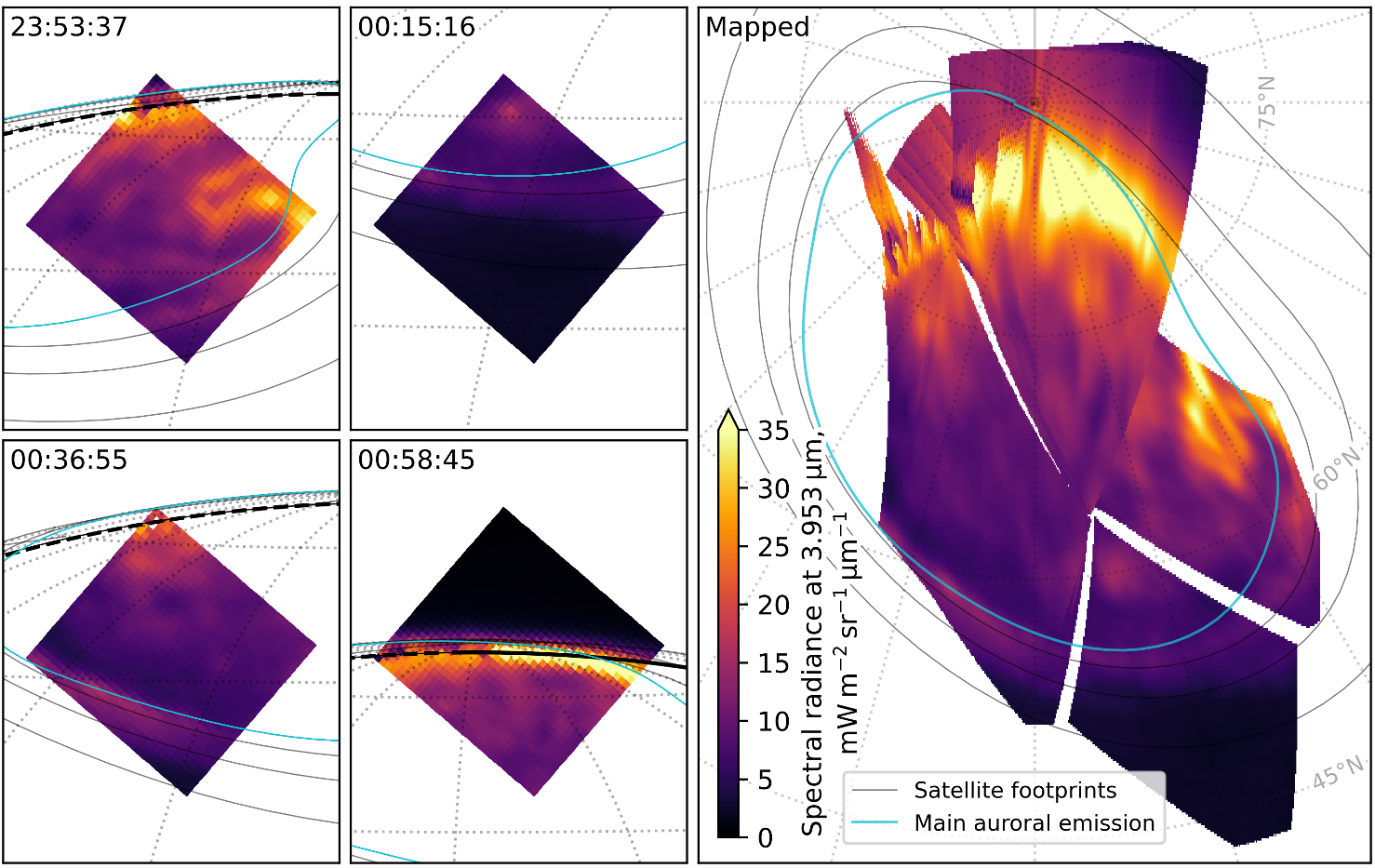
Figure 2: Spatial coverage of JWST/NIRSpec observations of Jupiter’s north polar aurora. Each observed location has a full 3-5 µm spectra (R=2700), acquired with a time resolution of ~30 seconds, providing a comprehensive spatial, spectral and temporal observations of Jupiter’s infrared auroral emissions.
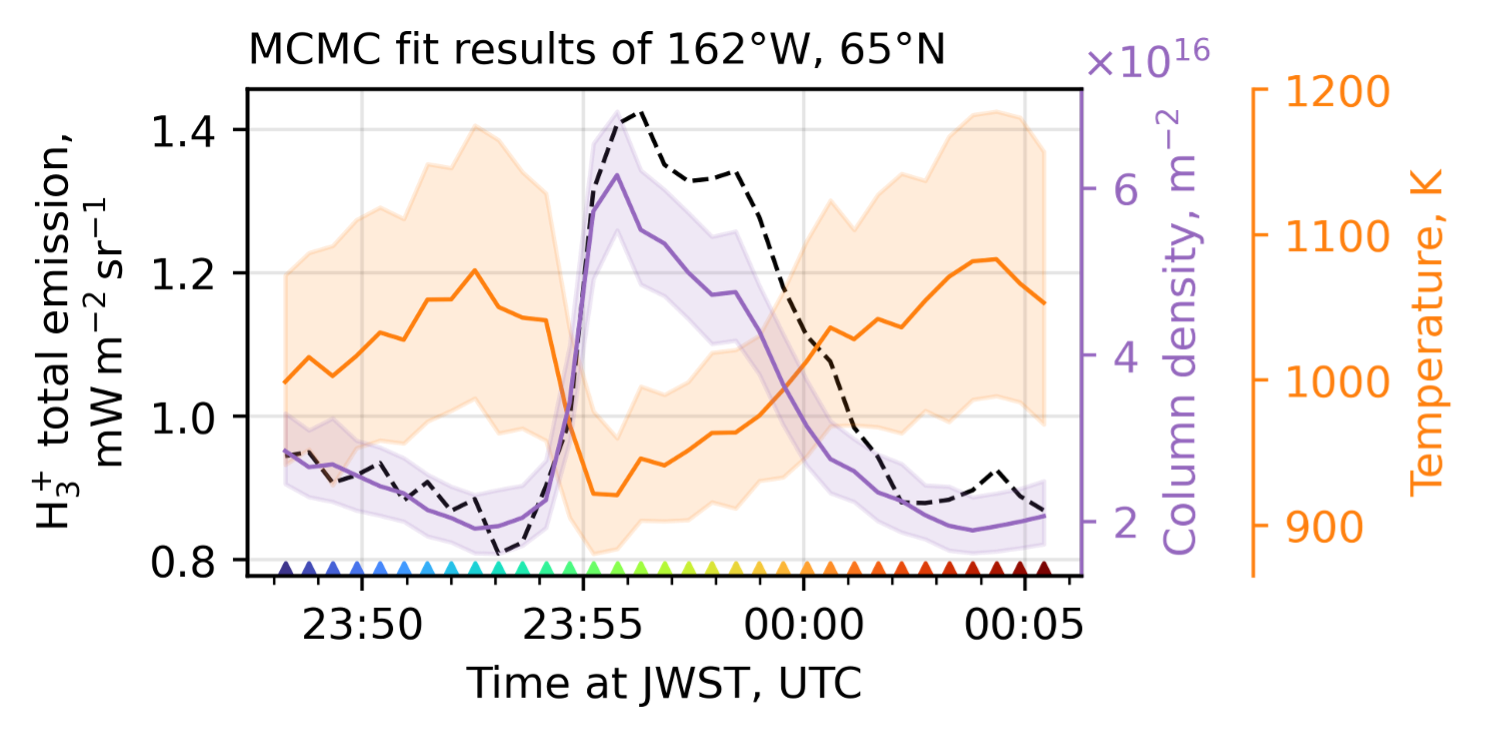
Figure 3: Transient brightening of Jupiter’s H3+ aurora observed by JWST/NIRSpec. The column density (purple) increases rapidly during the brightening event, while the temperature (orange) decreases.
How to cite: King, O., Nichols, J., Fletcher, L., Clarke, J., de Pater, I., Melin, H., Moore, L., and Tao, C.: JWST observations of Jupiter's time variable H3+ auroral emissions, EPSC-DPS Joint Meeting 2025, Helsinki, Finland, 7–12 Sep 2025, EPSC-DPS2025-813, https://doi.org/10.5194/epsc-dps2025-813, 2025.


