
 1,2,3,4,5,1,2
- 1Instituto de Astrofisica de Canarias, Tenerife, Spain (jmlc@iac.es)
- 2Departamento de Astrofisica, Universidad de La Laguna, Tenerife, Spain
- 3University of Craiova, Craiova, Romania
- 4Astronomical Institute of the Romanian Academy, Bucharest, Romania
- 5ESA, European Space Astronomy Centre (ESAC), Madrid, Spain
- 6Aurora Technology B. V. for ESA, ESAC, Madrid, Spain
- 7Department of Mechatronics, Optics and Engineering Informatics, Budapest University of Technology and Economics, Budapest, Hungary
- 8School of Electrical Engineering, Aalto University, Finland
- 9Department of Physics and Astronomy, University of Padova, Italy
- 10DLR Institute of Planetary Research, Berlin, Germany
The ESA Hera Planetary Defence mission was sucessfully launched from Cape Cañaveral in October 7, 2024, with the goal of studying in detail the near-Earth binary asteroid system (65803) Didymos-Dimorphos[1]. The smaller of the two objects, asteroid Dimorphos, was impacted by the NASA DART spacecraft in September 26, 2022, as part of the first test of the kinetic impactor deflection technology. DART impact changed the orbital period of Dimorphos around Didymos, measured to be around 12 hours, in a total of 33.24 ± 0.03 minutes [2], generating a huge cloud of dust and debris observable from the Earth, and that lasted for almost a year [3]. After a successful comissioning phase, were the Hera spacecraft tested most of its instruments and imaged the Earth-Moon system, the mission entered the cruise phase. This phase included the Mars swing-by in mid March, 2025, when images of the surface of the red planet were acquired for calibration purposes, in addition to one “extra” scientific target: the anti-Mars side of Deimos. The spacecraft is now traveling to its final destination, the Didymos-Dimorphos system where it is expected to arrive in late 2026, starting the asteroid phase. This includes different mission phases in which the spacecraf will progressively reduce its distance to the asteroid system, getting as close as ~1 km to the surface of Dimorphos at the final stage, in June-July 2027.
The Didymos-Dimorphos system has been extensively observed in the visible and the near-infrared using ground-based telescopes [4,5,6] and also the JWST[7]. Acquired data indicate that the unresolved system can be taxonomically classified as an S-type, i.e., it is relatively bright (average geometric albedo around 15%) and is dominated by mafic silicates, mostly pyroxene and olivine. These minerals show two very characterisic absorption bands in the visible and near-infrared wavelength region (0.5-2.5 µm), centred at 1 and 2 µm, that, together with the spectral slope, can be used to infer compositional information on the surface of the asteroids. Also, effects of space weathering in such surfaces have been broadly studied, with a decrease in albedo and band depth, and a reddening in the slope observed with increasing exposition [8].
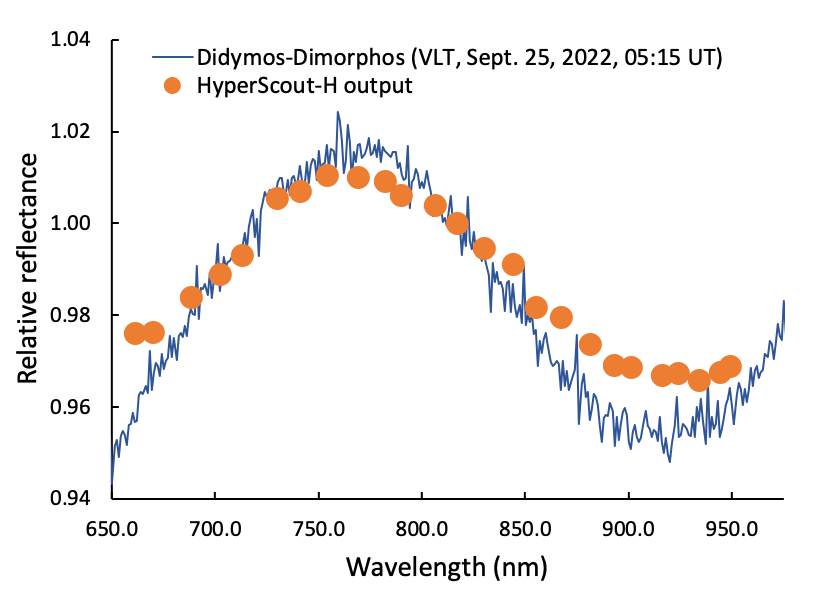
One of the instruments onboard the Hera spacecraft is HyperScout-H (HS-H hereafter). This is a hyperspectral imager developed by cosine1 with a large field of view (15° x 8°) and a CMOS detector exhibiting 2048 x 1088 pixels. The sensor incorporates a filter array consisting of on-chip, pixelated Fabry-Pérot interference filters, sampling a total of 25 bands in a configuration of 5 x 5 detector pixels and covering the 650 to 960 nm wavelength range. This instrumental setup allows to obtain both spectral and spatial information in one shot, the latter depending on the extent to which the original resolution can be restorted by demosaicking tecniques.
1https://www.cosine.nl/
How to cite: de Leon, J., Popescu, M., Prodan, G., Küppers, M., Grieger, B., Kovacs, G., Nagy, B., Kohout, T., Lazzarin, M., Vincent, J.-B., and Licandro, J.: Observations of the Didymos-Dimorphos binary asteroid system with HyperScout-H instrument onboard the ESA Hera mission: what to expect at the arrival, EPSC-DPS Joint Meeting 2025, Helsinki, Finland, 7–13 Sep 2025, EPSC-DPS2025-815, https://doi.org/10.5194/epsc-dps2025-815, 2025.


