
 1,1,3,
- 1University of Freiburg, Geology, Freiburg, Germany (michael.poelchau@geologie.uni-freiburg.de)
- 2Deutsches GeoForschungsZentrum Potsdam, Potsdam, Germany
- 3Museum für Naturkunde – Leibniz Institute for Evolution and Biodiversity Science, Berlin, Germany
- 4Fraunhofer-Institut für Kurzzeitdynamik, Ernst-Mach-Institut, Freiburg, Germany
Introduction: Calcite is a ubiquitous mineral at the earth’s surface. While shock effects for most of the rock-forming silicates have been intensely studied and calibrated experimentally against shock pressure, unambiguous shock effects for calcite, are rare. Thus, calcite has a currently overlooked potential as an indicator for shock deformation. Here we examine the potential of high twin densities as a shock effect in calcite.
Methods: A 25 cm cube of Carrara Marble was selected as target material. A two-stage light gas gun at the Fraunhofer Ernst-Mach-Institute for High-Speed Dynamics in Freiburg (EMI), Germany was used to accelerate a spherical 2.5 mm iron meteorite projectile to 5 km s−1. A thin section of the crater subsurface was prepared and microstructures were mapped in detail [1]. Linear twin densities (i.e., the number of twins per mm) were measured using the line count method (e.g. [2]) in 39 BSE images. Additional TEM foils for twin density measurements were prepared with FIB at the GFZ Potsdam.
Results: The impact created a crater with a diameter of 56.6 ± 4.2 mm and a depth of 6.0 ± 0.4 mm. Polarized light microscopy analysis of the thin section shows that apart from intra-granular cracks and tensile fractures the main deformation features in the crater subsurface are calcite twin lamellae and open cleavage. Under crossed polarized light, some domains in calcite grains show no extinction behavior.
Twin densities in BSE images show local maxima of ~4000 twins/mm over short line sections of 10 µm, while averaged grain measurements near the surface can reach ~2000 twins/mm and gradually decrease with depth (Fig. 1). In the two TEM-foils a twin density of 4373 ± 711 twins/mm was measured at the crater floor, while at 350 µm below the crater floor, a twin density of 2924 ± 621 twins/mm was determined.
The cratering experiment was numerically modeled using the iSALE-2D Eulerian shock physics code in the “Chicxulub” version [3]. Calculated peak pressures exceed 4 GPa at the crater floor but rapidly decrease over several mm depth. Shear stresses of 1378 ± 130 MPa and 1333 ± 130 MPa were calculated for the two TEM samples located near the crater floor. Values determined from the BSE images range from 1378-849 MPa over ~5 mm depth in the crater subsurface.
Twin density line counting results of the TEM and BSE images are plotted against the numerically derived shear stress (Fig. 1). Experimental data from [2] are also plotted, as well as the twin density-based piezometer from [2]. The new impact data points lie above the piezometer. Combining all data points, the piezometer can be revised, giving the following equation:
log(τ)=0.738±0.057+(0.718±0.024)logNL
where τ is the shear stress and NL is the twin density.
Discussion: The systematic relationship between twin density in calcite and applied shear stress was derived for tectonic situations (e.g., [2]). The highest twin densities from [2] are less than 800 twins/mm, and the highest experimental shear stresses were less than 300 MPa. These stresses are well above the maximum shear stresses of ~140 MPa for natural limestone samples reported in [4]. In comparison, peak shear stresses from numerical models of shock waves that occur during the impact cratering process are calculated at 1-2 GPa for shock pressures between 5 and 50 GPa in crustal rocks [5].
Apart from maximum crustal shear stresses for Carrara marble at ~125 MPa, higher shear stresses in the crust are possible for other rock types. [6] calculate maximum shear stresses of ~0.7 GPa for quartzites and granites (Fig. 1). As these values are below shear stress values calculated for shock deformation in impact craters, the occurrence of twin densities >1000 twins/mm, in particular in sedimentary or other supracrustal rocks, must indicate high shear stresses characteristic for shock waves.
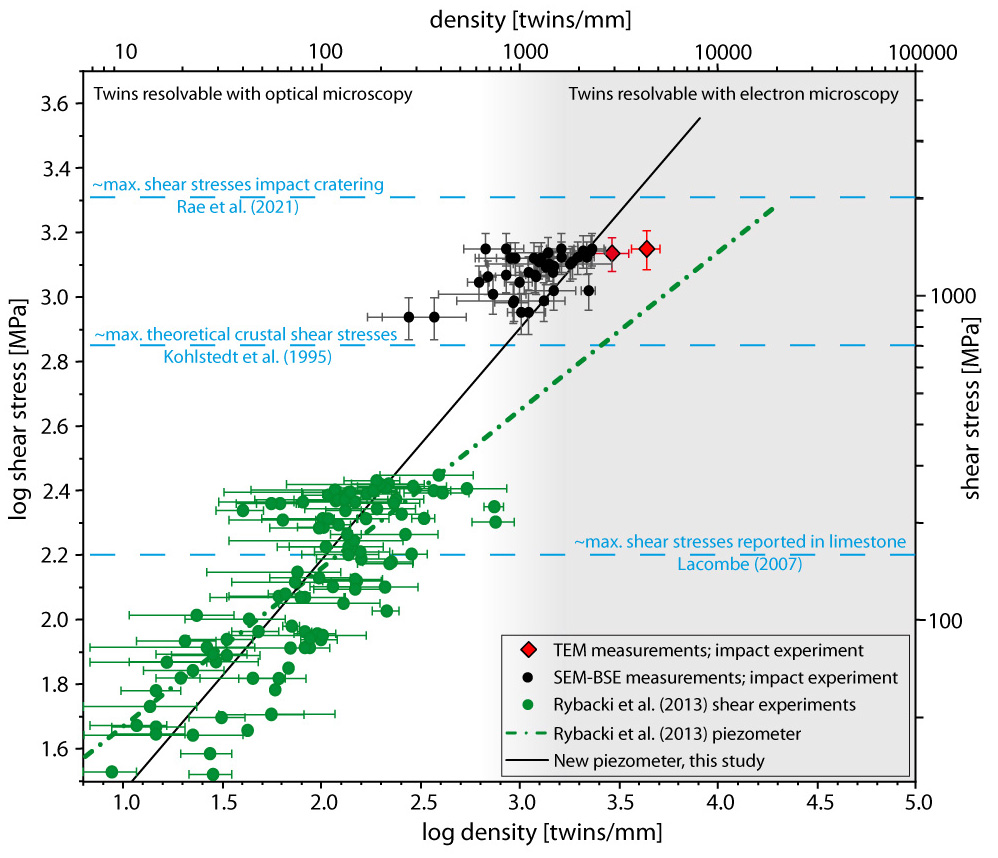
Figure 1: Calcite twin density from impact and shear experiments plotted against shear stress. Modified from [1].
Conclusions: We find that twin densities above 1000 twins/mm in calcite can be used as a novel indicator for high shear stresses encountered in impact cratering settings, and thus as an indicator for shock metamorphism. In polarized light microscopy, the loss of extinction and reduced interference colors in calcite in the shallow crater subsurface regions are an initial indicator for intense twinning. However, full recognition of these high twin densities requires either high resolution SEM imagery or TEM. Further experimental calibration data are certainly necessary to validate and better constrain these findings, and future studies should additionally take a detailed look at the effect of grain size on twin density (c.f. [7]).
References:
[1] Poelchau, M. H., Winkler, R., Kenkmann, T., Wirth, R., Luther, R., & Schäfer, F. (2025). Extreme twin densities in calcite—A shock indicator. Geology, 53(3), 279-283.
[2] Rybacki E., Evans, B., Janssen, C., Wirth, R., & Dresen, G. (2013) Influence of stress, temperature, and strain on calcite twins constrained by deformation experiments. Tectonophysics, 601, 20–36.
[3] Wünnemann, K., Collins, G. S., and Melosh, H. J. (2006). A strain-based porosity model for use in hydrocode simulations of impacts and implications for transient crater growth in porous targets. Icarus, 180, 514–527.
[4] Lacombe, O. (2007). Comparison of paleostress magnitudes from calcite twins with contemporary stress magnitudes and frictional sliding criteria in the continental crust: Mechanical implications. Journal of Structural Geology, 29(1), 86-99.
[5] Rae, A. S., Poelchau, M. H., & Kenkmann, T. (2021). Stress and strain during shock metamorphism. Icarus, 370, 114687.
[6] Kohlstedt, D. L., Evans, B., & Mackwell, S. J. (1995). Strength of the lithosphere: Constraints imposed by laboratory experiments. Journal of Geophysical Research: Solid Earth, 100(B9), 17587-17602.
[7] Rutter, E., Wallis, D., & Kosiorek, K. (2022). Application of electron backscatter diffraction to calcite-twinning paleopiezometry. Geosciences, 12(6), 222.
How to cite: Poelchau, M., Kenkmann, T., Winkler, R., Wirth, R., Luther, R., and Schäfer, F.: Extreme twin densities in calcite as a shock indicator , EPSC-DPS Joint Meeting 2025, Helsinki, Finland, 7–12 Sep 2025, EPSC-DPS2025-819, https://doi.org/10.5194/epsc-dps2025-819, 2025.


