
 1,1,1,1,3,4,5,6,3,6
- 1School of Physics and Astronomy, University Of Leicester, Leicester, United Kingdom of Great Britain – England, Scotland, Wales
- 2Universidad Adolfo Ibáñez, Santiago, Chile
- 3Department of Earth and Planetary Science, University of California, Berkeley, USA.
- 4Institute for Space Astrophysics and Planetology, National Institute for Astrophysics (INAF—IAPS), Rome, Italy
- 5Department of Maths, Physics, and Electrical Engineering, Northumbria University, Newcastle upon Tyne, UK
- 6LESIA, Observatoire de Paris, Université PSL, CNRS, Sorbonne Université, Université Paris-Cité, Meudon, France
We present observations of Jupiter’s south polar region using the JWST/NIRSpec IFU spectrometer, providing high resolution spectral imaging across the near-infrared that probes the vertical and latitudinal distribution of aerosols and gaseous species. Near-infrared spectroscopic mapping is a powerful diagnostic for studying giant planet atmospheres, enabling constraints on cloud structure in the weather-forming lower troposphere, and haze in the radiatively-controlled lower stratosphere. The 1.7-5.3 µm range sampled here provides access to reflected sunlight both inside and outside of strong methane absorption bands; ionospheric emission from CH4 and H3+; and deep thermal emission from the 5 µm window where gaseous absorption is relatively low; sensing the 1 – 10 bar region. Locating and constraining the aerosol layers of Jupiter’s atmosphere is of great importance for photochemical models, as these hazes are produced in high-altitude photochemistry [1], and affect the efficiency of radiative heating and cooling of the upper troposphere and stratosphere [2]. The highest latitudinal zonal jets entrain a cold polar vortex, with clear transitions in aerosol properties (and potentially gaseous abundances) across the polar vortex boundary. Reflective aerosols may also be created by auroral particle precipitation [3] which allows magnetospheric phenomena to be traced onto the Jovian clouds [4]. We will invert the JWST NIRSpec observations to explore how aerosol and gaseous properties differ between the south polar vortex and the mid-latitudes.
JWST/NIRSpec observed the south pole of Jupiter on 24 December 2022 as part of ERS-1373 (Co-PIs: de Pater & Fouchet), using the high-resolution, long-wavelength filter/grating combination F290LP/G395H (2.8 – 5.3 µm). This provides exceptional spectral resolution (R~2700,  =0.7nm) over the latitude range 42 – 85oS at spatial resolutions between 74km at 42oS and 1100km at 85oS. Six tiles were taken using this grating, giving 100o of longitudinal coverage, and three tiles were taken with F170LP/G235H (1.7 – 3.2 µm) extending the wavelength range down to 1.7µm. This covers the full near-IR range, from short-wavelength reflected sunlight to long-wavelength thermal emission. Hubble and Juno also observed the region at a similar time (2022/11/12 and 2022/12/15) allowing comparison of features in visible light and tracking over time in the same wavelength range.
The vertical structure of aerosols and gases will be determined using spectral modelling and inversion package NEMESIS [5]. A key challenge is modelling and removing the ionospheric emissions from methane fluorescence and H3+, which is done outside NEMESIS, before performing the multiple-scattering retrievals to constrain aerosol properties. We vary the vertical profile of several gases including PH3 and NH3 and compare hazes in the upper troposphere and stratosphere atop a single extended cloud deck in the troposphere. We found that a stratospheric haze is required to replicate the broad shape of the region between 3.2 µm and 3.6 µm, where an upper tropospheric haze alone is not sufficiently reflective. Once these gas profiles and aerosols are tuned to provide a physical best-fit, model will be applied to zonally-averaged spectra across the full latitude range of the observations in order to study the changes in chemistry and aerosol properties that occur over the polar vortex boundary.
Figures:
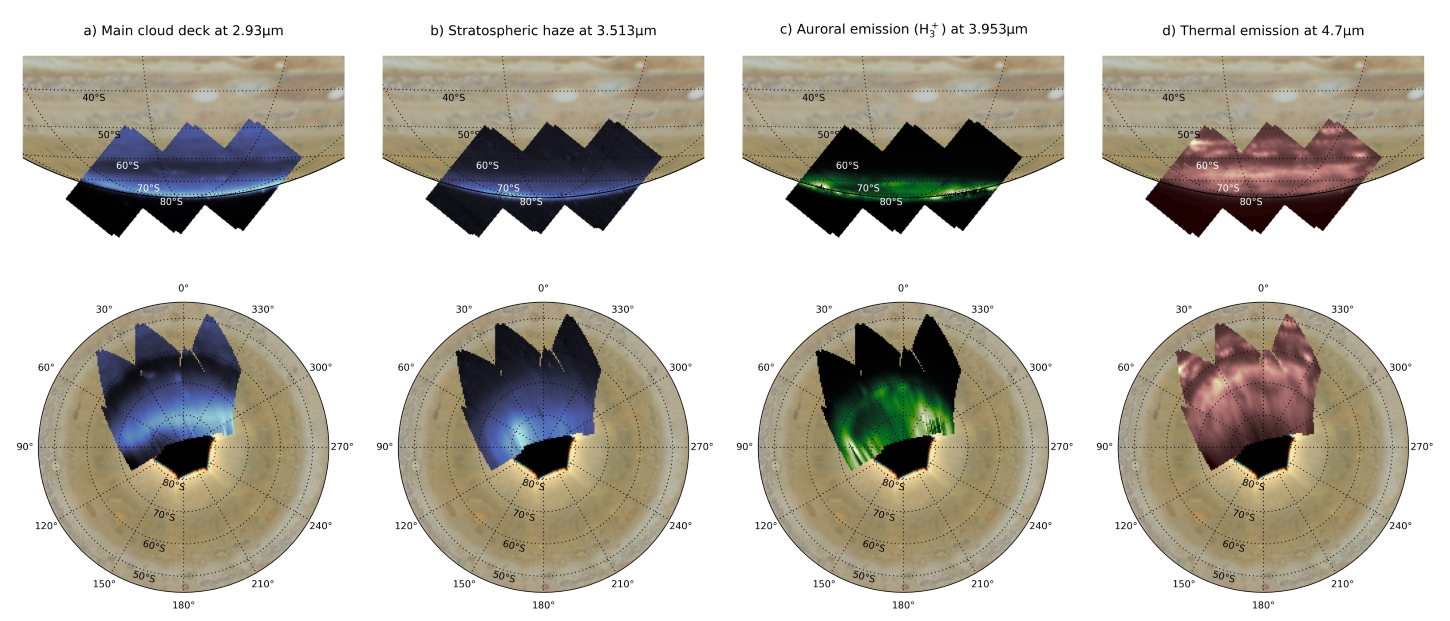
Figure 1 The South Polar region observed by JWST/NIRSpec using G395H at 4 selected wavelengths. Top: Mosaic in the RA/Dec frame, rotated such that North is up. Bottom: reprojected onto an equidistant polar projection. 2.93µm (a) shows sunlight reflecting off the main cloud deck, 3.513µm (b) shows the highly reflective stratospheric haze layer, 3.953µm (c) is dominated by auroral emission from excited H3+ ions, and 4.7µm (d) shows thermal emission from deep within Jupiter (1 – 10bar). Context images are Hubble OPAL visible light images from Nov 2022.
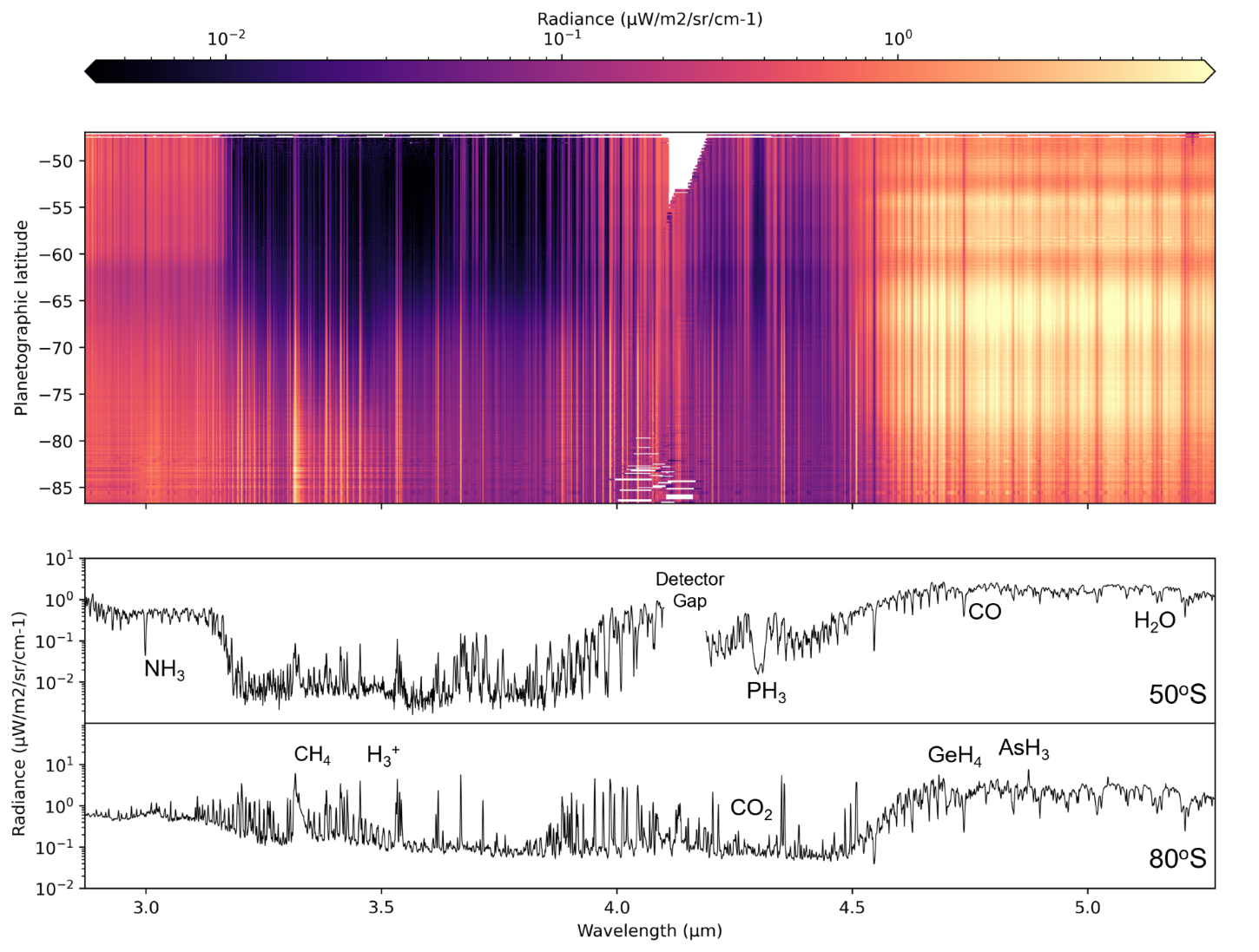
Figure 2 Top: Observed radiance with JWST as a function of latitude and wavelength. Bottom: Two zonally averaged spectra at 50oS and 80oS, with some gas absorption/emission features labelled. The difference between the mid-latitude and high-latitude spectra are evident, with broadband methane and phosphine absorption disappearing at high latitude, and auroral emission from H3+ and CH4 becoming more dominant.
References:
[1] Wong, A.-S., Y. L. Yung, and A. J. Friedson (2003), Benzene and Haze Formation in the Polar Atmosphere of Jupiter, Geophys. Res. Lett.
[2] Zhang X., West R. A., Banfield D., and Y.L. Yung (2013), Stratospheric aerosols on Jupiter from Cassini observations, Icarus
[3]: Sinclair J.A., Moses J.I., Hue V., Greathouse T.K., Orton G.S., Fletcher L.N., Irwin P.J.G (2019), Jupiter's auroral-related stratospheric heating and chemistry III: Abundances of C2H4, CH3C2H, C4H2 and C6H6 from Voyager-IRIS and Cassini-CIRS, Icarus
[4]: Tsubota, T.K., Wong, M.H., Stallard, T., Zhang X., Simon, A. (2025), UV-dark polar ovals on Jupiter as tracers of magnetosphere–atmosphere connections, Nature Astronomy
[5]: Irwin P.G.J., Teanby N.A., de Kok R., Fletcher L.N., Howett C.J.A., Tsang C.C.C., Wilson C.F., Calcutt S.B., Nixon C.A., Parrish P.D. (2008), The NEMESIS planetary atmosphere radiative transfer and retrieval tool, Journal of Quantitative Spectroscopy and Radiative Transfer
How to cite: Toogood, S., Fletcher, L., King, O., Harkett, J., Roman, M., de Pater, I., Biagiotti, F., Melin, H., Fouchet, T., Wong, M., and Rodriguez-Ovalle, P.: JWST/NIRSpec IFU Observations of Jupiter’s South Pole: Vertical and Latitudinal Structure of Aerosols in the Near-Infrared, EPSC-DPS Joint Meeting 2025, Helsinki, Finland, 7–13 Sep 2025, EPSC-DPS2025-820, https://doi.org/10.5194/epsc-dps2025-820, 2025.


