

- European Space Agency, ESTEC, Noordwijk, Netherlands (colin.wilson@physics.ox.ac.uk)
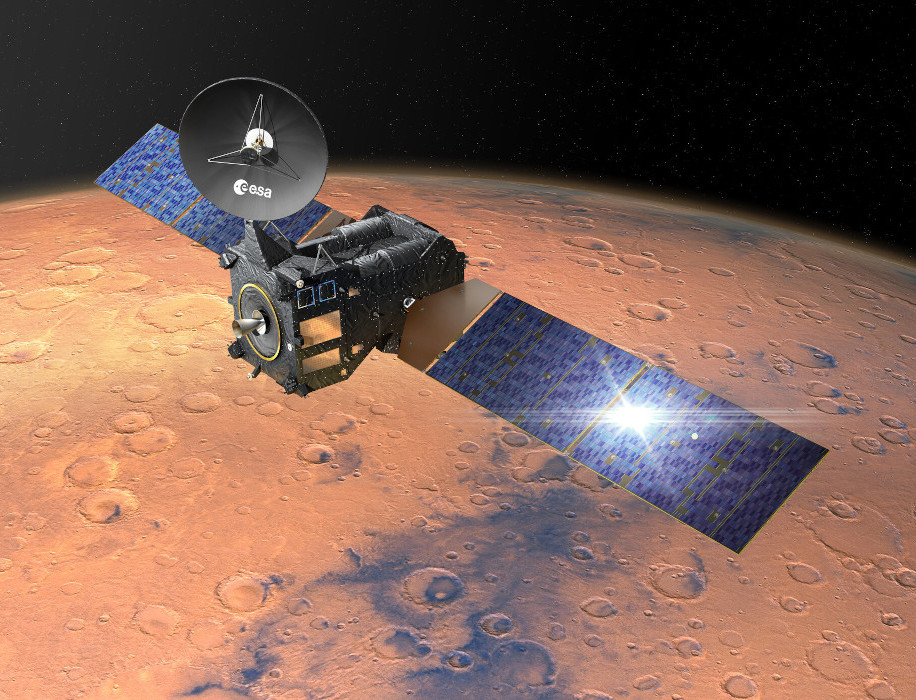
ExoMars Trace Gas Orbiter (TGO): TGO has now completed almost four full Mars years since reaching its science orbit in April 2018.
Scientific highlights include (1) continuing non-detection of methane, with upper limits as low as 20 ppt by volume [1]. Reconciling this continued non-detection by TGO with the background levels of several hundred ppt in Gale crater by MSL remains an enigma, stimulating further research; (2) further characterization of variations of HCl, the first reported halogen-containing species in the atmosphere of Mars [2,3]; (3) further characterization of the transport of water to high altitudes, a critical step in the escape of water from Mars [4]; (4) detection of transient water ice frost on tropical volcanoes by multiband CaSSIS imaging, confirmed by MEX/HRSC and TGO/NOMAD observations [5]; (5) calculation of a near-surface hydrogen abundance map, revealing surprisingly high hydrogen abundances at a number of low latitude locations including in Valles Marineris [6]; and (6) monitoring of radiation doses throughout the mission, including the most energetic event recorded yet, in May 2024, as we near the peak of the current solar cycle [7].
The TGO spacecraft health is nominal and appears consistent with operation well into the 2030s. Since Nov 2024, TGO has adopted a gyroless operation mode in order to further prolong spacecraft life.
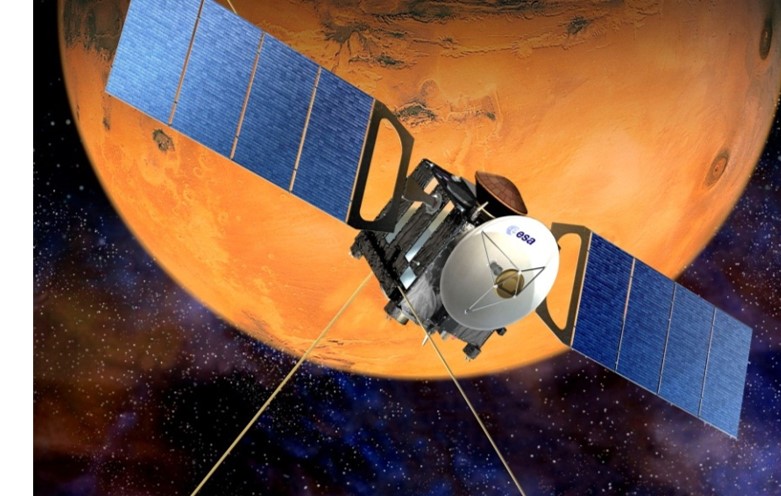
Mars Express (MEX): MEX remains a highly productive mission as it enters its third decade of operation at Mars.
Recent science highlights include (1) continued mapping of subsurface reflectors beneath the south polar layered ice deposits [8], and associated work to explain the cause of these reflections; (2) a global map of minerals on Mars with 200 m/px resolution, obtained from analysis of MEX & OMEGA infrared spectra [9]; (3) construction of a globally consistent colour mosaic of Mars corrected for local scattering atmospheric variations using high-altitude imagery [10]; (4) publication of a catalogue of HRSC imagery of transient atmospheric cloud phenomena, such as twilight or orographic clouds [11]; (6) First analysis of ionospheric profiles obtained from spacecraft-to-spacecraft (MEX-to-TGO) radio occultation at Mars [12]; (7) discovery that, in rare solar wind conditions, the induced magnetosphere of Mars can degenerate, meaning that the bow shock apparently disappears for periods of hours to days, temporarily allowing increased transport where the bow shock would have been [13]; (8) the most detailed shape model of Phobos yet, constructed using stereophotoclinometry from datasets including MEX/HRSC/SRC [14].
Mars Express operations are currently funded until end of 2026, with indicative extension (subject to further review) until end of 2028.
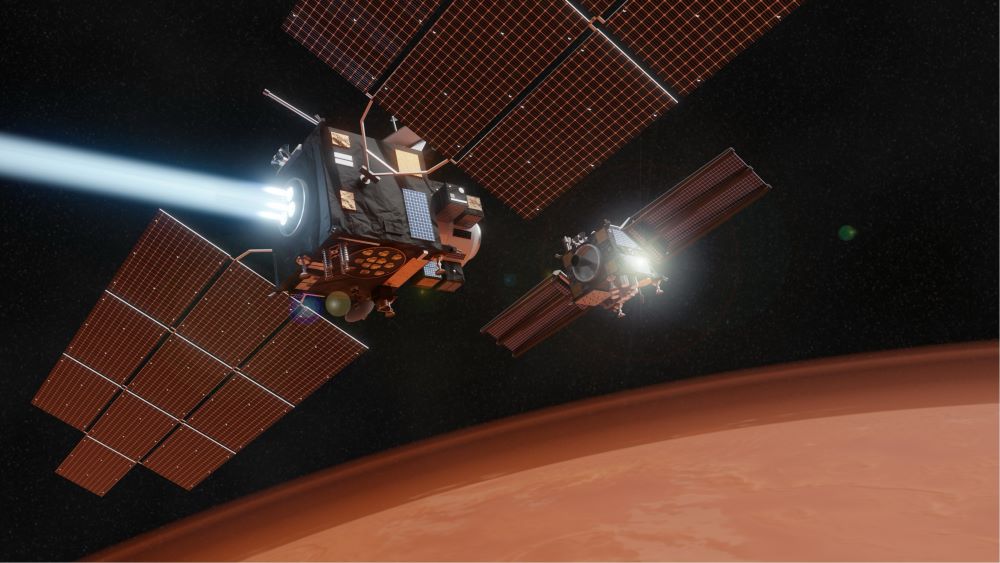
Mars LightShip: ESA is currently developing a concept for future Mars infrastructure including a propulsive tug service with integrated communication and navigation (MARCONI) service. This concept is called Lightship. Each LightShip would deliver one or more passenger spacecraft to Mars orbit, and then would itself manoeuvre to a high (5720 km altitude) near-equatorial (20° inclination) MARCONI service orbit from which it would carry out data relay and navigation services for other surface or orbital missions, as well as carry out atmospheric science investigations. The first LightShip mission (LightShip-1) would deliver to Mars a low polar orbiter named SpotLight, whose payload would include high resolution surface imaging.
This mission concept is currently the subject of industrial phase A study, with the aim of launching not earlier than 2032. Development of the mission beyond Phase A would be dependent on further approval by ESA member states.
Acknowledgments: This abstract represents the work of hundreds of researchers and engineers across the MEX, TGO and LightShip teams. MEX and TGO data are freely and publically available at ESA’s Planetary Science Archive (https://psa.esa.int/).
References:
[1] Montmessin F. et al. (2024) 10thInt. Mars Conf, abstract id 3145. [2] Olsen K. et al. (2024), JGR 129, art. id e2024JE008350. [3] Rajendran K. et al. (2025), JGR 130, art. id e2024JE008537. [4] Brines, A. et al. (2024), GRL 51, art. Id e2023GL107224. [5] Valantinas, A. et al. (2024), Nat GeoSci 17, 608-616. [6] Golovin, D. et al. (2024) LPSC, Abstract #1923. [7] Semkova, J. et al. (2024), Sol Sys Res 58 p 367-376. [8] Lauro, S et al. (2021) Nat Astron 5 p 63-70. [9] Carter J. et al. (2023) Icarus 389 art id 115164. [10] Michael, G. et al (2025) Icarus 425 art id 116350. [11] Tirsch, D. et al (2024), EPSC abstract #44. [12] Parrott, J. et al. (2024), Radio Science, art. id. e2023RS007873. [13] Zhang, Q et al., (2024), Nature 634 (8032) p. 45-47. [14] Ernst, C. et al., Earth Planets Space 75(1) :103.
How to cite: Wilson, C.: Europe's Mars Orbiters: current status, science highlights & future prospects, EPSC-DPS Joint Meeting 2025, Helsinki, Finland, 7–12 Sep 2025, EPSC-DPS2025-822, https://doi.org/10.5194/epsc-dps2025-822, 2025.


