
 1,2,3,
- 1Florida Space Institute, University of Central Florida, Orlando, FL, USA (charles.schambeau@ucf.edu)
- 2Department of Physics, University of Central Florida, Orlando, FL, USA
- 3Planetary Science Institute, Tucson, AZ, USA
- 4University of Arizona, Tucson, AZ, USA
Introduction: Coma images of active comets are commonly used to identify inhomogeneities that appear as coma features, which provide key insights into coma dynamics and nucleus properties [e.g., 1, 2]. We have developed a 3D Monte Carlo model to simulate such features and have successfully applied it to interpret cometary activity and nucleus characteristics in prior studies [e.g., 3, 4, 5]. We are currently preparing to release this software as a Tool to the wider astronomy community via a user-friendly web interface, Coma Factory. A companion Python package containing the underlying codes will also be made available. Our presentation will include a live demonstration of Coma Factory using both the web interface and the Python package in a Jupyter Notebook. We welcome community feedback to help guide the development of comprehensive tutorials and ensure the Tool’s broad utility.
Coma Model: The 3D Monte Carlo coma model simulates the spatial distribution of particles – first-, second-, or third-generation species – emitted from a nucleus. The resulting 3D particle distribution is then projected onto a 2D skyplane corresponding to the observer’s line of sight (e.g., Figure 1), enabling direct comparison with observed coma images. The model requires input parameters that describe the comet’s activity, nucleus properties, particle-specific species characteristics, and observing geometry. It also includes the capability to simulate the effects of solar radiation pressure on all species.
Coma Factory: When using Coma Factory, once the user provides the necessary input parameters, the web interface runs the Python code to generate the corresponding image in FITS format. The image header includes keywords identifying all the input parameters and hence each image created by Coma Factory maintains a digital record of the input parameters corresponding to each image. Additionally, Coma Factory may be used to produce 2D coma simulations corresponding to a range of viewing directions that enable the user to assess the 3D structure of the coma feature(s) that are useful for interpreting actual coma observations of comets.
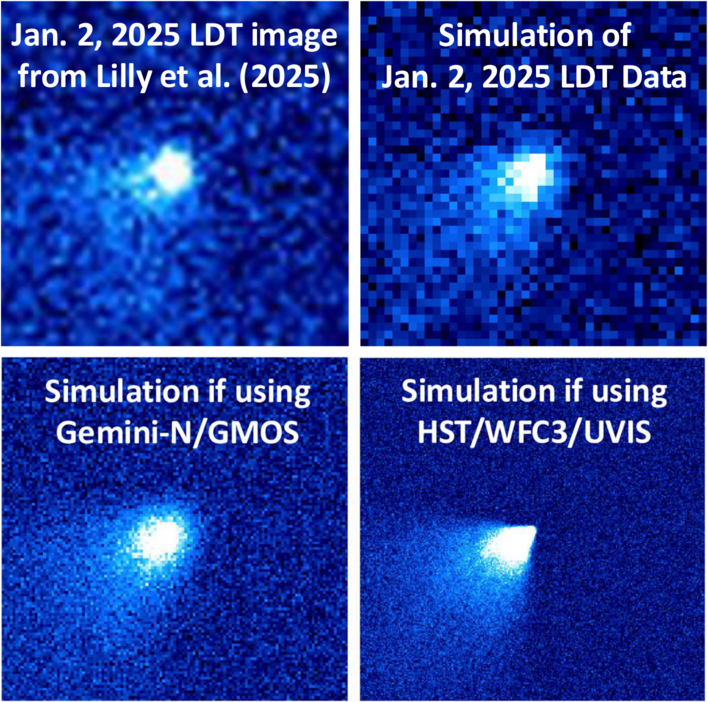
Figure 1. Top-left: Image of the active Centaur 2023 RS61 from [6]. Top-right: shown is a simulated image using Coma Factory that is consistent with the data. The bottom two panels show the same simulated image but if the data had been acquired with other facilities with different image resolutions. The same coma model was used for each of the three image simulations, where characteristics of each telescope and instrument combination were used to replicate imaging data if observations had been acquired from the specified facility. Coma Factory is capable of generating realistic comae images as illustrated by these simulations.
Acknowledgments: We gratefully acknowledge the support provided by the NASA PDART Program through award 80NSSC21K0881.
References: [1] Schleicher D. G. and Woodney L. M. (2003) Icarus, 162, 190-213. [2] Goldberg C. et al. (2023) Planet. Sci. J., 4, 19pp. [3] Schulz R. et al. (1993) Icarus, 103, 319-328. [4] Samarasinha N.H. (2000) Astrophys. J., 529, L107-L110. [5] Schambeau C. A. et al. (2017) Icarus, 284,359-371. [6] Lilly et al. (2025) RNAAS, 9, Issue 3, id.67.
How to cite: Schambeau, C., Samarasinha, N., Gay, P., and Bauer, I.: Simulating and Analyzing Comet Comae with Coma Factory, EPSC-DPS Joint Meeting 2025, Helsinki, Finland, 7–12 Sep 2025, EPSC-DPS2025-825, https://doi.org/10.5194/epsc-dps2025-825, 2025.


