
 ,
,- Instituto de Astrofísica de Andalucía - CSIC, Solar System, Spain (irenem@iaa.csic.es)
We present our recent efforts to measure the dust-to-gas ratio in several comets, motivated by the need to improve our understanding of this critical parameter, which provides key constraints for dust-to-ice interior models and dust-gas interaction processes. We will focus on the results obtained for the Jupiter Family Comet (JFC) 7P/Pons-Winnecke (hereafter 7P) during its 2021 apparition (Mariblanca-Escalona et al. 2025). Additionally, we are conducting similar observations of the dynamically new comet (DNC) C/2024 E1 (Wierzchos). We will share preliminary results based on the data collected so far.
- BACKGROUND:
Comets belong to different dynamical classes that reflect their origins and evolutionary histories. JFCs, such as 7P, have undergone multiple perihelion passages, leading to thermal processing and alteration of their surface layers. In contrast, DNCs are considered among the most pristine objects in the Solar System, offering valuable insights into its formation and early evolution. However, determining how unaltered these comets truly are remains challenging, largely because critical magnitudes such as the dust-to-ice ratio cannot be measured directly. Even for the well-studied 67P/Churyumov-Gerasimenko, accurately determining the dust-to-ice ratio has proven elusive (e.g., Choukroun et al. 2020). From ground-based observations, the dust-to-gas ratio measured in the coma provides the most accessible proxy for this critical parameter.
However, accurately determining the dust-to-gas ratio requires thorough characterization of both the dust and gas components of the coma. Moreover, due to the variability of cometary activity, continuous monitoring is essential to capture the coma’s changing properties over time, and therefore, to properly capture the evolution of the dust-to-gas ratio. Driven by the need to better understand the evolution of the dust-to-gas ratio in comets, we have initiated an observational program to characterize the gas and dust environments of multiple comets. Our program is also developed in support of the Comet Interceptor mission. By focusing on DNCs and backup candidates like 7P (initially proposed as a mission target in Schwamb et al. 2020), our work bridges fundamental cometary science with practical mission needs, supporting the planning of the instrument onboard and data interpretation of the Comet Interceptor mission.
- OBSERVATIONS:
After estimating the dust-to-gas ratio for 7P at 1.25 AU using broadband imaging and long-slit visible spectroscopy, we began a similar observational program for the DNC C/2024 E1 (Wierzchos) at Calar Alto Observatory (Spain) in March 2025. So far, we have obtained data at heliocentric distances around 4 AU, with guaranteed observing time until 3.4 AU and additional time requested down to 2.2 AU. Our observations are designed to capture data at intervals of roughly 0.1 AU, allowing us to tightly constrain the temporal evolution of the dust-to-gas ratio throughout the comet’s trajectory.
- METHODS:
Dust: We analyse the dust environment using a forward Monte Carlo dust tail code (Moreno, F., 2022), which uses images to derive the dust production rate, size distribution, and ejection velocities of the dust particles. Reliable modeling requires images at several heliocentric distances, therefore, comprehensive and continuous monitoring is essential.
Gas: We derive column density profiles of the observed radicals (CN, C2, C3, and NH2) and fit the column density profiles using the classical Haser and Festou models to estimate production rates of the observed radicals. If these standard models fail to fit the data reliably using classical scale lengths, we plan to to better explore additional processes, such as grain fragmentation and distributed sources, to better understand the coma’s physical and chemical complexity.
We calculate the dust-to-gas ratio by estimating the water production rate using the empirical relation log(QOH/QCN) = 2.5 (A'Hearn et al. 1995) and combining this with the dust loss rate derived from our Monte Carlo dust tail model.
- RESULTS (7P):
We observed 7P during its 2021 apparition from Calar Alto Observatory (Spain), using broadband imaging (1.71–1.25 AU pre-perihelion) and long-slit spectroscopy near 1.25 AU pre-perihelion, supplemented by ZTF r-Sloan images before and after perihelion.
Dust analysis: Our Monte Carlo model generally matched the observed isophotes covering both pre- and post-perihelion observations. We found a peak dust production rate of 83 kg s⁻¹ occurring 15 days after perihelion (see Fig. 1). The derived parameters, including a power-law size distribution index of −3.7 and ejection velocities ranging from 3 m s⁻¹ for the largest particles (0.1 m) to 23 m s⁻¹ for the smallest (5 µm), are consistent with typical cometary dust characteristics.
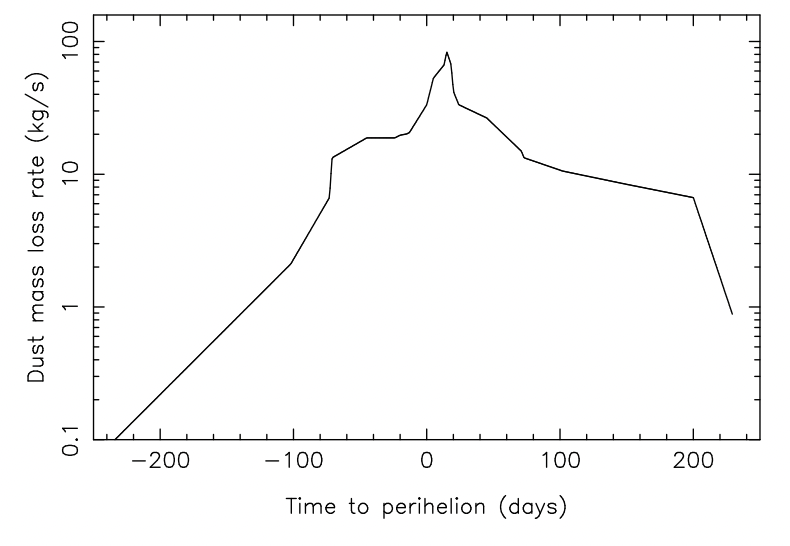
Figure 1. Derived dust mass loss rate as a function of time to perihelion for 7P.
Gas: We fitted the column density profiles with a classical Haser mode, analyzing sunward and anti-sunward directions separately. We adopted parent and daughter scale lengths from A’Hearn et al. (1995), scaling them as rₕ². Tab. 1 shows the production rates obtained along with the logarithmic ratios of the production rates of C3 and C2 relative to CN. Using the C3/CN and C2/CN ratios, we found that 7P cannot be classified as carbon-depleted, though it is somehow C3-depleted.
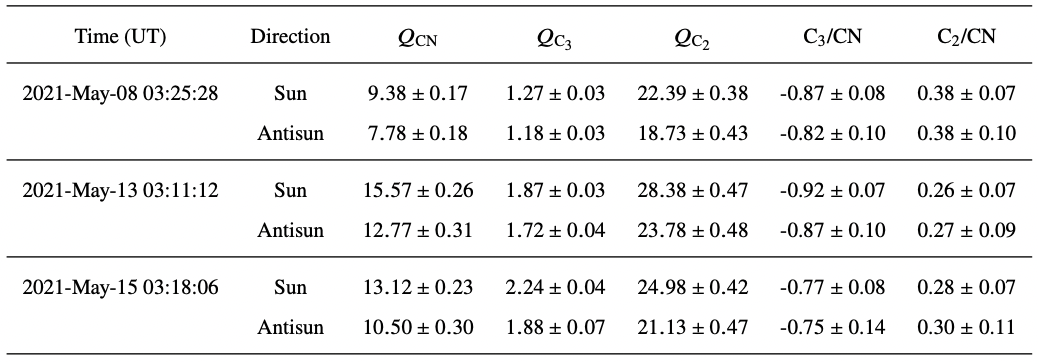
Table 1: Gas production rates of 7P for different species (in units of 10²³ s⁻¹), and the logarithmic ratios of the production rates of C3 and C2 relative to CN: C3 /CN and C2 /CN.
We estimated a dust-to-gas mass ratio of ∼2 at 1.25 AU, indicating a dust-rich composition. Our work significantly broadens the previously limited understanding of the activity and characteristics of 7P.
References
- A'Hearn M. F., et al., 1995, Icarus, 118, 223
- Choukroun M., et al., 2020, Space Sci. Rev , 216, 44
- Mariblanca-Escalona I., et al. 2025, MNRAS, 538, 1329
- Moreno F., 2022, Universe, 8, 366
- Schwamb M. E., et al., 2020, RNAAS, 4, 21
How to cite: Mariblanca-Escalona, I., Lara López, L. M., Moreno Danvila, F., Gutiérrez Buenestado, P. J., and Evangelista Santana, M.: Dust and gas characterization of 7P/Pons-Winnecke and C/2024 E1 (Wierzchos) in support of the Comet Interceptor mission, EPSC-DPS Joint Meeting 2025, Helsinki, Finland, 7–12 Sep 2025, EPSC-DPS2025-830, https://doi.org/10.5194/epsc-dps2025-830, 2025.


