
 1,1,2
1,1,2- 1University of Liverpool, Electrical Engineering and Electronics, United Kingdom of Great Britain – England, Scotland, Wales
- 2University of Liverpool, Mechanical and Aerospace Engineering, United Kingdom of Great Britain – England, Scotland, Wales
Transforming dense, arbitrarily angled RF attenuation chords acquired by an in-situ swarm of surface-bound transceivers into faithful three-dimensional permittivity maps of kilometre-scale asteroids presents a critical yet inherently ill-posed inverse problem. Subsurface voids, boulders and compositional layers dictate an asteroid’s mechanical response to anchoring, sampling and deflection while preserving clues to its formation history. Radar experiments, such as the bistatic CONSERT experiment on Rosetta/Philae and the monostatic JuRa sounder aboard Hera’s Juventas CubeSat, have demonstrated subsurface sounding[1], [2], but their limited transmitter–receiver geometries sample only a small fraction of interior paths. By contrast, a distributed network of surface transceivers can acquire high-density, multi-angle chords, vastly improving volumetric coverage and reconstruction robustness.
To close this gap, we developed a three-dimensional simulation framework based on high-resolution meshes from the Small Body Mapping Tool[3] and a custom generator that assigns spatially varying permittivity fields to each polyhedral model. Voids are introduced via Perlin-noise masks whose amplitude and feature-size parameters control the granularity and homogeneity of dielectric contrasts, yielding analogues from nearly uniform interiors with fine, dispersed cavities to highly heterogeneous bodies with large, sharp voids. Figure 1 shows two extreme cases and a medium range for the field noise amplitudes versus a radially defined field. Measurement acquisition is simulated by placing approximately equidistant nodes on the surface and recording attenuation along each inter-node chord, which is discretised through the volume using a three-dimensional Bresenham algorithm. By varying the number of unique signal paths, from highly underdetermined cases to richly overdetermined ones, and preserving identical datasets for machine-learning training, we enable a direct comparison of inversion methods under matched inputs.
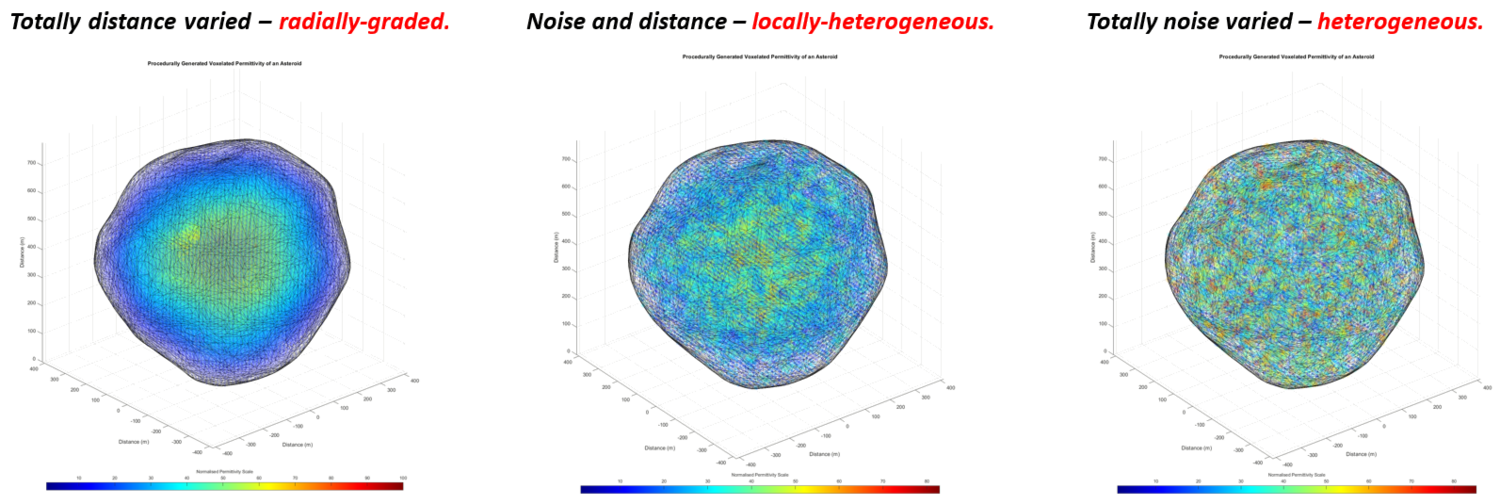
Figure 1 Bespoke asteroid generation tool outputs, with representative extreme ends and a middle value output.
Reconstruction of the attenuation field is performed using five established paradigms under matched inputs, with the addition of early results from a ML model. Simple back-projection (SBP) smears measurement residuals directly into the volume, offering a rapid yet low-fidelity baseline. Filtered back-projection (FBP) applies a band-limited filter in the frequency domain before back-projection, attenuating low-frequency blur at the cost of ringing artefacts around sharp interfaces. Algebraic Reconstruction Technique (ART) iteratively projects individual residuals along each ray in sequence, achieving fast initial updates but leaving streak artefacts that can obscure finer structures. Simultaneous Iterative Reconstruction Technique (SIRT) aggregates corrections from all rays at each cycle, smoothing these artefacts yet demanding more iterations to converge. Bayesian Maximum A Posteriori (B-MAP) estimation enhances the forward model with discrete 7-stencil Laplacian regularisation to penalise local curvature and enforce smoothness, thereby stabilising the inversion by minimising second-order differences between neighbouring voxels, improving noise resilience while preserving broad permittivity gradients.
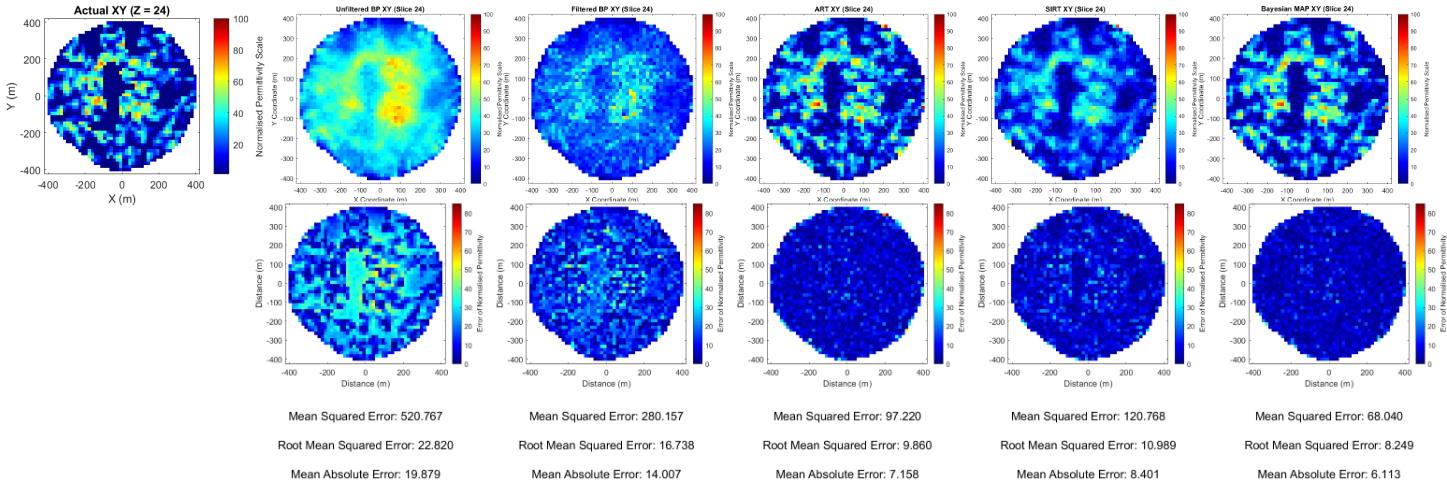
Figure 2 Top, left to right: Generated true field followed by SBP, FBP, ART, SIRT, and B-MAP reconstructions. Bottom, left to right: voxelised errors for SBP, FBP, ART, SRT, and B-MAP reconstructions.
Figure 2 juxtaposes the ground-truth permittivity distribution with reconstructions obtained by SBP, FBP, ART, SIRT and B-MAP, alongside voxel-wise error maps quantifying local deviations. Back-projection methods prove ineffective for small-body tomography: FBP’s frequency-domain filtering removes desired permittivity contrasts, while SBP suffers from 1/r blurring and over-contrasting. ART accurately captures the broad outline of void regions and consistently delivers high-quality reconstructions, with only minor streak artefacts. SIRT reduces those artefacts at the expense of blending the field, thereby diminishing accuracy. Bayesian MAP delivers the sharpest delineation of interfaces and the most uniform error distribution under noisy conditions, but only once the number of nodes approaches roughly ten times the single-dimension voxel count. For instance, a interior achieves high-quality reconstructions from an untuned B-MAP using 500 nodes. As path density increases, all methods converge towards the true field, yet their relative performance remains unchanged: analytical approaches plateau in accuracy, algebraic solvers differ in artefact profiles, and the Bayesian method maintains superior boundary clarity and noise resilience. Early ML algorithms demonstrate promise, provided sufficiently varied training datasets.
The outcomes of this study furnish mission planners with quantitative guidance for selecting inversion methods across diverse operational scenarios. For rapid, resource-constrained surveys, ART delivers the most favourable trade-off between speed, simplicity and reconstruction quality. When measurement density is high enough (on the order of ten times the one-dimensional voxel count), Bayesian MAP becomes the method of choice, offering superior boundary delineation and robustness to noise via its 7-stencil Laplacian regularisation. SIRT, which tends to blur true permittivity variations, is not recommended for detailed small-body mapping. Early ML reconstructions show promise in underdetermined regimes, but their quantitative performance awaits completion of network training on substantially larger, more varied datasets. Identical simulation datasets have been prepared for future ML development, and detailed ML results will be reported once training converges.
By integrating high-resolution asteroid meshes, Perlin-noise heterogeneity models, variable measurement-density simulations and a suite of analytical, algebraic and statistical inversion techniques, this work establishes a comprehensive framework for evaluating radio-frequency tomographic imaging methods on kilometre-scale bodies. Mapping performance envelopes across discretisation resolutions, measurement densities and interior contrasts provides precise algorithm-selection criteria for forthcoming small-body missions. As we explore hybrid schemes that combine Laplacian regularisation with data-driven models and refine our ML architectures, this framework will underpin autonomous, high-resolution subsurface imaging capable of revealing the hidden structure of kilometre-scale asteroids.
ACKNOWLEDGEMENTS
William Hickmott is supported by the Ashworth Electrical Engineering Studentship, University of Liverpool
Stefania Soldini was supported by the Medical Research Council UKRI-FLF grant number MR/W009498/1
REFERENCES
[1] Y. Barbin et al., ‘The CONSERT instrument for the ROSETTA mission’, Advances in Space Research, vol. 24, no. 9, pp. 1115–1126, Jan. 1999, doi: 10.1016/S0273-1177(99)80205-1.
[2] A. Herique, D. Plettemeier, and W. Kofman, ‘Radar Tomography of Asteroid Deep Interior - JuRa / HERA to Didymos and Ra proposed to APOPHIS’. Accessed: Apr. 03, 2025. [Online]. Available: https://meetingorganizer.copernicus.org/EPSC2024/EPSC2024-753.html
[3] JHUAPL, ‘Small Body Mapping Tool’, Small Body Mapping Tool. Accessed: May 06, 2025. [Online]. Available: https://sbmt.jhuapl.edu/
How to cite: Hickmott, W., Hoettges, K., and Soldini, S.: Comparative Evaluation of Inversion Methods for In-Situ RF Tomography of Kilometre-Scale Asteroids, EPSC-DPS Joint Meeting 2025, Helsinki, Finland, 7–12 Sep 2025, EPSC-DPS2025-831, https://doi.org/10.5194/epsc-dps2025-831, 2025.


