
- 1Escuela Internacional de Posgrado, Universidad De Granada, Granada, Spain (luisafz@correo.ugr.es)
- 2Florida Space Institute, University of Central Florida, Orlando, FL, USA ( luisa.zambranomarin@ucf.edu)
Space Rocks, such as asteroids and comets, constitute primordial remnants of the formation of our Solar System. During the last decades these objects have become increasingly available to study, particularly those that enter near-Earth space, due to the advancement of detection and follow-up techniques. With the discovery and cataloging of most Potentially Hazardous Objects (PHO), our ability to anticipate possible impacts has significantly improved.
Impact cratering is an ubiquitous process in the solar system, and Earth is not exempt from this phenomena. However, detection alone is not enough: without accurate orbit prediction and knowledge of an object's physical properties, we cannot develop effective deflection strategies.
In this context, the physical and dynamical characterization of near-Earth objects (NEO) has grown into a rapidly advancing field—evolving from purely cosmological interest to a cornerstone of planetary defense.
For over five decades the Arecibo Observatory in Puerto Rico, served as a key facility for these studies, via its planetary radar system instrumentation. Even with the closure of the facilities, the data endures, and are available to the scientific community and continue to be of great scientific value. This work includes an effort to catalog all the objects detected at the Arecibo Observatory with its Planetary Radar System, which includes over 800 NEAs. As well as the use of some of these observations to enhance our knowledge of physical characteristics of these objects.
The thesis is presented as a compilation of peer reviewed articles pertaining to the physical and dynamical characterization of a subset of NEAs observed with the AO Planetary Radar System.
The first article: “Radar and Optical Characterization of Near-Earth Asteroid
2019~OK”,~demonstrates the adaptability in observation scheduling and the impressive precision of the radar technique. With just a few minutes of data, the reported astrometry secured its orbit for the next two centuries. This object was found to be a very fast rotator, having a rotation period of 3-5 minutes.
The next publication: “The Fastest Rotators: Near-Earth Asteroids Observed with the Arecibo Planetary Radar System", studies a subset of NEAs with rotation periods less than 10~minutes. In this work we compare optical and radar derived parameters, and find, in general, both methodologies to be in good agreement.
The last publication included is: “2020 BX12-The Last Binary Asteroid Discovered at Arecibo", which presents the analysis and shape modeling of this PHA. A rotation period typical of the population, close to the spin barrier, is found for the primary. Data acquired during the 2024 apparition using the Gran Telescopio Canarias (10.4~m) provided a spectrum which is in agreement with the expected taxonomy based on the radar derived circular polarization.
This research integrates radar and optical data (Figure 1) from selected NEAs to contribute to our understanding of their physical and dynamical properties. By combining both optical and radar data sets, we can cross-validate and refine our findings. Understanding their composition is essential for developing potential planetary defense strategies, should they be needed in the future.
Beyond enhancing our knowledge of rapidly rotating asteroids and binary systems, this study preserves a detailed record of all observations made by the Arecibo Planetary Radar system. This catalog offers the scientific community a unique opportunity to explore and make use of the previously under-explored Arecibo data archive, unlocking new possibilities for future discoveries.
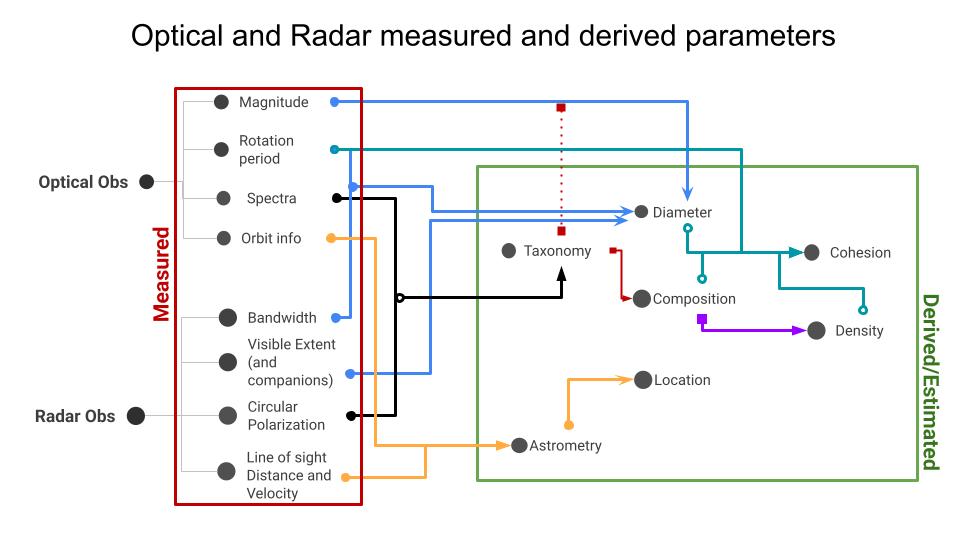
Figure 1. Comparison of Measured values (Red box) for specific physical and dynamical parameters of NEA’s obtained via optical and radar observations and relationships with derived/estimated parameters (green box). Colored lines to mark parameters relationship. Arrow end direct to calculated values, open circles are derived. Solid black circles are physical or dynamical parameters.
How to cite: Zambrano Marin, L. F.: Constraining physical characteristics of near-Earth Asteroids using Arecibo legacy radar data and optical observations, EPSC-DPS Joint Meeting 2025, Helsinki, Finland, 7–12 Sep 2025, EPSC-DPS2025-845, https://doi.org/10.5194/epsc-dps2025-845, 2025.


