
 1,2,1,2,4,1,2,2,
- 1Lowell Observatory, Flagstaff AZ, United States of America
- 2Northern Arizona University, Flagstaff AZ, United States of America
- 3SETI Institute, Mountain View CA, United States of America
- 4Planetary Science Institute, Tucson AZ, United States of America
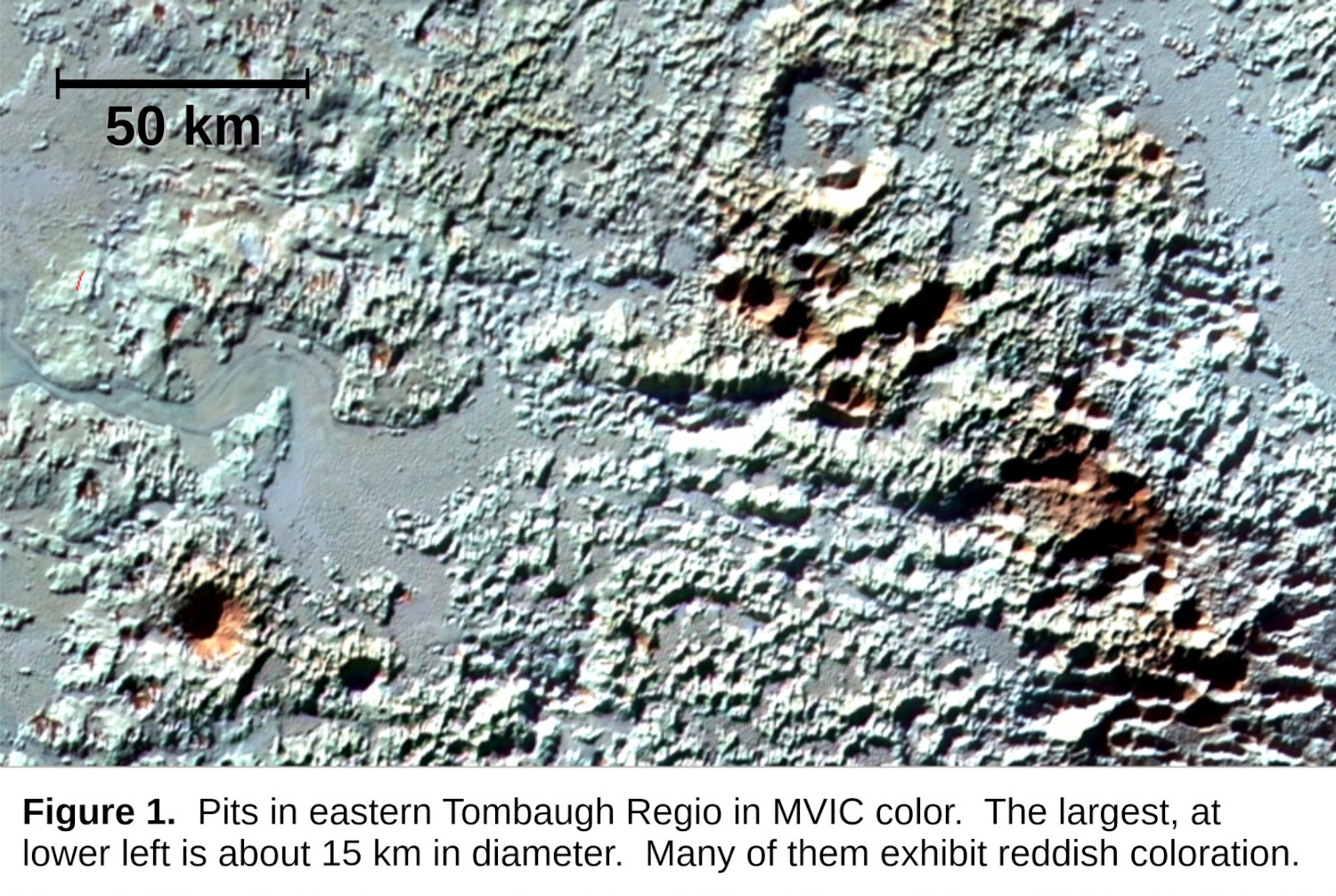
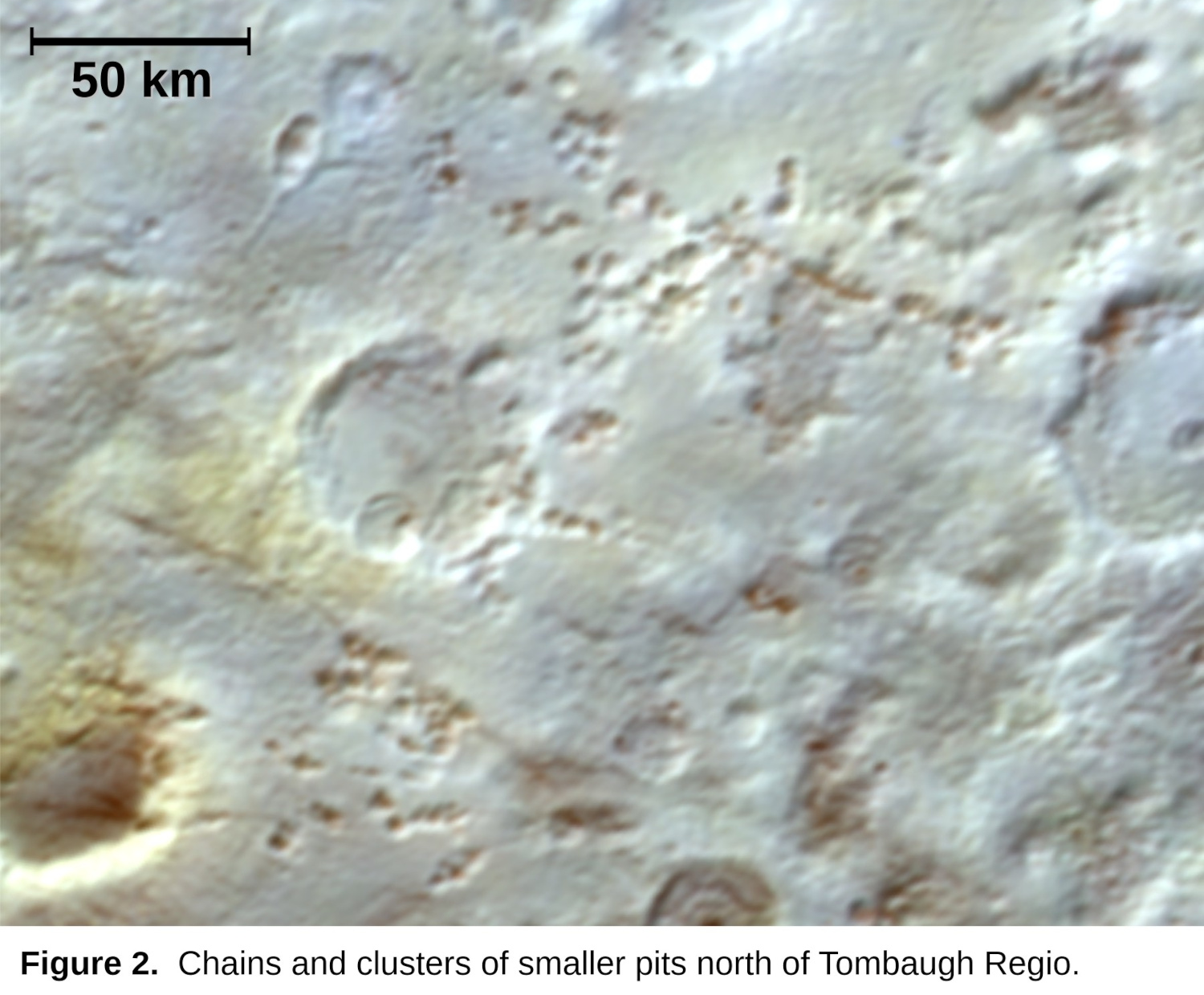
We hypothesize that Pluto’s volatiles (N2, CO, and CH4) could be involved in the formation of enigmatic pits seen in New Horizons images of eastern Tombaugh Regio. These pits exhibit a variety of morphologies, potentially pointing to more than one formation mechanism or to regional differences in subsurface composition or structure. Larger, well-separated pits reach up to ~15 km diameter. Smaller pits occur in chains and clusters. Interior profiles vary from conical to more rounded or flat-floored, and a few have raised rims. We will present several hypotheses for the formation of these features involving Pluto’s volatiles. The first involves sublimation or melting loss of subsurface volatile ices, producing voids that lead to collapse and pit formation. The second involves heating of subsurface volatiles, leading to build up of pressure and eruptive excavation of material. The third also involves eruptions, but of volatiles expelled during cooling and freezing of a mixed volatile liquid. We will discuss the physics and thermodynamics of these scenarios and consider how they fit with morphological and compositional evidence from New Horizons data.
Acknowledgment: This work was partly supported by NASA SSW grants 80NSSC19K0556 and 80NSSC25K7114.
How to cite: Grundy, W., Umurhan, O., Raposa, S., Engle, A., Tan, S., Steckloff, J., Tegler, S., Lindberg, G., Hanley, J., Thieberger, C., and Knudsen, I.: Role of Subsurface Volatiles in the Formation of Pluto's Pits, EPSC-DPS Joint Meeting 2025, Helsinki, Finland, 7–12 Sep 2025, EPSC-DPS2025-862, https://doi.org/10.5194/epsc-dps2025-862, 2025.


