
 1,2
1,2- 1Centro de Astrobiología CSIC-INTA, Carretera de Ajalvir km4, 28850 Torrejón de Ardoz, Spain (iherreros@cab.inta-csic.es)
- 2Departamento de Ingeniería Térmica y Fluidos, Universidad Carlos III de Madrid, 28911 Leganés, Spain
- 3Deceased
Non-equilibrium thermodynamics provides fundamental principles for understanding dissipative systems, from fluid dynamics to biological processes. The General Evolution Criterion (GEC), formulated by Glansdorff and Prigogine [1], establishes an inequality governing the evolution of thermodynamic forces in macroscopic systems. However, this criterion is limited to cases where boundary conditions remain fixed in time. Many real-world systems, particularly in biological and geophysical contexts, operate under time-dependent boundary conditions, necessitating a more comprehensive theoretical framework.
In this work, we present an Extended General Evolution Criterion (EGEC) [2] to account for the thermodynamic and mechanical evolution of convective viscous flows subjected to time-dependent boundaries. The resulting inequality incorporates both bulk volume and surface contributions, showing that the evolution of the system is conditioned not only by internal thermodynamic forces but also by the dynamics imposed at its boundaries. Using both analytical and numerical approaches [3], we validate the EGEC. The starting flow problem in cylindrical pipes serves as an analytical benchmark, demonstrating that entropy production evolves differently when boundary conditions vary in time. Further, numerical simulations in non-fully developed flows within helical pipes [4] reveal the interplay between external mechanical constraints and the internal thermodynamic forces driving the system’s relaxation to a non-equilibrium steady state (Figure 1).
The implications of this EGEC extend beyond fluid dynamics. In biological systems, cells and tissues function as open thermodynamic structures, exchanging matter and energy with their surroundings. The evolution of these systems is dictated not only by internal metabolic and transport processes but also by the constraints imposed by their boundaries, such as membranes, interfaces, or extracellular conditions. Our results suggest that understanding how time-dependent boundaries influence dissipation and entropy production could provide new insights into self-organization, homeostasis, and the emergence of order in living systems.
This study highlights the fundamental role of boundary conditions in shaping the evolution of dissipative processes, with applications in physics, engineering, and biology. By incorporating time-dependent constraints into the thermodynamic evolution criterion, we offer a more general perspective on how systems transition toward steady states, paving the way for a deeper understanding of non-equilibrium processes across disciplines.
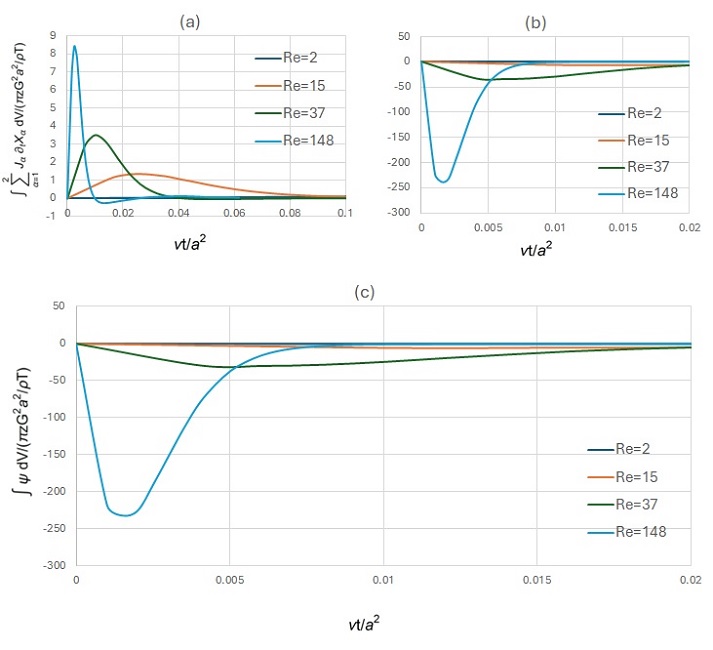
Figure 1. Entropy production within a helical flow subjected to time-dependent boundary conditions for different Reynolds numbers (Re): (a) Positive contribution from the interior volume; (b) Negative contribution from the surface boundary; (c) Total negative contribution, including both the interior volume and the boundary.
Acknowledgments
This research has been funded by grant No. PID2020-116846GB-C22 by the Spanish Ministry of Science and Innovation/State Agency of Research MCIN/AEI/10.13039/501100011033 and by ”ERDF A way of making Europe”. I.H. expresses her gratitude for these years of scientific collaboration with the late D.H., who is mourned by family, friends, and colleagues.
References
[1] P. Glansdorff and I. Prigogine, On a General Evolution Criterion in Macroscopic Physics, Physica 30, 351–374 (1964).
[2] D. Hochberg, I. Herreros, Extended thermodynamic and mechanical evolution criterion for fluids, Communications in Nonlinear Science and Numerical Simulation, 146: 108775 (2025); https://doi.org/10.1016/j.cnsns.2025.108775
[3] M.I. Herreros, S. Ligüérzana, Rigid body motion in viscous flows using the finite element method, Physics of Fluids 32, 123311 (2020); https://doi.org/10.1063/5.0029242
[4] I. Herreros, D. Hochberg, Chiral Symmetry Breaking and Entropy Production in Dean Vortices, Physics of Fluids 35, 043614 (2023); https://doi.org/10.1063/5.0142665
How to cite: Herreros, I. and Hochberg, D.: The Thermodynamics of Life: The Role of Boundaries in Non-Equilibrium Evolution, EPSC-DPS Joint Meeting 2025, Helsinki, Finland, 7–12 Sep 2025, EPSC-DPS2025-925, https://doi.org/10.5194/epsc-dps2025-925, 2025.


