EXOA10 | The emergence of Life in our Solar System and Beyond

EXOA10

The emergence of Life in our Solar System and Beyond
Convener: Rosanna del Gaudio
Orals TUE-OB2
| Tue, 09 Sep, 09:30–10:30 (EEST)
 
Room Earth (Veranda 2)
Posters TUE-POS
| Attendance Tue, 09 Sep, 18:00–19:30 (EEST) | Display Tue, 09 Sep, 08:30–19:30
 
Finlandia Hall foyer, F221–222
Tue, 09:30
Tue, 18:00
This session seeks papers on the biological, physicochemical, astrophysical, and paleontological studies of the living-matter origination problem, conditions necessary and sufficient for living-matter origination and development, mechanisms of living-matter origination on the Earth and other celestial objects, promising celestial objects for the living-matter occurrence, and other experimental, theoretical, and observational works related to the emergence and development of Life in our Solar System and beyond are welcomed.
This includes work related to theme of the Origins of Life to study interstellar chemistry, meteorites and comets chemistry as well as the chemistry of planets.

Session assets

Orals: Tue, 9 Sep, 09:30–10:30 | Room Earth (Veranda 2)

Chairperson: Rosanna del Gaudio
09:30–09:42
|
EPSC-DPS2025-616
|
ECP
|
On-site presentation
Manuel Scherf, Tereza Constantinou, Paul Rimmer, Peter Woitke, Helmut Lammer, Martin Ferus, Fabian Weichbold, Petr Eminger, Kateřina Němečková, Jaroslav Kačina, and Giuseppe Cassone

Formaldehyde (CH2O) is an important building block in forming prebiotic molecules, including sugars via the formose reaction. It is therefore regarded as a crucial precursor for the origin of life on early Earth. For this, however, it must have either been delivered via comets and meteorites or formed directly in Earth’s early atmosphere via photochemical synthesis, such as the radical-radical reaction of two HCO molecules (e.g., Koyama et al. 2024). In their seminal paper, Pinto et al. (1980) were the first to simulate the photochemical production of formaldehyde in Earth’s primitive atmosphere, which they assumed to mostly contain N2 with minor abundances of CO2, H2O, H2, and CO. Their chemical network resulted in a substantial photochemical production of CH2O of up to 1011 mol/year, indicating that photochemically produced formaldehyde could have indeed been an important building block for prebiotic chemistry on early Earth. By assuming the same boundary conditions (i.e., atmospheric composition, solar flux, eddy diffusion coefficient, etc.), we can reproduce the results by Pinto et al. (1980) with the photochemical atmosphere model ARGO and its chemical network STAND (e.g., Rimmer et al. 2021). By simulating early Earth’s atmosphere with a more realistic composition based on recent geophysical and aeronomical results, and by implementing the flux of the early Sun, we even obtain higher formaldehyde production rates as found by Pinto et al. (1980), supporting photochemistry as an important source for formaldehyde at the time of life’s origin. In addition, we also investigate the rainout of formaldehyde in Earth’s early atmosphere, a process that could have led to elevated concentrations of CH2O in early Earth's oceans or in mildly alkaline pools on early volcanic islands – a potential location for the origin of life. We further investigate whether the rainout of formaldehyde has been sufficient to trigger the formose reaction in different settings on early Earth.

References:

  • Koyama, S., Kamada, A., Furukawa, Y. Terada, N. Nakamura, Y. et al., Atmospheric formaldehyde production on early Mars leading to a potential formation of bio‑important molecules, 2024, Scientific Reports, 14, 2397.
  • Pinto JP, Gladstone GR, Yung YL, 1980, Photochemical Production of Formaldehyde in Earth’s primitive Atmosphere, Science 210, 4466, 183-185.
  • Rimmer P, Jordan S, Constantinou T, Woitke P, Shorttle O, Hobbs R, Paschodimas A, 2021, Hydroxide Salts in the Clouds of Venus: Their Effect on the Sulfur Cycle and Cloud Droplet pH, PSJ, 2, 4, id133.in

How to cite: Scherf, M., Constantinou, T., Rimmer, P., Woitke, P., Lammer, H., Ferus, M., Weichbold, F., Eminger, P., Němečková, K., Kačina, J., and Cassone, G.: Photochemical Production of Formaldehyde in Early Earth's Atmosphere as a Precursor for Prebiotic Chemistry, EPSC-DPS Joint Meeting 2025, Helsinki, Finland, 7–13 Sep 2025, EPSC-DPS2025-616, https://doi.org/10.5194/epsc-dps2025-616, 2025.

09:42–09:54
|
EPSC-DPS2025-1308
|
Virtual presentation
First characterization of anti-recrystallization effect on high pressure ice, implications for habitability in icy worlds
(withdrawn)
Christopher Woodburn, Joseph Pasterski, Marshall Seaton, Chaman Gupta, Zhaojie Feng, Tobias Weidner, Li Xiang, Bryana Henderson, Peter Pauzauskie, Melissa Trainer, Morgan Cable, and Baptiste Journaux
09:54–10:06
|
EPSC-DPS2025-1776
|
ECP
|
On-site presentation
Sai Shruthi Murali and Paul Rimmer

Understanding the origin of life on early Earth is challenging, as it requires work across several different disciplines like astrophysics, astrobiology, chemistry, geology etc.[1]Despite these complexities, the research in this field is progressing steadily. Several chemical pathways have been proposed to understand the formation of biologically significant molecules on early Earth, with lessons for the exploration of life’s origins on other rocky planets. One promising scenario for the synthesis of many of life’s building blocks is the cyanosulfidic scenario, where the major building blocks of life  –  lipids, sugars and nucleotides – can be synthesised using hydrogen cyanide (HCN) and cyanoacetylene (HC3N).[2]However, research has just begun to discover the feasibility of these reactions under prebiotic conditions and the physical factors influencing their efficiency in a planetary context

     In this presentation, I will show empirical constraints of the stability of HCN and HC3N. My results constrain the prebiotic environment in which the prebiotic synthesis of amino acids, nucleotides and phospholipids could have occurred. I measure the hydrolysis of cyanide at different temperature, pH and in the presence of salts like sulphate, sulfite, sulfide and phosphate, and provide a degradation rate for this in wide range of conditions. I find that the hydrolysis rates are significantly influenced by pH and temperature with variations observed depending on the nature of salts. Phosphate and sulphate do not measurably affect the degradation rate of cyanide. The lifetime of HCN in the presence of sulfide is 10x shorter due to the formation of products like thioformamide and thioformate in addition of formate. I also show how the presence of sulfite affects the lifetime of cyanide.

Finally, I observe the hydrolysis of cyanoacetylene at different temperature and pH. My preliminary results show that the lifetime of HC3N is 100x shorter in alkaline solution than the neutral solution at 30°C, consistent with literature values.[6] I will present the first-ever measurements of cyanoacetylene lifetimes as a function of both pH and temperature. These observations provide new insights into the effect of physical parameters on cyanide and cyanoacetylene stability, providing firm constraints for environments where prebiotic chemistry involving cyanide and cyanoacetylene can take place.

Fig 1: Hydrolysis of HCN at 80 °C, pH-8 to form formate ion (a) Quantitative 1H NMR showing the increase in the concentration of formate ion with time and (b) Kinetics of formation of formate ion fitted to a kinetic model to estimate the rate of formation of formate ion.

References:

1. Sutherland, J.D., The Origin of Life—Out of the Blue. Angewandte Chemie International Edition, 2016. 55(1): p. 104-121.

2. Patel, B.H., et al., Common origins of RNA, protein and lipid precursors in a cyanosulfidic protometabolism. Nat Chem, 2015. 7(4): p. 301-7.

3. Miyakawa, S., H. James Cleaves, and S.L. Miller, The Cold Origin of Life: A. Implications Based On The Hydrolytic Stabilities Of Hydrogen Cyanide And Formamide. Origins of life and evolution of the biosphere, 2002. 32(3): p. 195-208.

4. Todd, Z.R., N.F. Wogan, and D.C. Catling, Favorable Environments for the Formation of Ferrocyanide, a Potentially Critical Reagent for Origins of Life. ACS Earth and Space Chemistry, 2024. 8(2): p. 221-229.

5. White, S.B., P.B. Rimmer, and Z. Liu, Shedding Light on the Kinetics of the Carboxysulfitic Scenario. ACS Earth and Space Chemistry, 2024. 8(11): p. 2133-2144.

6. Ferris, J.P., R.A. Sanchez, and L.E. Orgel, Studies in prebiotic synthesis. 3. Synthesis of pyrimidines from cyanoacetylene and cyanate. J Mol Biol, 1968. 33(3): p. 693-704.


How to cite: Murali, S. S. and Rimmer, P.: The stability of hydrogen cyanide and cyanoacetylene under a wide range of planetary conditions, EPSC-DPS Joint Meeting 2025, Helsinki, Finland, 7–13 Sep 2025, EPSC-DPS2025-1776, https://doi.org/10.5194/epsc-dps2025-1776, 2025.

10:06–10:18
|
EPSC-DPS2025-2025
|
ECP
|
On-site presentation
Lise Boitard-Crépeau, Cecilia Ceccarelli, Piero Ugliengo, Pierre Beck, and Lionel Vacher

The source of Earth’s water —whether endogenous or delivered— is a key unresolved problem in our planet formation. There is consensus on the fact that water was mostly formed on micrometer-sized dust grains at the very beginning of the Solar System formation, in the molecular cloud and prestellar phase, where it remained frozen on the icy mantles enveloping the grains [e.g. 1]. With time, in the so-called Proto Solar Nebula (PSN: the protoplanetary disk of the Solar System), these grains coagulated and grew, forming planets, asteroids and comets. However, when the disk temperature increased with the formation of the Sun, water sublimated from the grain surfaces inwards the so-called snowline, depleting the inner disk of volatiles, including water, not trapped in larger bodies. Thus, standard Solar System formation models suggested that Earth accreted from the dry inner-disk material, questioning the origin of its water content [e.g. 2, 3].
The classical approach of the snowline based on a single condensation temperature of water has long been invoked to address this problem. However, the sublimation of a frozen molecule critically depends on the adsorption strength (in jargon called binding energy or BE) of the molecule onto the grain surface, and this value is not unique as it depends on the different orientation of the molecule on the several absorbing sites of the surface. Relevant to the water snowline, recent theoretical quantum chemical calculations have shown that the water BE on a icy surface has a gaussian distribution, with a non-negligible contribution of BE values larger than that usually adopted in PSN models [4].
In this work, we apply, for the first time, this water BE distribution to a simplified PSN thermal structure model. We show that the BE distribution implies a gradual, temperature-dependent desorption across the PSN disk— a diffuse snowline — rather than a sharp transition. Our model successfully reproduces the highest and lowest estimates of the Earth’s water content [5] and matches the water content trends observed across chondrite groups at their expected formation locations [e.g., 6]. These results suggest that a significant fraction of Earth’s water could have originated locally, without requiring delivery from beyond the classical snowline.
References
1. Ceccarelli, C. & Du, F. We Drink Good 4.5-Billion-Year-Old Water. Elements 18, 155–160. issn: 1811-5217, 1811-5209 (June 2022).
2. Morbidelli, A. et al. Source Regions and Timescales for the Delivery of Water to the Earth. Meteoritics & Planetary Science 35, 1309–1320. issn: 1086-9379, 1945-5100. https://onlinelibrary.wiley.com/doi/10. 1111/j.1945-5100.2000.tb01518.x (Nov. 2000).
3. Morbidelli, A., Lunine, J., O’Brien, D., Raymond, S. & Walsh, K. Building Terrestrial Planets. Annual Review of Earth and Planetary Sciences 40, 251–275. issn: 0084-6597, 1545-4495 (May 2012).
4. Tinacci, L. et al. Theoretical Water Binding Energy Distribution and Snowline in Protoplanetary Disks. The Astrophysical Journal 951, 32. issn: 0004-637X, 1538-4357. https://iopscience.iop.org/article/10. 3847/1538-4357/accae8 (July 1, 2023).
5. Peslier, A. H., Sch ̈onb ̈achler, M., Busemann, H. & Karato, S.-I. Water in the Earth’s Interior: Distribution and Origin. Space Science Reviews 212, 743–810. issn: 0038-6308, 1572-9672 (Oct. 2017).
6. McCubbin, F. M. & Barnes, J. J. Origin and Abundances of H2O in the Terrestrial Planets, Moon, and Asteroids. Earth and Planetary Science Letters 526, 115771. issn: 0012821X (Nov. 2019).

How to cite: Boitard-Crépeau, L., Ceccarelli, C., Ugliengo, P., Beck, P., and Vacher, L.: Was water on Earth acquired locally ? A Diffuse Snowline Model from Computational Chemistry, EPSC-DPS Joint Meeting 2025, Helsinki, Finland, 7–13 Sep 2025, EPSC-DPS2025-2025, https://doi.org/10.5194/epsc-dps2025-2025, 2025.

10:18–10:30
|
EPSC-DPS2025-2100
|
ECP
|
Virtual presentation
Rosie Wilson, Inès Torres, Emilie Bessette, Blandine Gorce, Thomas Theben, Alexander Rützler, Léon Schiltz, Uma Cladellas, Ysé de Reydet de Vulpillieres, Elena Maria Campanaro, Christian Jenewein, and Juan-Manuel García-Ruiz

Introduction:

The LEOrigin payload is an initiative led by young professionals at the European Space Agency. LEOrigin is a pioneering astrobiology experiment investigating how space radiations may trigger the formation of life’s building blocks. The payload is designed for launch in mid-2027 aboard Space Rider, which will remain in Low Earth Orbit (LEO) for two months and features an exposure facility.

The experiment focuses on the conversion of formamide [1] – a simple, one-carbon molecule found throughout the Universe (interstellar medium, comets, and protoplanetary disks) – triggered by energetic UV and cosmic radiations catalyzed by asteroid-, meteorite- and comet-like minerals, in space environment conditions, see (Fig. 1).

Inspired by the groundbreaking Miller-Urey experiment [2], which demonstrates the synthesis of organic compounds under early Earth-like conditions, and the discovery that silica played a major role in these reactions [3], LEOrigin builds on these findings by testing how formamide condensation catalyzed by silicate minerals common in asteroids and comets, can lead to the formation of nucleobases and other life-relevant compounds.

Recent discoveries highlight the importance of studying these processes: the OSIRIS-REx mission detected amino acids (including 14 of the 20 used in terrestrial biology) and all five RNA/DNA nucleobases on asteroid Bennu [4], while the Hayabusa-2 mission found the uracil nucleobase on asteroid Ryugu [5]. These findings suggest that life’s precursors may have formed on multiple bodies in the early solar system (including Earth) and that asteroids could have also delivered additional complex molecules to our planet.

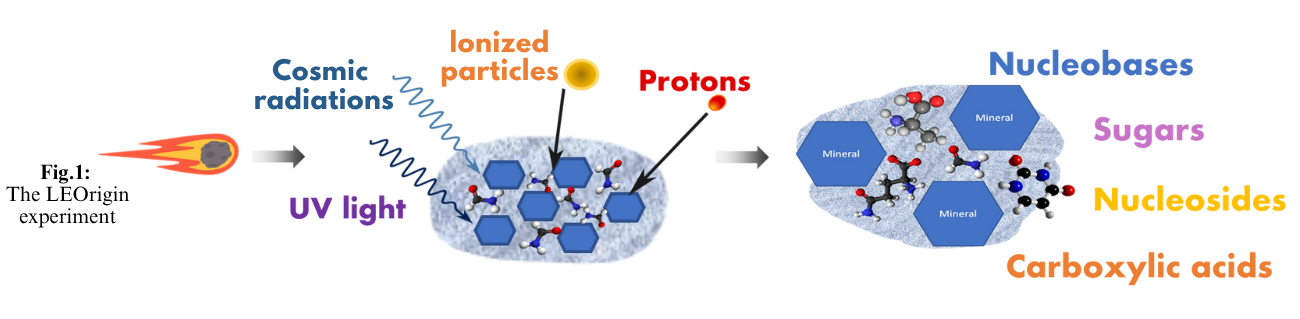
Formamide: Reactive to UV Light and Cosmic Radiations.

Previous research has demonstrated that formamide condensation, when catalyzed by silica-rich [1] or photocatalytic semiconductive minerals [6], can produce a wide panel of organic molecules crucial for genetic and metabolic processes. Condensation occurs when the reaction’s activation energy is reached, either through thermal heating or exposure to high-energy irradiation (protons, UV).

This has been confirmed through various laboratory experiments, where UV-lamps [6] and proton irradiation [7] were used to mimic space-like conditions, providing valuable insights into the prebiotic chemistry of formamide. LEOrigin will, for the first time, recreate these experiments in orbit, utilizing the high energy radiation in space.

Choice of Catalytic Mineral Samples:

LEOrigin will carry a set of four minerals, selected to be representative of asteroids, comets, and Martian soil & meteorites, as well as to replicate ground-based experiments:

  • Titanium dioxide (TiO2): a photocatalytic semiconductive mineral, selected based on the successful ground-based UV exposure experiment by Senanayake et al. [6].
  • Olivine: a silicate mineral abundant in carbonaceous asteroids and the dominant mineral in most chondritic meteorites [8]. Crystalline and amorphous olivine was also observed in the dust around comet 9B-Tempel 1 [9].
  • Smectite (Saponite/Nontronite): Fe/Mg-smectite is the most abundant phyllosilicate identified on the surface of Mars [10] almost always found in ancient rocks ~4 Gy old, suggesting that this mineral may have formed early in the life of the Solar System. Smectites were also detected in achondrite Martian meteorites (e.g., saponite in Nakhla [11]), they are present in some chondrite meteorites (e.g., smectites in Ivuna and Orgueil were found intimately mixed with a carbon-rich matrix attributed to pre-terrestrial acqueous alteration [12]), and is also the most common clay mineral in comets when detected (e.g., nontronite in comet 9B-Tempel 1 [13]).
  • Vermiculite (Oxia Planum analog): Vermiculite is a Fe2+/Mg-rich phyllosilicate, which constitutes the main spectral signature found at the ~ 4 Gy old clay-bearing Oxia Planum landing site for the ExoMars Rover mission [14]. Assessing the role of this mineral as a catalyst in the formation of prebiotic molecules would thus create synergies and contribute to the objectives of the ESA astrobiology rover mission.


Payload Design and Configuration:

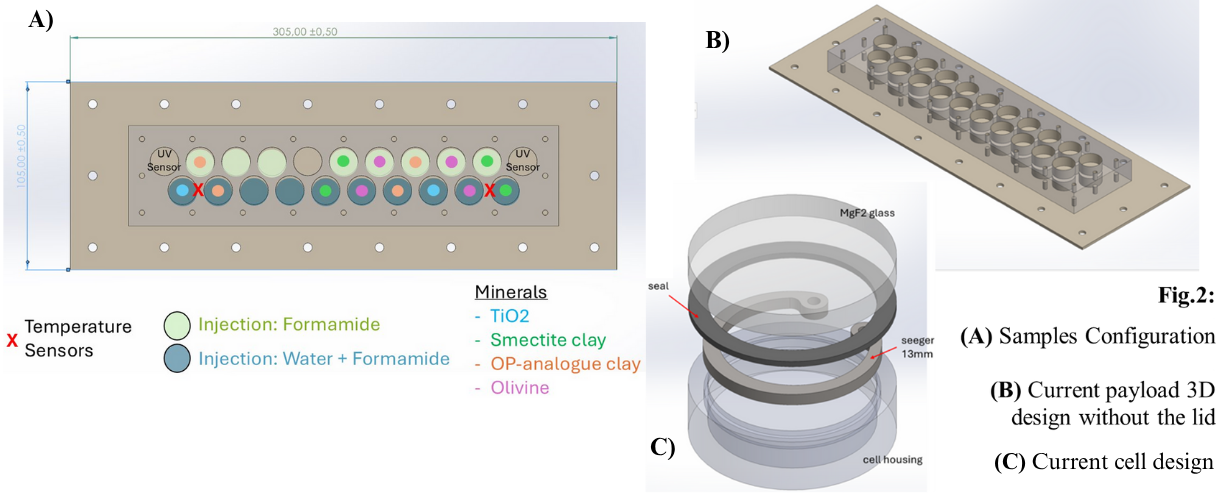
The payload is composed of 42 cells (Fig. 2 A&B) divided into two superimposed stacks. Each stack consists of 14 pelletized minerals injected with formamide or formamide+water; 4 control cells containing only formamide or formamide+water; and 3 cell spots for UV and thermal sensors. The top stack will be exposed to UV light while the second will serve as dark control. The cell windows are made from MgF2, which is transparent to UV light and the cell housing is chosen such that no interference with the formamide condensation is expected (Fig. 2C). Top cells will be exposed to solar and cosmic radiations when Space Rider Cargo Bay doors open.

References: [1] Saladino, R. et al. Phys Life Rev 9, 84–104 (2012). [2] Miller, S. L. & Urey, H. C. Science (1979) 130, 245–251 (1959). [3] Criado-Reyes, J. et al. Sci Rep 11, 21009 (2021). [4] McCoy, T. J. et al. Nature 637, 1072–1077 (2025). [5] Oba, Y. et al. Nat Commun 14, 1292 (2023). [6] Senanayake, S. D. et al. Proceedings of the National Academy of Sciences 103, 1194–1198 (2006). [7] Saladino, R. et al. Proceedings of the National Academy of Sciences 112, (2015). [8] Sunshine, J. M. et al. Meteorit Planet Sci 42, 155–170 (2007). [9] Kelley, M. S. & Wooden, D. H. Planet Space Sci 57, 1133–1145 (2009). [10] Carter, J. et al. J Geophys Res Planets 118, 831–858 (2013). [11] Hicks, L. J. et al. Geochim Cosmochim Acta 136, 194–210 (2014). [12] Morlok, A. et al. Geochim Cosmochim Acta 70, 5371–5394 (2006). [13] Lisse, C. M. et al. Science (1979) 313, 635–640 (2006). [14] Quantin-Nataf, C. et al. Astrobiology 21, 345–366 (2021).


How to cite: Wilson, R., Torres, I., Bessette, E., Gorce, B., Theben, T., Rützler, A., Schiltz, L., Cladellas, U., de Reydet de Vulpillieres, Y., Campanaro, E. M., Jenewein, C., and García-Ruiz, J.-M.: LEOrigin Space Mission – Illuminating Life’s Origins , EPSC-DPS Joint Meeting 2025, Helsinki, Finland, 7–13 Sep 2025, EPSC-DPS2025-2100, https://doi.org/10.5194/epsc-dps2025-2100, 2025.

Posters: Tue, 9 Sep, 18:00–19:30 | Finlandia Hall foyer

Display time: Tue, 9 Sep, 08:30–19:30
Chairpersons: Rosanna del Gaudio, Sohan Jheeta
F221
|
EPSC-DPS2025-203
|
On-site presentation
Rosanna del Gaudio

The origin of life on Earth remains one of the most intriguing questions in science, as well as the definition of life itself, prompting extensive research into the transition from non-living to living matter.

Central to this inquiry is understanding how simple inorganic molecules in the primeval soup evolved into complex organic compounds capable of triggering the emergence and sustaining early life.

The early Earth's environment, rich in a variety of minerals, offered a vibrant, dynamic and active backdrop for prebiotic chemical processes. Among the various catalysts proposed to drive this molecular progression, magnetite (Fe₃O₄) and minerals originating from meteorites have attracted considerable interest due to their potential catalytic properties.

Searching for the very first instants of life on Earth, with several hypotheses in play [1] the challenge has been to replicate the conditions that could have allowed the emergence of early life to emerge. I developed a new approach to stimulate physicochemical processes that may have led to the emergence of the first life forms from inanimate matter on Earth or Earth-like planets via photo-metabolic pathways. My studies does not starts from ground zero, but provide evidence of non-enzymatic catalysis that modifies sugars, aminoacids, urea and other molecules produced in the prebiotic environments on the planets or satellites of our solar system by investigating the effect of physico-chemical stress on the formation of insolubile Micro-Metallorganic-Magnetic-Materials (M4) able to perform non-enzymatic catalytic activities typical of modern life [2]. Their structural complexity, , chemical composition, interactions with some mineral and/or rocks leave open the possibility that these materials might represent a kind of non-conventional form of protometabolic complex chemical system from which the ancestors of the first living cells could have evolved on Earth.

Here, I propose the possibility that M4 materials were an example of biofilm-like entity proposed recently by other authors [3] serving as the starting point where life and non-life molecules interacted within a tight and rigid environment which eventually gave rise to a variety and plurality of progenotes, one of which became LUCA evolving from IDAs. The effects of extreme conditions on the catalytic activities of structures made of M4 material will be presented.

How to cite: del Gaudio, R.: From Non-Living to Living Matter on Early Earth: The Role of Magnetite and Meteorite Components as Prebiotic Catalysts in boosting Molecular Complexity toward the Origin of Life under the presence of Water and light sources., EPSC-DPS Joint Meeting 2025, Helsinki, Finland, 7–13 Sep 2025, EPSC-DPS2025-203, https://doi.org/10.5194/epsc-dps2025-203, 2025.

F222
|
EPSC-DPS2025-925
|
On-site presentation
Isabel Herreros and David Hochberg

Non-equilibrium thermodynamics provides fundamental principles for understanding dissipative systems, from fluid dynamics to biological processes. The General Evolution Criterion (GEC), formulated by Glansdorff and Prigogine [1], establishes an inequality governing the evolution of thermodynamic forces in macroscopic systems. However, this criterion is limited to cases where boundary conditions remain fixed in time. Many real-world systems, particularly in biological and geophysical contexts, operate under time-dependent boundary conditions, necessitating a more comprehensive theoretical framework. 

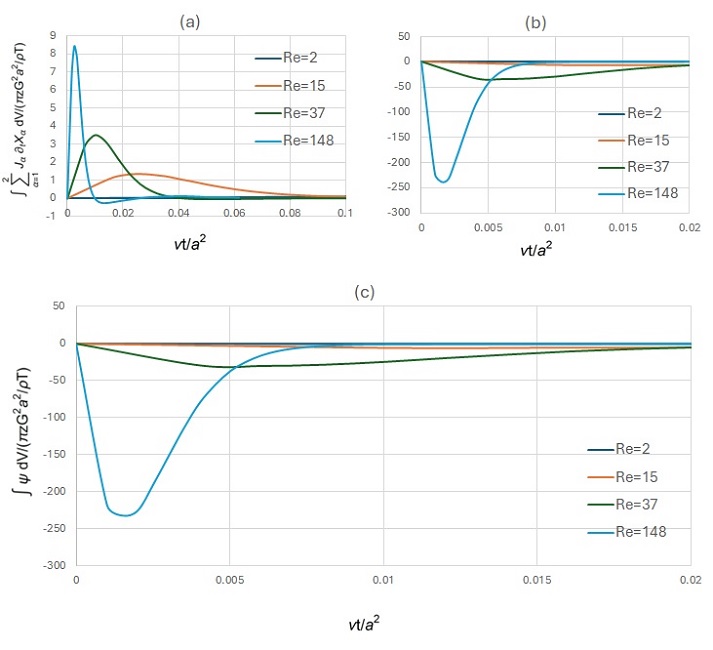
In this work, we present an Extended General Evolution Criterion (EGEC) [2] to account for the thermodynamic and mechanical evolution of convective viscous flows subjected to time-dependent boundaries. The resulting inequality incorporates both bulk volume and surface contributions, showing that the evolution of the system is conditioned not only by internal thermodynamic forces but also by the dynamics imposed at its boundaries. Using both analytical and numerical approaches [3], we validate the EGEC. The starting flow problem in cylindrical pipes serves as an analytical benchmark, demonstrating that entropy production evolves differently when boundary conditions vary in time. Further, numerical simulations in non-fully developed flows within helical pipes [4] reveal the interplay between external mechanical constraints and the internal thermodynamic forces driving the system’s relaxation to a non-equilibrium steady state (Figure 1). 

The implications of this EGEC extend beyond fluid dynamics. In biological systems, cells and tissues function as open thermodynamic structures, exchanging matter and energy with their surroundings. The evolution of these systems is dictated not only by internal metabolic and transport processes but also by the constraints imposed by their boundaries, such as membranes, interfaces, or extracellular conditions. Our results suggest that understanding how time-dependent boundaries influence dissipation and entropy production could provide new insights into self-organization, homeostasis, and the emergence of order in living systems. 

This study highlights the fundamental role of boundary conditions in shaping the evolution of dissipative processes, with applications in physics, engineering, and biology. By incorporating time-dependent constraints into the thermodynamic evolution criterion, we offer a more general perspective on how systems transition toward steady states, paving the way for a deeper understanding of non-equilibrium processes across disciplines. 

Figure 1. Entropy production within a helical flow subjected to time-dependent boundary conditions for different Reynolds numbers (Re): (a) Positive contribution from the interior volume; (b) Negative contribution from the surface boundary; (c) Total negative contribution, including both the interior volume and the boundary.

Acknowledgments

This research has been funded by grant No. PID2020-116846GB-C22 by the Spanish Ministry of Science and Innovation/State Agency of Research MCIN/AEI/10.13039/501100011033 and by ”ERDF A way of making Europe”. I.H. expresses her gratitude for these years of scientific collaboration with the late D.H., who is mourned by family, friends, and colleagues.

References

[1] P. Glansdorff and I. Prigogine, On a General Evolution Criterion in Macroscopic Physics, Physica 30, 351–374 (1964).

[2] D. Hochberg, I. Herreros, Extended thermodynamic and mechanical evolution criterion for fluids, Communications in Nonlinear Science and Numerical Simulation, 146: 108775 (2025); https://doi.org/10.1016/j.cnsns.2025.108775

[3] M.I. Herreros, S. Ligüérzana, Rigid body motion in viscous flows using the finite element method, Physics of Fluids 32, 123311 (2020); https://doi.org/10.1063/5.0029242

[4] I. Herreros, D. Hochberg, Chiral Symmetry Breaking and Entropy Production in Dean Vortices, Physics of Fluids 35, 043614 (2023); https://doi.org/10.1063/5.0142665

How to cite: Herreros, I. and Hochberg, D.: The Thermodynamics of Life: The Role of Boundaries in Non-Equilibrium Evolution, EPSC-DPS Joint Meeting 2025, Helsinki, Finland, 7–13 Sep 2025, EPSC-DPS2025-925, https://doi.org/10.5194/epsc-dps2025-925, 2025.