
 ,,
,,- University of Münster, Institut für Planetologie, Germany (philipp.kost@uni-muenster.de)
Introduction
On 13 April 2029, asteroid (99942) Apophis will fly by Earth with a distance of approximately 38,000 km. Several authors suggest that the gravity field of Earth may lead to surface reshaping, e.g. avalanches [1,2,3]. These would be observed through planned space missions, providing insights into the granular dynamics of small rubble-piles asteroids. A key parameter for the models above is the so-called static angle of repose, which describes the angle of a slope that must be exceeded to start an avalanche [4].
To provide ground truth on the angle of repose under reduced gravity, an experimental setup was designed to determine the static angle of repose in vacuum and under reduced gravity. For this, the “Vacuum Angle of Repose Determination Experiment under Reduced Gravity” (VADER) was based on the concept of a rotating tumbler experiment. In these experiments, a granular material is slowly rotated in the discrete flow regime, which leads to the start of an avalanche, when the static angle of repose is exceeded. As a tumbler we use a volume of 20 mm diameter and 5 mm depth inside a rotating vacuum chamber with a glass blanking flange.
Laboratory Experiments
First successful investigations on the static angle of repose of WF 34 quartz sand were carried out in a laboratory environment under Earth gravity at our laboratory. Two series of laboratory experiments were performed under vacuum and ambient pressure conditions. Both series of experiments were performed at sample chamber rotation speeds between 0.2 and 6.9 rpm. For all vacuum experiments, the pressure after each experiment was always below 0.1hPa.
Results showed the static angle of repose at low tumbler rotation speeds to be similar in vacuum and under ambient pressure, despite the expected influence of humidity [5]. For laboratory experiments in vacuum, we find an angle of repose ϑS = 41.3±1.2° at the lowest rotation speed. For higher rotation speed and increasing duration of an experiment run, it was revealed that electrostatic charging of the sample affected the results. Sand grains were sticking to the glass blanking flange of the tumbler and the angle of repose increased. The experiments were therefore kept short and slow enough to avoid an electrostatic influence.
Drop Tower Experiments
During a first drop tower campaign in September 2024, nine drop experiments with the same tumbler setup were performed at the Bremen Drop Tower of the Center for Applied Space Technology and Microgravity (ZARM). The choice of material and the maximum vacuum gas pressure were identical to the laboratory experiments above. The static angle of repose was determined under different gravitational accelerations g by mounting the tumbler onto a rotating centrifuge to simulate accelerations between 0.10 and 0.31 gE.
After the release of the capsule (change of gravity direction, reorientation of granular sample) the tumbler was rotated at a reasonably high speed for up to 0.5 s. The practical purpose of this was to arrange the sample at an angle close to its angle of repose. After this phase, the tumbler speed was either reduced (procedure P1) or briefly stopped and restarted at a reduced speed (procedure P2) for the remaining time of the experiment. The rotation speed for P1 was small enough to remain in the discrete flow regime. In contrary, the rotation speed in P2 was allowed to be higher, because the intention was only to observe the start of an avalanche from a static state. The latter allowed experiments down to a smaller gravitational acceleration. Due to the short experiment time in the Bremen Drop Tower, there were no signs nor expected influence of electrostatic charging (sticking grains).
Experimental results under varying gravity conditions (g/gE) are shown as red and cyan squares in Fig. 1. Approximating the data with a trend line ϑS = -4.02 x log10(g/gE) + 41.26 (Eq. 1), a slight formal trend of an increased static angle of repose ϑS under reduced gravity was observed. Thus, these experiments expand on similar trends that were observed in other experiments (other data in Fig. 1). Consistent with early experiments [4,6], all experiments with irregular grains show static angles of repose that are larger than assumed in numerical models predicting avalanches on Apophis [1,2,3].
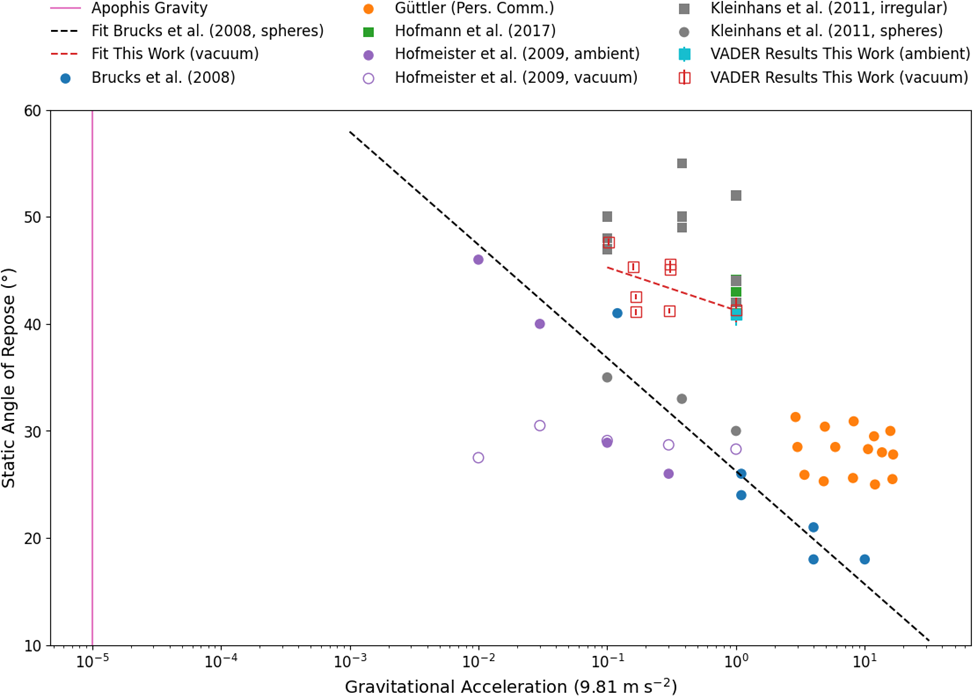
Figure 1: The static angle of repose of experimental data in the literature in comparison to our new data (red and cyan squares).
Perspective
The goal for future investigations lies in the expansion of the number of experiments and therefore datapoints. The current experimental results described above are only of small number and must be increased to get a better extrapolation to Apophis gravity and the 2029 Apophis-Earth encounter. We aim to increase the relative effect of cohesive forces (Bond number, [9]). Performing experiments at lower gravitational accelerations than what is presented above is anticipated to be achieved by procedure P2.
Acknowledgements
We acknowledge financial support by the DLR Agency (50WM2544).
References
[1] G. Noiset et al., 2022. EPSC 2022-1159. https://doi.org/10.5194/epsc2022-1159
[2] Ballouz et al., 2024. The Planetary Science Journal, 5 (11), 251. https://doi.org/10.3847/PSJ/ad84f2
[3] Kim et al., 2023. MNRAS, 520 (3), 3405-3415. https://doi.org/10.1093/mnras/stad351
[4] M.G. Kleinhans et al., 2011. J. Geophys. Res. 116, E11. https://doi.org/10.1029/2011JE003865
[5] Fraysse et al., 1999. Eur. Phys. J. B, 11 (4), 615–619. https://doi.org/10.1007/s100510051189
[6] M. Hofmann et al., 2017. MNRAS 469. https://doi.org/10.1093/mnras/stx1190
[7] A. Brucks et al., 2008. Earth & Space 2008. https://doi.org/10.1061/40988(323)9
[8] P.G. Hofmeister et al., 2009. AIP Conf. Proc. 1145. https://doi.org/10.1063/1.3180028
[9] Elekes and Parteli (2021). PNAS, 118 (38), e2107965118. https://doi.org/10.1073/pnas.2107965118
How to cite: Bannemann, L., Kost, P.-M., Güttler, C., and Gundlach, B.: Static angle of repose on asteroid (99942) Apophis: first results of a microgravity vacuum experiment, EPSC-DPS Joint Meeting 2025, Helsinki, Finland, 7–12 Sep 2025, EPSC-DPS2025-928, https://doi.org/10.5194/epsc-dps2025-928, 2025.


