
 1,1,1,1,
- 1Université Paris-Saclay, CNRS, Institut d’Astrophysique Spatiale, Orsay, France
- 2SOLEIL synchrotron, Saint-Aubin, France
- 3Procédés et Ingénierie en Mécanique et Matériaux, Paris, France
Introduction: Primitive extraterrestrial materials, such as carbonaceous chondrites and returned asteroid samples, exhibit considerable mineralogical and chemical heterogeneity across a wide range of spatial scales—from nanometers to millimeters. This heterogeneity reflects the complex interplay of processes occurring both before and after the accretion of these bodies. Among the features that preserve the record of these evolutionary stages, porosity remains one of the least understood parameters. Pores of various sizes—ranging from nanometers to micrometers—are found within these materials, along with larger-scale fractures, and can provide key insights into their thermal, aqueous, and mechanical history.
Methods: In this study, we have investigated the multiscale pore structure of a millimeter-sized grain, A0159, from the C-type asteroid Ryugu, returned by the Hayabusa2 mission. This grain is particularly interesting due to its complex internal structure, including a prominent carbonate vein and the coexistence of multiple lithologies [1,2]. To characterize the three-dimensional pore architecture across scales, we performed X-ray computed tomography (XCT) analyses at two different resolutions.
First, the entire grain was imaged using micro-XCT at the PSICHE beamline (Synchrotron SOLEIL, France) with a voxel size of 1.3 µm, enabling the identification of larger pores and fractures. Then, ~30 μm³ sub-volumes were extracted from surface regions of distinct lithologies. Finally, Zernike nano-XCT was conducted at the ANATOMIX beamline (Synchrotron SOLEIL, France) using phase-contrast imaging with a voxel size of 50 nm.
Results & Discussion: Our multiscale analyses revealed a highly complex pore network (Figure 1), with over 10,000 individual pores detected at each scale. We have performed a statistical analysis of their geometrical properties, including size distribution, degree of anisotropy, and elongation index. Preliminary results indicate the coexistence of distinct pore size regimes with characteristic geometrical signatures. In particular, micrometer-scale pores tend to be more elongated and anisotropic, while nanoscale pores appear more circular.
We will discuss how these contrasting pore geometries reflect different stages in the evolution of Ryugu's parent body. Our findings will be compared with previous studies suggesting that nanoscale porosity may be inherited from pre-accretional processes [3], while the larger and more elongated pores are likely the result of later-stage modifications, such as those caused by shock events, aqueous alteration or thermal stress [4].
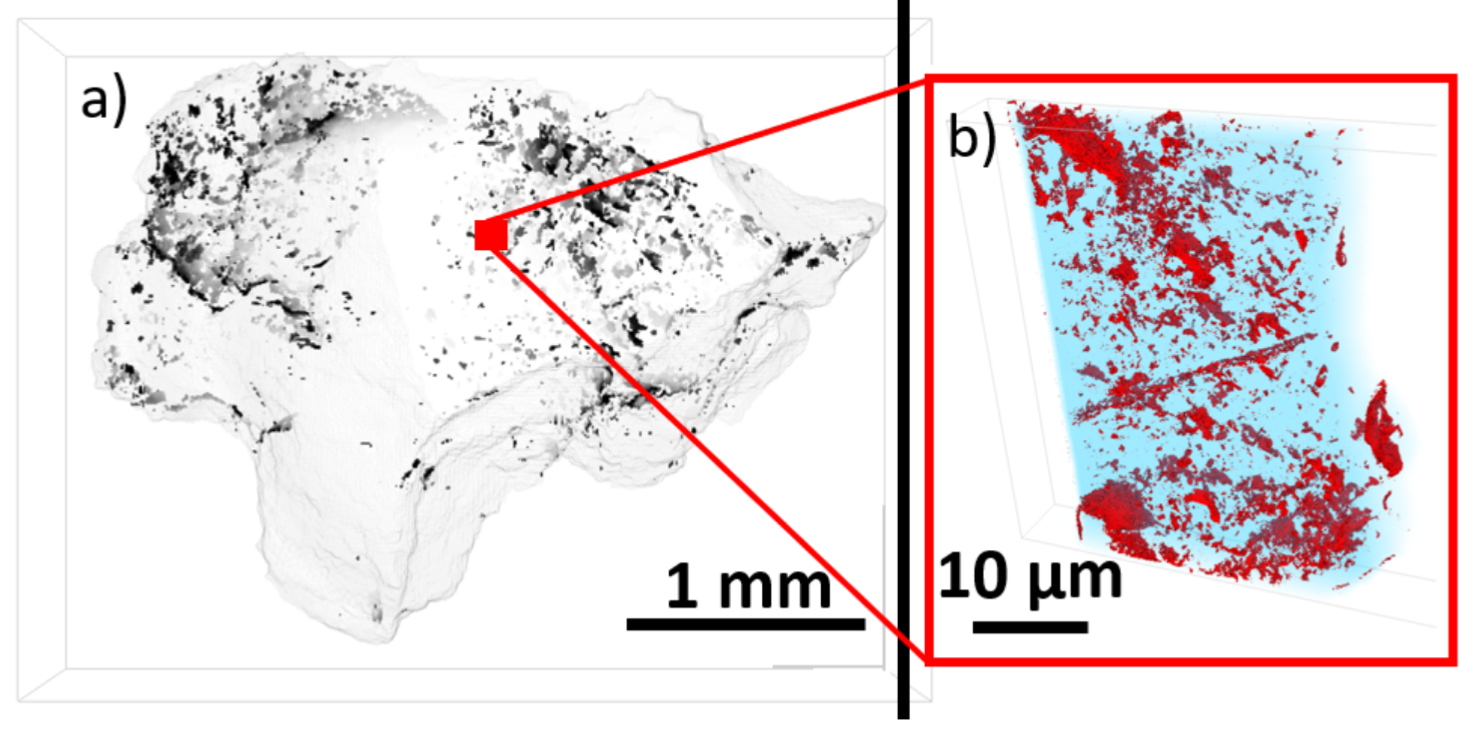
Figure 1 : 3D pores network (a) observed at the micrometric scale (in black) inside Ryugu A0159 and (b) at the nanometric scale (in red) inside a small cube extracted from Ryugu A0159.
Acknowledgment: We thank JAXA for providing the Ryugu sample A0159 as part of the first Hayabusa2 A0 and K. Hatakeda and M. Matsumoto for their help. This work is the result of a collaboration between IAS, CNRS, Université Paris-Saclay, and JAXA, and was supported by CNES, the ANR (LARCAS project, ANR-22-CE49-0009-01), and the SOLEIL synchrotron facility.
References: [1] Jossé et al. (2025), EPSC 2025, [2] Jossé et al. (2025) submitted to MAPS, [3] Zanetta, P. M. (2021) GeCoA 295, 135–154, [4] Genge M.J. (2024) Nat Astron 8, 1544–1552.
How to cite: Dionnet, Z., Jossé, L., Aléon-Toppani, A., Brunetto, R., Rascle, J., Djouadi, Z., King, A., Scheel, M., and Heripre, E.: Constraining the evolution of the asteroid Ryugu through 3D multiscale porosity analysis, EPSC-DPS Joint Meeting 2025, Helsinki, Finland, 7–12 Sep 2025, EPSC-DPS2025-944, https://doi.org/10.5194/epsc-dps2025-944, 2025.


