
 1,2,1,2,5,8,2,8,9,12,
- 1National Research Council of Canada, Herzberg Astronomy and Astrophysics Research Centre, Victoria, Canada (wesley.fraser@nrc-cnrc.gc.ca)
- 2Department of Physics and Astronomy, University of Victoria, 3800 Finnerty Road, Victoria, BC, V8P 5C2, Canada
- 3University of Regina, Regina, SK, Canada
- 4Center for Astrophysics | Harvard & Smithsonian, Cambridge, MA, USA
- 5Institute of Astronomy and Astrophysics, Academia Sinica, No.1, Sec. 4, Roosevelt Rd, Taipei 10617, Taiwan
- 6Dept of Physics and Astronomy, University of British Columbia, Vancouver, BC, Canada
- 7National Astronomical Observatory of Japan, 2-21-1 Osawa, Mitaka, Tokyo 181-8588, Japan
- 8Université Marie et Louis Pasteur, CNRS, Institut UTINAM (UMR 6213), OSU THETA, F-25000 Besançon, France
- 9Planetary Science Institute, Tucson, Arizona, USA
- 10Yukon Astronomical Society
- 11School of Physical and Chemical Sciences—Te Kura Matū, University of Canterbury, Christchurch, New Zealand
- 12Department of Physics, University of Auckland, Auckland, New Zealand
- *A full list of authors appears at the end of the abstract
Here we present results of CLASSY: the Classical and Large-A Solar SYstem survey. Running into its third year, this 2-year CFHT Large Program was allotted 75 nights from 2022B through 2024A inclusive, with a 16 night extension in 2024B and 2025A to accommodate time lost due to equipment failure. Using shift’n’stack techniques, CLASSY has been surveying 5 independent pointings (10.1 square degrees total) of the cold classical belt’s forced midplane in search of Kuiper Belt Objects and very distant extreme trans-Neptunian Objects. Field opposition locations are chosen to be spaced as evenly as possible in ecliptic longitude and each spans a two-month window (AS: Aug-Sept, ON, JF, MJ, JA). The survey design involves 5 visits to each field across the first year (discovery), with observations of these fields at a second opposition one year later for some fields, and 2 years later for others (tracking). The survey has achieved limiting magnitudes of r~26.5, and we expect to have an >80% recovery rate during tracking. Due to the nature of the observations which by design are drifted at rates that approximate typical main-belt Kuiper Belt Objects, highly distant and/or inclined objects tend to sheer off the tracking pointings, resulting in a reduced recovery rate for objects on those orbits. To compensate, a pointed recovery effort at Magellan and supplemented at Palomar has accompanied the main CFHT program, successfully recovering many of our discoveries on more extreme orbits. To date, all discovery fields have been acquired, and all fields have received a complete year 2 or year 3 follow-up, thereby completing the main CLASSY observing program.
The main science goals of CLASSY are to measure the size distribution of the cold classical belt to absolute magnitudes as faint as H_r~10, and to provide a census of extreme TNOs with minimal and well measured bias in ecliptic longitude. By nature of the robust pre/recovery during the first year, free inclinations can be calculated with sufficient accuracy to provide a surprisingly robust separation between members of the cold classicals and the more excited TNO populations, thereby enabling robust measurements of the luminosity functions of each population separately. We find that both populations exhibit the same luminosity functions to within the precision of the observations. Our observations reveal that the cold classical Kuiper Belt Objects exhibit an absolute magnitude distribution that is somewhat shallower than a direct extrapolation of the tapered exponential that accurately describes the size distribution measured for larger and brighter objects (see Figure 1). The inferred differential power-law slope over the range of CLASSY discoveries q~-2.5, revealing a decreasing mass per size, and suggests that what ever formation process resulted in these objects, it preferentially resulted in objects with diameters D~150 km, where the size distribution rolls over to this shallower slope.
Even though our analysis clearly demonstrates sensitivity to objects at distances as far as 200 au, CLASSY has found a surprising dearth of eTNOs, discovering no more than 1 in the three fields we have searched to date (AS, ON, JF) though at time of writing, the year 2 and 3 follow-up observations have not been included in our analysis resulting in large uncertainties in orbital semi-major axis. At the distances over which most eTNOs are found, CLASSY is sensitive to objects with sizes smaller than the roll-over size of objects in the more proximate main Kuiper Belt, D~150 km. This preliminary result implies that eTNOs either exhibit a different size distribution and thus, possess relatively fewer large bodies than the main belt, or that these objects have subdued albedos compared with main belt objects, or both. We will conclude with a discussion of these and other prospects that can address the observed paucity of eTNOs.
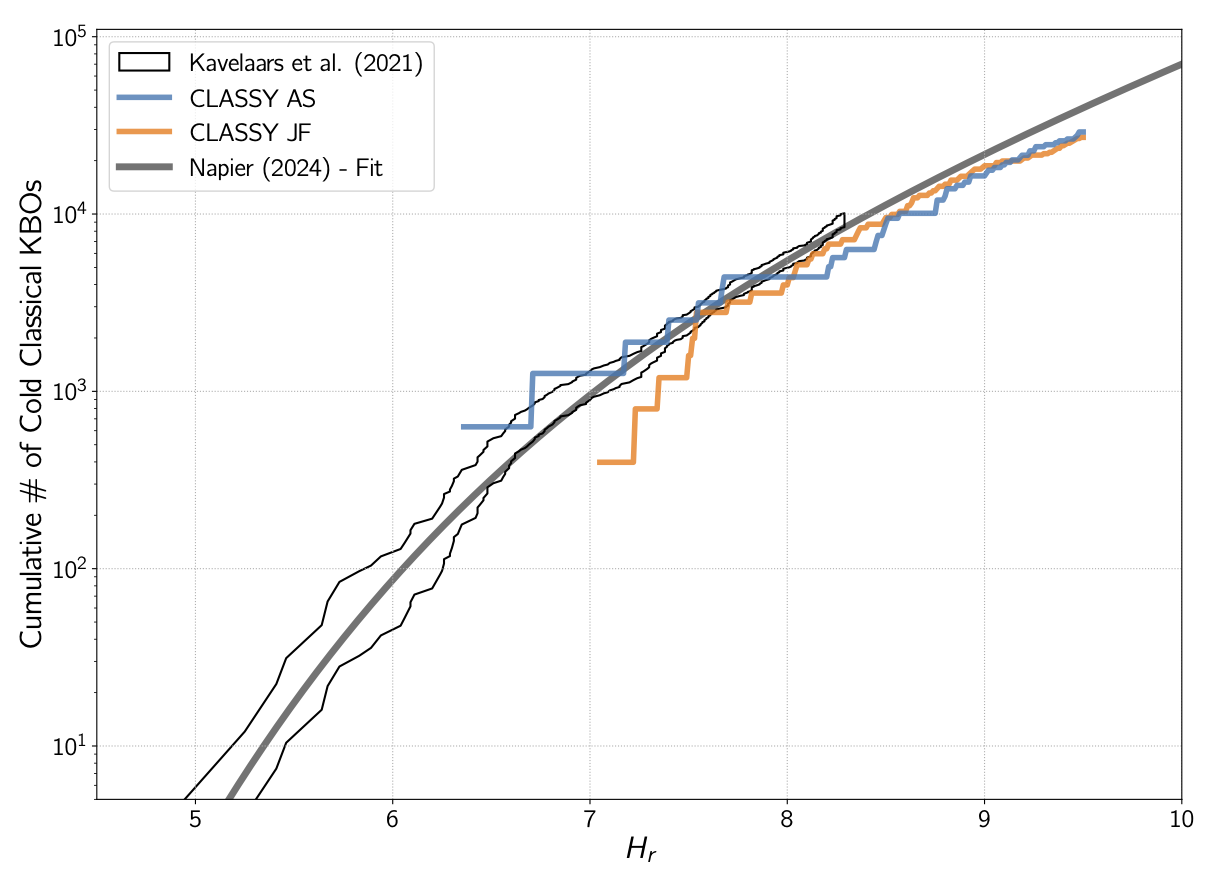
Figure 1: The preliminary absolute magnitude distribution of the cold classicals derived from the observations of AS (blue) and JF (orange) blocks. The thin black outline marks the cold classical Kuiper Belt Object H-distribution presented by Kavelaars et al. (2021) and the thick grey curve displays the best-fit tapered exponential of the cold classicals presented by Napier et al. (2024).
References
Kavelaars et al. (2021) OSSOS Finds an Exponential Cutoff in the Size Distribution of the Cold Classical Kuiper Belt ApJ, 920L, 28K
Napier et al. (2024) The DECam Ecliptic Exploration Project (DEEP). V. The Absolute Magnitude Distribution of the Cold Classical Kuiper Belt, PSJ Vol 5, 270N.
Jack Petersen (Auckland), Mario Juric (University of Washington), Simran Kaur (University of British Columbia)
How to cite: Fraser, W., Lawler, S., Pike, R., Kavelaars, J., Ashton, E., Gwyn, S., Chen, Y., Gladman, B., Huang, Y., Petit, J., Obidowski, J., Peltier, L., Alexandersen, M., Noyelles, B., Chang, C., Wang, S., Volk, K., Van Laerhoven, C., Bannister, M., and Cowan, P. and the The CLASSY Team: The Classical and Large-a Solar System , EPSC-DPS Joint Meeting 2025, Helsinki, Finland, 7–12 Sep 2025, EPSC-DPS2025-955, https://doi.org/10.5194/epsc-dps2025-955, 2025.


