
 1,2,1,4,1,1,
- 1Institute of Space Research, German Aerospace Center (DLR), Planetary Laboratories, Berlin, Germany (stephen.garland@dlr.de)
- 2ESTEC, European Space Agency, The Netherlands
- 3TESCAN GROUP, Brno, Czech Republic
- 4Museum für Naturkunde, Berlin, Germany
Introduction
Sample return missions provide the ultimate ground truth to better understand and interpret remote sensing data and enable a far more detailed analysis of extraterrestrial material than is possible via in-situ methods. Through technological advances in recent decades it is now possible to bring samples back from small bodies. Successful sample return missions have been carried out for the asteroids Itokawa and Ryugu (Hayabusa 1 [1] and 2 [2]), and most recently Bennu (OSIRIS-REx [3]). The Martian Moons eXploration (MMX) mission [4] aims to bring back samples from Phobos in 2031, and samples from Mars itself could be reality in the near future [5]. Sample return is a growing field of research and there is increased need for laboratory facilities capable of analyzing these small and sensitive samples. In response to this the Sample Analysis Laboratory (SAL) is being constructed at the German Aerospace Center in Berlin. SAL builds on the existing [6] Planetary Spectroscopy Laboratory (PSL) at the DLR Berlin, which offers facilities for spectral and micro-spectral characterisation of samples from the UV/visible to mid-infrared wavelength range, as well as analysis with Raman spectroscopy and digital 3D microscopy. In addition, the capabilities of the current sample preparation laboratory [7] are being extended to support the new instrumentation.
The goal of SAL is to provide a comprehensive range of instrumentation for structural, geochemical, mineralogical and elemental analysis at one location in a clean room environment for the analysis of extraterrestrial material in the form of returned samples and meteorites, allowing efficient analysis with a minimal disturbance to sensitive material. The long term aim of SAL is to establish a European center for extraterrestrial sample curation and analysis in Berlin in close cooperation with the Museum für Naturkunde (MfN).
SAL setup and instruments
The SAL facility consists of 80 m2 of clean room space on the ground floor of the DLR Institute of Space Research (former Institute of Planetary Research) in Berlin. Underneath the clean room is a technical room where vacuum pumps, cooling systems, and power and gas supplies will be housed, reducing contamination sources in the clean room, as well as improving the working environment. Three major new analytical instruments have been purchased for SAL: a JEOL iHP200F Field Emission Electron Microprobe Analyzer (FE-EMPA), a JEOL JSM-IT800 Field Emission Scanning Electron Microscope (FEG-SEM) and a Malvern Panalytical Empyrean X-ray Diffraction (XRD) system, shown in Figure 1a), b) and c) respectively. In addition to these a Brucker Hyperion 2000 FTIR microscope, interfaced with an existing Brucker Vertex 80V spectrometer and a Keyence VHX-7000 3D microscope (Figure 1d) and e)) have been acquired.
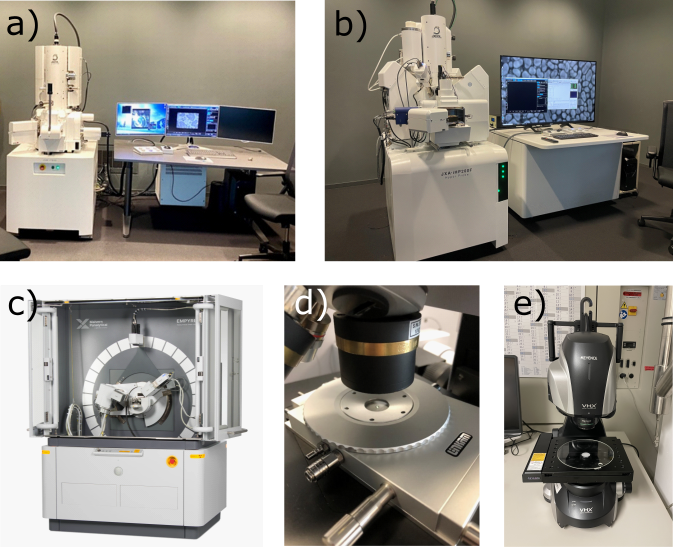
Figure 1. a). JEOL FEG-SEM. b). JEOL FE-EMPA. c). Malvern Panalytical XRD. d) Brucker FTIR microscope. e) Keyence digital 3D microscope.
The FE-EMPA is equipped with 5 wavelength dispersive x-ray spectrometers (WDS) with the interchangeable crystals TAPL/J, LDE1L/2, PETL/J/H and LIF/L/H, enabling a comprehensive coverage of elements and increased flexibility and efficiency in elemental mapping. In addition, it has an energy dispersive x-ray spectrometer (EDS) for rapid mapping and identification of target areas. The SEM is equipped with an EDS detector for rapid compositional mapping of samples. An additional backscattered electron (BSE) detector enables detailed topographical measurements. The XRD has Bragg-Brentano geometry, which can be switched to parallel beam geometry, and a Cu kα source with a 1Der detector. The sample form is flexible, from powders to larger solid objects. Localised µ-XRD analyses can be performed by reducing the beam spot size down to 140µm. All three devices have dedicated sealed transport vessels allowing sample transfer from the glovebox environment to the instruments under a controlled atmosphere. Two glove boxes will be acquired, for sample storage and for sample manipulation. Both glove boxes will be N2-purged and have an ISO 5 particle contamination requirement with active O2 and H2O monitoring. Vacuum compatible surface requirements and materials will be used to reduce contamination sources. Each glove box will have space for up to two users and will be equipped with a viewing port for sample documentation with a camera or microscope. The layout of the instruments and gloveboxes in the laboratory is shown in Figure 2.
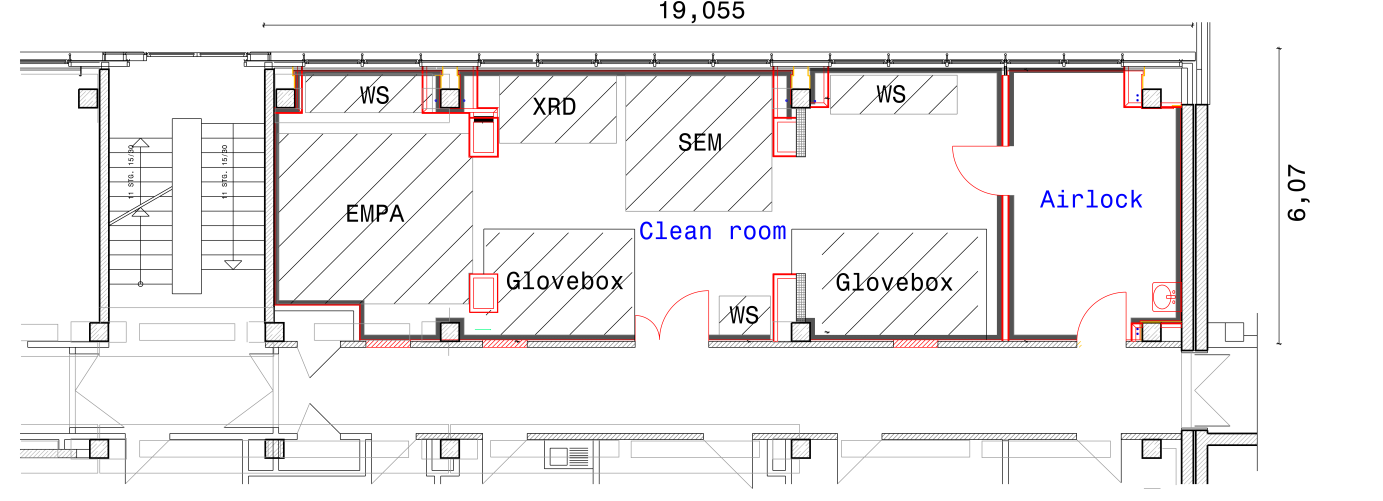
Figure 2. The layout of the Sample Analysis Laboratory with key instruments indicated. Hatched areas represent the service space requirement for the instruments, not the instrument footprints.
Outlook
The current status (as of April 2025) of the construction site is shown in Figure 3. In the coming months the new floor and the air purification system will be installed. The SAL clean room is due to be finished in September 2025. Following this there will be a phase of instrument installation and comissioning before SAL is fully functioning in spring 2026.
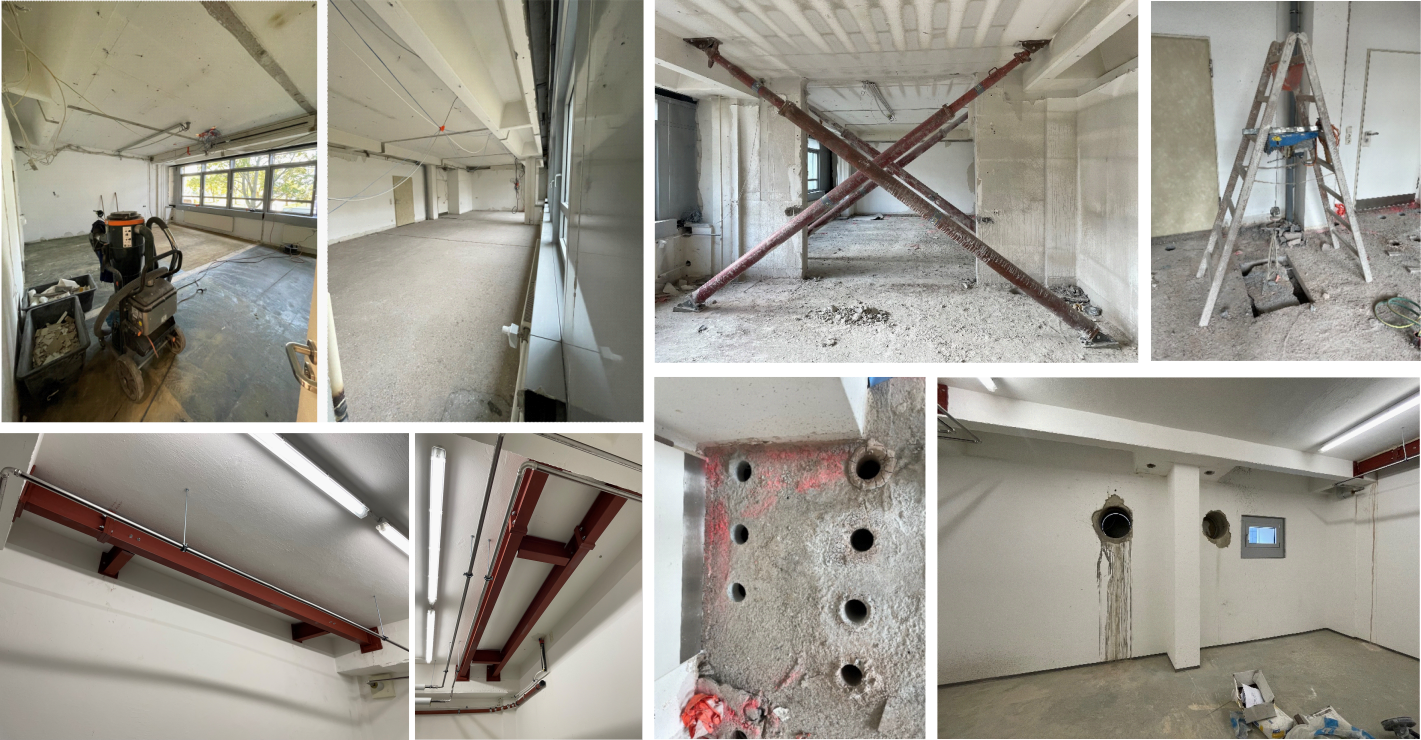
Figure 3 The current status of the building SAL progress (April 2025). The rooms have been stripped back, the partitioning wall has been removed, the necessary reinforcements and openings for the air purification system have been made, and the openings for conduits for the technical supplies have been made.
As well as providing a center for sample analysis SAL aims to be a European center for extraterrestrial sample curation. To achieve, we are working in close collaboration with the Museum für Naturkunde (MfN) in Berlin as well as with partners at NASA and JAXA to develop curatorial knowledge and procedures with the mid-term aim of receiving MMX returned samples in 2031.
References
[1] A. Tsuchiyama et al. (2011) Science 333, 1125-1128, 10.1126/science.1207807. [2] T. Nakamura et al. (2023) Science 379, abn8671, 10.1126/science.abn8671. [3] D.S. Lauretta, et al. (2017) Space Sci Rev 212, 925–984. https://doi.org/10.1007/s11214-017-0405-1 [4] K. Kuramoto et al. (2022) Earth, Planets and Space, 74, 12. 10.1186/s40623-021-01545-7 [5] B. K. Muirhead et al. (2020) Acta Astronautica, vol. 176, pp. 131–138, doi: 10.1016/j.actaastro.2020.06.026. [6] J. Helbert et al. (2023) LPI Contributions, 2806, 1989. [7] J. Helbert et al. (2024) SPIE13144, https://doi.org/10.1117/12.3027601
How to cite: Garland, S., Helbert, J., Maturilli, A., Van den Neucker, A., Bonato, E., Hamann, C., Greshake, A., Alemanno, G., Hecht, L., Adeli, S., Büttner, I., and Rauer, H.: The Sample Analysis Laboratory (SAL) at the German Aerospace Center (DLR) Berlin - a cutting edge laboratory for extraterrestrial material analysis, EPSC-DPS Joint Meeting 2025, Helsinki, Finland, 7–12 Sep 2025, EPSC-DPS2025-981, https://doi.org/10.5194/epsc-dps2025-981, 2025.


