
 1,2,3,3,
- 1Center for Astrophysics | Harvard & Smithsonian, United States of America (kevin.napier@cfa.harvard.edu)
- 2Michigan Institute for Data and AI in Society, University of Michigan
- 3Department of Physics, University of Michigan
In the two centuries that scientists have been working to detect and characterize solar system bodies, progressive improvements in telescope and detector technology have greatly enhanced our capabilities (see Figure 1 for the historical progression of minor planet discovery magnitudes). However, we are reaching the physical limits of detectors and the practical engineering limits of telescopes, and since the objects we are searching for are moving, we cannot simply take longer exposures to increase our image depth. How, then, can we continue to make progress?
The standard procedure for detecting moving objects fainter than the single-image detection threshold, called shift-and-stack, has most often been limited to the regime where an object’s proper motion remains linear, because nonlinear motion drastically increases the complexity of the problem. This limitation effectively means that the stacks must be done on data taken within a single night, thus limiting the depth of search we can achieve.
In this talk I present heliostack, an algorithm that enables shift-and-stack searches for minor planets over extended time baselines, and apply it to archival data from the Hubble Space Telescope taken over a timespan of multiple days. By increasing the time baseline accessible to shift-and-stack, we will be able to find fainter solar system objects in carefully-selected segments of data from space telescopes, and surveys with sparser cadences such as the Dark Energy Survey (DES), or the upcoming Legacy Survey of Space and Time (LSST), pushing into a new regime in Figure 1.
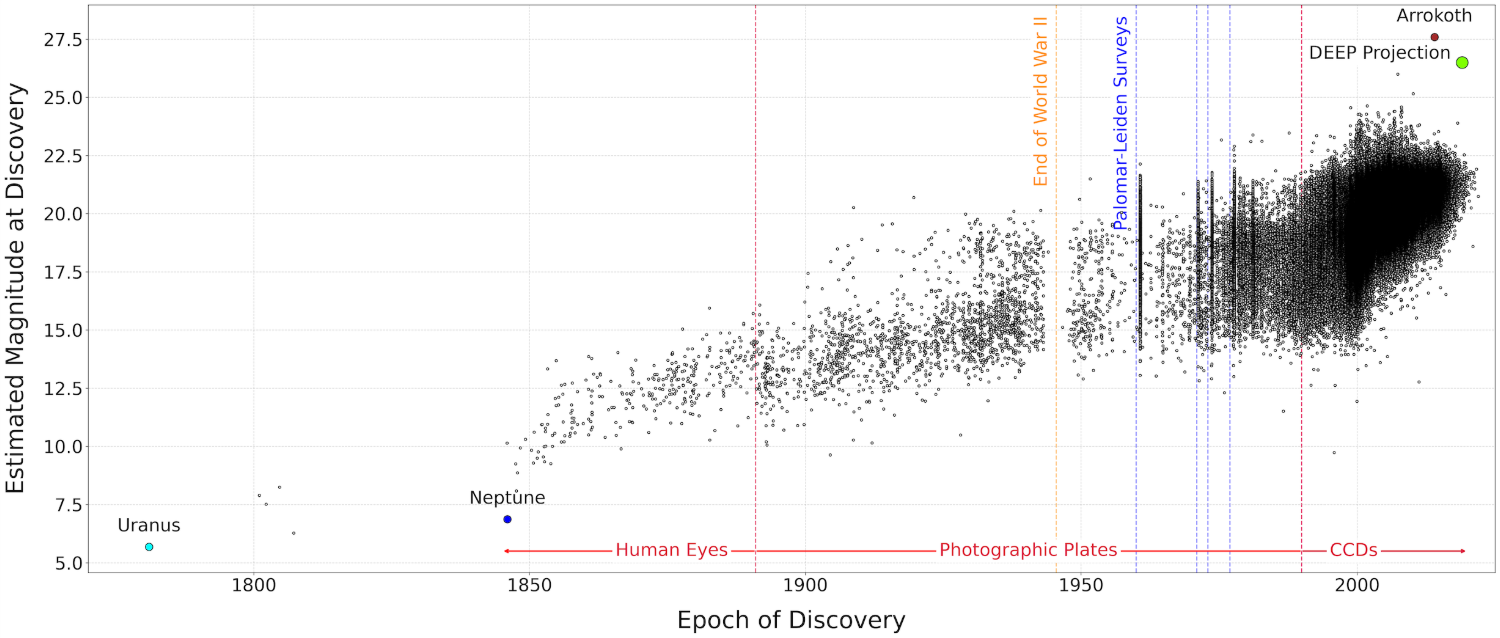
Figure 1: Visual magnitude of all numbered objects listed in the Minor Planet Center, as viewed from the Geocenter at the epoch of discovery.
How to cite: Napier, K., Holman, M., Lin, H.-W., and Ruch, T.: heliostack: A Novel Approach to Minor Planet Detection, EPSC-DPS Joint Meeting 2025, Helsinki, Finland, 7–12 Sep 2025, EPSC-DPS2025-989, https://doi.org/10.5194/epsc-dps2025-989, 2025.


