EPSC Abstracts
Vol. 18, EPSC-DPS2025-997, 2025, updated on 09 Jul 2025
https://doi.org/10.5194/epsc-dps2025-997
EPSC-DPS Joint Meeting 2025
© Author(s) 2025. This work is distributed under the Creative Commons Attribution 4.0 License.

A Pilot Rapid-Response Project to Characterize Small Near Earth Objectswith LCO’s MuSCAT Instruments.
 1,2,5,1
- 1Department of Physics and Astronomy, Northern Arizona University, Flagstaff, AZ, USA
- 2Las Cumbres Observatory, Goleta, CA, USA
- 3South African Astronomical Observatory, Cape Town, South Africa
- 4NASA Goddard Space Flight Center, Greenbelt, MD, USA
- 5Lowell Observatory, 1400 W. Mars Hill Rd., Flagstaff, AZ, USA
1. Summary
Close to 80% of meteorites are ordinary chondrites, commonly associated with S-type asteroids [1]. However, among Near-Earth Objects (NEOs), silicate-rich S-types are no more abundant than abundant as primitive (C-, D-, and X-) types [2]. The most likely parent bodies for meteorites are small NEOs, the composition of which are not well understood. The taxonomic make-up of small NEOs is further complicated by recent meteorite recoveries corresponding to rare taxonomic types, such as the Almahata Sitta ureilite [3] and an aubrite meteorite that was formerly 2024 BX1 [4].
Here we present the results of a pilot-project in preperation for a longer program to determine the rough taxonomies of at least ∼1000 very small (absolute magnitude >25, or diameters <30 meters) NEOs over a three year period using the MuSCAT3/4 simultaneous four-channel imagers on the Las Cumbres Observatory (LCO) 2-meter telescopes.
2. Observations and Data Reduction
The smallest NEOs are best observed during their closest approach to Earth shortly after discovery and are typically only visible for a few weeks. MuSCAT3/4’s ability to perform simultaneous g, r, i, and zs observations make it possible to observe our targets accurately and efficiently, and LCOs queue-scheduled robotic observing system means targets can be observed within minutes of their submission and well within their window of visibility.
We observed 10 NEOs between Nov 9 2024 and Feb 22 2025 using MuSCAT3 installed on the 2-meter Faulkes North Telescope in Haleakala. Each target was observed for ∼7 minutes, with seven tracked 60-second exposures in each filter sandwiched between two 10-second exposures that were used for photometric calibration. Targets were selected from newly discovered asteroids, and chosen based on several constraints. The object must have been discovered in the 5-weeks prior to observation and have an official designation. This group was further filtered to objects with an apparent magnitude (V) < 21, the limiting magnitude required to achieve an SNR of 10 within a 7-minute exposure, and an absolute magnitude (H) > 25. The rate of the object was also taken into consideration and limited to 1000 ”/hour to avoid trailing in calibration frames. These targets were then submitted to the LCO observing queue. Data from successful observations were reduced and calibrated using LCO’s in-house BANZAI reduction software [5]. Photometry was carried out with a simple procedure that utilizes the Python Photutils package.
As part of the goals for this pilot project, we developed a pipeline to automate observations and analysis. Each step — from selecting targets from the Minor Planet Center database, submitting targets to the LCO queue, acquiring reduced, calibrated data and photometry — was carried out using this pipeline. Future work will incorporate a machine learning-based tool to assign objects to a probabilistic taxonomic classification.
3. Results
Preliminary results, shown in Figure 1, indicate that 6 out of the 10 sampled objects exhibit colors consistent with S- and C-type classifications, evenly divided between the two. Unexpectedly, 4 objects resembled taxonomic types that are not commonly found amongst NEOs; the most surprising of these were the colors of 2025 AF and 2024 VC.
2025 AF (H = 25.10, D ≈ 28 m) shows a best match to O-type asterods. O-types are exceptionally rare, with only seven confirmed to date [6] — primarily among NEOs — with the notable exceptions of main-belt asteroid 3628 Božněmcová and potentially 7472 Kumakiri [7]. 2024 VC (H = 27.41, D ≈ 9.8 m) on the other hand did not match exactly to any known taxonomies, but fit best to A or R type asteroids. Both A- and R- types are also notably rare with 17 known A-types (mostly Inner Main Belt asteroids and Mars-crossers) and 5 R-types (4 main-belt and 1 Amor NEO) [6].
Spectrophotometric measurements such as those presented here are far more efficient than spectroscopy, but have much lower fidelity. Therefore, these colors are suggestive, but not conclusive. The relatively high fraction of uncommon taxonomic classes observed in our target sample may suggest greater diversity within the small NEO population; however, additional observations are required to substantiate this. Generally, these findings demonstrate that the MuSCAT3 and 4 instruments, along with our analysis tools, are sufficient to derive coarse taxonomies for small NEOs. Our full survey will begin on May 1, 2025. We will observe 1000 NEOs with the MuSCAT cameras through the end of 2027B. We will measure the implied compositional distribution of very
small NEOs.
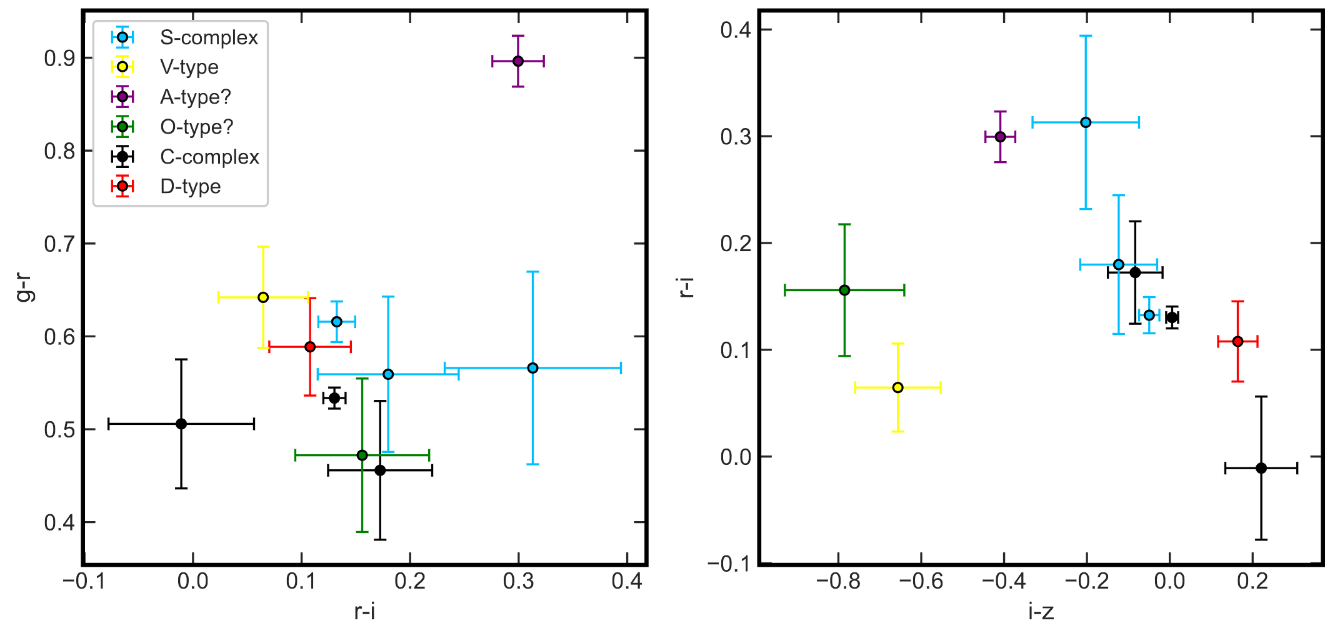
Figure 1: Color-color diagram showing the colors of 10 pilot project NEOs presented here, grouped by
taxonomic class.
taxonomic class.
4. Acknowledgments
This work makes use of observations from the Las Cumbres Observatory global telescope network. This paper is based on observations made with the MuSCAT3 instrument, developed by Astrobiology Center and under financial supports by JSPS KAKENHI (JP18H05439) and JST PRESTO (JPMJPR1775), at Faulkes Telescope North on Maui, HI, operated by the Las Cumbres
Observatory. This project is supported by the Arizona Board of Regents Technology and Research Initiative Fund and by NASA YORPD award 80NSSC25K7438.
References
[1] Nakamura, T., Noguchi, T., Tanaka, M., et al. 2011, Itokawa Dust Particles: A Direct Link Between S-Type Asteroids and Ordinary Chondrites, Science, 333, 1113
[2] Mommert, M., Trilling, D. E., Borth, D., et al. 2016, First Results from the Rapid-response Spectrophotometric Characterization of Near-Earth Objects using UKIRT, AJ, 151, 98
[3] Jenniskens, P., Shaddad, M. H., Numan, D., et al. 2009, The impact and recovery of asteroid 2008 TC3, Nature, 458, 485
[4] Cantillo, D. C., Ridenhour, K. I., Battle, A., et al. 2024, Laboratory Spectral Characterization of Ribbeck Aubrite: Meteorite Sample of Earth-impacting Near-Earth Asteroid 2024 BX1, , 5, 138
[5] McCully, C., Turner, M., Volgenau, N., et al. 2018, LCOGT/banzai: Initial Release, 0.9.4, Zenodo
[6] Bus, S. J., Binzel, R. P., & . 2002, Phase II of the Small Main-Belt Asteroid Spectroscopic Survey. A Feature-Based Taxonomy, Icarus, 158, 146
[7] Burbine, T. H., Duffard, R., Buchanan, P. C., Cloutis, E. A., & Binzel, R. P. 2011, in 42nd Annual Lunar and Planetary Science Conference, Lunar and Planetary Science Conference, 2483
How to cite: Cantelas, R., Trilling, D., Chatelain, J., Erasmus, N., Lister, T., López-Oquendo, A., Moskovitz, N., and Thomas, C.: A Pilot Rapid-Response Project to Characterize Small Near Earth Objectswith LCO’s MuSCAT Instruments., EPSC-DPS Joint Meeting 2025, Helsinki, Finland, 7–12 Sep 2025, EPSC-DPS2025-997, https://doi.org/10.5194/epsc-dps2025-997, 2025.


