ODAA2 | At the convergence of art and science

ODAA2

At the convergence of art and science
Convener: Federica Duras | Co-conveners: Daniela de Paulis, Konstantina Moutsouroufi, Thibaut Roger
Orals WED-OB2
| Wed, 10 Sep, 09:30–10:30 (EEST)
 
Room Mars (Veranda 1)
Posters TUE-POS
| Attendance Tue, 09 Sep, 18:00–19:30 (EEST) | Display Tue, 09 Sep, 08:30–19:30
 
Lämpiö foyer, L44
Wed, 09:30
Tue, 18:00
Not limited to any rules, interrogating us about our own nature, providing emotional and intellectual insights, impacting the masses and challenging the status quo, Art is the universal language of the people.
On the other hand, defined by clear rules and laws, invariable across time and space, described by ideas, concepts and mathematics more than words, Science is the universal language of our world and universe.
This session will explore the intersectionality of Art and (planetary) Science from both directions.

Artists are invited to display their science-inspired or science-driven projects and art pieces, and explain their creative process: why did they choose a specific approach, a specific media, or a specific way to represent a concept.
Scientists are invited to present data visualisation or sonification techniques - projects where art has been generated directly by the science and its components, either by design or by a happy accident.
Science communicators and educators are invited to showcase how they use art to impact various publics, and to inspire the next generation of scientists.

From painting to sculpture, from infographics and video content to generative AI, from video games to music, from photo to comics, all arts and media are welcome to this session.

If logistically possible, this session will be complimented by a temporary in-person art exhibition in Finlandia Hall, where contributors to the session will be able to expose their art.

Session assets

Orals: Wed, 10 Sep, 09:30–10:30 | Room Mars (Veranda 1)

Chairpersons: Federica Duras, Daniela de Paulis, Konstantina Moutsouroufi
09:30–09:42
|
EPSC-DPS2025-1837
|
On-site presentation
Daniela de Paulis

“One Million Poems” is a project coordinating a global collaboration among members of the general public and other specialists from various fields, through experimental poetry and astronomy. The project aims at transforming the cosmic space into a theatrical stage in which the relational movement of celestial bodies creates transient conceptual and poetic synapsis by attributing a concept, a sentence or a  word to each celestial object. The movements of asteroids, the Moon and comets are choreographed by laws of physics and their effect ripples down to Earth, greatly affecting all life on our planet. Yet, these movements are hardly perceived as part of our terrestrial experience. If we imagine the extension of our terrestrial awareness into the solar system and into the cosmos, the celestial objects inhabiting outer space become part of our human understanding and experience of life on Earth.

"One Million Poems" echoes several philosophical theories and poetics. A primary source of inspiration for the project is the poetry of the Oulipo group, among other contemporary styles, founded by French poets and mathematicians, and consisting in combining words according to pre-determined structures, typically following mathematical reasoning. The words, structured under such constraints, bloom with hidden poetic meanings, freeing themselves from literal connotations. The project is also informed by dark skies awareness and dark skies appreciation, inviting participants to delve into the hidden narratives of the night skies that have been deeply connecting humans to the cosmos, and that are too often shadowed by light pollution.  "One Million Poems" aims at highlighting the extension of our human presence into the cosmos through an experiential and participatory process, accessible to people from all over the world. By collaborating with amateur and professional astronomers from around the world, the project opens the curtains of our planetary theatre for the public from around the world to experience and interact with the movements of celestial objects inhabiting outer space as a subjectively and collectively meaningful event. For the project, celestial objects, including the Moon, asteroids, comets, stars, are attributed individual fictional meanings, symbols or sentences by citizen scientists and other members of the public. Members of the international public can collaborate in creating words or sentences in different languages or in imaginary languages, weaving transcultural poems. As the words become associated and dissociated by the soundless movements of celestial objects across the sky, they generate transient meanings, flickering poetic and conceptual associations, like in Raymon Queneau’s book “One Hundred Million Poems”. 

How to cite: de Paulis, D.: One Million Poems: Global Collaboration through Astronomy and Experimental Poetry, EPSC-DPS Joint Meeting 2025, Helsinki, Finland, 7–13 Sep 2025, EPSC-DPS2025-1837, https://doi.org/10.5194/epsc-dps2025-1837, 2025.

09:42–09:54
|
EPSC-DPS2025-1802
|
ECP
|
Virtual presentation
Understanding the Cosmic Dance via Role play, Year Planner and Social Media Tools
(withdrawn after no-show)
Chrisphin Karthick
09:54–10:06
|
EPSC-DPS2025-821
|
On-site presentation
Konstantina Moutsouroufi

Science communication is increasingly seeking to engage wider and more diverse audiences through interdisciplinary approaches, including the arts. Among these, the integration of music into science outreach has shown great promise, particularly due to its emotional resonance, accessibility and mnemonic potential. This contribution explores the structured use of popular music as a medium to communicate core concepts in planetary science and cosmology to non-specialist audiences.

Building on previous outreach efforts in the field of space weather, this work presents a new case study entitled "Planetary Can-Can & Universal Rhapsody". The project adapts the lyrics of Jacques Offenbach's Can-Can and Queen's Bohemian Rhapsody to present scientific content related to the formation of stars and planetary systems, the characteristics of Solar System bodies, and broader cosmological themes. Particular attention is paid to maintaining scientific accuracy while preserving fidelity to the original musical structure, including rhythm, rhyme, and phrasing.

This method provides a creative avenue for informal science education and public engagement that is particularly effective for younger audiences and general public events. By translating complex astrophysical phenomena into familiar and engaging formats, the project increases the accessibility, promotes conceptual understanding and fosters active audience participation.

By translating complex astrophysical phenomena into familiar and engaging formats, the project enhances accessibility, promotes conceptual understanding, and encourages participatory learning experiences.

How to cite: Moutsouroufi, K.: A planetary can can and a universal rhapsody: Approaching planetary outreach through popular music, EPSC-DPS Joint Meeting 2025, Helsinki, Finland, 7–13 Sep 2025, EPSC-DPS2025-821, https://doi.org/10.5194/epsc-dps2025-821, 2025.

10:06–10:18
|
EPSC-DPS2025-1327
|
On-site presentation
Ja Grier

Introduction

Paper quilling is the art of rolling and curling thin strips of paper, placing them on edge, and forming them into shapes, mosaics, and designs, and it is hundreds of years old.  Global societies of quillers and dynamic online groups exist for sharing the art, exchanging ideas, and promoting the form.  The highly flexible and malleable nature of paper quilling makes it ideal as a medium to meld science and art.  Quilling can be used for impressionistic or abstract work as easily as it can be used to create realistic, detailed, lifelike pieces.  Paper quilling sculpture can be exceptionally large scale, with some installations covering entire walls, and it can also accommodate the utterly meticulous work of tiny, 3D miniatures.  This abstract offers examples of three science topics one may explore with astronomical quilling, and illustrates how they are brought together using the example of the artwork “Spiral Moon.”  This text is to be of use to artists with limited astronomical knowledge as well as to space scientists.  Additional work is underway, and along with “Spiral Moon” may  be available for exhibition.

The Science Concepts

Albedo - The ‘albedo,’ the level of light/dark in an image, is similar to what an artist might call this ‘value.’  But scientists typically only use ‘albedo’ with black and white images.  The relative and absolute quantities of light and dark are the most basic kind of image data, and yet they can reveal topography, composition, shadows, and all basic land formations.  If the albedo across the image changes slowly, one might infer that the light is being diffused by an atmosphere.  If the albedo across an image changes sharply, that might indicate that there is no atmosphere to scatter the light.  The ability of paper on edge to sharply reflect or softy diffuse light makes it highly useful in illustrating these concepts.   

Point-Spread Function - The ‘point spread function’ or PSF is the response of an imaging system to a point source of light – the PSF may extend or diffuse the object into a blob.  If one understands how a device ‘spreads’ light, then one can apply techniques to help correct.  A common instrument used in astronomical research is a CCD (charge-couple device).  Generally speaking, a CCD is a grid of tiny detectors, each of which records how much light it has detected over a certain time interval (integration.)  Each of the boxes on the grid is a pixel, a tiny square making up the image like a mosaic of tiles.  If an astronomer is interested in taking an image of a point source, like a star, ideally all the light from that source would fall into a single square, but in practice that is not what happens.  Mosaics of paper quills can be used as an excellent analogy to similar pixelated images.

The Opposition Effect  - The Opposition Effect is the enhanced brightening of a surface that is covered with dust, particles, or is naturally rough, when the source of light falling on it is directly behind the person viewing the surface.  The Opposition Effect or Surge refers to the non-linear way that the brightness of the surface increases as the phase angle goes to zero.  The ‘phase angle’ is the angle between the observer, the object they are observing, and the source of the light that is illuminating the object.  That is, as the source of light shines more directly on the object from the observer’s perspective, the phase angle goes from higher to lower numbers.  At 0 degrees, your source of light is behind you, shining directly on the object you are looking at.  The Opposition Surge is a complicated effect – one major factor that might contribute is ‘shadow hiding.’  At higher phase angles, there is more of the surface hidden in shadows.  As the phase angle goes to zero, there are areas of the surface suddenly revealed, reflecting light back to the observer.  At opposition, it can be easier to see differences in composition (more calcium rich areas (light) vs more magnesium rich areas (dark)) but it is hard to see the topography.  Paper quilling offers an excellent medium, as the inherent depth of each quill and their interspacing can mimic this effect.

Bringing it Together – Quilling the Moon

The art piece “Spiral Moon” - by artist JA Grier,  is craftedof more than 2000 individual quills, all loose coils.  In creating this piece I considered a variety of scientific concepts and a range of possible artistic expression.  As a lunar scientist as well as an artist, I wanted a ‘realistic’ representation of the moon that also conveyed wonder and beauty.  I wanted the viewer to see something both expected and unexpected at the same moment.  In terms of albedo, the near side is a fantastic example of the power of the contrast of light and dark, with the dark maria, bright highlands, and extra-bright, young, rayed craters in juxtaposition.  Stark contrasts and subtle shading are used to demarcate familiar features, but in unfamiliar ways.  The few straight pieces of paper stand out in a sea of circles, just as the real rays of the youngest craters do on the Moon.  The art uses only four shades to convey the entire range of light to dark of the lunar surface.  Our eyes and brains have their own PSF, allowing us to look at bits and pieces and integrate them instantly into a coherent picture.  Paper quilling is by its nature a dimensional, sculptural medium.  Coiled paper creates valleys, grooves, shadows, and angles that allow for a strong opposition effect, but perhaps not in the way one might always predict.  Depending on the paper’s color, width, and placement, the effect might be stronger from an angle where the sides of the paper are more visible than the edges.  Spiral Moon uses this phenomenon to enhance the realism, as well as sense of the unexpected.

This work first appeared as a part of the “Making Space” art and science workshop, PI Jamie Molaro. 

How to cite: Grier, J.: Astronomy in Paper - Quilling to Engage with Beauty and Communicate Science, EPSC-DPS Joint Meeting 2025, Helsinki, Finland, 7–13 Sep 2025, EPSC-DPS2025-1327, https://doi.org/10.5194/epsc-dps2025-1327, 2025.

10:18–10:30
|
EPSC-DPS2025-1838
|
On-site presentation
Thibaut Roger

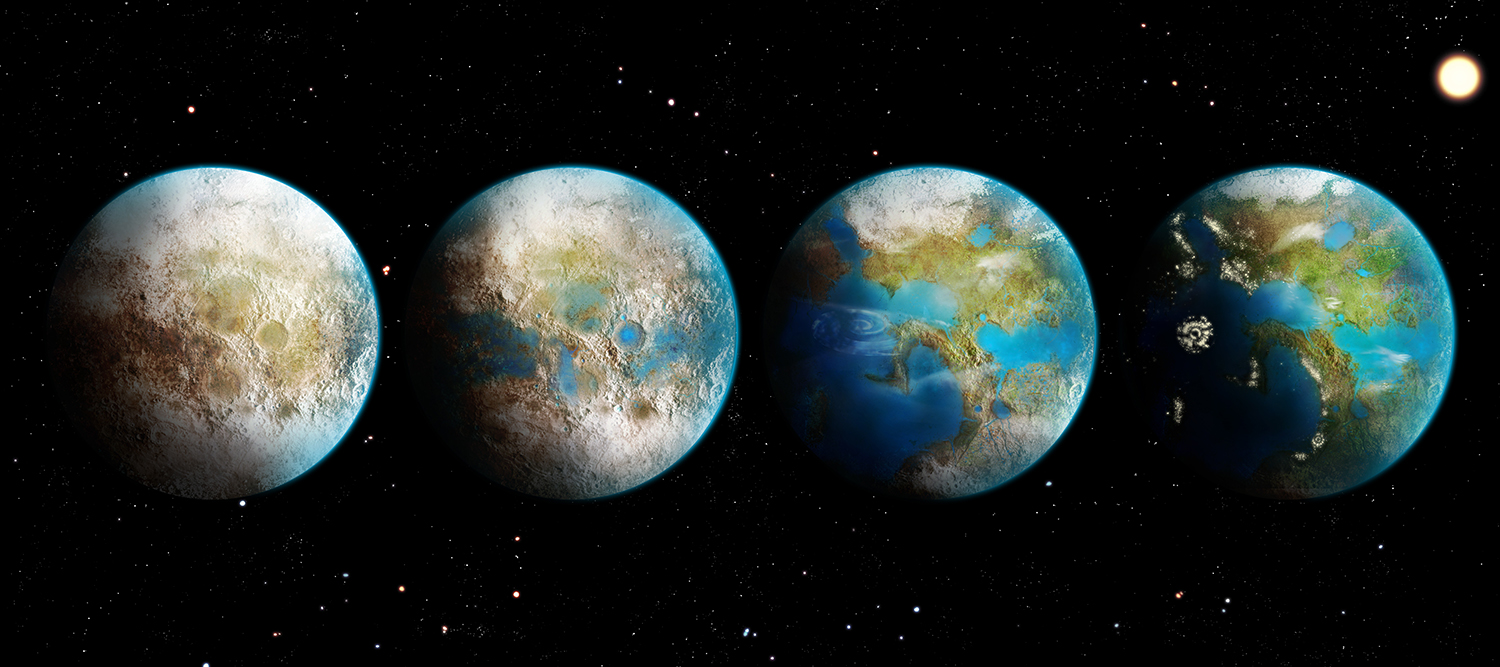
As astronomy is often not able to image more than a single dot of light, artist impressions of detected objects is of prime importance to communicate our results to the public, and convey the wonders of the cosmos. This is particularly true in the case of exoplanets which are usually not even imaged directly but detected indirectly via their effect on their parents stars. In this talk, I will lead you through my usual workflow to create artist impressions of exoplanets and planetary bodies for the press releases published by my institute.

I will reveal my secrets to make images creating stronger emotional impact, while balancing respect for the physics of the displayed planetary body. One such secret is to push further than the simple illustration and include a story in it: questioning why each minute detail of the illustration is where it is and how it would have came to be in the real world. If time and technical set up allow, I will also give a live demonstration of this workflow by crafting a (simplified) illustration with the inputs of the session attendees. I will also tackle how I take inspiration from nature's beauty and of the textures of my environment, incorporating every day elements in my illustrations.

Example of an illustration with an embedded story - representing the terraformation of a planet.

In this example, the story telling was naturally occuring from the represented subject: a planet undergoing terraformation, which could lead to detection of technosignatures in the atmosphere of an exoplanet.

How to cite: Roger, T.: Stop crafting mere illustrations - craft stories, EPSC-DPS Joint Meeting 2025, Helsinki, Finland, 7–13 Sep 2025, EPSC-DPS2025-1838, https://doi.org/10.5194/epsc-dps2025-1838, 2025.

Posters: Tue, 9 Sep, 18:00–19:30 | Lämpiö foyer

Display time: Tue, 9 Sep, 08:30–19:30
Chairperson: Thibaut Roger
L44
|
EPSC-DPS2025-2093
|
On-site presentation
Thibaut Roger and Bárbara Soares

How do you showcase planetary system architecture at public events, in a fun, simple, interactive and engaging way, while producing a durable impact? 

This was the premise that led us to develop the concept of "Make your own exoplanet system bracelet". 

The pitch is simple: natural stones come in a plethora of textures, many of which, once turned into spherical beads, are very evocative of the looks of planets. In the world of stone beads, obsidian mahogany becomes Mars-like planets, apatite beads are lush water-covered worlds, tiger eyes are Jupiters with beautiful stripes and storms, or pyrites are the metal-rich Mercury for instance.

In this activity, the public is going to use the natural stone beads to build their own exoplanetary system. They have access to a large quantity of beads, of all sizes and textures. First, they are invited to pick up their host star, of different colours to teach the spectral types of stars and their relation to the size and mass of the star. Next, they can choose a few planets, up to 6 or 7: a great opportunity for them to learn the zoology of exoplanet classification, from Mercury- or Mars-like planets, to inflated hot-Jupiters, passing by Earth-like, super-Earths, sub-Neptunes and Neptune-like. Participants also have the opportunity to pick a tiny moon to orbit a Jupiter, or an asteroid belt represented by a lava rock bead.

Once they have selected the content of their system, they can seat at a table to craft their bracelets, using small black glass beads to represent the void of space between the planets in their system. This last step will let them explore under a scientist guidance, the various possible architectures of exoplanet systems, such as ordered, anti-ordered or "peas in a pod" configurations, as well as concept such as Titus-Bode law, resonant systems displaying an even-spacing of their planets, or compact systems. 

At the end, participants leave with their system around their wrist, and will always be reminded of the diversity of exoplanets and system architectures: every time they have a look at their precious bracelet. 


We will try to arrange for session participants to have an opportunity to craft themselves their bracelet during the presentation. 

An example of bracelet system

This image presents a photomontage mock-up of the concept which will be experimented with the public for the first time at the Fantasy Basel event in May 2025.

How to cite: Roger, T. and Soares, B.: Craft your own exoplanet system bracelet, EPSC-DPS Joint Meeting 2025, Helsinki, Finland, 7–13 Sep 2025, EPSC-DPS2025-2093, https://doi.org/10.5194/epsc-dps2025-2093, 2025.
