
 1,1,2,
- 1Charles University, Faculty of Mathematics and Physics, Department of Geophysics, Praha, Czechia (lebec@karel.troja.mff.cuni.cz)
- 2Nantes Université, Univ Angers, Le Mans Université, CNRS, Laboratoire de Planétologie et Géosciences, LPG UMR 6112, 44000 Nantes, France
Introduction
With its geologically young surface crosscut by linear structures such as ridges, lineae, and bands, Europa is a unique moon in our Solar System. It has been explored by multiple spacecraft, in particular the Galileo mission, which inferred the existence of a subsurface salty ocean, as well as the presence of surface salts, likely MgSO4 [1]. The Hubble Space Telescope also identified irradiated NaCl, which is consistent with the reddish color of Europa [2]. Their distribution across the surface coincides with geological structures, suggesting an internal origin and exchange of non-ice material (NIM) with its interior [1]. Europa undergoes periodic eccentricity variations over cycles of hundreds of million years [3], leading to global compression and extension [4,5]. As a result, the ice shell exhibits significant thickness variations, ranging from ~3-10 km to ~60-70 km [3,4,5].
Unraveling the formation of dilational bands is a key to a better understanding of Europa's history. These wide bands, extending for hundreds of kilometers across its surface, are characterized by a complete opening of the surface with exposure of subsurface material in the fault zone. Their morphology suggests an extensional origin, and they likely form during the thickening of the ice shell [6,7]. Most of them spread from a V-shaped central trough, are roughly symmetrical, and often elevated with respect to surrounding terrains [6,7,8]. They exhibit a moderate topography of a few hundred meters [6,8,9] and are commonly classified into four main categories, depending on their brightness and texture [7]. Dark bands are the most common and are inferred to be richer in non-ice materials (NIM) and younger than bright bands [6,9]. Bright bands, on the contrary, are usually older, and often flanked by darker material [6,7,8]. Smooth bands have a hummocky texture with small-amplitude oscillations [7,8], while lineated bands consist of regularly spaced sub-parallel ridges and faults, spreading symmetrically from the central depression [6,7,8].
We aim to unravel the conditions under which these bands are formed. We investigate the effect of various parameters, such as the ice shell thickness D, extension velocity Vext, ice cohesion Cice, and grain size, on band morphology and topography, using a two-dimensional Cartesian model of the ice shell undergoing a constant strain-rate tectonic extension. We also seek to investigate how tectonic extension drives transport of NIM and oceanic material to the surface, as well as their distribution.
Results
Several parameters significantly affect the formation of dilational bands, particularly Vext and D. We identify three main dynamical regimes, controlled by the efficiency of surface opening (Fig.1). Complete surface opening occurs only for sufficiently high strain rates, on the order of 10 km.Myr−1, and is further enhanced for thinner ice shells. The third regime is therefore the most consistent with dilational band formation (Fig.1).
Efficient surface opening also promotes mass exchanges, with higher strain rates favoring the exposure of oceanic material at the surface. Thinner ice shells further enhance the exposure of oceanic material within the fault zone (Fig.2B). In these cases, NIM are pushed away from the fault zone. One important result is that the final lateral distribution across the band reflects the initial vertical distribution of material within the ice shell.
Another key parameter is Cice, which controls the strength of the lithosphere. Fig.2 illustrates the effect of Cice on band formation for two different ice shell thicknesses. Tectonic extension commonly drives local convection within the ice shell, enhancing mass exchanges with the surface (Fig.2A). The strength of the lithosphere strongly affects band morphology, particularly the symmetry of the structure and the presence of a distinct central trough (Fig.2).
Conclusion
We suggest that various types of bands were formed during distinct extensional events, explaining their brightness and texture differences. In particular, bright bands may form at an early stage of ice shell thickening when a thinner ice shell promotes the exposure of oceanic material within the fault zone. This provides a consistent explanation for their bright central region and often darker edges enriched in NIM. These darker edges may also result from a longer radiation exposure. In most cases, the farther from the center of the domain, the longer the material has remained at the surface, exposed to radiation (Fig.2C). In contrast, dark bands may form later, when the ice shell is thicker, limiting the exposure of oceanic material and resulting in a higher fraction of NIM within the fault zone. Finally, we are able to predict the morphology and composition of the dilational bands based on the rheological and physical properties of the ice shell at the time of extension. We show that we can also constrain the initial vertical profile in the ice shell from the vertical distribution of material across the band.
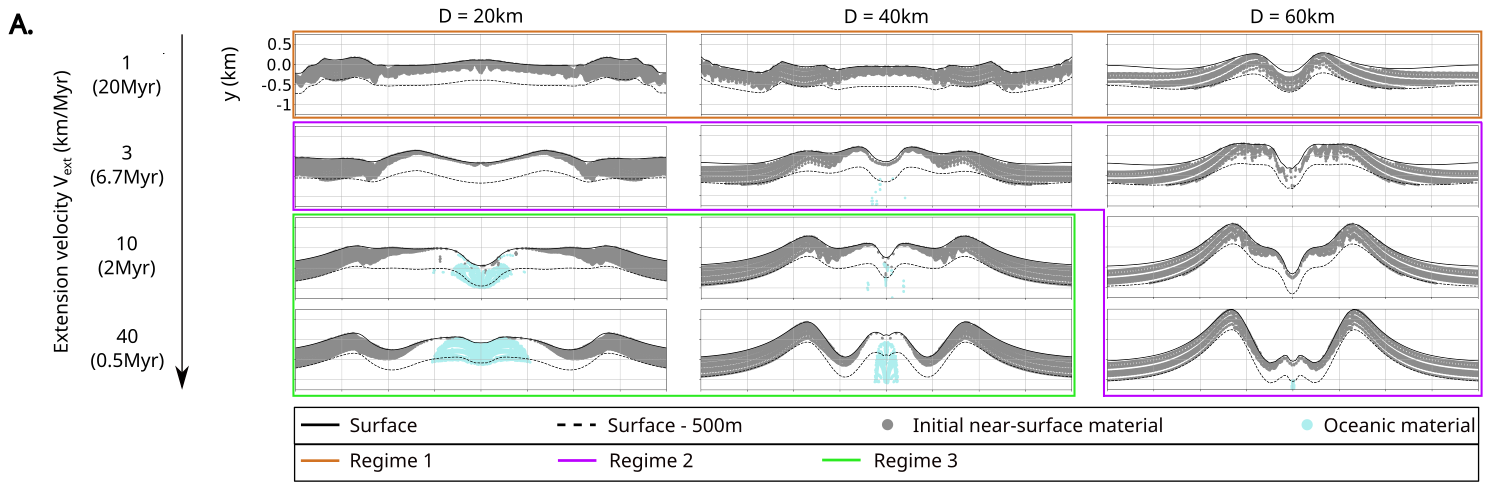 Figure 1 - Effect of D and Vext on the final distribution of initial near-surface material and exposure of oceanic material.
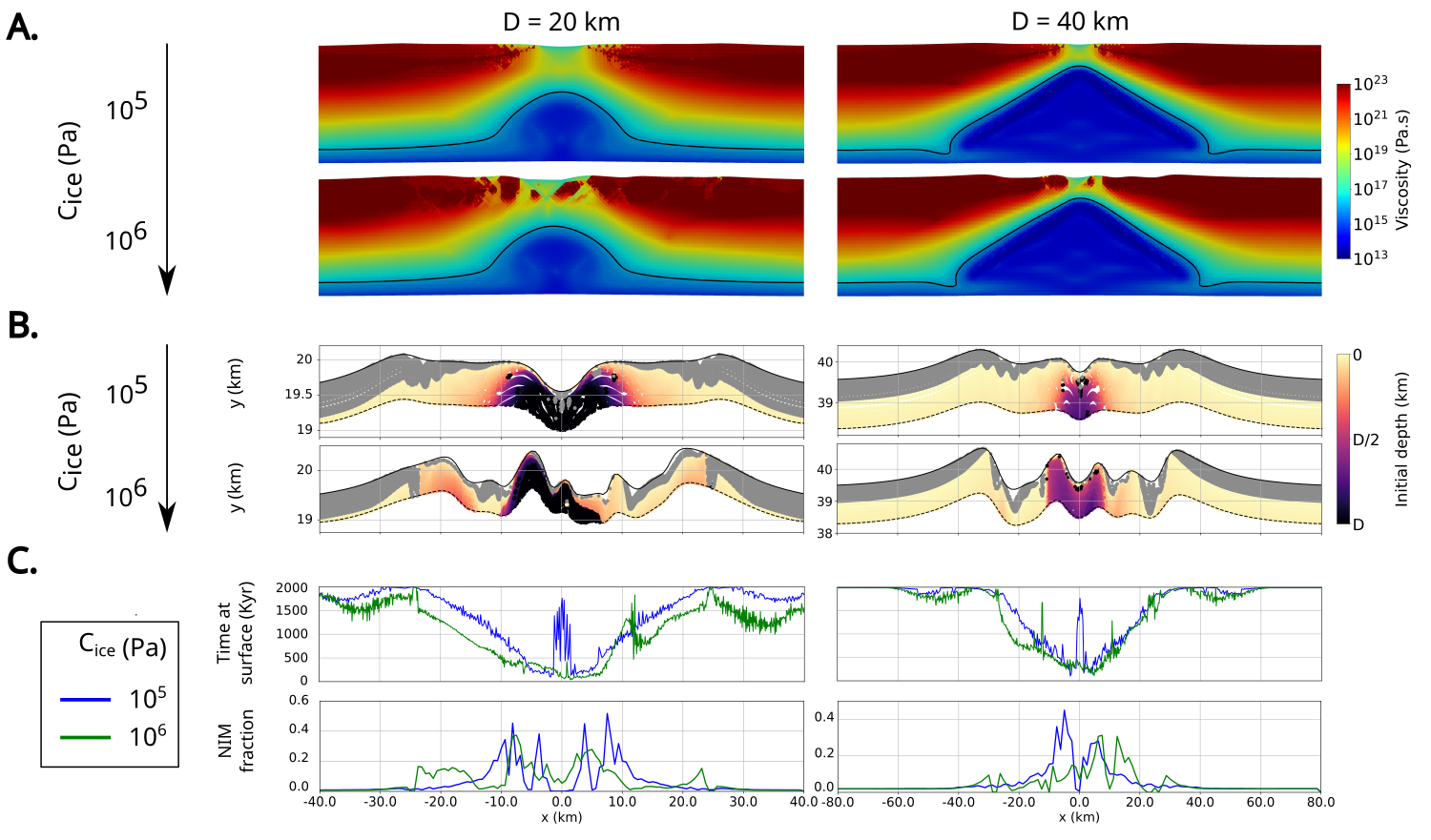
Figure 2 - Effect of Cice and D on: A. the viscosity field at the end of the extension, and B. the initial depth of the post-extension near-surface material. Grey part corresponds to what remains of the initial near-surface material. C. Comparative plots for two values of Cice: average time spent in the topmost cell by post-extension near-surface material, and fraction of NIM at the surface at the end of the extension.
References
[1] R. Carlson et al. (2009), In Europa, eds. R. T. Pappalardo et al., 283–327
[2] S. K. Trumbo et al. (2019), Sci. Adv., 5, eaaw7123
[3] H. Hussmann and T. Spohn (2004), Icarus, 171, 391-410
[4] M. L. Rudolph et al. (2022), Geophys. Res. Lett., 49(5), e2021GL094421
[5] M. Kihoulou et al. (2025), Sci. Adv., 11, eadq8719
[6] L. Prockter et al. (2002), J. Geophys. Res. Planets, 107(E5), 5028
[7] L. Prockter and G. Patterson (2009), In Europa, eds. R. T. Pappalardo et al., 237-258
[8] B. Tufts (2000), Icarus, 146, 75-97
[9] F. Nimmo et al. (2003), Geophys. Res. Lett., 30(5), 1233
How to cite: Lebec, L., Kihoulou, M., Čadek, O., Tobie, G., and Choblet, G.: Cracking Europa: Dilational bands formation and material transport in the ice shell, Europlanet Science Congress 2026, The Hague, The Netherlands, 7–11 Sep 2026, EPSC2026-100, https://doi.org/10.5194/epsc2026-100, 2026.


