
 ,,
,,- German Aerospace Center (DLR), Institute of Space Research, Berlin, Germany
Laser-induced breakdown spectroscopy (LIBS) is an elemental analysis technique that offers several advantages for planetary in-situ exploration. It only requires optical access to the sample, measurements are rapid, and it is sensitive to all elements including hydrogen [1]. For LIBS, a pulsed laser beam is focused onto the sample surface, where it ablates material which evolves into a microplasma of exited atoms, ions and simple molecules. Those emit characteristic radiation from which the elemental composition of the sample can be derived. In both NASA missions currently operational on the Martian surface – Mars Science Laboratory and Mars 2020 - LIBS instruments belong to the payload of the rovers [2-5] and have been successfully measuring the geochemistry of the Martian surface for several years. The first LIBS measurements on the Moon were demonstrated with a LIBS on the small lunar rover Pragyan in the framework of India's Chandrayaan-3 mission [6].
LIBS strongly depends on the ambient atmospheric conditions in which the plasma expands, in particular on the pressure [7]. Compared to the thin atmosphere of Mars which provides close to ideal conditions for good quality LIBS data, reduced pressure environments such as those on airless bodies like the Moon or asteroids pose challenges to the elemental analysis with LIBS. The plasma lifetime is much shorter as there is no plasma confinement resulting in lower total intensities [7,8]. However, LIBS under vacuum conditions has been investigated before and several studies show that the quantification of mostly major rock forming elements with LIBS is still feasible [8-11]. Here, we focus on the minor elements C, Cl, and S and investigate their detectability with LIBS in reduced pressure environments. Those elements are of relevance in several mission scenarios to airless bodies, both from a scientific and from an in-situ resource utilization (ISRU) point of view. They can serve as tracers of volatile evolution and provide information on habitability, but also play an important role in ISRU related activities such as fuel production, life support and concrete production.
We performed measurements with two laboratory LIBS setups: (1) the VOILA setup with prototype components [12,13]; and (2) a high-spectral resolution and time-resolved LIBS setup with an Echelle spectrometer [14]. Both systems use infrared lasers emitting at 1030 nm and 1064 nm, respectively, with nanosecond pulses for plasma creation. The plasma is observed in the wavelength range of 400-850~nm (spectral resolution of about 0.4 nm) and 190-850~nm in two spectral ranges (spectral resolution of 5-34~pm), respectively. For both setups the samples are placed in vacuum chambers which can be evacuated to pressures of 10-3 Pa and 10-1 Pa, respectively. While the performance of VOILA is expected to be similar to compact LIBS space instruments, the high spectral resolution of the Echelle spectrum is beyond what is expected for real space mission instruments in the near future.
For a first feasibility check, we measured pressed pellets with mostly pure compositions in order to identify relevant emission lines and to evaluate the feasibility of developing calibration models for quantification in vacuum LIBS. The investigated samples are: graphite, LiCl, NH4Cl, Na2CO3, Na2SO4, NaCl. Spectra measured with the VOILA setup are shown in Fig. 1. It can be seen that C, Cl, and S emission lines are clearly detectable in vacuum LIBS conditions at those high concentrations. As expected, the C lines are particularly prominent in the graphite sample, whereas the spectra of Na₂CO₃ show weaker but still detectable C lines. Zooms to selected wavelength ranges in the spectra measured with the Echelle spectrometer can be found in Fig. 2. In the UV region, ionized C lines are visible, including a C(IV) line at 252.9 nm (Fig. 2(b)), which was not observed under Martian atmospheric conditions [15,16]. However, these lines are only clearly visible in the graphite sample. Only the C(III) line at 229.8 nm can be seen in the spectrum of Na₂CO₃ (Fig. 2(a)). Furthermore, weak C₂ molecular bands at 516.3 nm of the so-called Swan system can also be observed for graphite (Fig. 2(d)). Overall, the emission lines of C, Cl, and S visible in the spectra are generally the same that are also detected under Martian atmospheric condition [15,16].
More realistic samples with varying concentrations of selected minor elements will be prepared in order to determine their limits of detection with LIBS in vacuum conditions, and a detailed analysis of the impact of atmospheric conditions on selected relevant emission lines will be performed.
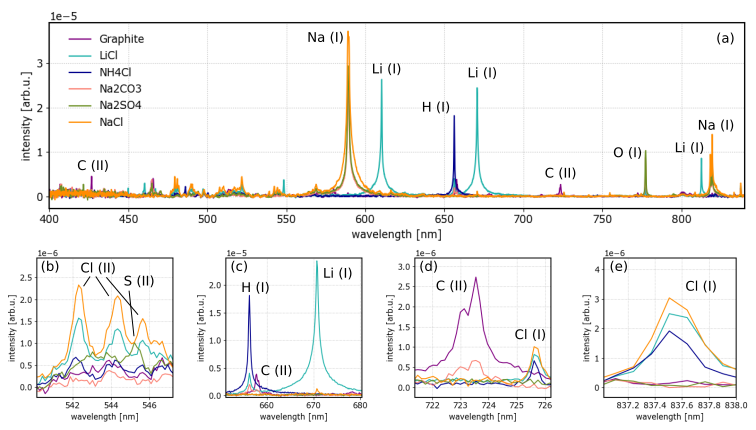
Fig. 1: Mean spectra of 5 repetitive measurements per sample with the VOILA setup. In (a) the whole spectral range is shown, while (b)-(e) show zooms to spectral ranges with emission lines of C, Cl, and S.
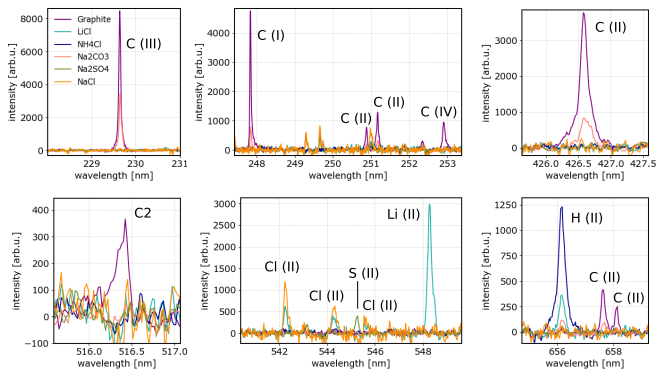
Fig. 2: Zooms to selected spectral ranges of spectra measured with the Echelle spectrometer. Shown are mean spectra of 5-10 repetitive measurements per sample. All spectra were measured with a short integration time of 200 ns directly after the laser pulse.
References
[1] Knight et al. (2000). Applied Spectroscopy. https://doi.org/10.1366/0003702001949591
[2] Maurice et al. (2012). Space Science Reviews. https://doi.org/10.1007/s11214-012-9912-2
[3] Wiens et al. (2012). Space Science Reviews. https://doi.org/10.1007/s11214-012-9902-4
[4] Maurice et al. (2021). Space Science Reviews. https://doi.org/10.1007/s11214-021-00807-w
[5] Wiens et al. (2012). Space Science Reviews. https://doi.org/10.1007/s11214-012-9902-4
[6] Sridhar et al. (2025), IEEE Sensors, 25. https://ieeexplore.ieee.org/document/10778223
[7] Seel et al. (2025). Icarus. https://doi.org/10.1016/j.icarus.2024.116376
[8] Lasue et al. (2012). Journal of Geophysical Research: Planets. https://doi.org/10.1029/2011JE003898
[9] Sallé et al. (2005). Spectrochimica Acta Part B: Atomic Spectroscopy. https://doi.org/10.1016/j.sab.2005.02.009
[10] Clegg et al. (2026). 57th Lunar and Planetary Science Conference, #1492.
[11] Kubitza (2020). Spectrochimica Acta Part B: Atomic Spectroscopy. https://doi.org/10.1016/j.sab.2020.105990
[12] Vogt et al. (2022). Sensors. https://doi.org/10.3390/s22239518
[13] Rammelkamp et al. (2024). Frontiers in Space Technologies. https://doi.org/10.3389/frspt.2024.1336548
[14] Schröder et al. (2013). Icarus. https://doi.org/10.1016/j.icarus.2012.11.011
[15] Anderson et al. (2017). Journal of Geophysical Research: Planets. https://doi.org/10.1002/2016JE005164
[16] Clavé et al. (2026). Spectrochimica Acta Part B: Atomic Spectroscopy. https://doi.org/10.1016/j.sab.2026.107537
How to cite: Rammelkamp, K., Schröder, S., and Seel, F.: Laser-induced breakdown spectroscopy (LIBS) for in-situ exploration of airless bodies: detection of minor elements , Europlanet Science Congress 2026, The Hague, The Netherlands, 7–11 Sep 2026, EPSC2026-1001, https://doi.org/10.5194/epsc2026-1001, 2026.


