
 1,1,
1,1,- 1LIRA, Observatoire de Paris-PSL, Sorbonne Université, Université Paris Cité, CY Cergy Paris Université, CNRS, Meudon, Fr
- 2DIO-VO, Observatoire de Paris-PSL/CNRS, Fr
- 3UNIDIA, Observatoire de Paris-PSL, CNRS, Meudon, Fr
- 4Observatoire de Strasbourg/ Université Strasbourg/CNRS UMR 7550, Fr
- 5Heidelberg University, Ge
- 6University of Bristol, UK
VESPA is an environment designed to facilitate both the sharing and access of data relevant to Solar System science. It has been developed within the framework of the Europlanet 2020 and Europlanet 2024 Research Infrastructure programmes. Building on the infrastructure of the astronomical Virtual Observatory (VO), VESPA extends VO standards and tools to support planetary science and heliophysics data [1]. Central to this framework is EPN-TAP [2], a standardized metadata vocabulary and access protocol that enables a uniform description of Solar System datasets and efficient discovery across large, distributed repositories. EPN-TAP is regularly extended to support an increasing range of applications, including observational data, numerical simulations, and laboratory measurements.
Current status: As part of the Virtual Observatory ecosystem, VESPA strongly promotes Open Science and FAIR principles in order to facilitate interoperability and reuse of planetary science data. The infrastructure currently provides access to 96 certified data services together with more than 70 planetary HiPS datasets (multi-resolution maps). These services are contributed by over 30 institutes worldwide and include the ESA Planetary Science Archive, collections from the PDS PPI node, results from more than ten European research programmes, derived products from over twelve space-borne instruments, as well as datasets produced by several Pro-Am collaborations. Certified services can be queried simultaneously through the VESPA portal, enabling homogeneous discovery across distributed repositories. In total, nearly 250 EPN-TAP services of various sizes are currently declared in the IVOA registry, many of which are in the process of validation and integration into the operational VESPA environment.
Activities in progress: Current VESPA activities focus on two complementary objectives: extending the accessible data content and improving scientific workflows based on interoperable services.
A major effort is devoted to enlarging the range of accessible datasets. Regular interactions with space agencies support the deployment of EPN-TAP interfaces on existing archives, while dedicated solutions are being developed to expose planetary science datasets embedded in astronomical observatory archives. At the same time, lightweight and well-documented procedures are being promoted to enable small research teams to share original datasets and derived products, typically associated with scientific publications or research projects. These activities also support Pro-Am collaborations and citizen science initiatives, including stellar occultation observations [3] and fireball network data.
In parallel, VESPA identifies and develops use cases corresponding to common research tasks in planetary science. A key capability is the possibility to submit a single query simultaneously to distributed data services worldwide and to cross-match the returned results. To support such workflows, new functionalities are progressively implemented in existing Virtual Observatory tools, enabling faster data discovery, visualization, and analysis across heterogeneous planetary science datasets. Uses cases are available here: https://github.com/epn-vespa/tutorials/tree/master
Developments: VESPA has consistently focused on data content, interoperability procedures, and the adaptation of existing Virtual Observatory standards to planetary science needs. In this context, dedicated software developments have deliberately been kept to a limited scope in order to maximize sustainability and efficiency while relying as much as possible on the broader VO ecosystem.
The only tools specifically developed within VESPA are the main portal, which enables simultaneous querying of all validated services, and the VESPA geoportal, a VO-based GIS environment supporting EPN-TAP datasets georeferenced on planetary surfaces together with external footprints. In several cases, SAMP interfaces have also been implemented in external applications to facilitate seamless data exchange.
Most new functionalities required by the planetary science community have instead been integrated directly into existing VO tools by their original developers, particularly in Aladin, Aladin Lite, TOPCAT, and CASSIS. Similarly, developments related to scripted workflows have largely relied on community Python libraries such as astropy and pyvo, with extensions focused on planetary science use cases.
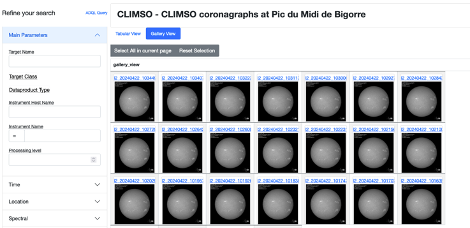
Fig.1: Solar images from CLIMSO in the VESPA portal in gallery mode
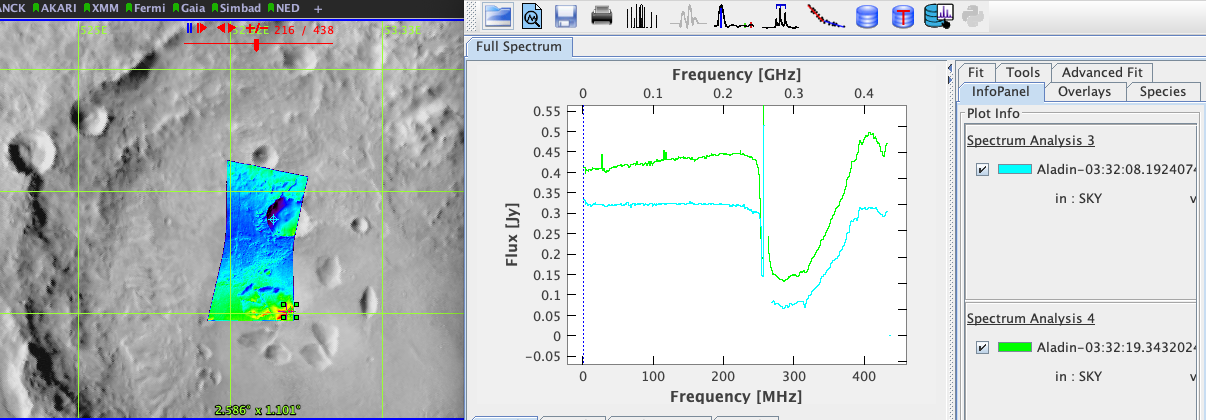
Fig.2: A CRISM spectral cube overplotted on the CTX HiPS in Aladin. Spectra are displayed with the CASSIS plugin
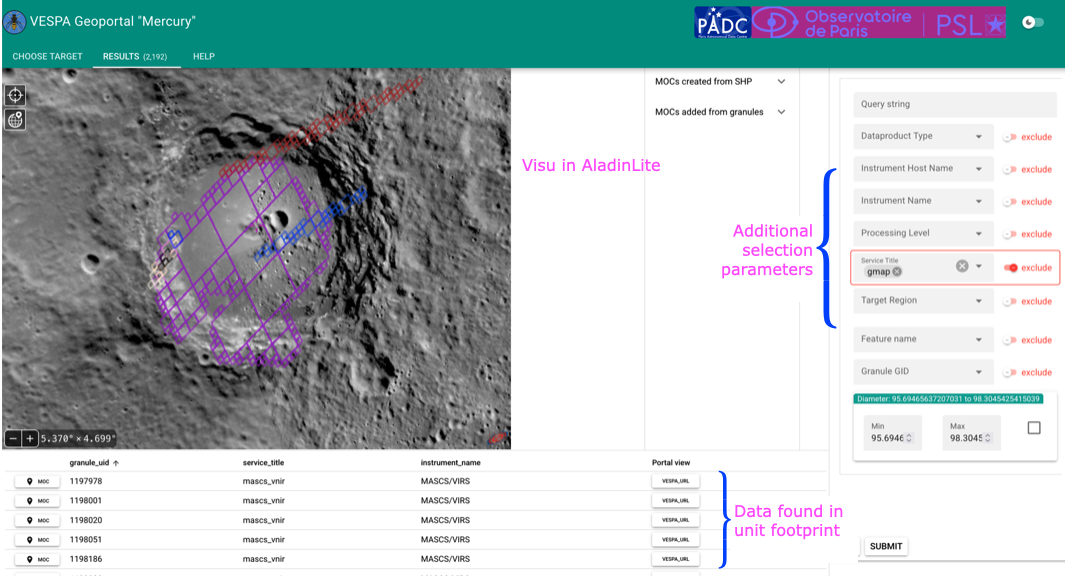
Fig.3: MESSENGER data in the VESPA geoportal. Data is found inside shapefile footprints from a publication
Prospects: VESPA continues as an active partner of the Europlanet community beyond its funded programmes, and contributes to international consortia in this field: IVOA [International Virtual Observatory Alliance], IPDA [International Planetary Data Alliance] and IHDEA [International Heliophysics Data Environment Alliance]. The main focus in the coming years will cover semantics, mapping to other metadata vocabularies, and ML readiness.
VESPA also participates to various European programmes in Astronomy and Open Science [4] and is involved in several projects of data infrastructures at national level, e.g. [5]. VESPA is committed to participating in future European science activities and to contributing to building an EOSC node for astronomy.
The Europlanet-2024 Research Infrastructure project has received funding from the European Union's Horizon 2020 research and innovation programme under grant agreements No 871149.
[1] S. Erard, B. Cecconi, P. Le Sidaner, M. Demleitner, and M. Taylor, “EPN-TAP: the VO standard to share and access Solar System data” PV2023 conference, Dec. 2023, doi: 10.5281/ZENODO.10255587
[2] S. Erard, B. Cecconi, P. Le Sidaner, M. Demleitner, and M. Taylor, “EPN-TAP: Publishing Solar System Data to the Virtual Observatory Version 2.0” IVOA Recommendation 22 August 2022. https://ivoa.net/documents/EPNTAP/
[3] T. Chope et al. “Towards a Community Standard for Stellar Occultation Results: an EPN-TAP Extension and Prototype Service”. 15th ACM conference, June 2026, Poznań, Pol.
[4] M. Molinaro et al. “Astronomy Open Science Competence Centre in Europe”. ADASS XXXV, Nov. 2025.
[5] F. Schmidt et al “Planetary Data Surface: Services and Portals (PDSSP)” This conference.
How to cite: Erard, S., Cecconi, B., Le Sidaner, P., Chauvin, C., Haigron, R., Fernique, P., Boch, T., Demleitner, M., and Taylor, M.: Virtual European Solar & Planetary Access (VESPA) 2026: Perseverance, Europlanet Science Congress 2026, The Hague, The Netherlands, 7–11 Sep 2026, EPSC2026-1012, https://doi.org/10.5194/epsc2026-1012, 2026.


