
 1,1,1,2,2,1
- 1Freie Universität Berlin, Institute of Geological Sciences, Planetary Sciences and Remote Sensing, Germany (pietro.matteoni@fu-berlin.de)
- 2German Aerospace Center, Institute of Planetary Research, Berlin, Germany
The Jovian moons Ganymede and Europa are prime targets for the exploration of icy moons by ESA’s JUICE and NASA’s Europa Clipper missions [1,2]. Future measurements from these missions will provide key insights into the structure of their ice shells and the depth of their subsurface oceans. Although the ocean represents the largest water reservoir beneath the surface, localized liquid brine reservoirs may also exist within the shallow subsurface of the ice shell. These reservoirs could serve as niches for habitability and provide ideal targets for exploration due to their proximity to the surface (∼1-5 km depth [e.g., 3]). The ice-penetrating radars REASON and RIME; onboard Europa Clipper and JUICE, respectively, will provide critical measurements to complement data from cameras (JANUS - JUICE; EIS - Europa Clipper), spectrometers (MAJIS - JUICE), and the in-situ dust analyzer SUDA (Europa Clipper), to provide a comprehensive picture of potential shallow habitats.
One of the top priorities of the two missions is the characterization of conditions that may have led to the emergence of habitable environments among the Jovian icy satellites through the investigation of past and/or recent geologic activity and its connection to the shallow subsurface, along with potential interactions with a subsurface ocean. Signs of possible past geologic activity were already observed in a few isolated spots on Ganymede's surface during the Voyager and Galileo missions. These spots have been described as "scalloped depressions" or "paterae" and have been interpreted as potential source vents for cryovolcanism, resembling possible calderas [e.g., 4,5]. An alternative origin related to diapirism has been proposed as well [6].
Most of the paterae have not been observed by imaging instruments with sufficient spatial resolution, and complementary information on local topography, surface age, and composition has not yet been acquired, preventing the discovery of unequivocal evidence for their origin, any potential interaction with Ganymede's subsurface ocean, and their relationships to the satellite's habitability [5]. Future measurements by JUICE will provide important information on the origin, overall characteristics, and formation mechanisms of Ganymede’s paterae.
In the case of relatively young paterae, possible associated liquid pockets in the shallow subsurface could provide clear evidence of processes related to the interaction with Ganymede's subsurface ocean. Reports of possible shallow liquid pockets in the ice shell have been extensively proposed for Europa as well [e.g., 3,7]. In particular, a recent study performed detailed geomorphological-structural investigations of Ménec Fossae, located within the major band Libya Linea [8]. The observed tectonic activity in this region of Europa could be related to a shallow water pocket located close to the surface, which would explain the observed overall topography of this area, in addition to the presence of specific geological features such as chaos terrain and double ridges. Comparing the observations on the two icy moons is therefore critically important, as analogies in their morphology, topography, and tectonic/fracture patterns could indicate similar processes at depth, either ongoing or relict.
In this work, we conduct geomorphological and topographic analyses of surface features on both Ganymede and Europa, potentially related to shallow water bodies located within their ice shells. We aim to obtain a comprehensive view, constrained by the resolution of currently available data, of such young and/or relict features, likely representing some of the most astrobiologically relevant locations on both Ganymede and Europa. Here, we specifically focus on Digital Terrain Model (DTM) production and analysis, based on JUNO stereo pairs in the case of Ganymede (Figure 1) and on shape-from-shading techniques for Europa (Figure 2). This work will inform the planning of future stereo observations of paterae on Ganymede by the JANUS camera onboard JUICE [9], to better understand the moon’s habitability potential.
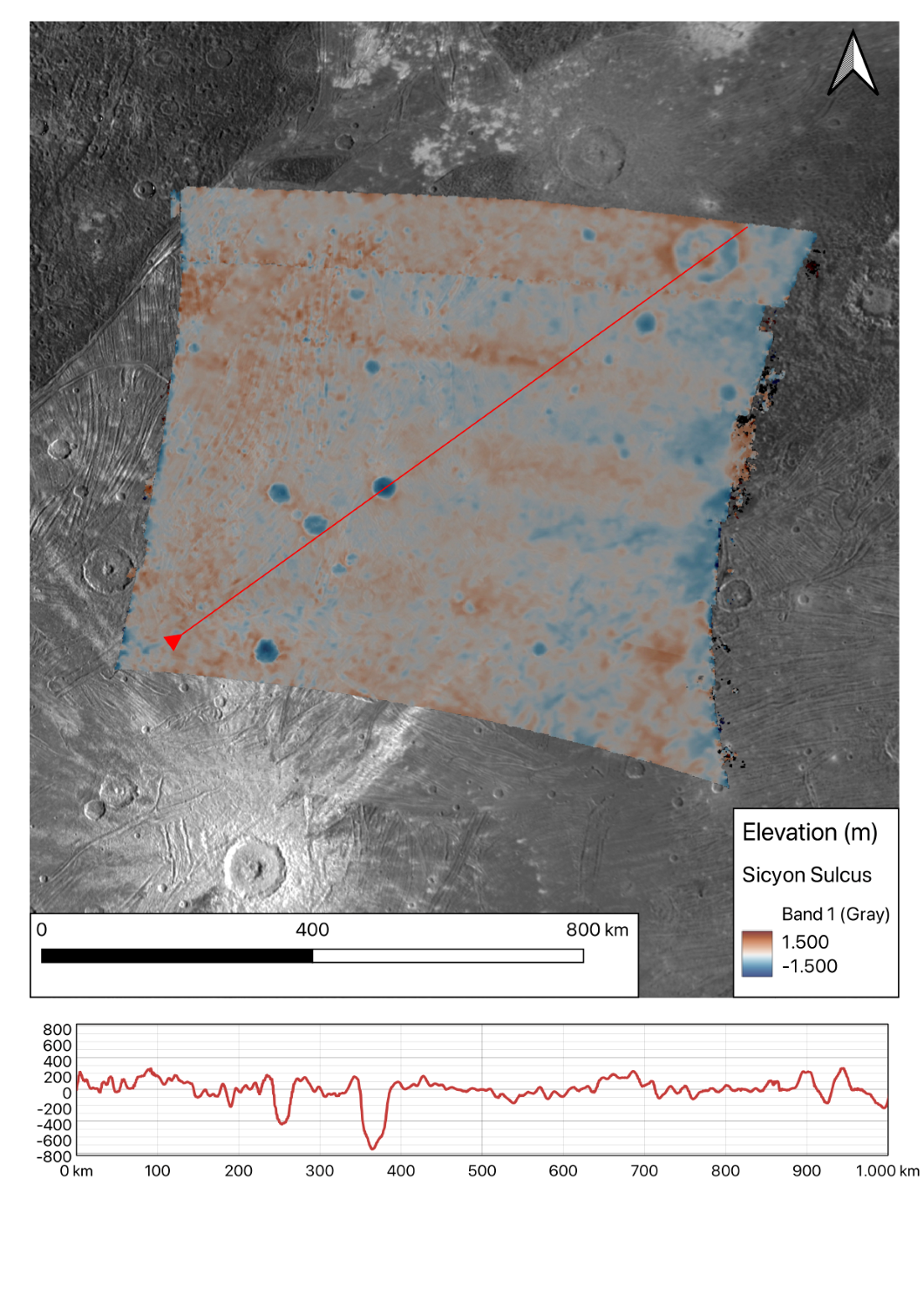
Figure 1. Digital Terrain Model (DTM) example for Ganymede, based on stereo coupling of JUNO images JNCR_2021158_34C00001_V01 and JNCR_2021158_34C00002_V01. Legend shows the elevation values, comprised between -1500 and 1500 m in relation to Ganymede’s reference ellipsoid.
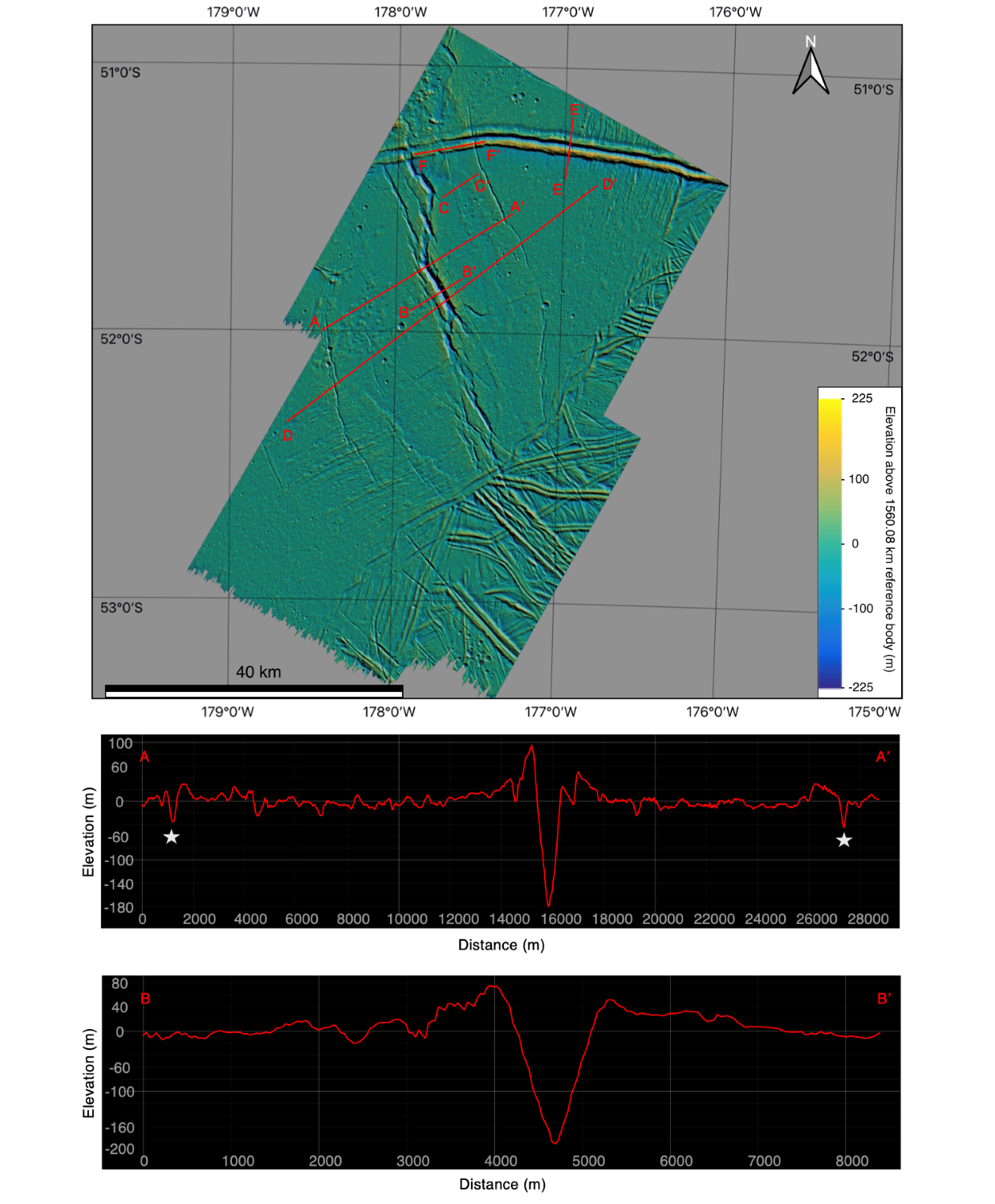
Figure 2. Shape-from-shading digital terrain model (DTM) of Ménec Fossae on Europa, individual DTMs are of 9926r and 9939r Galileo Solid-State Imager (SSI) image frames, later mosaicked together. From [8].
References:
[1] Grasset et al. (2013), PSS. https://doi.org/10.1016/j.pss.2012.12.002
[2] Pappalardo et al. (2024), SSR. https://doi.org/10.1007/s11214-024-01070-5
[3] Chivers et al. (2021), JGR: Planets. https://doi. org/10.1029/2020JE006692
[4] Schenk et al. (2001), Nature. https://doi.org/10.1038/35065027
[5] Stephan et al. (2021), PSS. https://doi.org/10.1016/j.pss.2021.105324
[6] Giese et al. (2017), 48th LPSC Abstracts. No. 1964 p. 2474
[7] Craft et al. (2016), Icarus. https://doi.org/10.1016/j.icarus.2016.01.023
[8] Matteoni et al. (2023), JGR: Planets. https://doi.org/10.1029/2022JE007623
[9] Palumbo et al. (2025), SSR. https://doi.org/10.1007/s11214-025-01158-6
How to cite: Matteoni, P., Walter, S., Aye, K.-M., Lamers, G., Hauber, E., Stephan, K., and Postberg, F.: Geomorphological and Topographic Analysis of Shallow Subsurface Water Reservoirs on Ganymede and Europa, Europlanet Science Congress 2026, The Hague, The Netherlands, 7–11 Sep 2026, EPSC2026-1022, https://doi.org/10.5194/epsc2026-1022, 2026.


