
 1,1,
1,1,- 1Department of Earth System Sciences, University of Hamburg, Hamburg, Germany (louisa.bahr@uni-hamburg.de)
- *A full list of authors appears at the end of the abstract
Introduction: The Chicxulub meteorite impact crater, located on the Yucatán Peninsula in Mexico, is the remnant of a significant short-term deformation process [1, 2]. The crater with a diameter of 200 km, contains a morphological peak ring 80 to 90 km in diameter [2, 3] (Fig. 1a). Peak rings are hallmarks of many large impact structures in the Solar System, formed toward the end of cratering [2, 4]. Elucidating the deformation kinematics of peak-ring formation is of particular significance for better understanding the formation of this class of complex impact craters. The IODP-ICDP Expedition 364 drill core revealed that shocked target rock of the Chicxulub peak ring is pervasively affected by decimeter-scale brittle shear faults (Fig. 2), apparently formed toward the end of peak-ring formation [5]. These shear faults lend themselves to infer the deformation kinematics under which the peak ring formed.
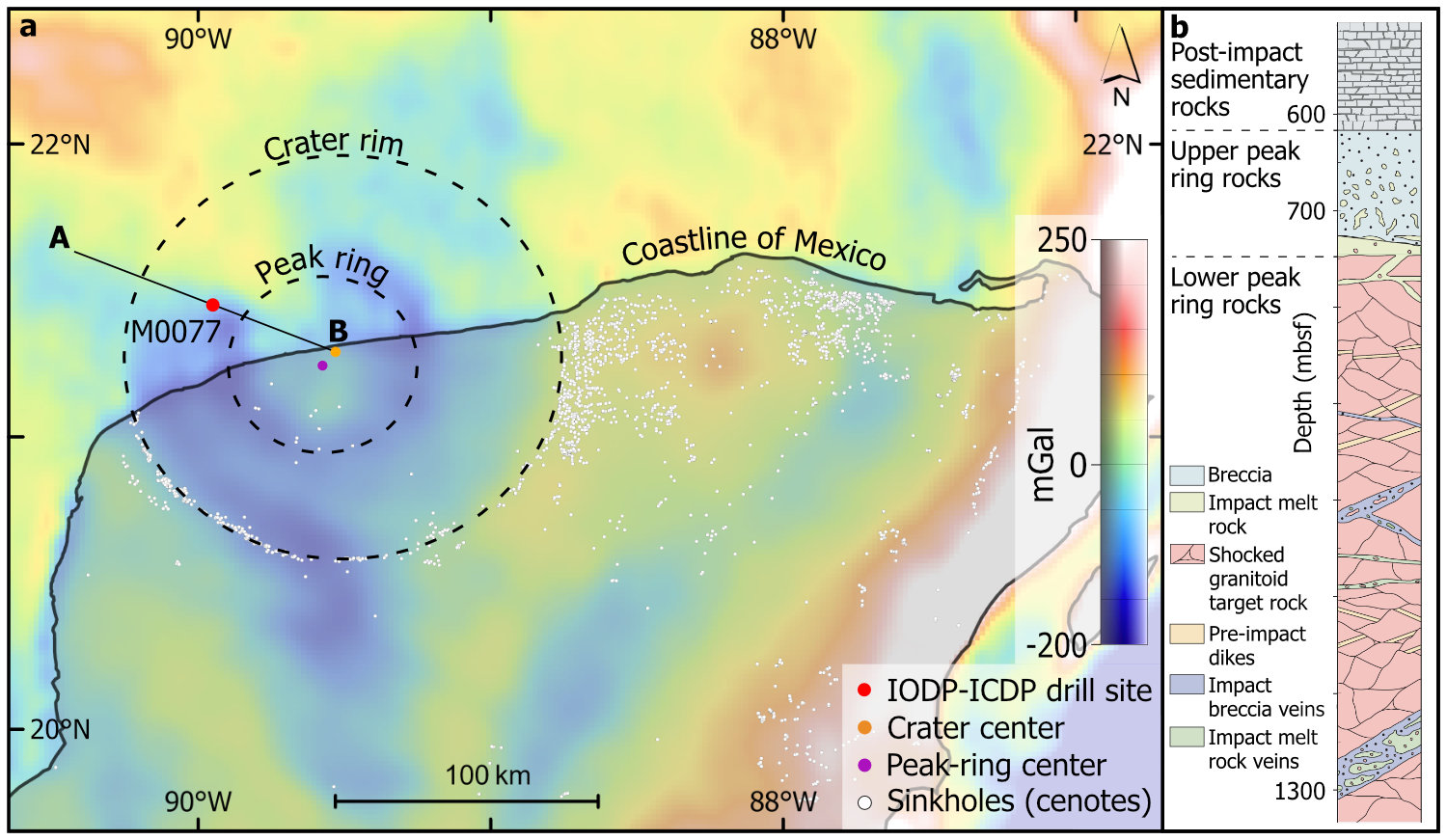
Figure 1. Drill site and lithological column of IODP-ICDP Expedition 364 drill core M0077. (a) Drill site and crater location on the Yucatán peninsula. Line labeled A/B shows the location of the cross section in Fig. 3. Background colors: Sandwell gravity anomaly map [7] (b) Schematic stratigraphy of the recovered lithologies (modified from [4]). The lower peak ring rocks exhibit pervasive evidence of brittle deformation.
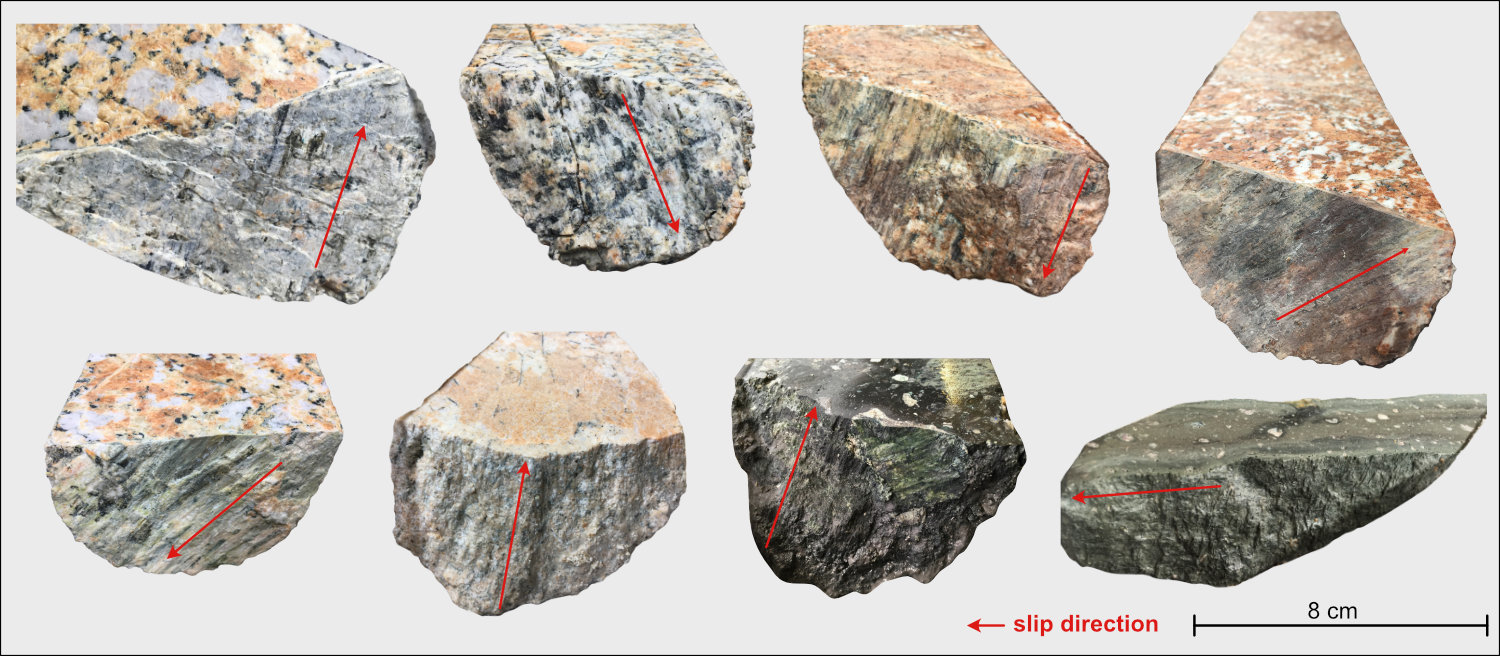
Figure 2. Brittle shear fault surfaces in the lower peak ring rocks from drill core M0077. Striations indicate the slip direction, marked by a red arrow for the hanging wall.
Methods: The orientations and slip senses of 602 exceptionally well-preserved mesoscopic shear faults (Fig. 2), extracted from the drill core, were analyzed kinematically. This structural data set and its quality are unique among drill-core-based structural studies and offer a most original contribution to the field of impact cratering studies. The data, initially measured on core segments in a horizontal position, was rotated back to its in-situ position prior to extracting the principal kinematic axis orientations for selected fault subsets. The kinematic inversion was then conducted using the software FaultKin [6], which produced lower-hemisphere equal-area projections of the kinematic data, most importantly the orientations of the principal kinematic axes. Contouring of the principal kinematic axes and application of a Linked Bingham Analysis allowed us to visualize the dominant orientation of principal kinematic axes for each fault subset. The heterogeneity of shear faulting with depth was elucidated by employing a fault separation method specifically designed for this purpose. This method treated the data according to their occurrence with depth and did not eliminate “unfitting” data, which, unfortunately, is a common practice of other fault-slip inversion programs. Our approach resulted in 17 domains of fault subsets based on the examination of multiple cycles of fault separation, guided by metric, lithologic and structural separation criteria. Subsequent analysis of the domains enabled the identification of prominent deformation regimes.
Results and Discussion: A total of thirteen distinct kinematic regimes were identified with depth along the drill core, four additional zones exhibited ambiguous results. The identification of multiple kinematic regimes indicates that kinematic heterogeneity occurs on the 10 to 100-meter scale. The kinematic regimes are characterized by various principal kinematic axis configurations. Transitions from one regime to another appear to be incremental in most segments of the core, while sudden shifts in the fault kinematics are also observed. The kinematic axes oriented horizontally demonstrate variability in direction. In the case of domains exhibiting horizontal maximum shortening axes, the predominant direction is NNW-SSE (Fig. 3). By contrast, the horizontal maximum extension axes cluster mostly around ENE-WSW, i.e., concentric with regard to the crater center (Fig. 3). These directions do not align with numerically predicted horizontal strain axes.
Our inversion of the fault-slip data revealed two major kinematic regimes, depicting the local complexity of the cratering flow field beneath the peak ring (Fig. 3). Horizontal shortening with vertical extension is the predominant principal kinematic axis configuration (Fig. 3). This kinematic regime is mostly evident from approximately 748 meters below seafloor (mbsf) to approximately 1234 mbsf (Fig. 1b). Consequently, we propose that this regime is the one that ultimately resulted in the formation of the peak ring. However, horizontal concentric extension prevails at greater depths within the drill core, from 1235 mbsf to 1333 mbsf (Fig. 1b, 3). We propose that this occurrence is associated with horizontal dilatation at this depth, where a localized thrust shear zone seems to be present (Fig. 3).
Collectively, the deformation kinematics are consistent with rock flow during peak ring formation. This is marked by the occurrence of two simultaneously operating processes: rollback of the crater margin, and outward displacement of collapsed central peak material. These processes result in a radial velocity discontinuity at the location of peak-ring formation. The findings of this study refine current numerical impact simulations of peak ring crater formation with ground truth data derived from the drill core. Currently, numerical models cannot depict kinematic regimes at the same resolution as our fault-slip analysis does. Our work supports gravity-controlled cratering of the dynamic collapse model. While the impetus for this study was the Chicxulub meteorite impact and the associated IODP-ICDP Expedition 364 drill core, the results demonstrate that impact-induced brittle shear faults can principally offer valuable insights into the deformation kinematics during peak-ring formation through a kinematic fault-slip analysis.
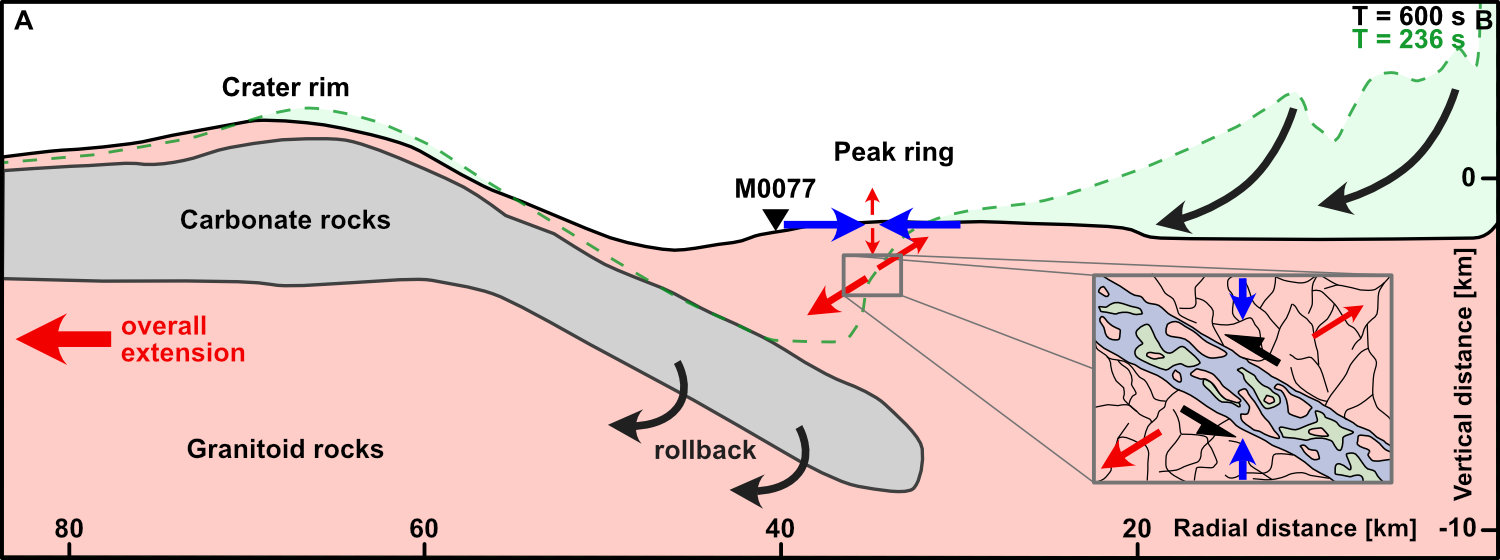
Figure 3. Schematic radial cross section of the crater, indicating major kinematic regimes as red/blue arrows for extension/shortening, respectively. Black arrows are proposed material transport trajectories during late cratering. Morphology at T = 600 s, i.e., after the peak ring formed; green stippled line marks crater morphology at T = 236 s, i.e., at the beginning of central peak collapse (based on [5]).
References:
[1] Melosh H. J. (1989) Oxford University Press.
[2] Gulick S. et al. (2013) Reviews of Geophysics 51:31–52.
[3] Morgan J. et al. (1997) Nature 390:472–476.
[4] Morgan J. V. et al. (2016) Science 354:878–882.
[5] Riller U. et al. (2018) Nature 562:511–515.
[6] Marrett R. and Allmendinger R. W. (1990) Journal of Structural Geology 12:973–986.
[7] Sandwell D. T. et al. (2014) Science 346:65–67.
Joanna Morgan, Sean Gulick, Claire Mellett, Johanna Lofi, Elise Chenot, Gail Christeson, Philippe Claeys, Charles Cockell, Marco Coolen, Ludovic Ferrière, Catalina Gebhardt, Kazuhisa Goto, Heather Jones, David Kring, Christopher Lowery, Rubén Ocampo-Torres, Ligia Perez-Cruz, Annemarie E. Pickersgill, Michael Poelchau, Auriol Rae, Cornelia Rasmussen, Mario Rebolledo-Vieyra, Ulrich Riller, Honami Sato, Jan Smit, Sonia Tikoo, Naotaka Tomioka, Michael Whalen, Axel Wittmann, Kosei Yamaguchi, Long Xiao, William Zylberman, Jaime Urrutia-Fucugauchi, Tim Bralower
How to cite: Bahr, L. and Riller, U. and the IODP-ICDP Expedition 364 Scientists: Deformation kinematics of peak-ring formation: unique evidence from brittle fault analysis of the Chicxulub IODP-ICDP Expedition 364 drill core, Europlanet Science Congress 2026, The Hague, The Netherlands, 7–11 Sep 2026, EPSC2026-103, https://doi.org/10.5194/epsc2026-103, 2026.


