TP5 | Impact processes in the Solar System

TP5

Impact processes in the Solar System
Co-organized by SB
Convener: Chrysa Avdellidou | Co-conveners: Elena Martellato, Isabel Herreros, Robert Luther, Jens Ormö, Cem Berk Senel
Orals THU1
| Thu, 10 Sep, 08:30–10:00 (CEST)|Room Jupiter (Jazz 1 & 2)
Orals THU2
| Thu, 10 Sep, 11:00–12:30 (CEST)|Room Jupiter (Jazz 1 & 2)
Orals THU3
| Thu, 10 Sep, 14:00–15:30 (CEST)|Room Jupiter (Jazz 1 & 2)
Posters THU-POS
| Attendance Thu, 10 Sep, 18:00–19:30 (CEST) | Display Thu, 10 Sep, 08:30–19:30|Foyer 2, F2.6–21
Thu, 08:30
Thu, 11:00
Thu, 14:00
Thu, 18:00
Collisional processes are integral mechanisms that both shape the final configuration of the Solar System, and modify planetary surfaces and small bodies from its birth until today.
This session aims at understanding planetary impact processes at all scales, in terms of impact cratering and ejecta dynamics, crater distribution and crater chronology, material mixing, shock metamorphism and other geochemical consequences, ejecta-atmosphere interactions, impact induced climatic and environmental effects, and biotic responses.
We welcome oral and poster presentations across this broad range of studies about natural or artificial impact collision phenomena on planetary surfaces and small bodies. In particular, abstracts on impact modelling, impact laboratory experiments, geologic and structural mapping, petrographic and geochemical analysis of impact products, as well as remote sensing observations from space missions to planets and small bodies. We also welcome the examination of competing hypotheses for the giant impact formation of terrestrial and outer solar system bodies. Finally, we also support abstracts investigating the DART impact, whose outcome will be observed by HERA few months after this conference.

Orals THU1: Thu, 10 Sep, 08:30–10:00 | Room Jupiter (Jazz 1 & 2)

Chairpersons: Chrysa Avdellidou, Cem Berk Senel
Large Impacts and Origins
08:30–08:42
|
EPSC2026-101
|
ECP
|
On-site presentation
Duarte Branco, Pedro Machado, and Sean Raymond

Cosmochemical studies have proposed that Earth accreted roughly 5%–10% of its mass from carbonaceous
(CC) material, with a large fraction delivered late via its final impactor, Theia (the Moon-forming impactor).
Here, we evaluate this idea using dynamical simulations of terrestrial planet formation, starting from a standard
setup with a population of planetary embryos and planetesimals laid out in a ring centered between Venus and
Earth’s orbits, and also including a population of CC planetesimals and planetary embryos scattered inward by
Jupiter. We find that this scenario can match a large number of constraints, including (i) the terrestrial planets’
masses and orbits; (ii) the CC mass fraction of Earth; (iii) the much lower CC mass fraction of Mars, as long
as Mars only accreted CC planetesimals (but no CC embryos); (iv) the timing of the last giant (Moon-forming)
impact; and (v) a late accretion phase dominated by non-carbonaceous (NC) bodies. For this scenario to work,
the total mass in scattered CC objects must have been ∼ 0.2−0.3 M, with an embryo-to-planetesimal mass ratio
of at least 8, and CC embryos in the ∼ 0.01 − 0.05 M mass range. In that case, our simulations show there are
roughly 50-50 odds of Earth’s last giant impactor (Theia) having been a carbonaceous object — either a pure
CC embryo or an NC embryo that previously accreted a CC embryo. Our simulations thus provide dynamical
validation of cosmochemical studies.

How to cite: Branco, D., Machado, P., and Raymond, S.: Dynamical origin of Theia, the last giant impactor on Earth, Europlanet Science Congress 2026, The Hague, The Netherlands, 7–11 Sep 2026, EPSC2026-101, https://doi.org/10.5194/epsc2026-101, 2026.

08:42–08:54
|
EPSC2026-202
|
ECP
|
On-site presentation
Harrison Agrusa, Joseph DeMartini, Thomas Meier, and Patrick Michel

Contact binaries are common among small bodies throughout the Solar System. Based on radar images,  ~10-30% of all NEAs larger than ~200 m are thought to be contact binaries [1,2], though their origin remains poorly explained. NASA’s Lucy mission recently encountered the main-belt asteroid 52246 Donaldjohanson (DJ), revealing its bilobate shape. DJ’s cratering age and YORP spin-down timescale are both consistent with the age of its collisional family (Erigone, ~150 Myr) [3,4], suggesting that its bilobate shape could be a direct product of catastrophic disruption and reaccumulation.

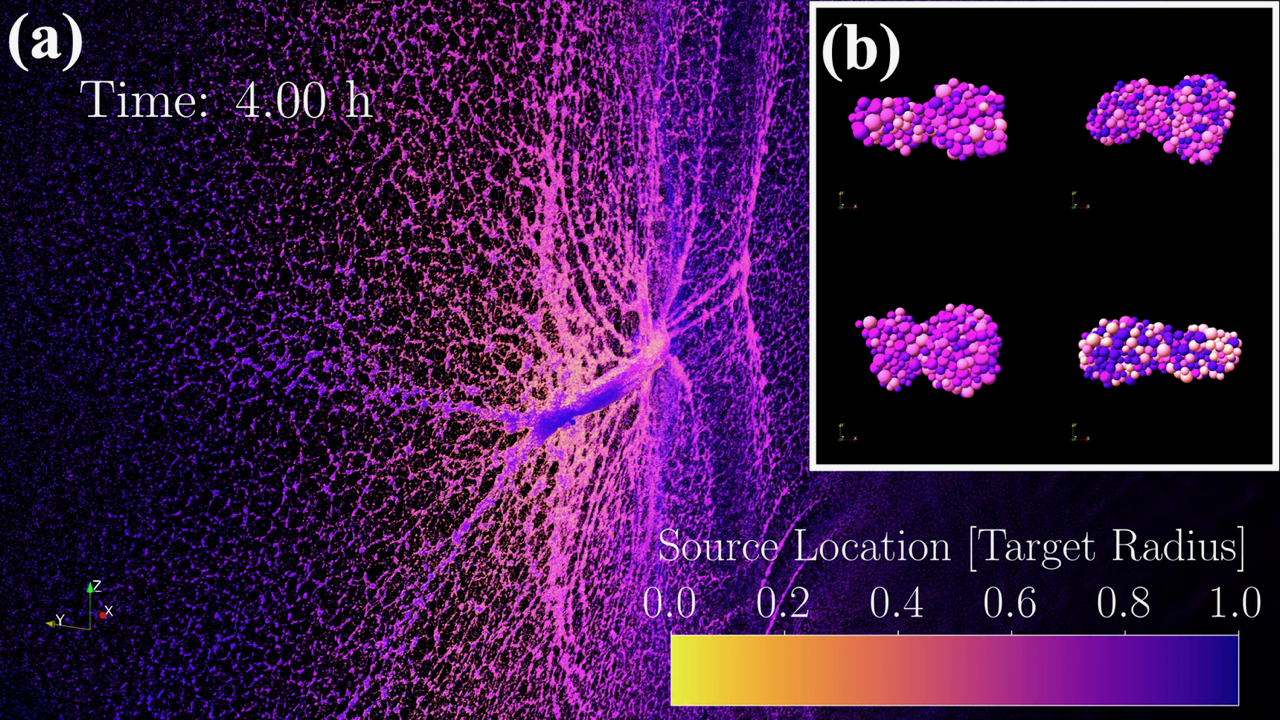
We perform smoothed-particle hydrodynamics (SPH) simulations of the collisional disruption of a 100 km asteroid followed by the subsequent gravitational reaccumulation of fragments using a N-body code with the soft-sphere discrete element method (SSDEM) for interparticle friction forces. With recent algorithmic improvements and GPU acceleration, we can simulate asteroid family formation using ~108 particles, roughly ~3 orders of magnitude beyond previous studies, resolving the spins and shapes of km-sized fragments. A preliminary low-resolution simulation is shown in Fig. 1, where we find roughly ~20% of the reaccumulated fragments form bilobate shapes as a result of hierarchical growth of debris, leading to frequent low-speed mergers of similarly sized objects. In addition to explaining the formation of asteroid Donaldjohanson, this high contact-binary fraction suggests that catastrophic disruptions may be the dominant formation mechanism for contact binaries observed among NEAs. We will present what are, to our knowledge, the highest-resolution simulations of asteroid catastrophic disruptions to date, and explore how contact-binary properties depend on material properties and impact conditions (friction, impact energy, target rotation, etc.).

Figure 1: (a) A snapshot showing the gravitational reaccumulation of particles 4 hours after a collision between a 25 km projectile and a 100 km target at an impact speed of 5 km/s and angle of 45°. (b) Renderings of four km-scale contact binaries ~50 hours after the collision. Particle colors indicate their source location within the parent body. 


References
1. Benner, et al., in Asteroids IV, Radar observations of Near-Earth and Main-Belt Asteroids, 2015, 165-182.
2. Virkki, et al., PSJ, Arecibo Planetary Radar Observations of Near-Earth Asteroids: 2017 December–2019, 2022, 3:222, 36.
3. Marchi et al., PSJ,  A Pre-flyby View on the Origin of Asteroid Donaldjohanson, a Target of the NASA Lucy Mission, 2025, 6:59, 19.
4. Bierhaus et al., EPSC-DPS Joint Meeting 2025, An overview of the geology on the C-type Main Belt asteroid (52246) Donaldjohanson from NASA's Lucy flyby.

How to cite: Agrusa, H., DeMartini, J., Meier, T., and Michel, P.: Catastrophic disruptions as the origin of contact-binary asteroids, Europlanet Science Congress 2026, The Hague, The Netherlands, 7–11 Sep 2026, EPSC2026-202, https://doi.org/10.5194/epsc2026-202, 2026.

08:54–09:06
|
EPSC2026-1156
|
ECP
|
On-site presentation
Carys Bill, Gareth Collins, Thomas Davison, Brandon Johnson, Shigeru Wakita, Aleksandra Sokolowska, Oliver Coombes, Danielle Kallenborn, Peter Grindrod, and Joe McNeil

Large impact basins provide key insights into planetary evolution by excavating and redistributing deep material. The South Pole–Aitken (SPA) Basin on the Moon and the Hellas Basin on Mars are among the largest known impact structures in the Solar System. Observations indicate that both impact events significantly modified crustal structure and exposed deep crustal and potentially mantle material (e.g., [1-4]). Numerical modelling allows these observations to be used to constrain basin formation and improve our broader understanding of basin-scale impact processes across planetary bodies.

3D numerical simulations of the SPA and Hellas basin formation were conducted using iSALE-3D [5-6]. Simulations explored impact velocities of 10–20 km s⁻¹, oblique impact angles of 20–45°, and a range of target thermal gradients representative of early lunar and martian interiors. Targets were modelled as spherical layered bodies and impactors as differentiated spheres, with materials defined by ANEOS-derived equations of state [7-10] and strength models from [11]. Simulations were run up to 5 hours post-impact, until crustal motions stabilised. Simulated crustal thickness, topography, and material distributions were compared with observation-based constraints, including basin morphology and crustal structure datasets [1, 12].

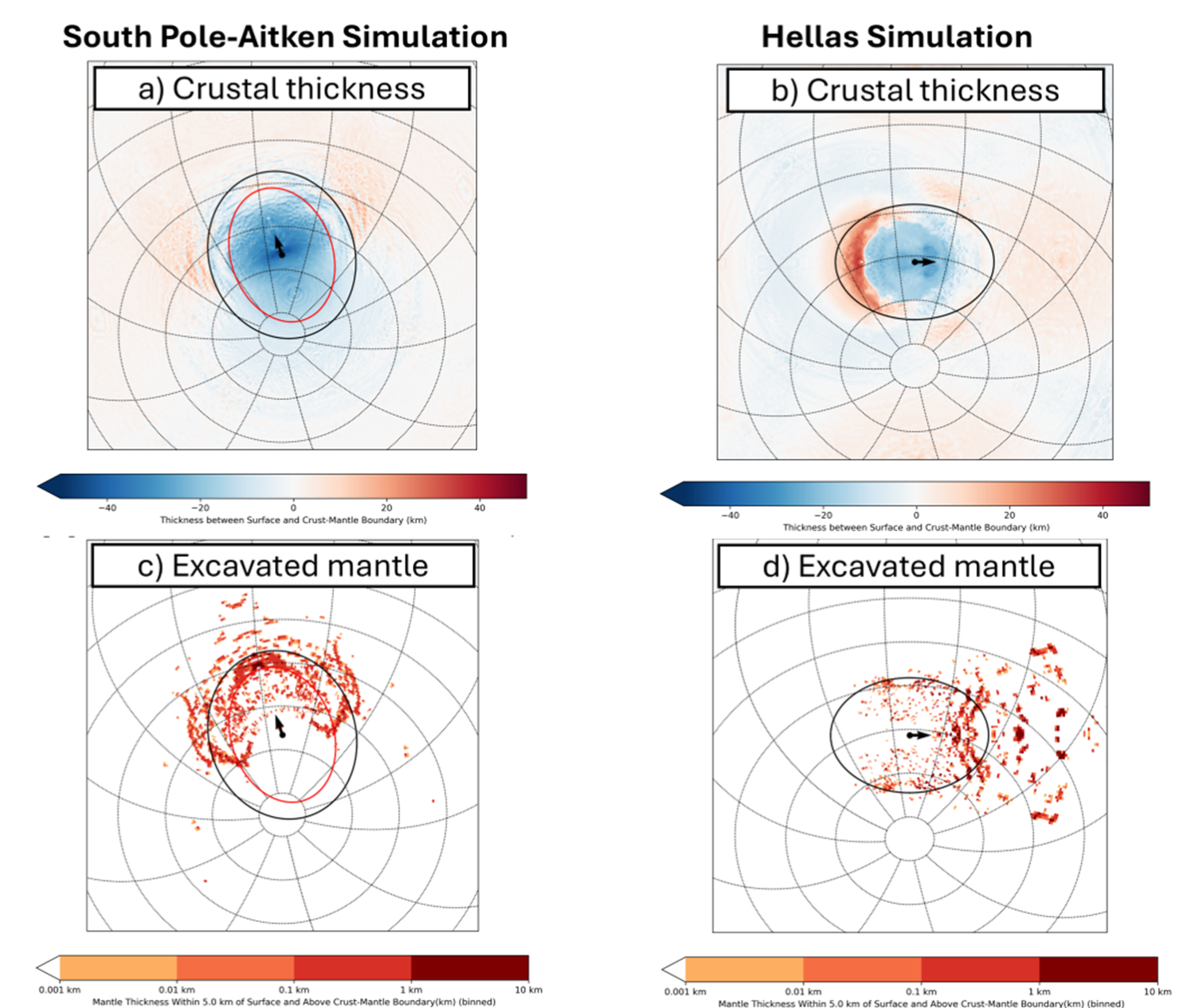
Best-fit scenarios for both SPA and Hellas favour moderately oblique impacts at an angle of 30° to the tangent plane, which produce elongated basin planforms that are consistent with the observed basin shapes (Figure 1a-b). This supports the idea that, for impacts large enough for planetary curvature to influence basin-forming dynamics, moderately oblique impacts produce elliptical basins.

Figure 1: Left: a best-fit SPA basin-forming simulation employing a 200km diameter impactor striking a target with a 30K/km near-surface thermal gradient and 1700K mantle at 11.1km/s and a 30° impact angle.  Inner and outer ellipses [13] and the centre of the basin are plotted. A northwards impact trajectory is assumed. Right: a best-fit Hellas basin-forming simulation employing a 480km diameter impactor striking a target with a 30K/km near-surface gradient and 1400K mantle at 10km/s and a 30° impact angle. Here, the crust is still deforming and has not yet reached its final state at 5 hours post-impact. An ellipse shows the approximate outline of the observed basin, and an eastward impact trajectory is assumed.  In the top figures, the change in crustal thickness induced by the simulation is shown, with areas of thickened crust in red and thinned crust in blue. In the lower figures, the integrated thickness of mantle above or entrained in the crust and within 5km of the model surface is shown. Each map shows the simulation at 5 hours after impact.

Basin-scale impacts are highly sensitive to target thermal structure and rheology, yet the pre-impact thermal states of both bodies are not yet well constrained. Simulation results show that impacts into warm, thermally weakened crust provide the best-fit for both SPA and Hellas, suggesting early formation times when lower crust and mantle temperatures were close to the solidus. In cases employing a cooler target, a thickened crust surrounds the basin whilst the mantle remains exposed at the basin centre. To produce a thin crust in the basin consistent with present-day observations, these scenarios would require a secondary buoyant crust to be produced from the mantle melt pool.

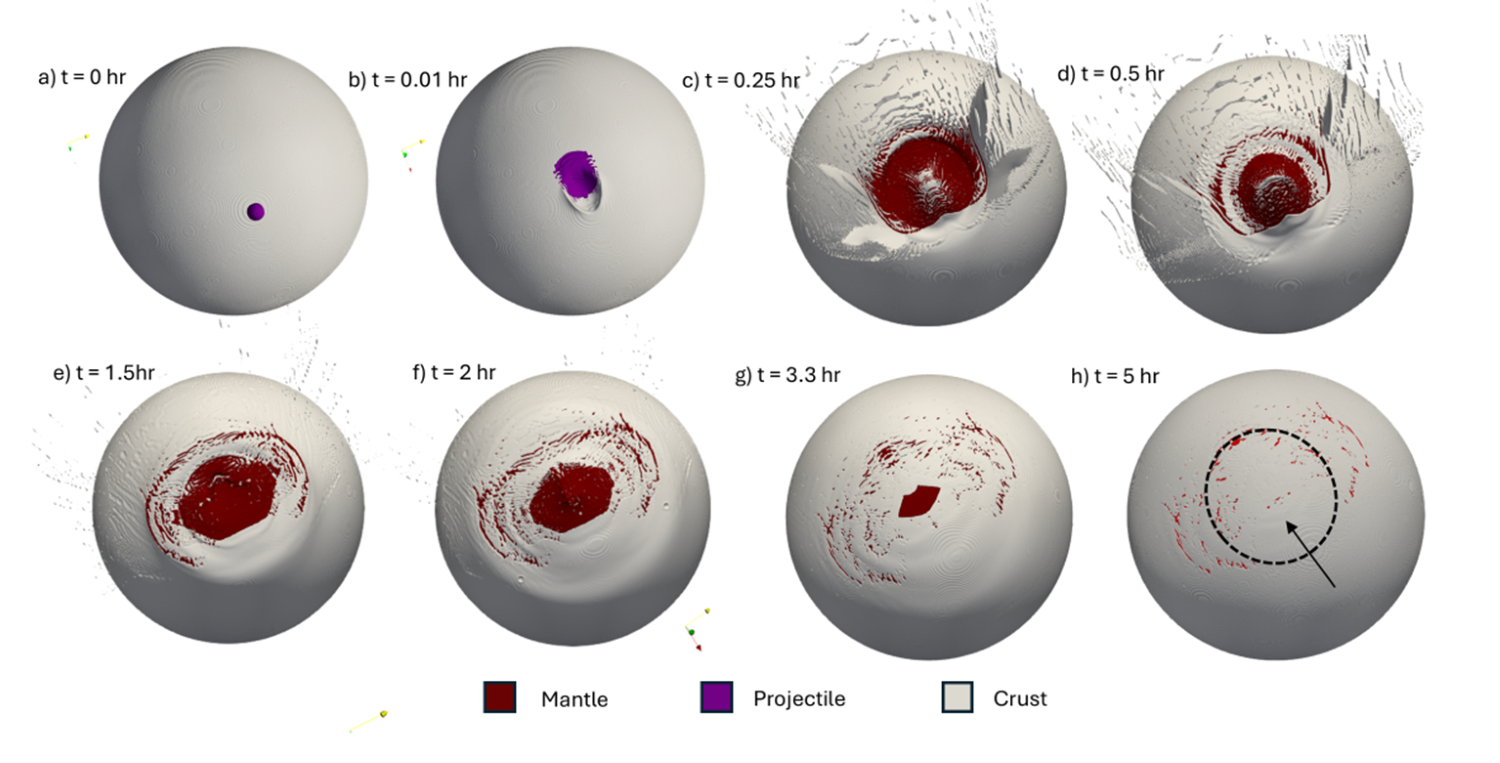
The preferred warmer scenarios produce extensive material redistribution, including crustal rafting that covers mantle exposed at the basin centre (Figure 2e-h) and asymmetrical, downrange “butterfly” patterns of ejecta (Figure 1c-d). Mantle material is excavated during both the excavation stage and central uplift collapse. However, continued post-impact crustal motion and inward crustal rafting bury or entrain much of this mantle beneath and into the redistributed crust. Thus, a large portion of the excavated mantle becomes mixed within the upper crust rather than remaining exposed at the surface. The precise trajectories and therefore the ultimate distribution of the material excavated by each of these basin-forming impacts remain uncertain.

Figure 2: Snapshots from an iSALE-3D simulation at different timesteps for a 200 km diameter impactor striking a 30 K/km Moon-like target with a 1700 K mantle at a 30° impact angle and 11.1 km/s velocity. The impact direction is toward the upper left (arrow) and the approximate outer rim of the basin (dashed outline) is shown in the final snapshot.

Ongoing and future work will investigate the effects of lateral variations in crustal thickness and thermal structure on basin formation and material redistribution. This will help better constrain impact direction and the fate of excavated material, while providing new insights into the role of basin-forming impacts in the early evolution of the Moon and Mars.


Acknowledgments: CB is funded by the Kentfield Scholarship. This work used the DiRAC Data Intensive service at the University of Leicester, managed by the University of Leicester Research Computing Service on behalf of the STFC DiRAC HPC Facility. This DiRAC service was funded by BEIS, UKRI and STFC capital funding and STFC operations grants. DiRAC is part of the UKRI Digital Research Infrastructure.

References : [1] Wieczorek, M.A. et al. (2013) Science 339: 671-675. [2] Melosh, H.J. et al (2017) Geology, 45 (12), 1063-1066. [3] Moriarty, D. et al. (2021) JGR: Planets, 126(1), e2020JE006589 [4] McNeil, J., et al. (2025),  PSC–DPS Joint Meeting 2025, Helsinki, Finland, Abstract EPSC-DPS2025-617. [5] Elbenhausen, D. et al. (2009) Icarus, 204:716-731. [6] Elbenhausen, D. & Wünnemann, K. (2011) 11th Hypervelocity Impact Soc. Symposium. [7] Thompson, S. L. & Lauson, H. S. (1972). Sandia National Laboratory Report, SC-RR-710:309p. [8] Benz, W. et al. (1989). Icarus, 81:113–131. [9] Pierazzo, E. et al. (1997). Icarus, 127:408–423. [10] Ivanov, B. A. et al. (2010). Geol. Soc. Spec. Pap. 465:29– 49. [11] Potter, RWK et al. (2012) Icarus, 220, 730–743. [12] Wieczorek, M. et al. (2022), JGR: Planets, 127, e2022JE007298. [13] Garrick-Bethell &  Zuber (2009),  Icarus, 204(2), 399–408. https://doi.org/10.1016/j.icarus.2009.05.032.

How to cite: Bill, C., Collins, G., Davison, T., Johnson, B., Wakita, S., Sokolowska, A., Coombes, O., Kallenborn, D., Grindrod, P., and McNeil, J.: 3D Numerical Modelling of the South Pole-Aitken and Hellas Basin-Forming Impacts, Europlanet Science Congress 2026, The Hague, The Netherlands, 7–11 Sep 2026, EPSC2026-1156, https://doi.org/10.5194/epsc2026-1156, 2026.

The Moon
09:06–09:18
|
EPSC2026-587
|
On-site presentation
Elisa Maria Alessi and Robert Jedicke

Earth’s co-orbitals are asteroids in mean motion resonance with the Earth. They are of interest because of their dynamics that is typically stable and because they represent low Δv targets for asteroid mining companies. Recently, spectroscopic analysis of the co-orbital asteroid Kamo‘oalewa, and of two objects temporarily captured by the Earth, have indicated the possibility of a lunar origin for these bodies. Several subsequent studies addressed this possibility by means of numerical integration, especially for the case of Kamo‘oalewa, and attempted to identify the crater that could have launched it.

Here we compute the steady-state number of Earth’s co-orbitals deriving from lunar ejecta by computing their frequency and lifetime by means of long-term numerical simulations (about 50 My), paying attention to their co-orbital regime (quasi-satellite, horseshoe, tadpole or compound) and orbital eccentricity and inclination. The number and size are estimated by employing scaling laws that characterize the impact processes. In parallel, we compute the population of Earth’s co-orbital that the Main Belt can yield using NEOMOD3 [2]. Both outcomes are compared with the known population obtained from JPL Horizons [3].

The results show that the co-orbitals that the Moon can provide have a lower average eccentricity and inclination than those that the Main Belt can provide. Moreover, the existing population can be explained by the NEOMOD3 model. With NEOMOD3 the co-orbitals’ provenance is mainly from the inner Main Belt and we find that about half of them are in the tadpole regime while only 2 Earth Trojans are officially recognized, likely due to observational bias. The tadpole population in our results are eccentric and inclined, and we identify 3 additional objects as Trojans, namely, 2005 UH6, 2005 QQ87 and 2024 JR16.

Finally, the main source of uncertainty is given by impact process’ laws and thus we suggest that a systematic spectroscopic and dynamical characterization of Earth’s co-orbital can help reduce the uncertainty on those scaling laws.

The work that we will present is based on [1].

References

[1] Alessi, E.M., Jedicke, R., 2026. The steady-state population of Earth’s co-orbitals of lunar provenance. Icarus 455, 117109.

[2] Nesvorný, D., Vokrouhlický, D., Shelly, F., Deienno, R., Bottke, W.F., Fuls, C., Jedicke, R., Naidu, S., Chesley, S.R., Chodas, P.W., Farnocchia, D., Delbo, M., 2024. NEOMOD 3: The debiased size distribution of Near Earth Objects. Icarus 417, 116110.

[3] https://ssd.jpl.nasa.gov/horizons/

How to cite: Alessi, E. M. and Jedicke, R.: Can the Moon be a source of Earth’s co-orbitals?, Europlanet Science Congress 2026, The Hague, The Netherlands, 7–11 Sep 2026, EPSC2026-587, https://doi.org/10.5194/epsc2026-587, 2026.

09:18–09:30
|
EPSC2026-664
|
On-site presentation
Marco Delbo, Philippe Lognonne, Daniel Sheward, Pierre-Yves Froissart, Chrysa Avdellidou, Paul Girard, Nicolas Mauclert, Laurent Herrier, Jean-Pierre Rivet, Bruno Mongellaz, Thierry Parra, Nicolas Anfosso, Enguerrand Maeght, Christelle Saliby, Andrea Ferrero, Fausto Giacometti, and Marco Angelini

Lunar impact flashes (LIFs) provide direct constraints on the flux and physical properties of meteoroids impacting the Earth–Moon system. Conventional monitoring is mainly performed in the visible wavelength range and is strongly limited by lunar phase, sky brightness, and observing geometry, resulting in sparse temporal coverage and a low probability of detecting rare energetic impacts.

We present the Twin Impact Lunar Telescope (TILT) network, a new infrastructure dedicated to monitoring LIFs in the short-wave infrared (SwIR). Each station consists of twin robotic 0.4 m telescopes operating simultaneously in the J band (1.25 μm) and Z band (0.9 μm), allowing rejection of false positives and multi-wavelength characterization of impacts. The systems use high-speed cameras operating at 60-100 FPS together with dedicated acquisition software (pyfcam) enabling on-the-fly compression and FITS cube storage.

The telescopes incorporate elongated carbon-fiber tubes and dedicated baffles allowing daylight observations of the Moon, substantially increasing observing time. TILT-1 is currently installed at Calern Observatory (Observatoire de la Côte d’Azur), while TILT-2 and TILT-3 are under construction. The objective is to deploy at least three stations at separated longitudes to maximize lunar coverage and increase detection of energetic LIFs.

The TILT network will support the Advanced ERC project LISTEN FLASH, which aims to combine telescopic observations of LIFs with lunar seismic detections. This unique approach will provide new constraints on the luminous efficiency of hypervelocity impacts, the flux of small bodies in cislunar space, and the properties of the lunar regolith and crust’s thickness.

We will also present some results from the TILT observations of the Geminids meteor stream in Dec 2025.  We detected 53 potential impact flashes and confirmed 11 of them through multi-frame observations, and independent detections by other observers. Our confirmed events range between magnitude +7.5 and +10.4, primarily in the V- and R-band. We obtained a higher rate of observations per hour than the expected values from existing campaigns, highlighting the importance of high-ZHR meteoroid streams for observing LIFs.

How to cite: Delbo, M., Lognonne, P., Sheward, D., Froissart, P.-Y., Avdellidou, C., Girard, P., Mauclert, N., Herrier, L., Rivet, J.-P., Mongellaz, B., Parra, T., Anfosso, N., Maeght, E., Saliby, C., Ferrero, A., Giacometti, F., and Angelini, M.:  The Twin Impact Lunar Telescope network and Geminids 2025 observations, Europlanet Science Congress 2026, The Hague, The Netherlands, 7–11 Sep 2026, EPSC2026-664, https://doi.org/10.5194/epsc2026-664, 2026.

09:30–09:42
|
EPSC2026-1021
|
On-site presentation
Daniel Sheward, Chrysa Avdellidou, and Marco Delbo
Over 850 lunar impact flashes (LIFs) have been reported in the literature and online databases by a wide range of observational campaigns and amateur astronomers [1, 2, 3, 4]. The introduction of PyNAPLE [5], a software package developed to identify craters formed by LIFs, enabled a revised calculation of the luminous efficiency [6]. This parameter is fundamental to LIF studies, as it quantifies the proportion of an impactor’s kinetic energy that is converted into observable light. Consequently, any revision to the luminous efficiency has significant implications for subsequent derived parameters.
 
Here, we revisit all previously reported LIFs using the updated luminous efficiency and expand the dataset to include all additional events recorded to date.
 
Using meteoroid stream determination software [7], we identify the likely parent stream(s) of the impactors, from which we derive properties including impact velocity, impact angle, and density. For flashes observed in multiple wavelength bands, we determine the blackbody temperature of the emission, while for events persisting over multiple frames, we examine the temperature evolution throughout the flash duration. We additionally estimate the diameters of the resulting craters, providing constraints to support future crater searches with tools such as PyNAPLE.
 
The revised luminous efficiency is larger than values previously adopted, meaning that a given impact generates more observable light and therefore corresponds to a smaller impactor than earlier estimates implied. This may account for the difficulty in detecting LIF-associated craters with PyNAPLE, as the craters produced by the faintest observable flashes are comparable to, or smaller than, the pixel scale of the Lunar Reconnaissance Orbiter Narrow Angle Camera (~0.5 m/px). We present the outcomes of these updated calculations along with revised statistical properties of the dataset, including the size–frequency distribution of the observed impacts.
 
References
1. Suggs R. M., Moser D. E., Cooke W. J., Suggs R. J., 2014, Icarus, 238, 23
2. Avdellidou C., et al., 2021, Planet. Space Sci., 200, 105201
3. Sheward D., Delbo M., Avdellidou C., Cook A., Lognonné P., 2025, A&A,699, L3
4. Liakos A., Bonanos A. Z., Xilouris E. M., Koschny D., Bellas-Velidis I., Boumis P., Maroussis A., Moissl R., 2024, A&A, 687, A14
5. Sheward D., Avdellidou C., Cook A., Sefton-Nash E., Delbo M., Cantarella, B., Zanatta L., 2022, MNRAS, 514, 4320
6. Sheward D., Delbo M., Avdellidou C., Cook A., Lognonné P., 2025, A&A, 699, L3
7. Avdellidou C., Vaubaillon J., 2019, MNRAS, 484, 5212

How to cite: Sheward, D., Avdellidou, C., and Delbo, M.: Statistical Analysis of Lunar Impact Flashes, Europlanet Science Congress 2026, The Hague, The Netherlands, 7–11 Sep 2026, EPSC2026-1021, https://doi.org/10.5194/epsc2026-1021, 2026.

09:42–09:54
|
EPSC2026-1276
|
On-site presentation
Elena Martellato, Paige Rice, Robert Luther, and Patrizia Borin

Introduction.

The Moon has long been considered a laboratory for collecting additional data to investigate impact craters, lacking an atmosphere and erosive processes caused by wind, water, and active plate tectonics that quickly modify landforms.

Past space missions, like the Lunar Reconnaissance Orbiter (LRO, [1]), have allowed to improve our understanding of impact structures and their formation, and the lunar surface more in general. For example, the LRO camera (LROC [2]) system can provide images in the panchromatic broad filter with a resolution up to 0.5 m (Narrow Angle Cameras / NACs), which can be furtherly combined to derive accurate digital terrain models (DTMs) of specific lunar features. These DTMs could allow the detailed analysis of the morphology of impact craters, and provide both constraints on the surface stratigraphy and ground-truth of numerical models of the formed impact structure [3, 4].

Currently, a new mission, “LUMIO” (LUnar Meteoroid Impacts Observer), dedicated to the observation of the impact process itself, is under development. It is an ESA 12U form-factor CubeSat mission for the lunar exploration [5, 6]. It aims to monitor and quantify the flashes produced by meteoroid impacts on the far side of the Moon from an L2 orbit, using its optical LUMIO-Cam designed for visible and near-infrared observations.

The collected data will be more accurate than the ground-based telescopes, due to the CubeSat closer to the observing event and unaffected by the influence of the terrestrial atmosphere. Thus, these will allow to outline the first accurate dynamical model of the meteoritical flux in the lunar environment. The lightcurve of the flash allows to derive the integrated energy Eremitted within the spectral interval Δλ on the lunar surface, and once known the luminous efficiency η, to derive the kinetic energy EK as Er/η.

The combination of these two sets of measurements will offer a natural validation of impact models, in addition to constrain the lunar stratigraphy. This work shows the results of systematic modelling that investigates how the impact mass and velocity, as well as the near-surface target properties, can affect the final crater morphology, in the framework of the scientific activities conducted within the LUMIO mission.

Methods. A systematic numerical investigation has been carried out using iSALE shock physics code (https://isale-code.github.io/, e.g., [7, 8, 9, 10]). Strength and porosity were modelled using a Drucker-Prager model and the ε-α-porosity compaction model, respectively.

For this initial investigation, we simulated projectiles of increasing diameters (from 1 µm to 1 m) impacting at 8.5 km/s to 71 km/s on the lunar surface. The target is assumed as an infinite half space, made of a basaltic regolith-like material, with 12% porosity. Different values of cohesion, friction coefficient, and porosity were tested. In particular, we varied cohesion (from 5 Pa to 0.5 MPa), friction coefficient (0.55, 0.6, 0.7), and porosity (12%, 20%, 40%), to evaluate their influence on crater morphology.


Results.

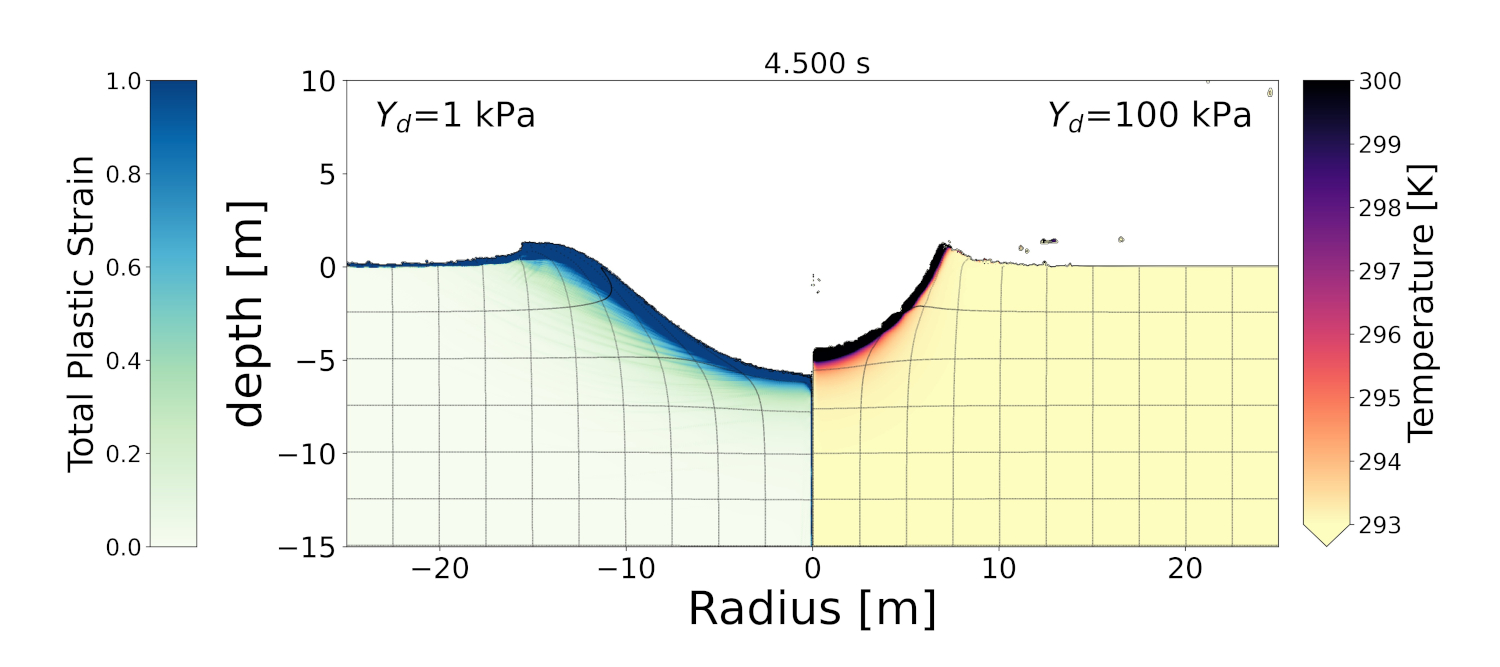
The first results have highlighted that craters exhibit a bowl-shape morphometry and a scattered ejecta deposit when forming in higher cohesion targets, whereas a decrease in cohesion lowers the aspect-ratio. This difference is shown in Figure 1. For the impact velocity of 9 km/s, passing from one extreme to the other of the tested range of cohesion (1 kPa and 100 kPa, cf. Figure 1), the diameter of the final crater can increase up to a factor of three. The depth-to-diameter ratio varies from 0.22 to 0.47. This is comparable to the effect of increasing impact velocity from 8.5 km/s to 71 km/s with cohesion held constant, which increases crater diameter by a factor of about 2.5; however, increased impact velocity has a minimal effect on depth-to-diameter ratio, remaining between 0.22 and 0.26.

Figure 1. Final time step of a 1 m basaltic projectile impacting at 9 km/s on the surface, with temperature set to 293 K. The left and right panels show the Total Plastic Strain distribution and the temperature variations, respectively. Cohesion is set to 1 kPa and 100 kPa, respectively in the left and right panels.


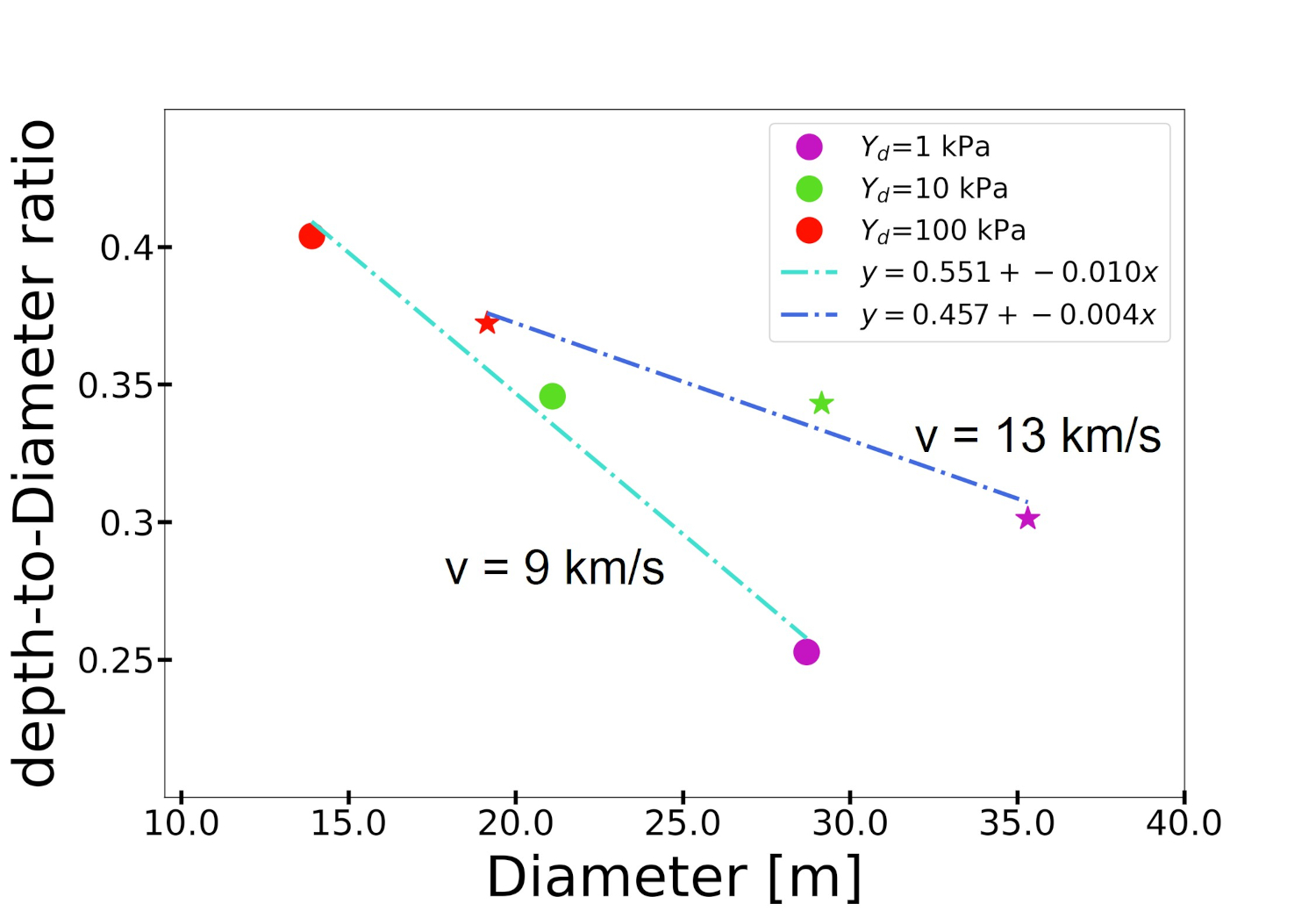
Generally, for a given projectile velocity, the crater sizes scale linearly, but different trends were found for different impact speeds (cf. Figure 2).

Figure 2. Comparison between the depth-to-diameter ratios of impacts occurring on one-layer regolith-like surface with various cohesions, at two different impact speeds (9 and 13 km/s).

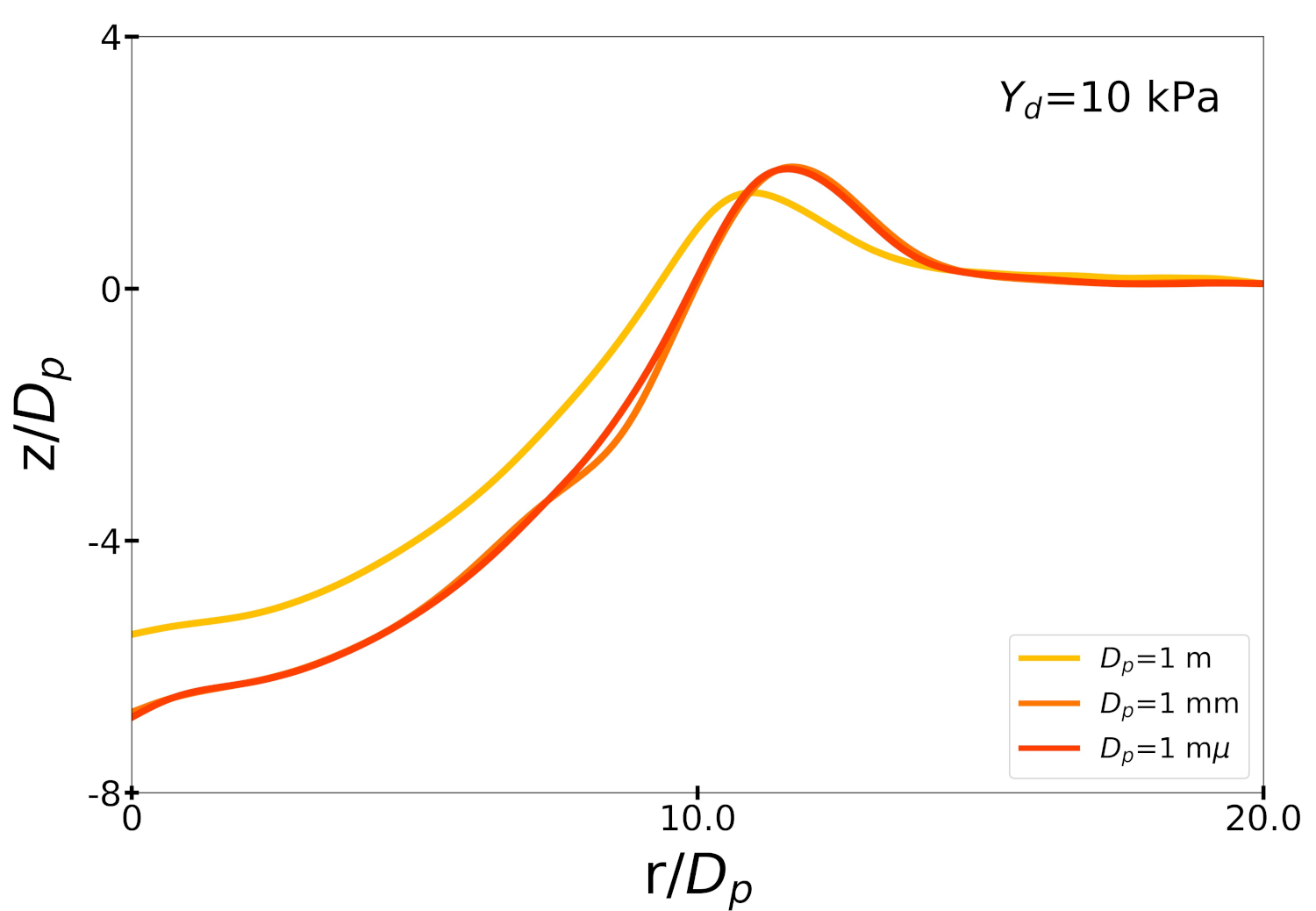
Finally, μm- and mm-scale craters show a slightly larger depth-to-diameter ratio than m-scale craters (0.3 vs. 0.25), and once normalized to projectile size they have greater dimensions (Figure 3).

Figure 3. Comparison between impacts occurring at the same 9 km/s speed, for different values of projectile size.


Future work. Future simulations will consider impacts on layered targets, which are a more realistic representation of planetary terrains (e.g., [11, 12]).


Acknowledgements.

We gratefully acknowledge the developers of iSALE‐2D/Dellen version (https://isale-code.github.io/), including Gareth Collins, Kai Wünnemann, Dirk Elbeshausen, Tom Davison, Boris Ivanov, and Jay Melosh. Some plots in this work were created with the pySALEPlot tool developed by Tom Davison.

This work has been funded by the Italian Space Agency through the agreement n. F43C23000340001 entitled “Supporto scientifico alla missione LUMIO”.


References.

[1] Keller et al. (2016) Icarus 273, 2−24.

[2] Robinson et al. (2010) Space Sci Rev 150, 81–124.

[3] Martellato et al. (2017) Meteorit Planet Sci 52, 1388−1411.

[4] Prieur et al. (2017) J Geophys Res: Planets 122, 1704−1726.

[5] Cipriano et al. (2018) Front Astron Space Sci 5, 29, 23 pp.

[6] Topputo et al. (2023) Icarus, 389, 115213.

[7] Amsden et al. (1980) Los Alamos Nat Lab Rep LA−8095, 101 pp.

[8] Collins et al. (2016) iSALE-Dellen manual, figshare.

[9] Collins et al. (2004) Meteorit Planet Sci 39, 217−231.

[10] Wünnemann et al. (2006) Icarus 180, 514−527.

[11] Hopkins et al. (2019) J Geophys Res: Planets 124, 349−373.

[12] Martellato et al. (2020) J Geophys Res: Planets 125, e2019JE006108.

How to cite: Martellato, E., Rice, P., Luther, R., and Borin, P.: Impact Flashes: exploring the far side of the Lunar surface, Europlanet Science Congress 2026, The Hague, The Netherlands, 7–11 Sep 2026, EPSC2026-1276, https://doi.org/10.5194/epsc2026-1276, 2026.

09:54–10:00

Orals THU2: Thu, 10 Sep, 11:00–12:30 | Room Jupiter (Jazz 1 & 2)

Chairpersons: Chrysa Avdellidou, Elena Martellato
Cratering across the Solar System
11:00–11:12
|
EPSC2026-1060
|
ECP
|
On-site presentation
Danielle P. Kallenborn, Gareth S. Collins, Thomas M. Davison, Carys A. Bill, and David A. Kring

Introduction:

Numerical impact simulations are mostly conducted as vertical impacts into homogeneous layers. Planetary targets, however, are complex and pre-existing topography and variations in the subsurface can significantly influence crater formation processes [e.g., 1-3]. The effect of pre-existing target heterogeneities is likely to be particularly important in heavily cratered terrains, such as the lunar south pole, or in proximity to major structural boundaries, such as the lunar dichotomy. Recent advances in computer hardware and shock physics codes now allow for more detailed impact simulations, enabling us to examine the complexities of oblique impacts in heterogeneous targets. In this work, we conduct three-dimensional numerical impact simulations of the Schrödinger basin to investigate how pre-existing target heterogeneity affects complex crater formation.

The Schrödinger basin is a ~330 km peak-ring basin on the lunar farside, close to the lunar south pole. It plays a prominent role in several upcoming missions such as Artemis and the Lunar Farside Seismic Suite [4]. The Schrödinger basin displays several asymmetries in its basin structure, particularly the crater rim and the peak ring. Those asymmetries are thought to be the result of an oblique impact [5] and pre-existing target heterogeneities [6,7], mostly caused by pre-existing craters, such as the South Pole-Aitken (SPA) basin in the east and the Amundsen-Ganswindt (AG) basin in the south. The Schrödinger basin is the best-preserved peak-ring basin on the Moon and the closest analogue to Earth’s buried Chicxulub crater [8], making it an excellent target for investigating complex crater and particularly peak-ring formation processes in a heterogeneous target.

Methods:

Simulation Setup in iSALE3D

We use the three-dimensional shock physics code iSALE3D [9,10] to simulate the formation of the Schrödinger basin. Instead of axisymmetric, cylindrical geometry impact simulations, a three-dimensional, cartesian mesh is employed, allowing for sloping layers and even more complex setups with lateral variations in topography and subsurface structures.

Schrödinger’s pre-impact terrain is mostly influenced by SPA, which caused a gentle eastward sloping topography and crustal thinning from 40 to 20 km, which we simulate with sloping layer boundaries (Fig. 1). We then add an artificial Amundsen-Ganswindt basin to the preimpact target, accounting for variations in both topography and crust-mantle interface relief (Fig. 2). We compare our simulations results with LOLA topography [11] and GRAIL crustal thickness [12,13] maps.

Mixed Material Cells

To improve the fidelity of complex target representation, we implemented an option to employ partially filled and mixed material cells at simulation startup. In previous simulations, initial conditions required cells to be full of a single material or empty, creating a “stair-cased” representation of sloping or curved surfaces (Fig. 1a,b). The new setup procedure allows for a more faithful representation of the impactor, complex topography and subsurface structures (Fig. 1c,d).

Figure 1. Sloping layer setup (a,b) without and (c,d) with mixed material cells.

Simulation Parameters

Target and impactor parameters are based on previous two-dimensional impact simulations of the basin [14]. The crust and mantle are represented by granite and dunite material models, respectively, the closest available material analogues. The impactor has a size of 25 km and a density of 2650 kg/m3. We simulate a vertical impact to isolate the effects of target heterogeneity. In the oblique impact simulations, we consider a range of impact trajectories and adjust impactor size and speed to preserve final crater sizes. We use the block model for acoustic fluidisation [15]. Simulations have a resolution of 10 to 15 cells per projectile radius.

Results and Discussion:

The Role of Target Heterogeneity

The eastward sloping topography introduced by SPA causes higher and steeper crater walls in the west, as observed in LOLA topography data (Fig 2c). Even in the vertical impact scenario, variations in crustal thickness across the pre-impact terrain affect the central uplift and subsequent collapse of mantle material. Those asymmetries potentially manifest in the final peak-ring structure. The pre-existing Amundsen-Ganswindt basin in the south introduces a topographic low (Fig. 2a,b) which causes an almost absent southern crater rim for Schrödinger (Fig. 2d).

Figure 2. (a) Pre- and (b) post-impact surface topography for a vertical impact on top of pre-existing Amundsen-Ganswindt basin (blue, dashed) without mixed material cells at startup. Final simulation results on (c) west to east and (d) south to north transect.

Impact Angle and Azimuth

Oblique impacts either enhance or offset asymmetries caused by target heterogeneity depending on the azimuth relative to the slope of the layers. However, in all impact scenarios, the annular crustal bulge that surrounds the central uplift is widest and deepest in the uprange direction. This could indicate that asymmetries in the mantle uplift below the crater could be useful for constraining the impact trajectory.

Conclusions:

Pre-existing target heterogeneities significantly affect the crater formation process and final crater structures. Both regional (SPA) and local (AG) variations in surface topography and crustal thickness play a role in the formation of the Schrödinger basin. There is a complex interplay between target heterogeneity and impact trajectory, and both need to be considered when interpreting crater asymmetries.

References:

[1] Collins, G. S. et al. (2008) Earth and Planetary Science Letters, 270(3–4), 221–230. [2] Gulick, S. P. S. et al. (2008) Nature Geoscience, 1(2), 131–135. [3] Kallenborn, D. P. et al. (2025) EPSC-DPS2025, 1373. [4] Panning, M. P. et al. (2022) 53rd LPSC, 1576. [5] Kring, D. A. et al. (2025) Nature Comm.16(1), 1146. [6] Gulick S. P. S. et al. (2024) 55th LPSC, 2234. [7] Kallenborn D. P. et al. (2025) 56th LPSC, 1441. [8] Kring, D. A. et al. (2017) GSA Today, 4–8. [9] Elbeshausen D. et al. (2009) Icarus, 204(2), 716–731. [10] Elbeshausen D. and Wünnemann K. (2011) Proc. 11th Hypervel. Impact Symp., Vol. 4, 287–301. [11] Smith D. et al. (2010). Geophys. Res. Letters, 37(18). [12] Wieczorek M. A. et al. (2013) Science339(6120), 671–675. [13] Kim, D. et al. (2025) Geophys. Res. Letters, 52(13), e2024GL114506. [14] Kring D. A. et al. (2016) Nature Comm., 7(1), 13161. [15] Wünnemann K. and Ivanov B. A. (2003). Planet. Space Sci., 51, 831–845.

How to cite: Kallenborn, D. P., Collins, G. S., Davison, T. M., Bill, C. A., and Kring, D. A.: Three-Dimensional Numerical Impact Simulations of the Schrödinger Basin: Crater Formation in a Heterogeneous Target, Europlanet Science Congress 2026, The Hague, The Netherlands, 7–11 Sep 2026, EPSC2026-1060, https://doi.org/10.5194/epsc2026-1060, 2026.

11:12–11:24
|
EPSC2026-103
|
ECP
|
On-site presentation
Louisa Bahr and Ulrich Riller and the IODP-ICDP Expedition 364 Scientists

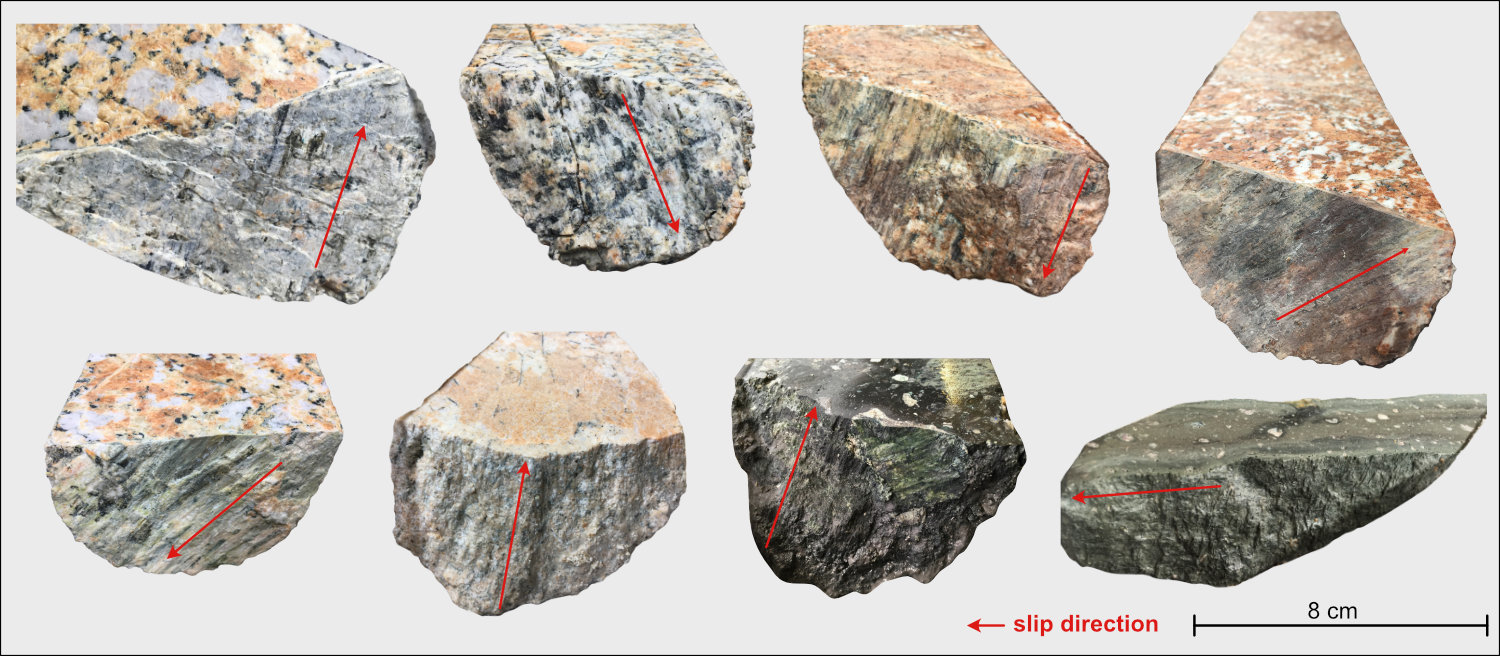
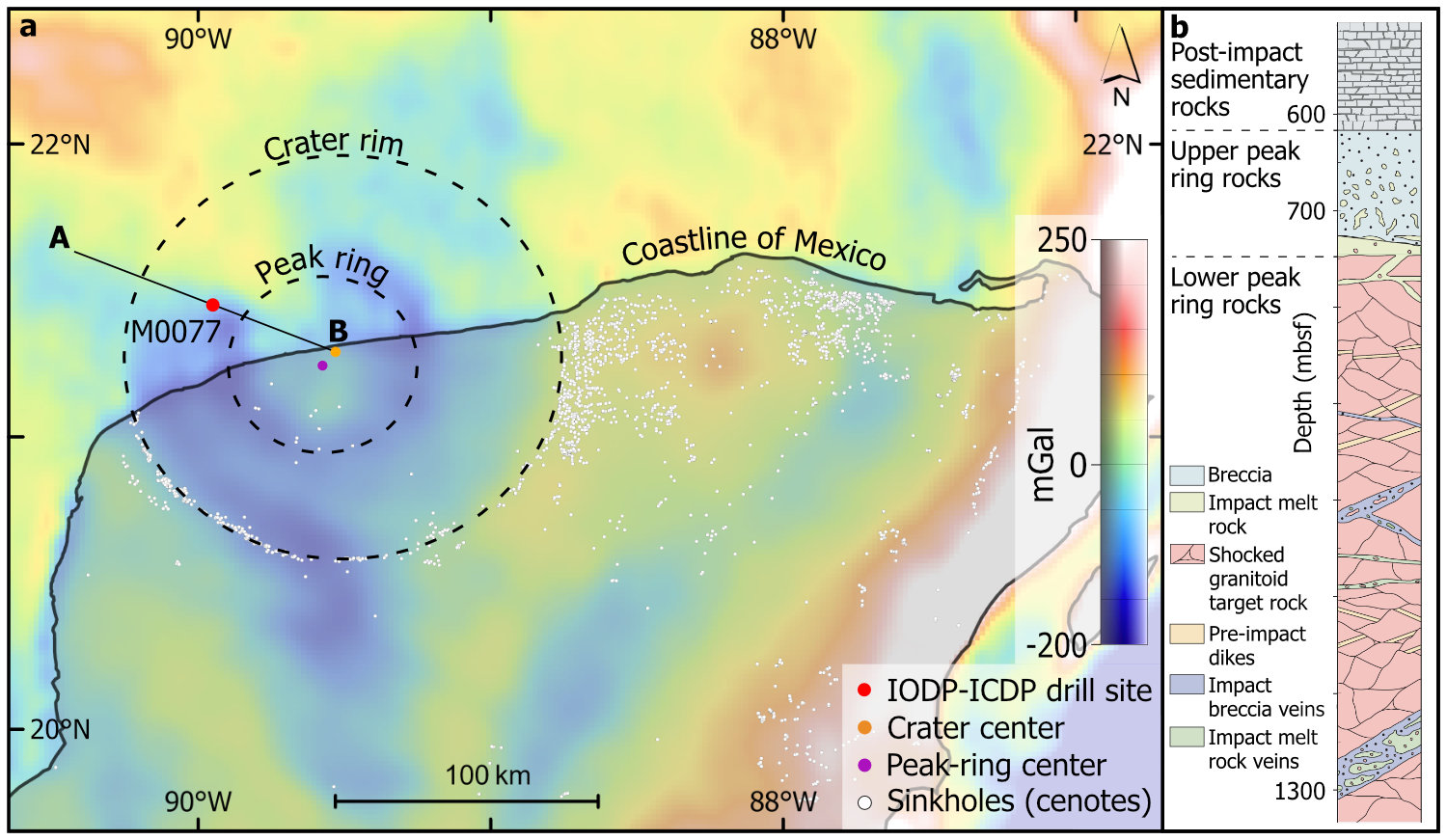
Introduction: The Chicxulub meteorite impact crater, located on the Yucatán Peninsula in Mexico, is the remnant of a significant short-term deformation process [1, 2]. The crater with a diameter of 200 km, contains a morphological peak ring 80 to 90 km in diameter [2, 3] (Fig. 1a). Peak rings are hallmarks of many large impact structures in the Solar System, formed toward the end of cratering [2, 4]. Elucidating the deformation kinematics of peak-ring formation is of particular significance for better understanding the formation of this class of complex impact craters. The IODP-ICDP Expedition 364 drill core revealed that shocked target rock of the Chicxulub peak ring is pervasively affected by decimeter-scale brittle shear faults (Fig. 2), apparently formed toward the end of peak-ring formation [5]. These shear faults lend themselves to infer the deformation kinematics under which the peak ring formed.

Figure 1. Drill site and lithological column of IODP-ICDP Expedition 364 drill core M0077. (a) Drill site and crater location on the Yucatán peninsula. Line labeled A/B shows the location of the cross section in Fig. 3. Background colors: Sandwell gravity anomaly map [7] (b) Schematic stratigraphy of the recovered lithologies (modified from [4]). The lower peak ring rocks exhibit pervasive evidence of brittle deformation.

Figure 2. Brittle shear fault surfaces in the lower peak ring rocks from drill core M0077. Striations indicate the slip direction, marked by a red arrow for the hanging wall.

Methods: The orientations and slip senses of 602 exceptionally well-preserved mesoscopic shear faults (Fig. 2), extracted from the drill core, were analyzed kinematically. This structural data set and its quality are unique among drill-core-based structural studies and offer a most original contribution to the field of impact cratering studies. The data, initially measured on core segments in a horizontal position, was rotated back to its in-situ position prior to extracting the principal kinematic axis orientations for selected fault subsets. The kinematic inversion was then conducted using the software FaultKin [6], which produced lower-hemisphere equal-area projections of the kinematic data, most importantly the orientations of the principal kinematic axes. Contouring of the principal kinematic axes and application of a Linked Bingham Analysis allowed us to visualize the dominant orientation of principal kinematic axes for each fault subset. The heterogeneity of shear faulting with depth was elucidated by employing a fault separation method specifically designed for this purpose. This method treated the data according to their occurrence with depth and did not eliminate “unfitting” data, which, unfortunately, is a common practice of other fault-slip inversion programs. Our approach resulted in 17 domains of fault subsets based on the examination of multiple cycles of fault separation, guided by metric, lithologic and structural separation criteria. Subsequent analysis of the domains enabled the identification of prominent deformation regimes.

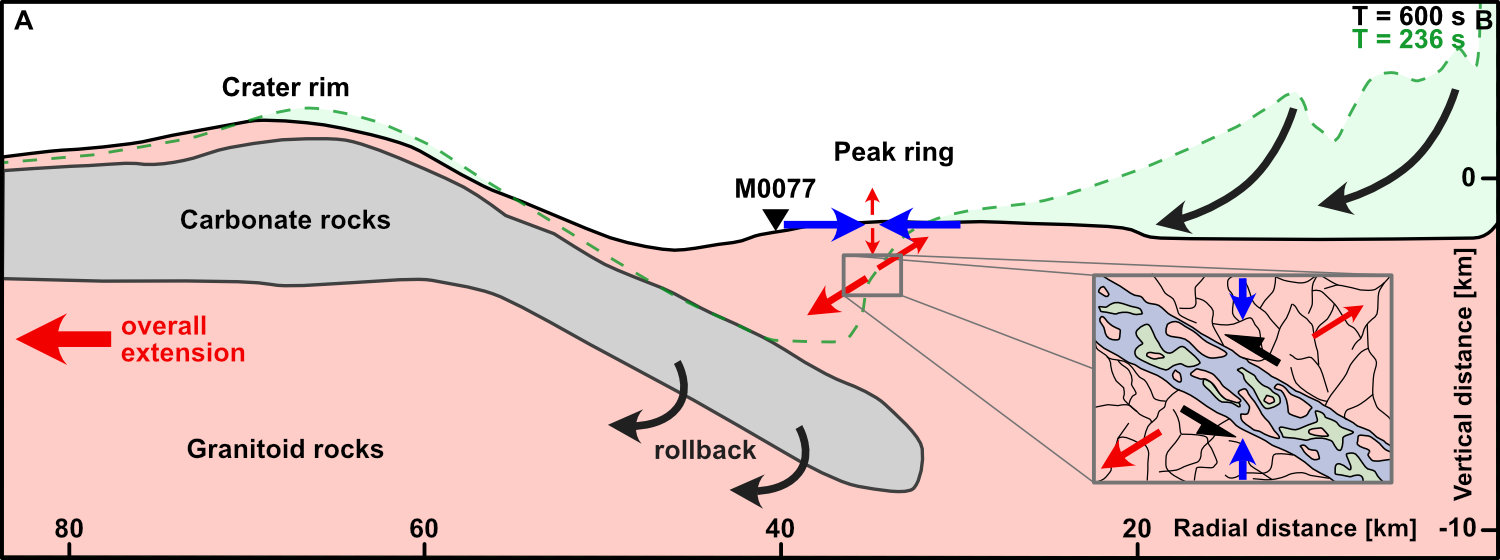
Results and Discussion: A total of thirteen distinct kinematic regimes were identified with depth along the drill core, four additional zones exhibited ambiguous results. The identification of multiple kinematic regimes indicates that kinematic heterogeneity occurs on the 10 to 100-meter scale. The kinematic regimes are characterized by various principal kinematic axis configurations. Transitions from one regime to another appear to be incremental in most segments of the core, while sudden shifts in the fault kinematics are also observed. The kinematic axes oriented horizontally demonstrate variability in direction. In the case of domains exhibiting horizontal maximum shortening axes, the predominant direction is NNW-SSE (Fig. 3). By contrast, the horizontal maximum extension axes cluster mostly around ENE-WSW, i.e., concentric with regard to the crater center (Fig. 3). These directions do not align with numerically predicted horizontal strain axes.

Our inversion of the fault-slip data revealed two major kinematic regimes, depicting the local complexity of the cratering flow field beneath the peak ring (Fig. 3). Horizontal shortening with vertical extension is the predominant principal kinematic axis configuration (Fig. 3). This kinematic regime is mostly evident from approximately 748 meters below seafloor (mbsf) to approximately 1234 mbsf (Fig. 1b). Consequently, we propose that this regime is the one that ultimately resulted in the formation of the peak ring. However, horizontal concentric extension prevails at greater depths within the drill core, from 1235 mbsf to 1333 mbsf (Fig. 1b, 3). We propose that this occurrence is associated with horizontal dilatation at this depth, where a localized thrust shear zone seems to be present (Fig. 3).

Collectively, the deformation kinematics are consistent with rock flow during peak ring formation. This is marked by the occurrence of two simultaneously operating processes: rollback of the crater margin, and outward displacement of collapsed central peak material. These processes result in a radial velocity discontinuity at the location of peak-ring formation. The findings of this study refine current numerical impact simulations of peak ring crater formation with ground truth data derived from the drill core. Currently, numerical models cannot depict kinematic regimes at the same resolution as our fault-slip analysis does. Our work supports gravity-controlled cratering of the dynamic collapse model. While the impetus for this study was the Chicxulub meteorite impact and the associated IODP-ICDP Expedition 364 drill core, the results demonstrate that impact-induced brittle shear faults can principally offer valuable insights into the deformation kinematics during peak-ring formation through a kinematic fault-slip analysis.

Figure 3. Schematic radial cross section of the crater, indicating major kinematic regimes as red/blue arrows for extension/shortening, respectively. Black arrows are proposed material transport trajectories during late cratering. Morphology at T = 600 s, i.e., after the peak ring formed; green stippled line marks crater morphology at T = 236 s, i.e., at the beginning of central peak collapse (based on [5]).

References:

[1] Melosh H. J. (1989) Oxford University Press.

[2] Gulick S. et al. (2013) Reviews of Geophysics 51:31–52.

[3] Morgan J. et al. (1997) Nature 390:472–476.

[4] Morgan J. V. et al. (2016) Science 354:878–882.

[5] Riller U. et al. (2018) Nature 562:511–515.

[6] Marrett R. and Allmendinger R. W. (1990) Journal of Structural Geology 12:973–986.

[7] Sandwell D. T. et al. (2014) Science 346:65–67.

How to cite: Bahr, L. and Riller, U. and the IODP-ICDP Expedition 364 Scientists: Deformation kinematics of peak-ring formation: unique evidence from brittle fault analysis of the Chicxulub IODP-ICDP Expedition 364 drill core, Europlanet Science Congress 2026, The Hague, The Netherlands, 7–11 Sep 2026, EPSC2026-103, https://doi.org/10.5194/epsc2026-103, 2026.

11:24–11:36
|
EPSC2026-121
|
ECP
|
On-site presentation
Alberto Pulvirenti, Elliot Sefton-Nash, and Olivier Witasse

Introduction

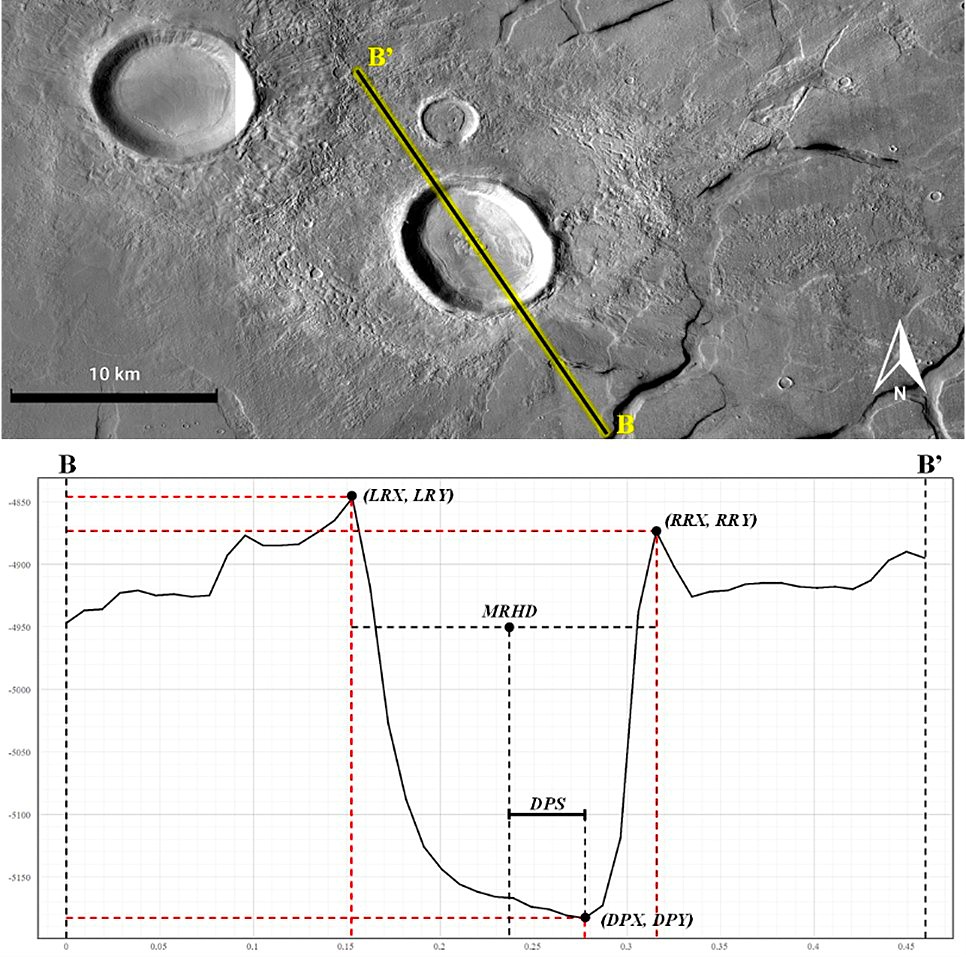
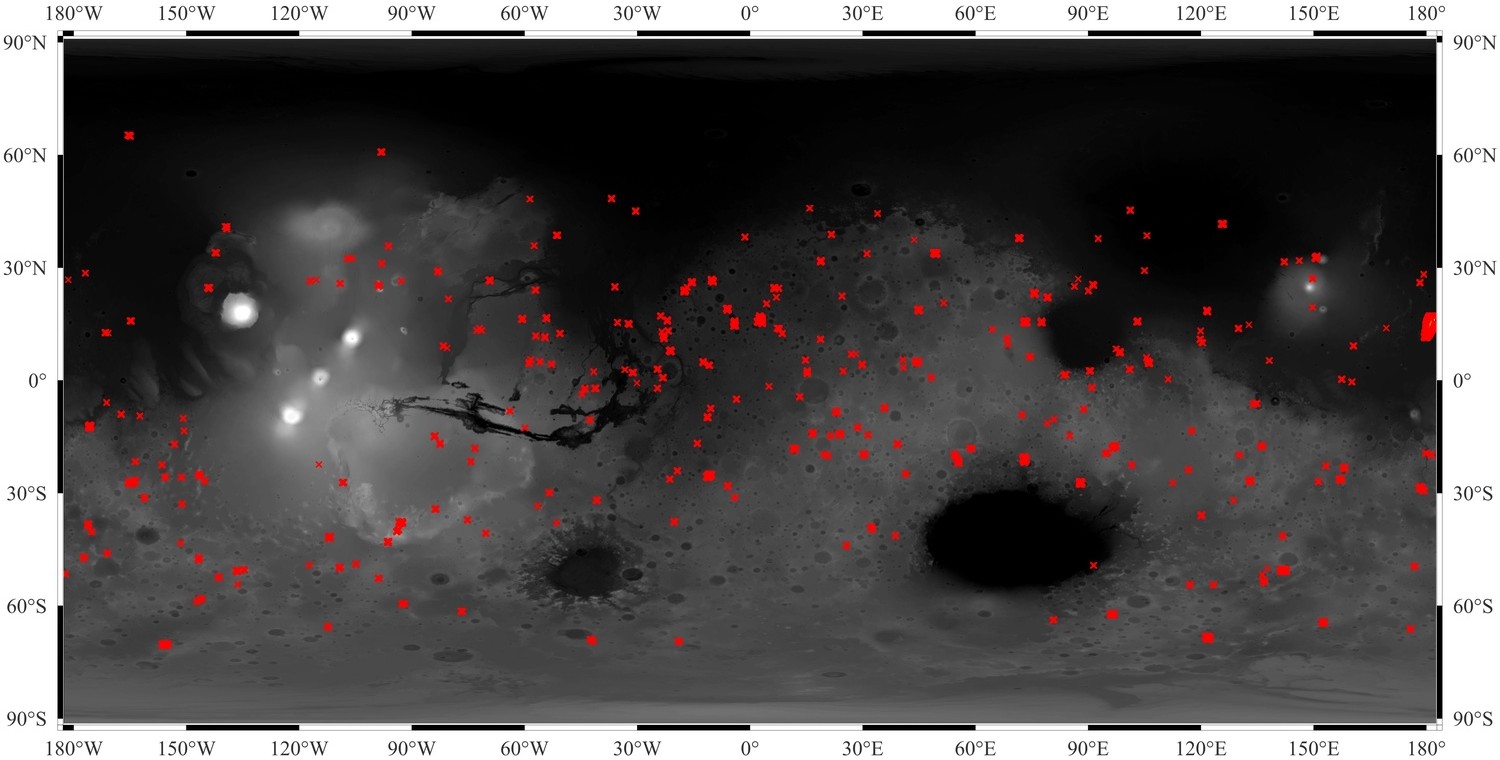
Elongated craters on Mars represent a unique class of geological features formed by very low-angle impacts, typically below 10-15° from the horizontal. According to the ‘Moonlets Decay Hypothesis’, some ancient impact structures may have originated from the orbital decay of multiple moonlets formed from an equatorial debris disk generated by a giant impact, such as that thought to have resulted in the formation of Phobos and Deimos [1,3,5]. Thus, this work pursues two main goals: (i) building a database of already identified Martian elongated craters that contains additional morphological measurements (of ejecta, rim) and derived geometric properties (azimuth), and (ii) introducing a new methodology to constrain the direction of impact by investigating the depth variation of the crater floor, hereafter referred to as Deepest Point (DP) analysis.

Updated Database

We performed a systematic revision of prior efforts [8, 9] using CTX imagery acquired by NASA's MRO spacecraft, which provides significantly higher resolution than the Viking and HRSC images used in previous versions [1,2,3]. This procedure led to the removal of 46 misidentified features, including non-impact landforms such as irregular depressions, fractured zones, and double circular impact structures. After identifying and adding new valid craters, this new version of our database consists of 306 craters, covering latitudes from +65° to −65°. Each entry is associated with at least 24 descriptive attributes, including coordinates, ellipticity, azimuthal orientation, degradation level (DL), crater type, ejecta morphology, and deepest point measurements. The Robbins & Hynek (2012) global crater database [6] served as an additional validation tool.

Deepest Point Analysis

Previous studies and laboratory experiments [4,7] have demonstrated that from the sole post-impact distribution of the ejected material, it is possible to retrieve the direction from which the impactor came. We aim to provide the deepest point methodology for further constraining and/or confirming the impact direction from the analysis of the depth variation of the crater floor along its major axis.

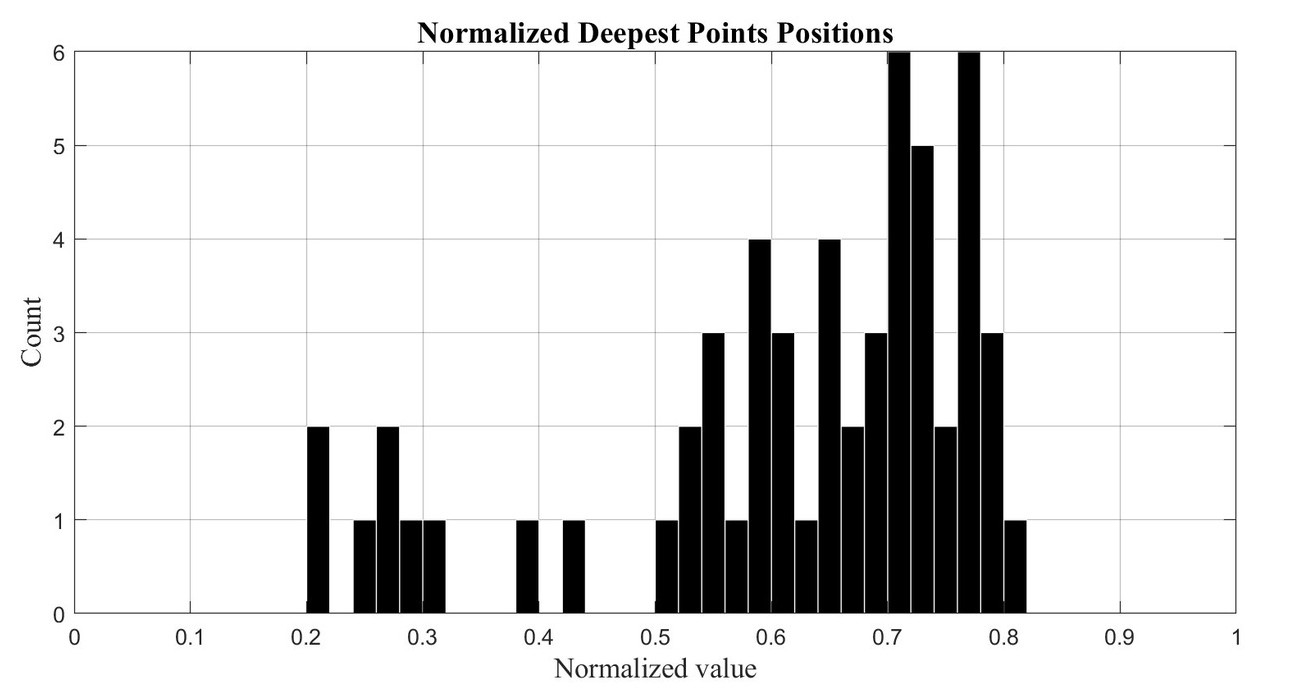
During the systematic data collection for each crater in the renewed database, a measurable rim-to-floor elevation difference along the major axis was identified, with the deepest point consistently shifted toward the crater downrange. The deepest point is assumed to be the best approximation of the lowest area of the crater floor, representing a morphological signature not previously exploited as an independent directional indicator.

Using the MOLA DEM (1px/463m), topographic profiles were traced and extracted along the major axis of selected craters in QGIS. For each profile, the positions of both rims and the DP were recorded, and the Deepest Point Shift (DPS) was measured relative to the geometric crater center. A normalization procedure (left rim = 0, center = 0.5, right rim = 1) was applied to enable size-independent comparison. Selection criteria included: recent craters (degradation level DL = 1–2), single-impact morphology [6], major axis > 7 km, absence of a linear central peak, and presence of a clearly identifiable forbidden zone. A subset of 10 older craters was included for comparison. The final sampling consists of 56 craters.

Results

Among the 56 craters analyzed, 47 recent craters (RC) show a DP shifted toward the crater downrange, contrary to numerical predictions [4,7], yielding a reliability rate of approximately 85% (40 correct vs. 6 inconsistent), compared to ~58% for the 10 older craters (OC). These results confirm that the deepest point is a statistically robust directional indicator, mainly for well-preserved elongated craters.

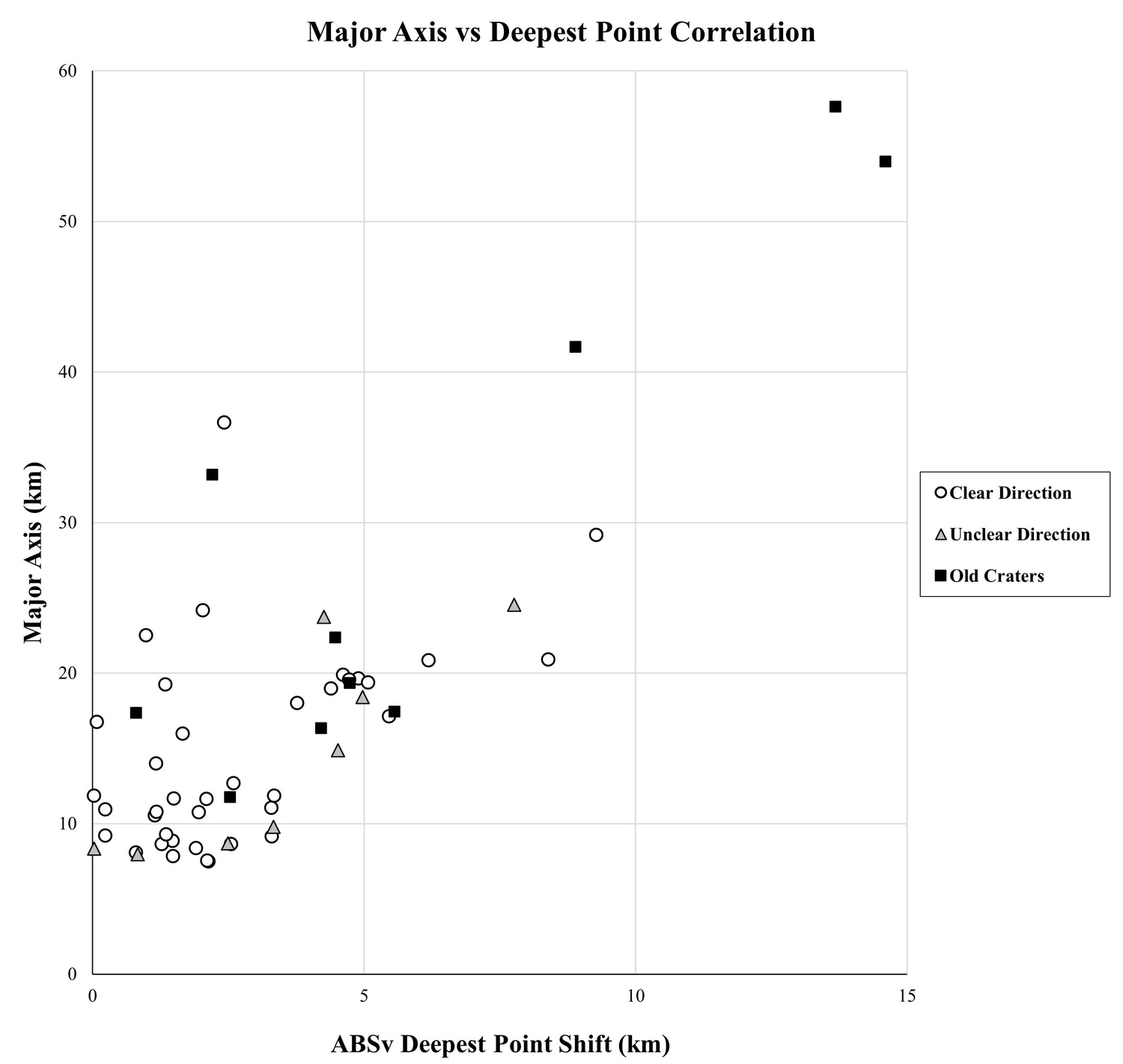
Moreover, we distinguished craters into: (i) clear direction (constrained by well-preserved ejecta distribution), (ii) unclear direction (limited by resolution or degradation), and (iii) old craters (with intrinsically higher directional uncertainty and degradation state).

The correlation between DPS and crater major axis reveals a direct proportionality: the larger the crater, the greater the shift from the crater's center. No significant correlation was found between DPS and ellipticity alone, confirming crater size as the dominant control. Regarding impact angle, a rough correlation is observed between shallower impacts and absolute DPS values, but strong limitations were found due to the estimation of impact angles.

Conclusion

Revising the latest database and adding new features were fundamental steps to accurately distinguish and classify elongated craters in the new catalog version. Additionally, the deepest point finding demonstrates that the crater floor topography of elongated craters preserves a measurable record of impactor trajectory, providing a new morphological tool complementary to the traditional ejecta-distribution-based method. Numerical simulations and experimental analyses are necessary to better understand oblique impact processes and the crustal response at different impact angles.

References

[1] Schultz, P. H. and Lutz-Garihan, A. B.: Grazing Impacts on Mars: A Record of Lost Satellites, Journal of Geophysical Research, Vol. 87, pp. 84-96, 1982.

[2] Barlow, N. G.: Crater Size-Frequency Distributions and a Revised Martian Relative Chronology, Icarus, Vol. 75, pp. 285-305, 1988.

[3] Bottke, W. F., Love, S. G. and Tytell, D.: Interpreting the Elliptical Crater Populations on Mars, Venus and the Moon, Icarus, Vol. 145, pp. 108-121, 2000.

[4] Anderson, J. L. B., & Schultz, P. H. (2006, March). Flow-field center migration during oblique impacts: Implications for curved uprange ejecta rays. In 37th Annual Lunar and Planetary Science Conference (p. 1726).

[5] Craddock, R. A. (2011). Are Phobos and Deimos the result of a giant impact? Icarus, 211(2), 1150–1161

[6] Robbins, S. J., & Hynek, B. M. (2012). A new global database of Mars impact craters ≥1 km: 1. Database creation, properties, and parameters. Journal of Geophysical Research: Planets, 117(E5), 2011JE003966

[7] Elbeshausen, D., Wünnemann, K., & Collins, G. S. (2013). The transition from circular to elliptical impact craters. Journal of Geophysical Research: Planets, 118(11), 2295–2309

[8] Sefton-Nash, E., Faes, Z., Witasse, O., & Buchenberger, B. (2019). Alignment of Mars Elongated Crater Azimuths with Orbit Planes Representing Paleo-Equators. In 50th Annual Lunar and Planetary Science Conference (p. 3252).

[9] Buchenberger, B., Sefton-Nash, E., & Witasse, O. (2021). Analysis of topographic profiles of elongated craters on Mars. In European Planetary Science Congress (pp. EPSC2021-492).

How to cite: Pulvirenti, A., Sefton-Nash, E., and Witasse, O.: An Updated Database of Elongated Craters on Mars: Revised Population, New Attributes, and Deepest Point Analysis, Europlanet Science Congress 2026, The Hague, The Netherlands, 7–11 Sep 2026, EPSC2026-121, https://doi.org/10.5194/epsc2026-121, 2026.

11:36–11:48
|
EPSC2026-235
|
ECP
|
On-site presentation
Maddalena Faletti, Gabriele Cremonese, Elena Martellato, Valentin Tertius Bickel, Giovanni Munaretto, Adriano Tullo, Silvia Bertoli, Nicole Costa, Francesco Marzari, Angelo Zinzi, Nicolas Thomas, and Antoine Pommerol

INTRODUCTION

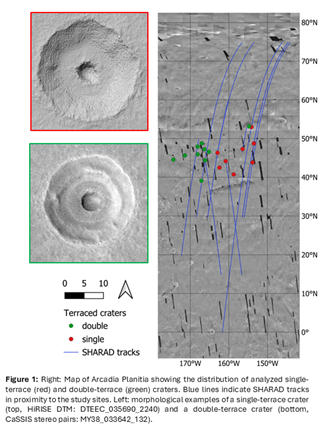
Water ice plays a fundamental role in the geological history of Mars, human exploration, and the search for life. Its distribution constrains paleo-climate interpretations, while sub-surface ice concentrations reveal key depositional processes [1,2]. Impact craters serve as probes into deeper layers; their morphology reflects the mechanical properties and volatile content of the target material. Craters in ice-rich substrates exhibit lower depth-to-diameter ratios (d/D) than those in dry regolith due to differences in target rheology and post-impact viscous relaxation [3]. This effect is most pronounced in simple craters, which are highly sensitive to local substrate properties [4]. Impacts in ice-rich, layered substrate could also lead to the formation of terraced craters, indicative of a strength discontinuity/interface in the subsurface (Figure 1).

This study focuses on simple craters with terraced morphologies in selected martian regions. While some of these features have been mapped locally [2], we leverage high-resolution imagery acquired by several orbiters and convolutional neural networks (CNNs) to substantially expand the existing catalogs, building on our preliminary survey [5]. Our improved dataset, combined with surface topographic data, enables a large-scale, accurate analysis of morphometric properties, such as d/D and terrace dip angles, to better characterize the underlying stratigraphy responsible for terraced crater morphologies.

DATA & METHODS

We performed morphometric analysis on 22 craters in Arcadia Planitia (11 with single and 11 with double terraces) using the catalog by [2]. High-resolution DTMs were generated from HiRISE [6] and CaSSIS [7] stereo pairs; specifically, a dedicated observation campaign planned with the CaSSIS instrument (7-14 June 2025) led to the acquisition of four new stereo pairs. The study sites and the 11 intersecting SHARAD [8] radargrams used to investigate the subsurface structure are illustrated in Figure 1. In addition, CTX [9] images were employed to extend our mapping efforts to other martian regions. The positions of the terraced craters analyzed in this study, as well as those already present in [2], have been integrated into the MATISSE tool of ASI [10].

Morphological Analysis: Using QGIS and custom Python scripts, we compared the d/D ratios of terraced craters against a global sample of bowl-shaped craters. To validate the hypothesis of subsurface layering, we are currently using EchoTerraeTrace [11] software to analyze SHARAD data and studies subsurface features.

Deep Learning Algorithm: To expand our current terraced crater dataset, we adopt a supervised CNN-driven mapping approach that is using a YOLOv5x model, following e.g.  [12,13]. The model is fine-tuned on manually annotated CTX images, also incorporating negative examples (e.g., bowl-shaped craters) and data augmentation to prevent overfitting. During inference, the CNN generates georeferenced candidate detections with associated model confidence scores; default Non-Maximum Suppression is applied to remove duplicates. Model performance is validated using a withhold test set and Recall, Precision, and Average Precision (AP) [14].

RESULTS

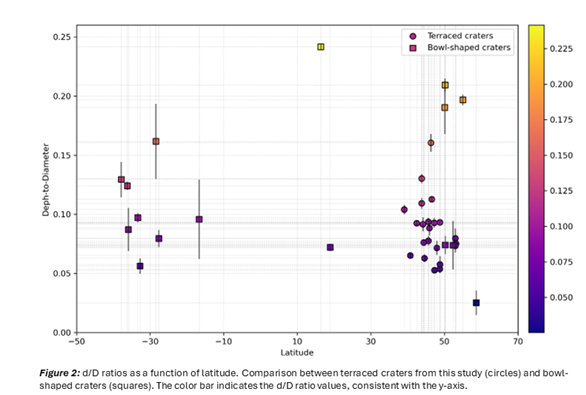
Morphological Analysis: At the same latitude, terraced craters systematically exhibit lower d/D ratios than bowl-shaped ones, suggesting that subsurface ice reduces target material strength during impact (Figure 2). As all considered craters are smaller than 2 km, gravitational collapse processes are limited, making their morphology particularly sensitive to target material properties and volatile content. Variability in terraces number and arrangement further indicates a stratified subsurface with a range of mechanical properties, while shape and asymmetric terraces distribution can reveal impact angle and direction.

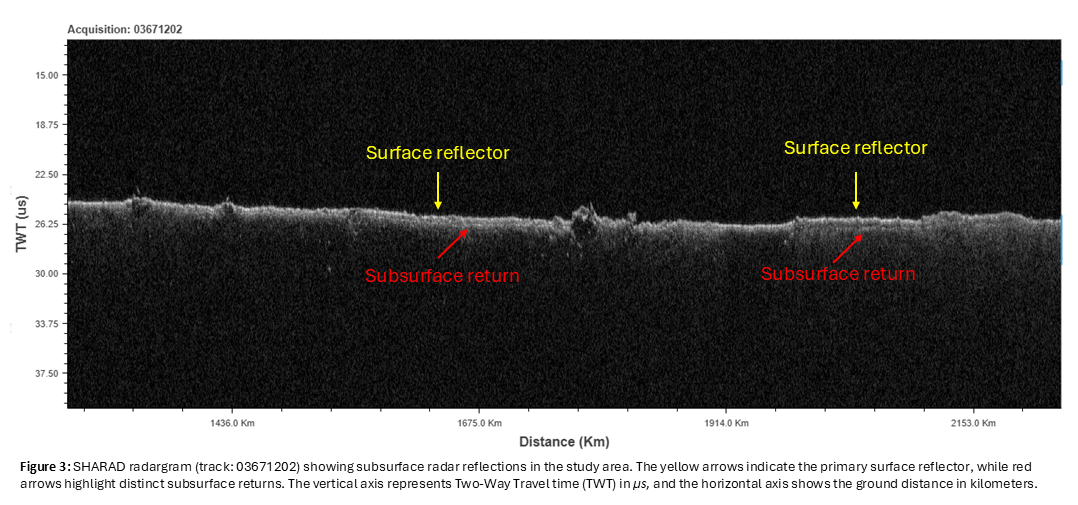
To validate the hypothesis of a layered substrate, we analyze SHARAD radar sounding data to identify subsurface dielectric interfaces (secondary returns); these detections can confirm stratigraphic layering and allow for the estimation of the dielectric constant (εr), providing a direct constraint on composition. Figure 3 illustrates a representative radar echo, differentiating surface and subsurface returns associated with distinct material properties.

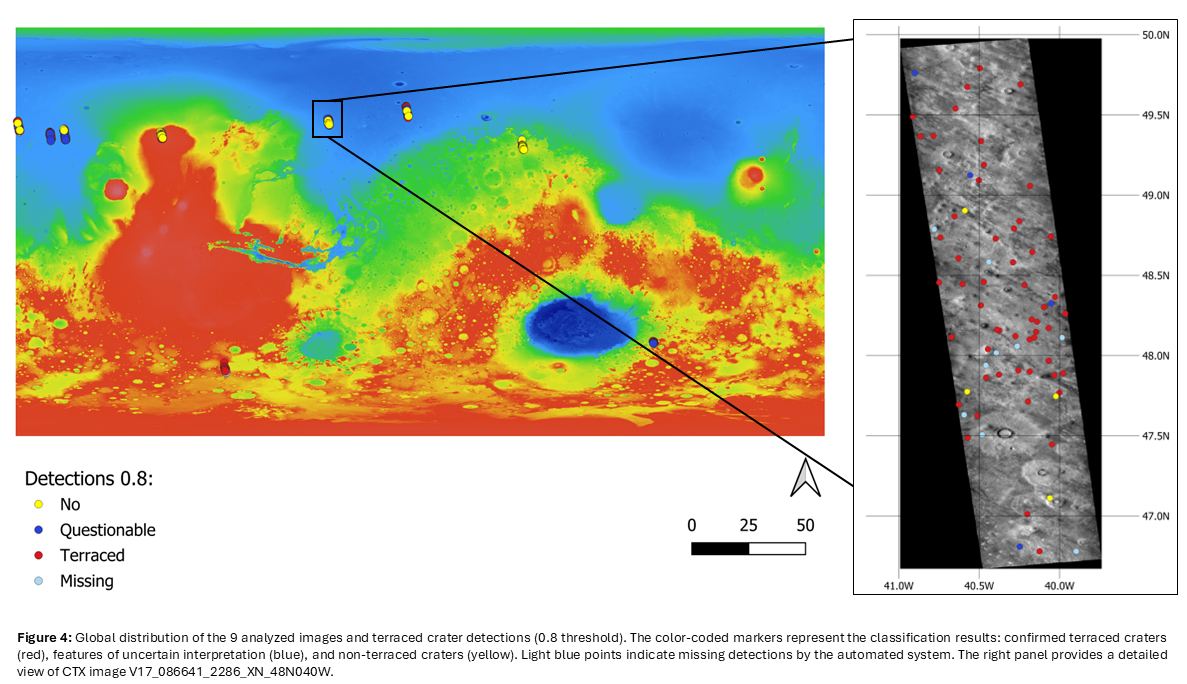
Deep Learning Algorithm: In our withheld test set of 9 CTX images covering the mid-latitudes (Figure 4), the detector effectively distinguished terraced craters from bowl-shaped ones (and other features). At a model confidence of 0.8 and above, the detector identified a total of 350 candidates in the test set, corresponding to a recall of 0.63 (% of terraced craters found) and a precision of 0.92 (% of detections correct).

CONCLUSIONS & FUTURE WORK

The successful evaluation of our terraced craters detector in this initial analysis validates our overall approach of using deep learning to expand our feature catalog across the full longitudinal extent of the northern and southern mid-latitudes (32°-60°N/S) and potentially globally. The goal is to produce a comprehensive new catalog that will provide a robust foundation for further large-scale geographical, morphological, and morphometric studies, integrating both existing datasets and new high-resolution observations, including the planning of additional CaSSIS and HiRISE stereo pair acquisitions.

In support of the automated detection workflow, we employ an established multi-instrumental strategy that integrates morphometric, stratigraphic, and radar data to interpret the martian subsurface. Based on this integrated approach, we are performing a rigorous statistical analysis to identify significant correlations between terrace parameters, dielectric properties, and latitudinal distributions.


ACKNOWLEDGMENTS: This work has been developed under the ASI-INAF agreement n.2024-40-HH.0


REFERENCES: [1] Bramson, Ali M., et al., Geophysical Research Letters 42.16 (2015): 6566-6574.

[2] Bramson, A. M., Shane Byrne, and J. Bapst., Journal of Geophysical Research: Planets 122.11 (2017): 2250-2266.

[3] Douglass, B. S., & Bell, J. F. (2025) LPI Contributions, 3090, 2677.

[4] Robbins, Stuart J., and Brian M. Hynek., Journal of Geophysical Research: Planets 117.E5 (2012).

[5] Faletti, M., et al., EPSC-DPS2025-729, https://doi.org/10.5194/epsc-dps2025-729, 2025.

[6] McEwen, Alfred S., et al., Journal of Geophysical Research: Planets 112.E5 (2007).

[7] Thomas, Nicolas, et al., Space science reviews 212.3 (2017): 1897-1944.

[8] Seu, Roberto, et al., Journal of Geophysical Research: Planets 112.E5 (2007).

[9] Malin, Michael C., et al., Journal of Geophysical Research: Planets 112.E5 (2007).

[10] Zinzi, Angelo, et al., Astronomy and Computing 15 (2016): 16-28.

[11] 10.5281/zenodo.14728638

[12] Bickel, V.T., Nature Communications 16.1 (2025): 9583.

[13] Bickel, V.T., and Valantinas, A., Nature Communications 16.1 (2025): 4315.

[14] Bickel, Valentin Tertius, et al., IEEE Journal of Selected Topics in Applied Earth Observations and Remote Sensing 13 (2020): 2831-2841.

How to cite: Faletti, M., Cremonese, G., Martellato, E., Bickel, V. T., Munaretto, G., Tullo, A., Bertoli, S., Costa, N., Marzari, F., Zinzi, A., Thomas, N., and Pommerol, A.: Terraced craters on mars: morphological and subsurface analysis in arcadia planitia and detection in additional regions via deep learning, Europlanet Science Congress 2026, The Hague, The Netherlands, 7–11 Sep 2026, EPSC2026-235, https://doi.org/10.5194/epsc2026-235, 2026.

11:48–12:00
|
EPSC2026-1114
|
On-site presentation
Aleksandra Sokolowska, Ingrid Daubar, Logan Ramanathan, Mark Boslough, and Annabelle Gao

Introduction. New impact craters on Mars, discovered during spacecraft observation, are identified by their extensive "blast zones" of disturbed dust [1]. Distinct albedo features within these blast zones include quasi-spherical halos [2], extensive ejecta rays, and arcuate rays/scimitars [3]. We present a detailed analysis of a new type of feature now termed blast zone (BZ) streaks [4], which differ from the aforementioned. BZ streaks are elongated, unidirectional, and asymmetrical with respect to the crater center. They also have diffuse edges and low albedo compared to the pre-impact surface. Since these features resemble wind streaks formed by wind interaction with topographical obstacles like crater rims [5], we refer to them as "streaks." However, as they are significantly wider and longer relative to the crater rims than typical wind streaks, we hypothesize other formation mechanisms.

 In addition to local wind origins, we test other origins related to the projectile, the impacted target, and various shock wave fronts. Our analysis suggests that BZ streaks are likely of impact origin and indicate the direction of impact. 

Methods. Image data analysis. We analyzed map-projected RED images of 1,203 new impact sites on Mars [3] from HiRISE [6]. Using JMARS [7] and QGIS [8], we measured the azimuthal orientations of various features and the lengths of the streaks.

Local winds. We extracted annual average wind speeds at impact sites through JMARS map sampling [9] and obtained global circulation model data from the Mars Climate Database [10] for a representative climate scenario.

Proxy for prevalent winds. We identified sites where wind streaks or spire streaks [5], indicating strong wind directions, are near the BZ streaks and measured the angles between them to assess alignment.

Proxy for impact direction.  Ejecta asymmetry indicates impact direction [11]. We identified sites where the impact direction could be approximated using ejecta asymmetry and measured the angles between the downrange direction and the streak direction.

Entry & touchdown model. Using the CTH shock physics code for modeling impact and airburst phenomena [12], we simulated a 66-cm diameter meteoroid entering the Martian atmosphere at a 15-degree angle from horizontal. The simulation accounted for meteoroid ablation and surface-atmosphere interactions, excluding crater excavation. We analyzed the geometry and scalar quantities of resulting wind speeds and surface pressures.

Results. Feature identification. Among the 503 craters classified as “single” (indicating an intact projectile) [3], we confirmed BZ streaks at 106 sites (21%). We identified 54 sites (32%) as possible streaks based on diffuse asymmetric albedo features, despite lacking clear elongation. In clusters formed by projectile fragmentation, we found streaks at 76/700 sites (11%). We also noted 20 sites with wind/spire streaks near BZ streaks. Of the 106 single sites with streaks, 36 exhibit asymmetric ejecta, with 16 showing asymmetries allowing us to determine the impact direction within 30deg.

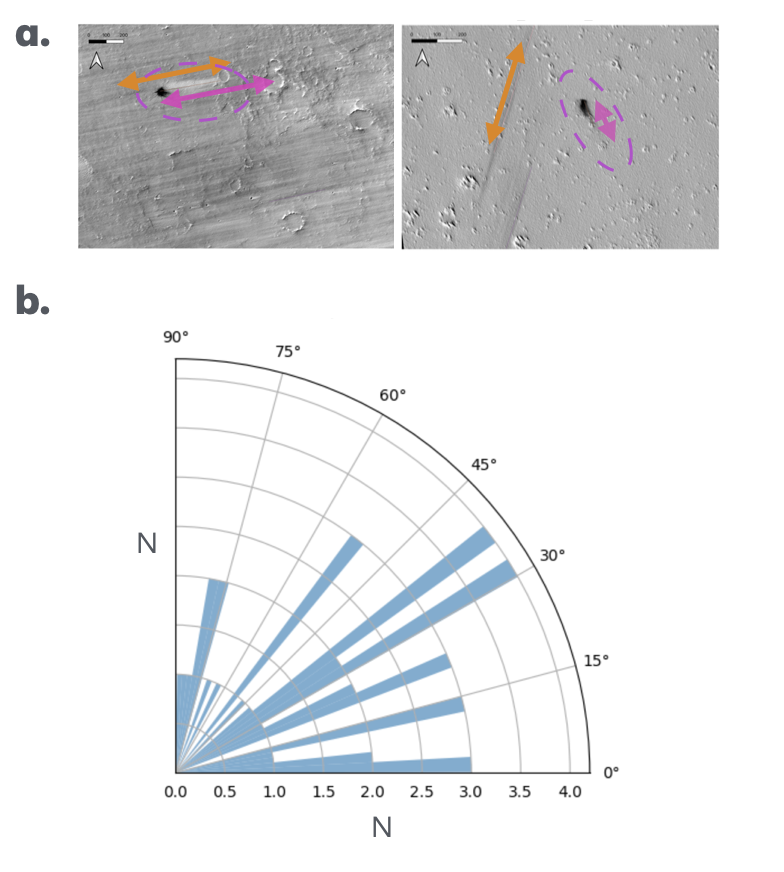
Local winds. No relationship was observed between map-sampled annual average wind speeds and BZ streak lengths, nor between BZ streak length and wind speeds from the Mars Climate Database. Figure 1b shows a lack of alignment between the directions of nearby wind streaks (proxies for prevalent winds) and BZ streaks.

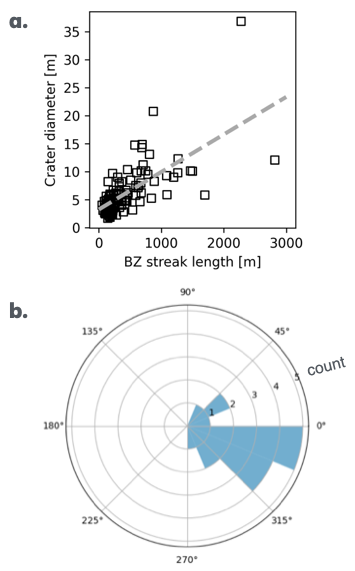
Impact geometry. Lengths of BZ streaks correlate with crater diameter (Figure 2a). The distribution of differences between vectors indicating downrange impact direction and streak direction falls within half a quadrant (Figure 2b). Despite measurement uncertainties (5°-10° for BZ streak azimuth and within 30° for impact direction), the results suggest that BZ streaks predominantly point downrange from the impact direction.

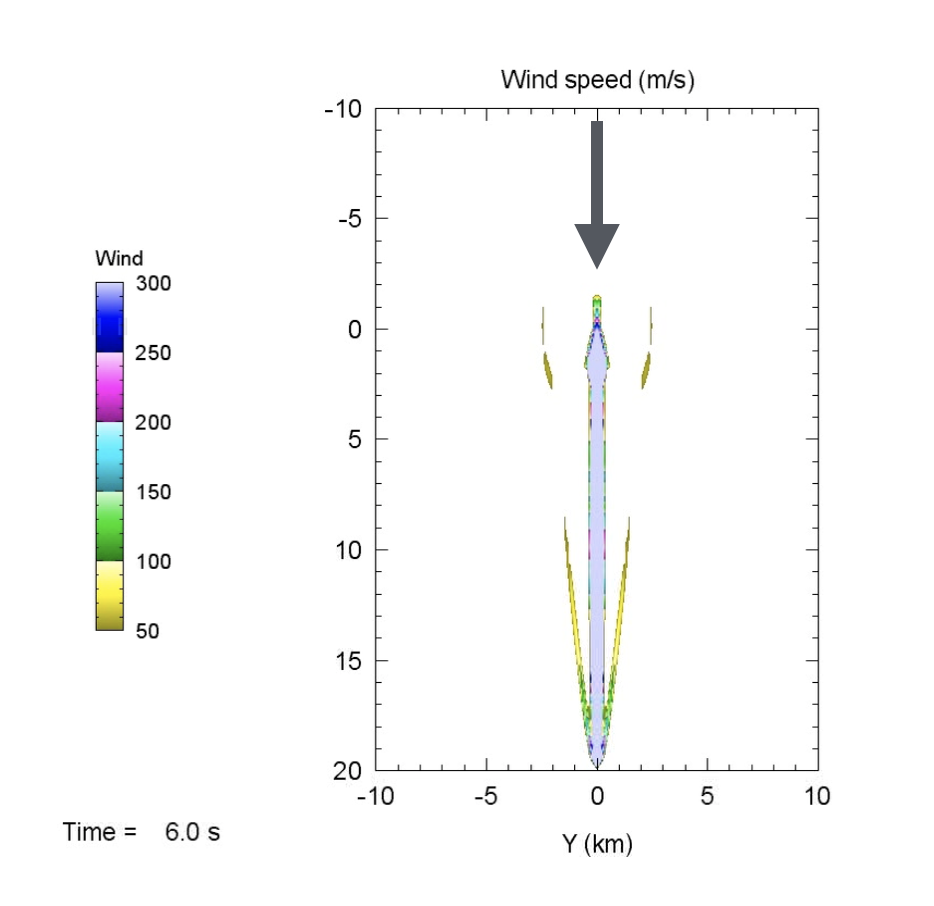
Simulated winds. CTH simulations demonstrated that a vaporized jet from an ablated projectile can couple with the ground and travel over a significant distance. The wind pattern on the surface resembles the BZ streaks (Figure 3). Surface winds reach speeds of several hundred m/s, exceeding the typical wind speeds from the Mars Climate Database(tens of m/s).

Figure 1.a. Examples of local wind-driven streaks (orange) near BZ streaks (pink,ellipses). Arrows indicate directions.(Image: NASA/JPL/University of Arizona).b.The histogram of minimum angular differences between the directions of  these features.


Figure 2.a. Crater diameter and streak length are correlated. b. The histogram of the angular difference between the azimuths of downrange impact direction and BZ streaks.

Figure 3. CTH wind speeds at the surface level . The arrow points downrange to the impact point (0,0).

Conclusions.

Local wind theory. We found no relationship between the lengths of BZ streaks and average wind speeds, nor any clear alignment between the line directions of BZ streaks and nearby wind/spire streaks. Our results indicate that local winds are not the primary drivers of the BZ streaks.

Impact / projectile theories. The correlation between crater diameter and the length of the BZ streak implies an impact origin for the BZ streaks. This may be explained by larger impact energies generating stronger winds. Several potential sources of “impact wind” exist, including the quasi-hemispherical blastwave, the uprange wave shock behind the incoming projectile, and bow shock ahead of a projectile / a vaporized jet from a projectile coupling with the ground. However, the shape and proportions of the surface feature (i.e. pointy, narrow and long) along with their downrange direction, are all consistent with the bow shock or vapor jet dynamics. Our simulation also confirmed that winds generated from this origin can be stronger than local winds. Nevertheless, it remains possible that local wind fronts and “impact wind” fronts may interact with one another.

Implications. Our results indicate that the direction of the BZ streaks may offer a novel method for determining the impact trajectory. This approach is particularly valuable in cases where ejecta blankets are relatively axisymmetrical, obscured by other blast zone features, or influenced by topographic obstacles. Our findings also reveal that blast zone streaks are common, occurring at 21-32% sites, and due to their extended nature, BZ streaks play a significant role in enhancing impact detectability.

References: [1]Malin et al.(2006),10.1126/science.1135156 [2]Bart et al.(2014), j.icarus.2019.03.004 [3]Daubar et al.(2022),10.1029/2021JE007145 [4]Gao et al.(2023), 54th LPSC,2806 [5]Cohen-Zada et al.(2016),10.1002/2016JE005242 [6]McEwen et al.(2007),10.1029/2005JE002605 [7]Chistensen et al.(2009), AGUFMIN22,2009,IN22A-06 [8]QGIS.org [9]Adler et al.(2016),47th LPSC,2981  [10] Forget et al.(1999),10.1029/1999JE001025 [11]Schultz (1992),10.1029/92JE01508 [12]McGlaun et al.(1990),10.1016/0734-743X(90)90071-3 

Acknowledgements.A.S. is funded by a UKRI Fellowship EP/Z003180/1.


How to cite: Sokolowska, A., Daubar, I., Ramanathan, L., Boslough, M., and Gao, A.: The origin of asymmetric "blast zone streaks" formed by small impacts on Mars, Europlanet Science Congress 2026, The Hague, The Netherlands, 7–11 Sep 2026, EPSC2026-1114, https://doi.org/10.5194/epsc2026-1114, 2026.

12:00–12:12
|
EPSC2026-457
|
ECP
|
On-site presentation
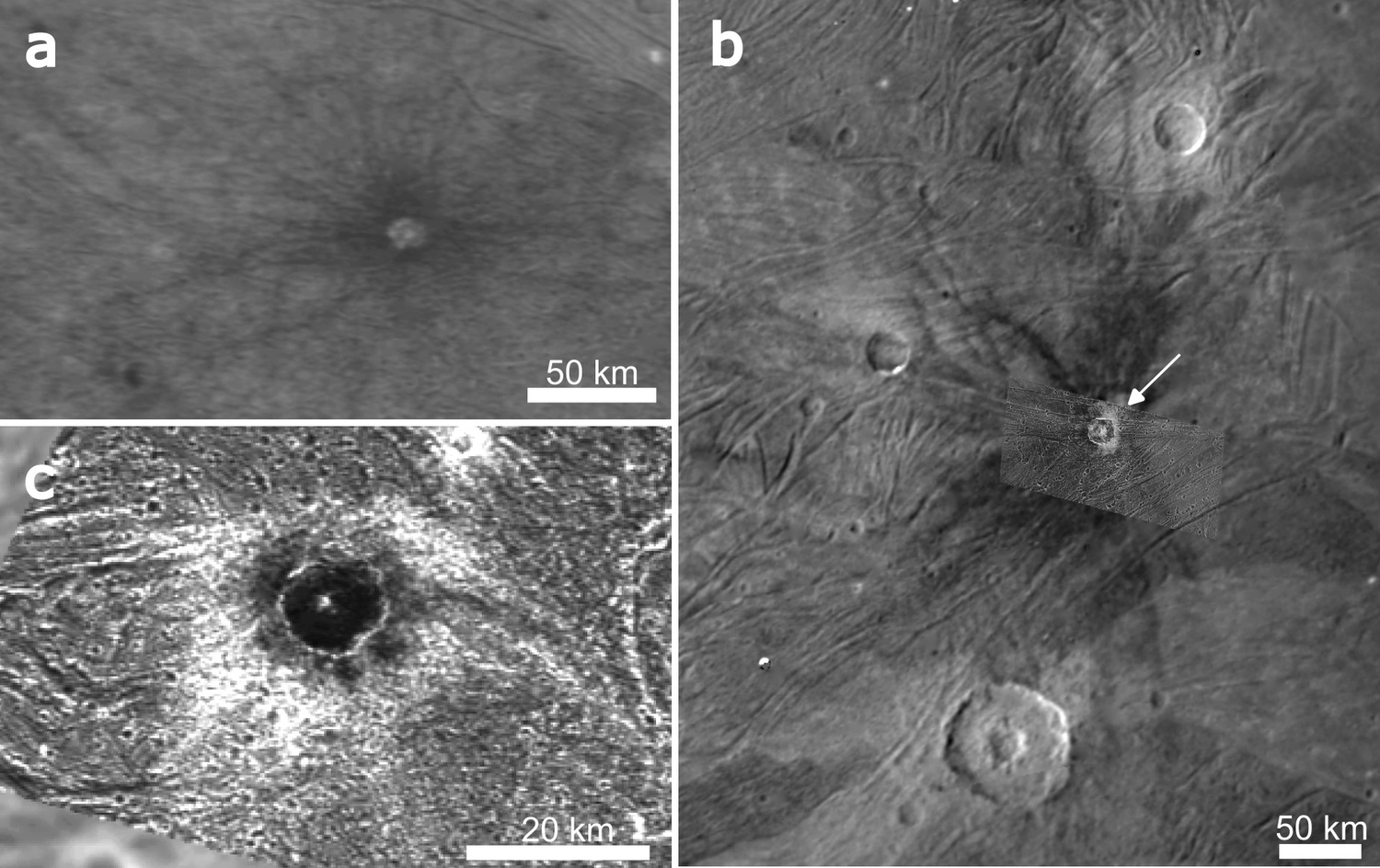
Rajit Das, Namitha Rose Baby, Oguzcan Karagoz, Thomas Kenkmann, Katrin Stephan, and Roland Wagner

Introduction

Ganymede, Jupiter’s largest moon and a primary target of the ESA’s JUICE mission [1], shows a distinct surface dichotomy between older, low-albedo (dark ice) terrains and comparatively younger, high-albedo (light ice) regions [2]. The surface preserves a complex record of impact cratering, resurfacing, and shallow crustal heterogeneity. Ray and halo craters across these terrains display distinct ejecta patterns and crater floor characteristics, providing important constraints on subsurface stratigraphy and material properties; however, the layer thicknesses and mechanical contrasts responsible for these morphologies remain poorly constrained. Here, we use iSALE2D numerical simulations [3, 4, 5] (strength input parameters in Table 1), informed by global photomosaics of Ganymede [6], to investigate how subsurface layering controls the formation of representative ray and halo craters [7].

Results

Our models reproduce the observed ejecta patterns of Antum, Kittu, and Nergal (Fig 1) through distinct near-surface stratigraphies. Antum (Fig 1a) is best explained by a 1.0 km thick dark ice layer overlying a light ice substrate (Fig 2). Kittu (Fig 1b) requires a more complex sequence, with 0.8 km of light ice above a 0.4 km thick dark ice layer and a deeper dark basement (Fig 3). Nergal (Fig 1c) exhibits the most elaborate structure, consisting of alternating layers of light and dark ice above a deeper light ice unit (Fig 4). These configurations indicate that Ganymede’s upper crust is vertically heterogeneous and likely shaped by a combination of tectonic resurfacing, cryovolcanic activity, and the episodic deposition of dust and organic-rich exogenic material.

Fig 1. a. Antum, a 15 km crater with dark ejecta on dark terrain with a bright crater floor; b. Kittu (indicated by the white arrow), a 15 km crater with dark ejecta on light terrain with a bright crater floor and c. Nergal, a 9 km crater with dark halo encircled by bright ejecta on light terrain with a dark crater floor.


Parameter Light Ice Dark Ice

Cohesion (yield strength at zero pressure) (Yi0)

10 MPa

12.5 MPa

Damaged cohesion (Yd0)

0.01 MPa

0.01 MPa

Limiting strength at high pressure for intact material (Yim)

0.11 GPa

0.11 GPa

Limiting strength at high pressure for damaged material (Ydm)

0.11 GPa

0.11 GPa

Coefficient of internal friction (μi)

2

2

Damaged coefficient of friction (μd)

0.6

0.6

Thermal softening parameter (ξ)

1.2

1.2

Table 1. Summary of the input parameters for the strength model of target (dark ice and light ice)

Comparisons between the ANEOS [8] and Tillotson [9] equations of state further show that the thermodynamic treatment of ice strongly influences excavation flow and final crater morphology. ANEOS produces nested cavities, double ejecta curtains, and relatively shallow craters with dense (potentially liquefied) crater floor material, whereas Tillotson yields deeper craters and more uniform excavation. The nested cavity formation in ANEOS is associated with vaporization and phase changes in ice, suggesting a more physically realistic representation of impacts into icy targets, albeit at higher computational cost.

Fig 2. Simulation results for Antum using Tillotson (a, c, e) and ANEOS (b, d, f). Dark ice indicated by dark grey and light ice with light grey.

Fig 3. Simulation results for Kittu using Tillotson (a, c, e) and ANEOS (b, d, f).

Fig 4. Simulation results for Nergal using Tillotson (a, c, e) and ANEOS (b, d, f).

Discussion

The results from numerical simulations align well with previous studies [7] which use the Z-model approach [10]. Despite simplifying assumptions (like homogeneous material properties within layers and vertical impact geometry), the simulations provide quantitative constraints on Ganymede’s near-surface stratigraphy and ice rheology. The inferred variations in layer thickness and strength contrast generate testable predictions for JUICE observations and contribute to geophysical models of Ganymede’s thermal and geological evolution. Future three-dimensional simulations incorporating oblique impacts and heterogeneous target properties will further refine these interpretations and improve our understanding of impact processes on icy satellites.

References: [1] Grasset et al., Planet. Space Sci., 78, 1-21, 2013. [2] Pappalardo et al., in Jupiter, 363-396, Cambridge Univ. Press, 2004. [3] Amsden et al., Los Alamos Nat. Lab. Rep., LA-8095, 1980. [4] Collins et al., Meteorit. Planet. Sci., 39, 217-231, 2004. [5] Wünnemann et al., Icarus, 180, 514-527, 2006. [6] Kersten et al., EPSC2022-450, 2022. [7] Baby et al., Earth Space Sci., 11, e2024EA003541, 2024. [8] Thompson & Lauson, Sandia Nat. Lab. Tech. Rep., 1972. [9] Tillotson, Gen. Atomic Rep. GA-3216, 1962. [10] Maxwell, D. E. Impact and explosion cratering, 1003–1008, Pergamon Press, 1977.

How to cite: Das, R., Baby, N. R., Karagoz, O., Kenkmann, T., Stephan, K., and Wagner, R.: Numerical Modeling of Ray and Halo Craters on Ganymede: Insights into Impact Cratering on Icy Targets, Europlanet Science Congress 2026, The Hague, The Netherlands, 7–11 Sep 2026, EPSC2026-457, https://doi.org/10.5194/epsc2026-457, 2026.

12:12–12:24
|
EPSC2026-345
|
On-site presentation
Isabel Herreros and Sébastien Charnoz

The kinetic impact of NASA’s Double Asteroid Redirection Test (DART) on Dimorphos generated a massive ejecta cloud, including material with velocities comparable to or lower than the escape speed of the satellite. Most of the low-velocity ejecta is expected to remain gravitationally bound to the Didymos-Dimorphos system and to re-impact Dimorphos within the first 10 hours after the impact. Understanding the fate of this material is essential for interpreting the surface state of Dimorphos at the time of the ESA Hera encounter.

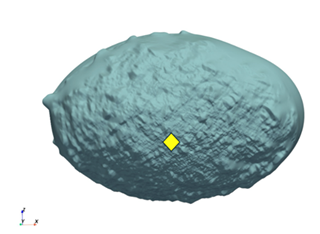
In this work, we introduce RAVEL (Regolith Astrodynamics in Variable Effective Low-Gravity Environments), a model particularly well suited for investigating the early post-impact evolution of low-velocity ejecta produced by the DART impact. Here, we apply RAVEL to ejecta with initial velocities of 1-9 cm/s, using a realistic shape model of Dimorphos derived from DART/DRACO observations. We couple three-dimensional orbital dynamics in the binary system with surface transport on shape models of Dimorphos. The model accounts for self-gravity, centrifugal acceleration, Coriolis acceleration, tidal forcing by Didymos, rebounds after surface contact, and friction-controlled sliding. The particles are treated as Lagrangian tracers, allowing us to map the main transport pathways from launch to final deposition without assuming detailed grain-scale properties. We assume a crater radius of 35 m, consistent with current estimates, although this value will be refined after Hera’s arrival. The initial tracers are launched with angles between 24° and 43°, measured with respect to the plane perpendicular to the ejection-cone axis, following DART observations, and with velocity distribution derived from a Housen-Holsapple-type scaling law. Surface motion is computed on the Digital Terrain Model (DTM) derived from DART/DRACO images (Fig.1). Since the DART/DRACO-based DTM only covers the leading hemisphere imaged during the DART encounter, the non-imaged part of Dimorphos is therefore represented as a smooth surface in the model.

Fig.1: DART/DRACO-based DTM. The yellow diamond marks the DART impact site.


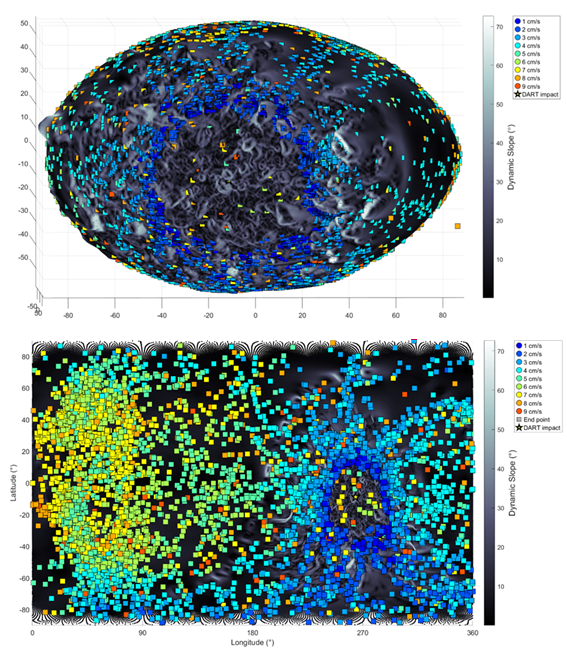
Our simulations show that the dynamics of low-velocity ejecta is highly asymmetric and strongly controlled by the binary environment. Ejecta with the lowest velocities (<5 cm/s) re-impact close to the DART impact site, whereas faster particles can follow partial orbits around Dimorphos or even circulate around Didymos before returning to the surface. More than 90% of the ejecta is reaccreted within the first 5 hours, and most of the ejecta returns to Dimorphos within the first 20 hours (Fig. 2). After re-impact, the material does not remain at the first contact point: rebounding and frictional sliding can redistribute ejecta over distances comparable to a significant fraction of the body radius.

Fig.2: Re-impacting low-velocity ejecta on Dimorphos' surface.


The final deposits show clear velocity-dependent sorting. Low-velocity ejecta preferentially accumulates around the DART impact region, intermediate velocities tend to produce antipodal accumulation, and the fastest reaccreted material generates a broader and more asymmetric surface pattern, with enhanced deposition on the trailing hemisphere and in polar regions. When a rough DART/DRACO-based terrain model is used, the interaction between ejecta and local topography can produce ray-like deposits around the impact site, mainly associated with the lowest-velocity material. These structures may extend farther than shown in our simulations, but their full extent cannot yet be assessed because the non-imaged part of the DART/DRACO-based DTM is represented as a smooth surface.

Our model, RAVEL, provides direct predictions for Hera observations. Ray-like structures, smooth mantling deposits, preferential resurfacing terrains, or antipodal accumulations would provide constraints on the low-velocity ejecta population, the post-impact redistribution of material, and the mobility of regolith under extremely low gravity. Our results therefore link DART impact physics, orbital dynamics, and surface transport, and provide a framework for interpreting the geomorphological state of Dimorphos during the Hera encounter.

Fig.3: Distribution of low-velocity ejecta after re-impacting on Dimorphos’ surface.


How to cite: Herreros, I. and Charnoz, S.: The morphological signature of DART ejecta distribution on Dimorphos: Predictions for the Hera encounter, Europlanet Science Congress 2026, The Hague, The Netherlands, 7–11 Sep 2026, EPSC2026-345, https://doi.org/10.5194/epsc2026-345, 2026.

12:24–12:30

Orals THU3: Thu, 10 Sep, 14:00–15:30 | Room Jupiter (Jazz 1 & 2)

Chairpersons: Chrysa Avdellidou, Elena Martellato
Experiments, Modelling and Field work
14:00–14:15
|
EPSC2026-700
|
ECP
|
solicited
|
On-site presentation
Vera Hoogland, David Flannery, Osama Ghidan, David Murphy, and Luke Nothdurft

Bolide impact events represent an important connection between solar system dynamics and the evolution of Earth’s early atmosphere and biosphere. Preserved carbonate platforms offer important records of these processes, as these successions have the ability to capture changes in sea water chemistry and biological processes. The Archean represents a critical time interval in Earth’s geobiological evolution when large scale bolide impacts occurred frequently. The Neoarchean in particular covers a time period in which major changes occurred in ocean and atmospheric composition, crustal evolution and the biosphere, potentially contributing to the rise in atmospheric oxygen during the great oxidation event (GOE).

The ~2.63 Ga Carawine Dolomite (Hamersley Group, Pilbara Craton, Western Australia) preserves an extensive carbonate platform succession, including a bolide impact event expressed as an impact spherule bearing megabreccia (SBMB)1. Notably, stratigraphically above the impact layer, we find the shallow-water expression of the first banded iron formation (BIF) of the Hamersley Group (recorded in the Marra Mamba Iron Formation) within the Carawine Dolomite. In this study, we aim to reconstruct a detailed stratigraphic framework representing a conformable transect from deep to shallow-water facies, including the SBMB and BIF, and a chemostratigraphy using major-, trace- and rare earth element (+ yttrium, REY) concentrations and inorganic/organic stable carbon isotope pairs.  

Seven stratigraphic sections were measured in the field, covering >400 meters of stratigraphy. One shallow and one deep-water section were sampled in high resolution (every 0.5 to 1 m) for geochemistry. The shallow-water section comprises a shallow subtidal facies containing tented microbialites and aragonite (pseudomorph) crystal fans; a storm facies consisting of oncolytic peloidal grainstone; and sub- to peritidal facies assemblage consisting of shallow water sedimentary features including thrombolites, ooids and exposure surfaces. REY-patterns are consistent with a shallow marine environment with episodic mixing of river water. The absence of negative Eu-anomalies indicates only minor contribution of hydrothermal fluids to the REY-budget. The storm facies shows elevated lithophile element concentrations and flat, “shale-like” REY-patterns, which probably reflects contamination with siliciclastic material during storm events. Additionally, the presence of local true negative Ce-anomalies may suggest local oxygen accumulation sufficient to oxidize Ce.  δ13Corg values in the shallow facies are typical for photosynthetic biomass (-30.4 to -21.8 ‰), possibly oxygenic photosynthesis given the negative Ce-anomalies. REY-patterns of the deep-water facies are consistent with typical Archean marine patterns and possess a positive La- and Eu-anomaly, superchondritic Y/Ho ratio and HREE/LREE enrichment.

Ce-anomalies are absent below the impact layer, but a notable shift to positive anomalies is observed stratigraphically above and persists after BIF deposition. We suggest the onset of a redox stratified ocean state post impact event, which initiated a manganese and iron shuttle. This oxygenation of shallow water settings may have been driven by an increase in nutrient availability (for example via upwelling due ocean mixing or enhanced continental erosion of volcanic products due to post impact uplift/volcanism) and increased productivity2.

Manganese and iron were then oxidized, and elements including Ce were scavenged by Mn-oxide minerals, in the upper water column. After sinking, and transport across the redoxcline, these elements were released and consequently enriched in the anoxic water column, where Mn-oxides were reductively dissolved. Positive Ce-anomalies consequently imparted to deeper water carbonate sediments, recording the operation of this redox-driven Mn shuttle3.

In our partially stratified ocean model, BIF deposition was driven by a biological Fe pump4. In this model, Fe(II) to Fe(III) oxidation occurs above the redoxcline, while Fe(III) is subsequently microbially reduced to Fe(II) below the redoxcline via dissimilatory iron reduction (DIR). This Fe(II) is readily bioavailable for photoferrotrophy, which re-oxidizes iron to Fe(III). We propose that impact related Fe(II) oversupply driven by increased terrestrial and/or hydrothermal input5, and Fe-oxidation rates, exceeded the rates of DIR, resulting in BIF precipitation.

Collectively, our results suggest that bolide impact related perturbations may have been sufficient to drive changes in ocean chemistry (increased iron concentrations and other nutrients) and in microbial activity (increased Fe cycling), and potentially led to ocean redox restructuring and served as a trigger for BIF deposition in the Neoarchean.  Further research focussing on Nd and Fe isotopes in the BIF interval may reveal the source of iron and the role of photoferrotrophy. Additionally, expanded geochemical analysis of stratigraphic sections, including carbonate and shale units associated with the impact layer, could further resolve the extent, duration, and intensity of redox stratification.

1. M. Simonson, K. A. Schubel and S. W. Hassler, Precambrian Research 1993 Vol. 60 Issue 1-4 Pages 287-335

2. Drabon, A. H. Knoll, D. R. Lowe, S. M. Bernasconi, A. R. Brenner and D. A. Mucciarone, Proceedings of the National Academy of Sciences 2024 Vol. 121 Issue 44

3. R. Warke, H. Strauss and S. Schröder, Precambrian Research 2020 Vol. 344 Pages 105767

4. O. Konhauser, T. Hamade, R. Raiswell, R. C. Morris, F. G. Ferris, G. Southam, Geology 2002 Vol. 30 Issue 12 Pages 1079-1082

5. Glikson and J. Vickers, Earth and Planetary Science Letters 2007 Vol. 254 Issue 1 Pages 214-226


How to cite: Hoogland, V., Flannery, D., Ghidan, O., Murphy, D., and Nothdurft, L.: Bolide impact–driven ocean redox stratification and microbial Fe cycling as a trigger for Neoarchean BIF deposition, Europlanet Science Congress 2026, The Hague, The Netherlands, 7–11 Sep 2026, EPSC2026-700, https://doi.org/10.5194/epsc2026-700, 2026.

14:15–14:27
|
EPSC2026-1274
|
ECP
|
On-site presentation
Vassi Spathis and Mark Price

Impact processes are generally regarded as destructive events in the history of our Solar System. However, previous experiments have shown that hypervelocity impacts into simple ice mixtures (e.g., H2O, CO2, NH4) can produce sufficient energy to synthesise more complex matter, such as amino acids [e.g., 1], as well as alter existing organic material, such as forming longer-chain organics when impacting with a polymer projectile [e.g., 2]. The energy produced on impact varies depending on the impactor and target compositions, as well as the impact velocity, which influence the peak temperatures and pressures achieved on impact. Currently, we rely on computational (‘hydrocode’) modelling to inform us on the conditions achieved during impact, which subsequently inform us on the conditions required for synthesis. However, water ice has a complex solid phase diagram, and consequently is a difficult material to model, therefore experimental data (specifically temperature and pressure) are sorely needed to test and validate such models. 

Previous work has demonstrated the ability to experimentally determine temperatures achieved on impact through studying impact flashes (‘self-luminous plumes’) produced during high velocity phenomena [3,4], with a preliminary concept for experimentally measuring impact pressures [5]. This work, developed by Spathis et al., used prototype strain gauges embedded in epoxy, which were subsequently implanted into ice targets. However, it was difficult to calibrate these sensors and, as they were bulky, that may have interfered with the shock propagation through the ice. In conjunction with Odin Space Ltd, we have now refined our pressure sensor system to ones which are calibrated to the 10s of GPa range. These more compact sensors are then implanted into the ice as before and connected to front-end electronics to read the sensors’ output. 

Initial impact experiments were performed using the All-Axis Light-Gas Gun at the Open University, where water ice targets (Fig. 1) were impacted using a 2 mm stainless steel projectile at 1.40 kms-1 and 5.14 kms-1. Results (e.g., Fig. 2) show the change in the speed of the shockwave for the two shot regimes as well as the decrease in the amplitude, although the wave seems to decelerate very quickly moving between the sensors. We have data to calibrate the pressure seen by the sensors to validate the readings for comparison with computational data, and hydrocode modelling is ongoing using the strength model described in Ma et al., 2023 [6]. Furthermore, studies into the structure of the ice will be performed using cryo-Raman spectroscopy, in collaboration with colleagues at the Open University, to investigate how the compression experienced during impact events influences the ice lattice. Finally, we hope to resurrect our homemade high-speed spectrometer constructed from an electric toothbrush, presented at EPSC 2025 [7], to investigate the spectra of the impact flashes. 

With ice being prevalent across bodies in our Solar System and studies into material and organic synthesis increasing, it is important to validate hydrocode modelling so we can confidently model impact events impossible to recreate in the lab (due to sizes/impact speeds). Additionally, with the search for life in our Solar System turning towards icy worlds, and missions such as NASA’s Europa Clipper and the European Space Agency’s first Large-class mission of Voyage 2050, ‘L4’, to Enceladus and the Saturn System aiming to search for habitability and signs of life on the icy moons, it is important to understand what detections (e.g., of organic molecules) have a biological origin, and which may be the result of environmental processes. Developing this system will allow us to experimentally constrain the conditions required for synthesis, or those where we expect none, which can provide valuable insight into sampling depth considerations, as well as useful references for contextualising mission data. 

Acknowledgements: The authors would like to thank Dr Z. Emerland and Dr M. Sylvest from the Open University Hypervelocity Impact Laboratory for operating the light-gas gun. 

References: [1] Z. Martins et al. (2013). Nat. Geoscience, 6, 1045.; [2] V. Spathis et al., 2021, LPSC Abstract # 1623; [3] V. Spathis et al., 2021, LPSC Abstract # 1625; [4] Spathis et al., 2021, IAC Abstract # 64949; [5] M. C. Price et al., 2021, LPSC, Abstract # 1328; [6] Ma et al., 2023, IJIE, 172, 104375; [7] M.C. Price & V. Spathis, 2025, EPSC Abstract # 200. 

Fig.1: Water ice target with embedded sensor system prior to impact 


Fig.2: Output from the pressure sensors embedded in an ice target impacted at 5.14 km/s with a 2-mm diameter stainless-steel projectile (blue: top sensor, red: middle sensor, black: bottom sensor). The decrease in the speed and amplitude of the shock wave can be clearly seen. 

How to cite: Spathis, V. and Price, M.:  Hypervelocity impacts into water ice: measuring shockwave propagation to validate hydrocodes , Europlanet Science Congress 2026, The Hague, The Netherlands, 7–11 Sep 2026, EPSC2026-1274, https://doi.org/10.5194/epsc2026-1274, 2026.

14:27–14:39
|
EPSC2026-1127
|
On-site presentation
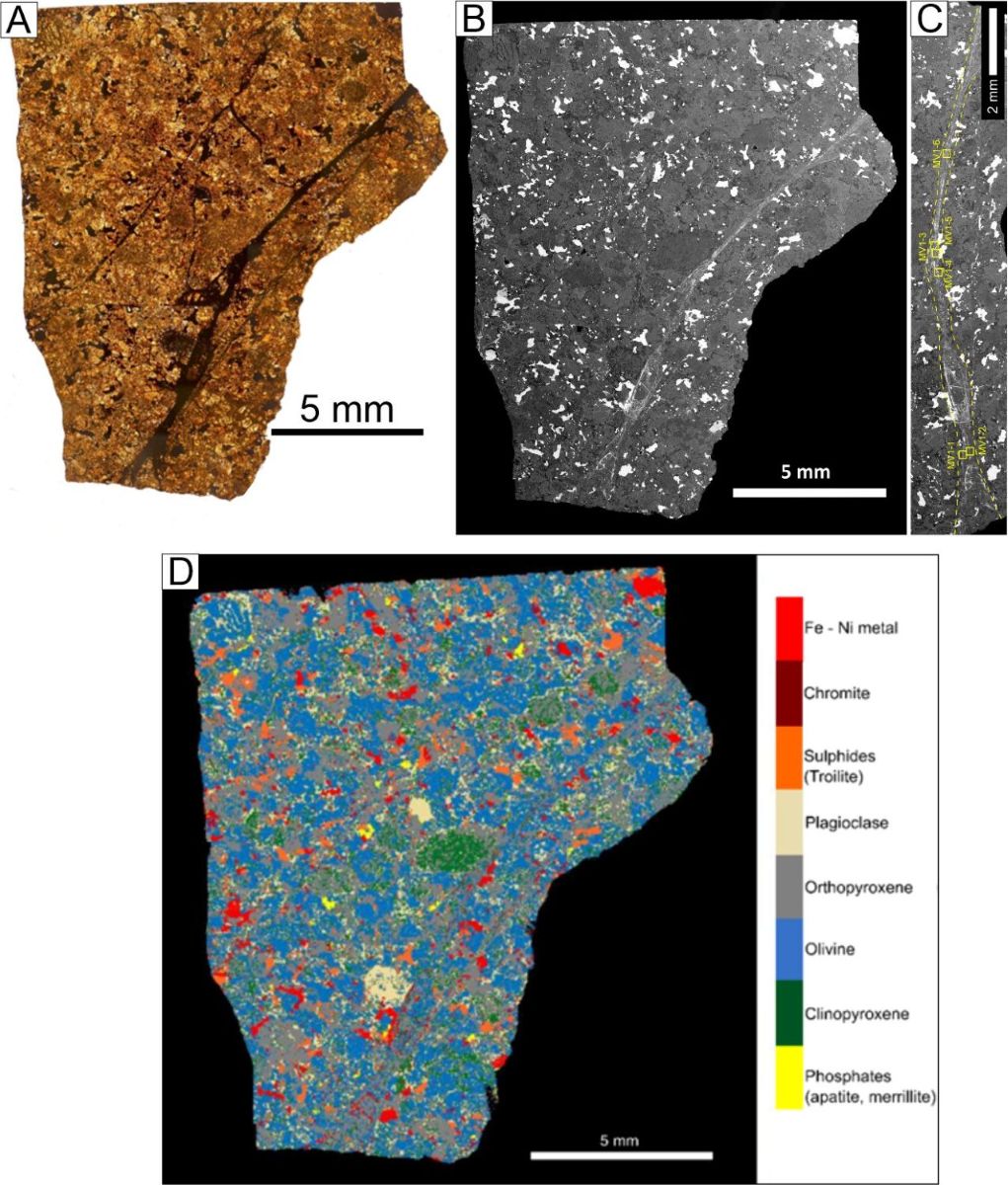
Ioannis Baziotis, Styliani Effraimidou, Myrto Simopoulou, Ludovic Ferrière, Stephan Klemme, Jasper Berndt, and Paul Asimow

Introduction

The L type ordinary chondrites preserve a complex record of impact processing. Preservation of High pressure (HP)  minerals is not controlled solely by peak shock pressure, but also by the post-shock pressure–temperature–time (P–T–t) evolution during decompression and cooling [1]. To evaluate the factors controlling HP phase preservation and understand why HP phases are so common in L-chondrites, we studied three meteorites with contrasting shock records: Northwest Africa (NWA) 4137 (L6), Homestead (L5), and Kunashak (L6).

Materials and Methods

We investigated one polished thin section of each meteorite. The Kunashak and Homestead samples were provided by the Natural History Museum Vienna (NHMW). Optical microscopy, SEM, EPMA, and Raman spectroscopy were used to fully characterize the melt veins (MVs).

Results

All meteorites preserve shock-related features including irregular and planar fractures, undulatory extinction, mosaicism, and MVs, indicating heterogeneous shock conditions ranging from S2 to S4. NWA 4137 (Figure 1) is characterized by a coarse-grained groundmass crosscut by a network of MVs, including a prominent MV (MV1) up to ~300 μm wide and a few thinner MVs up to 100 μm wide. The groundmass consists mainly of olivine (Fo69–74), orthopyroxene (En73–76Fs21–25Wo1–4), clinopyroxene, plagioclase, Fe-Ni metal, troilite, chromite, and phosphates. Using EPMA and Raman spectroscopy, we identified within MV1 the HP phases wadsleyite, majorite, albitic jadeite, tuite, and xieite.

Irregular wadsleyite up to ~20 μm in size show characteristic Raman peaks near ~722 and ~918 cm–1 (Figure 2). Majorite, confirmed by the characteristic ~927 cm–1 peak (Figure 3), occurs as isolated euhedral crystals and as equigranular clusters with ~120° triple junctions within the MV groundmass, suggesting crystallization from melt. Majorite composition yields a ~23 GPa pressure estimate [2], consistent with experimentally produced majorite in the range of 17–23 GPa. Irregular albitic jadeite up to ~50 μm across show the characteristic jadeite-family Raman peak at ~700 cm–1 (Figure 4) but have a composition by EPMA rich in vacancies, (Na0.61-0.64Ca0.08K0.02-0.050.25)M2(Al0.76-0.83Si0.12-0.17Fe0.02-0.08Mg0-0.15)M1Si2O6. Tuite and xieite were identified within MV1 through their characteristic Raman spectra: tuite has peaks at ~412, ~578, and 975 cm–1 (Figure 5), while xieite has a peak at ~607 cm–1 (Figure 6). Collectively, the observed HP assemblage defines shock pressures of approximately ~11–23 GPa.

In contrast, Homestead and Kunashak preserve abundant MVs and shock features, but no HP polymorphs. Homestead contains a complex MV network dominated by Fe-Ni metal and sulfides, with silicate minerals occurring as isolated grains or lithic clasts within the MVs. Kunashak hosts thick MVs up to ~900 μm wide composed of quenched silicate melt with olivine, pyroxene, plagioclase, Fe-Ni metal grains, and troilite droplets.

Discussion

The contrasting mineralogical records, despite similar shock stage and likely similar peak conditions, indicate that preservation of HP phases was controlled primarily by post-shock thermal evolution. In NWA 4137, the coexistence of majorite, wadsleyite, xieite, tuite, and albitic jadeite indicates crystallization under transient HP conditions followed by rapid quenching during decompression [3-5]. Experimental studies and thermal models demonstrate that MV cooling rates strongly depend on vein thickness, with thinner veins cooling on millisecond timescales. The ~100–300 μm wide MVs in NWA 4137 cooled rapidly enough to preserve metastable HP assemblages before complete pressure release [1, 6].

Conversely, the absence of HP phases in Homestead and Kunashak suggests decompression during a prolonged period at elevated post-shock temperature. Homestead preserves extensive metal–sulfide melting and pervasive thermal overprinting, indicating elevated post-shock temperatures and slow cooling. Such a path favors back-transformation of HP phases into low-pressure equivalents. Similar processes likely affected Kunashak, where shock deformation and MV formation occurred but thermal conditions during decompression inhibited preservation of HP minerals.

Conclusions

HP phases in the studied meteorites record local P–T–t paths within impact-related MVs. MVs are capable of recording extreme pressure conditions but may later be erased during thermal overprinting. Therefore, the absence of HP phases in shocked ordinary chondrites should not be interpreted as evidence of lower shock pressures. Instead, preservation depends strongly on the thermal trajectory during pressure release and cooling. The contrasting records preserved in NWA 4137, Homestead, and Kunashak confirm that impact processing within the L-chondrite parent body was highly heterogeneous with respect to shock duration, melt generation, and cooling history.

References

[1] Hu, J., Sharp, T. G. (2022). Prog. Earth Planet. Science, 9(1), 6.

[2] Collerson K. D. et al. (2010). GCA, 74: 5939–5957.

[3] Baziotis I., et al. (2025). Am. Mineral., 110(9):1472-1480.

[4] Tomioka N., et al. (2016). Science Adv. 2: E1501725.

[5] Chen M., et al. (2008). Chinese Sci. Bull. 53:3341–3345.

[6] Baziotis, I., et al. (2018). Scientific Reports, 8(1):9851.

[7] Rauch, M., et al. (1996). Am. Mineral.:81(9–10):1289–1292

Figures

Figure 1. (A) Optical microscope mosaic and (B) BSE of the NWA 4137 section. (C) Enlarged area of the prominent MV (MV1) showing the analyzed areas (MV1-1 to MV1-6). (D) Phase map of NWA 4137.


Figure 2. NWA 4137 meteorite. (A) BSE image of MV1-1. (B) Analyzed positions of the olivine and wadsleyite. (C) Raman spectra of wadsleyite compared with respective from the RRUFF database.


Figure 3. NWA 4137 meteorite. (A) BSE image of position MV1-2. (B) Analyzed positions of majorite. (C) Raman spectrum of majoritic garnet within MV1 compared to majorite from Handbook of Raman Spectra)[7] and enstatite (RRUFF).


Figure 4. NWA 4137 meteorite. (A) BSE image of position MV1-3. (B, C) Irregular albitic jadeite grains. (D) Raman spectrum of albitic jadeite compared with jadeite spectrum, and omphacite  (RRUFF).


Figure 5. NWA 4137 meteorite. (A) BSE image of position MV1-6. (B) Tuite annotated for the analysed Raman position. (C) Raman spectrum of a tuite grain within MV1-6 compared with respective from RRUFF database (merrillite R150063; fluorapatite R050617.


Figure 6. NWA 4137 meteorite. (A) BSE image within position MV1-5 showing the analyzed Raman spot. (B) Xieite within MV1-4 annotated for it’s Raman position . (C) Raman spectrum of xieite within MV1-4 and MV1-5 compared with Raman spectrum of xieite from [5] and chromite (RRUFF).

How to cite: Baziotis, I., Effraimidou, S., Simopoulou, M., Ferrière, L., Klemme, S., Berndt, J., and Asimow, P.: High-pressure phase preservation in L-chondrite melt veins: Evidence for control by post-shock thermal evolution, Europlanet Science Congress 2026, The Hague, The Netherlands, 7–11 Sep 2026, EPSC2026-1127, https://doi.org/10.5194/epsc2026-1127, 2026.

14:39–14:51
|
EPSC2026-140
|
On-site presentation
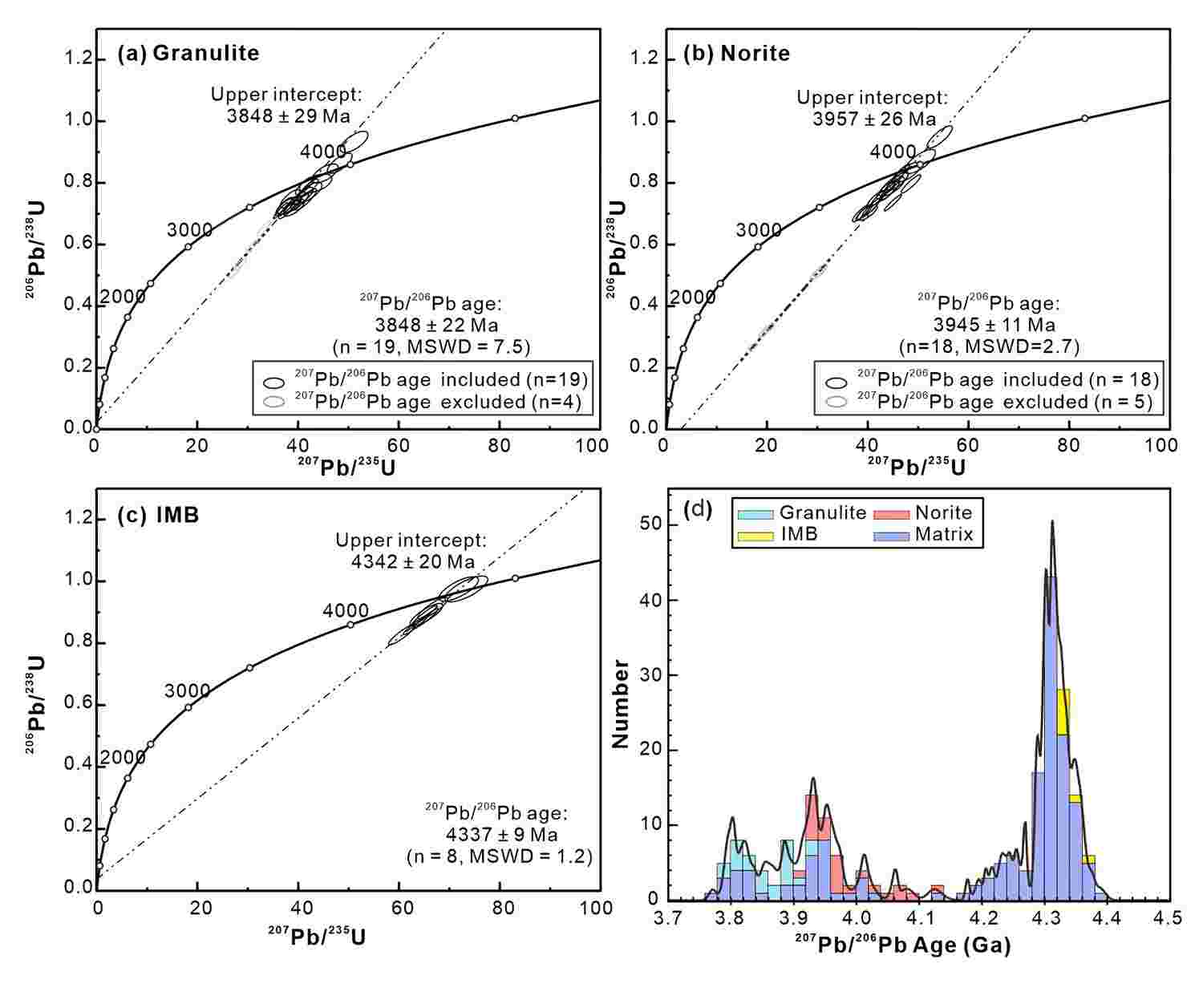
Qin Zhou, Qing-Zhu Yin, Ryan A. Zeigler, Bradley L. Jolliff, Qiu-Li Li, and Chunlai Li

Introduction: Since 1969, six Apollo missions, three Luna missions, and the recent Chang’E missions have returned ~385.6 kg of lunar samples, providing a robust dataset for reconstructing lunar surface processes and geologic history [1-2]. However, despite advances from Chang’e-5 and Chang’e-6 [e.g., 3-5], direct sampling remains geographically restricted to specific landing sites. Lunar meteorites- which likely originate from unsampled lunar regions-offer complementary records that advance our understanding of the Moon’s origin and global evolution [6-7].

Samples: Dhofar 1442 is the second most KREEP (potassium, rare earth elements, phosphorus)-rich lunar meteorites known (after SaU 169). Its geochemistry points to the Procellarum KREEP Terrane (PKT) on the nearside, which hosts the Moon’s primary KREEP reservoir and records prolonged magmatic activity. Unlike the limited sampling from Apollo 12, Apollo 14, and Chang’E-5, Dhofar 1442 offers complementary insights into KREEP magmatism and impact history.

Methods: The in-situ U-Pb dating of zircons were performed on a Cameca IMS-1280/1280HR at the Institute of Geology and Geophysics (IGG), Chinese Academy of Sciences (CAS). A 3-5 mm O2- primary beam at ~0.2 nA was employed in single-collector mode, with a mass resolving power of 7000 (50% peak height definition). Pb/U fractionation was calibrated against zircon standard M257 via the power relationship between 206Pb/238U and 238U16O2/238U. Common Pb was corrected using modern terrestrial value.

Results: Dhofar 1442 is a glassy-matrix regolith breccia containing a variety of mineral, lithic and glass clasts. The most abundant lithic clasts associated with zircons are granulitic, noritic, and impact melt breccia (IMB) clasts.

Granulitic clasts are metamorphic rocks formed at depth during large impacts. They exhibit a well-equilibrated mineral assemblage dominated by pigeonite, Na-rich plagioclase (average An73) and Si, K-rich glass, with minor ilmenite, Fe-Ni metal, troilite, phosphate and zircon. Zircons from these clasts yield an upper intercept age of 3848 ± 29 Ma (Fig. 1a). After excluding highly discordant points, the remaining analyses give a weighted average 207Pb/206Pb age of 3848 ± 22 Ma. This age records a metamorphic event at ~3.85 Ga and provides a lower limit for the consolidation age of Dhofar 1442.

Norite clasts comprise roughly equal proportions of low-Ca pyroxene and plagioclase (average An85), with minor ilmenite, troilite, phosphate and zircon. They preserve primary igneous textures (subophitic to granoblastic) and lack shock features. Zircons in these clasts give an upper intercept age of 3957 ± 26 Ma (Fig. 1b). After excluding discordant points, the weighted average 207Pb/206Pb age is 3945 ± 11 Ma, which is interpreted as the crystallization age of the noritic clast. This younger age records a later episode of magnesian magmatism on the lunar nearside, possibly linked to thermal effects from the Imbrium impact at ~3.92 Ga.

IMB clasts contain mineral and lithic fragments set in a fine-grained crystalline matrix. Pyroxene compositions vary widely, encompassing enstatite, pigeonite and augite. Plagioclase spans a range from An57to An93 (labradorite to anorthite). Zircons in IMB clasts yield an upper intercept age of 4342 ± 20 Ma (Fig. 1c) and a weighted average 207Pb/206Pb age of 4337 ± 9 Ma. This well-constrained age provides evidence for significant impact activity on the Moon pre-3.9 Ga.

In addition to lithic clasts, zircons also occur as matrix fragments. Although direct petrographic links to specific lithic clasts are limited, their 207Pb-206Pb age distribution closely resembles that of the lithic clasts, with prominent peaks at ~ 3.82, ~3.95, and ~4.32 Ga (Fig. 1d). This striking similarity suggests that matrix zircons are largely derived from the granulitic, noritic, and IMB clasts.

Discussion: Early Apollo studies identified the “lunar cataclysm” or Late Heavy Bombardment (LHB) at ~3.92–3.85 Ga [8], but pre-3.9 Ga impacts are increasingly recognized [9-10]. In Dhofar 1442, the ~4.34 Ga age of IMB clasts suggest a major impact. A similar ~4.35 Ga in other lunar meteorites such as Kalahari 009 and NWA 2995, is attributed to basin-forming impacts [10-11], though Borg and Carlson (2023) [1] proposed it as late Moon formation. Given our IMB zircon ages, we prefer an impact origin rather than Moon formation. As the South Pole-Aitken (SPA) basin is estimated at 4.25- 4.33 Ga [9-10], the impact recorded by Dhofar 1442 may be associated with SPA basin formation.

As a polymict regolith breccia, Dhofar 1442 provides a more representative record of lunar impact history than monomict specimens. Zircon age distribution indicates that impact activity at ~4.34 Ga was at least as intense as that during the ~3.94 Ga, with peak intensities decreasing progressively from ~4.34 to ~3.95 Ga and then to ~3.82 Ga, which is consistent with a declining impact flux over time [12].

Pre-3.9 Ga impacts are also recorded on Vesta (Ar-Ar: ~3.4–4.1 Ga; U-Pb: ~4.2 Ga) [13-14] and Mars (large basin: 4.10–4.25 Ga; NWA 7034/7533: 4.44, 4.35, 1.44 and 1.35 Ga) [15]. The 4.35 Ga zircon age in NWA 7034 is close to the oldest Martian basin [16], indicating major impact disturbance of the U-Pb system. These independent records support that significant bombardment began earlier than ~3.9 Ga, though establishing a synchronous chronology requires integration of multiple sample suites and geochronological techniques.

References: [1] Borg and Carlson, 2023, Annual Review of Earth and Planetary Sciences, 51, 25-52. [2] Neal et al., 2023, Reviews in Mineralogy & Geochemistry. [3] Li et al., 2021, Nature, 600, 54-58. [4] Cui et al., 2024, Science, 386, 1395-1399. [5] Zhou et al., 2025, Nature, 643, 371-375. [6] Joy et al., 2023, Reviews in Mineralogy & Geochemistry, 89: 509–562. [7] Korotev et al., 2005, Geochemistry, 65, 297-346. [8] Cohen et al., 2000, Science, 290, 1754-1756. [9] Su et al., 2025, National Science Review, 12, nwaf103. [10] Joy et al., 2025, Nature Astronomy, 9, 55-65. [11] Terada et al., 2007, Nature, 450, 849-852. [12] Yue et al., 2026, Science Advances, 12, eady9265. [13] Bogard, 1995, Meteoritics, 30, 244-268. [14] Zhou et al., 2011, 42nd LPSC, 2575. [15] Yin et al., 2014, 45th LPSC, 1320. [16] Marchi et al., 2021, The Astronomical Journal, 161, 187.

Figure 1: U-Pb concordia diagrams (a-c) and 207Pb/206Pb age probability density distribution (d) for zircons from different lithic clasts in Dhofar 1442. All uncertainties are reported at the 2σ level.

How to cite: Zhou, Q., Yin, Q.-Z., Zeigler, R. A., Jolliff, B. L., Li, Q.-L., and Li, C.: Zircon U-Pb Geochronology of Lunar Meteorite Dhofar 1442: Implications for Lunar Impact History and the Late Heavy Bombardment, Europlanet Science Congress 2026, The Hague, The Netherlands, 7–11 Sep 2026, EPSC2026-140, https://doi.org/10.5194/epsc2026-140, 2026.

14:51–15:03
|
EPSC2026-1189
|
On-site presentation
Jakob Wilk, Gourab Dey, and Amar Agarwal

Formation conditions of impact craters in volatile-bearing targets and the emplacement mechanisms of their ejecta blankets remain poorly constrained [1, 2]. Terrestrial impact structures formed in basaltic targets provide an opportunity to link crater-scale morphology, ejecta characteristics, and subsurface structure to impact parameters and target properties under well-constrained conditions [3].

Lonar crater (India), formed in the Deccan Traps, preserves a relatively well-developed ejecta blanket and associated surface and subsurface structures. We reevaluate the geomorphology and subsurface architecture of Lonar crater to constrain primary impact conditions (trajectory, energy, target saturation and cratering efficiency), while assessing the origin of the nearby “little Lonar” structure as a secondary objective.

We use drone-based photogrammetry (DEMs complemented by TanDEM-X data), ground-penetrating radar (GPR), and petrographic analysis as independent approaches, alongside iSALE-2D numerical simulations constrained by the observed topography.

Previous geomorphological analyses indicate distal thickening of the ejecta blanket and flow-like surface textures. Field observations suggest laterally variable internal layering of the ejecta [4], which is supported by GPR data showing heterogeneous subsurface structures and strong variations in signal attenuation.

Our reevaluation focuses on excavation depth, transient cavity geometry, ejecta extent, crater polygonality and micro-fracture networks. Best-fit iSALE simulations reproduce a transient cavity of ~1.4 km diameter and ~530 m depth, evolving into the present ~1.9 km diameter crater, with peak shock pressures of up to ~10 GPa at the crater floor. These results provide a quantitative framework linking observed structural features to impact energy and target conditions.

Comparison with the Ries crater (Germany) indicates two distinct ejecta units and comparable stratigraphic relationships. Within this framework, the “little Lonar” structure shows disrupted subsurface geometries and possible normal faulting, consistent with formation in unconsolidated ejecta, although a binary impact scenario cannot be excluded.

[1] Osinski et al. 2011 Earth and Planetary Science Letters 310, 167–181. [2] Weiss and Head 2018 Meteoritics & Planetary Science 53, 741–777. [3] Wulf et al. 2019 Earth and Planetary Science Letters 506, 209–220. [4] Kumar et al. 2014 JGR Planets 119, 2029-2059.

How to cite: Wilk, J., Dey, G., and Agarwal, A.: Formation conditions and ejecta characteristics of Lonar crater (India): Constraints from photogrammetry, GPR and iSALE-2D, Europlanet Science Congress 2026, The Hague, The Netherlands, 7–11 Sep 2026, EPSC2026-1189, https://doi.org/10.5194/epsc2026-1189, 2026.

15:03–15:15
|
EPSC2026-530
|
On-site presentation
Thomas Kenkmann, Michael H. Poelchau, Sebastian Sturm, Oguzcan Karagoz, Allan Fraser, and Kent Sundell

Introduction: Since the initial finding of a large number of secondary craters in southeast Wyoming [1, 2], the search for a source of the secondaries has been a major goal. Two potential locations of the primary crater, in the Denver basin and near the Hartville uplift near the town of Guernsey were proposed [3].

Recent field work was carried out in April 2026 in SE Wyoming, USA to investigate these potential sites of the primary and to prove and sample more secondary crater sites. Generally, accessibility to outcrops is challenging due to the prevalence of privately owned land; permission from landowners is mandatory for access to sites. Here, we report on our findings near the Glendo Reservoir, where Pennsylvanian to Permian lithologies were mapped as the Hartville Formation. We targeted the upper portions of this formation (Hartville divisions 1-3) as they are correlated to the upper Casper Formation, which contains secondaries further to the North and West.

Results: 15 new potential secondary craters were found north of the Glendo Reservoir and are currently being evaluated for shock effects. These secondaries occur as morphologically raised features in the field. Rings of partly brecciated quartzitic sandstones with diameters up 100 m were found. The rings show a stronger quartzitic overprint than surrounding sandstone layers. These quartzitic sandstones commonly form meter-high walls that delineate the rims of the circular to elliptical craters. A tightly spaced cluster of four secondaries with diameters of ~50 m each was found, where crater rims partially overlap. Within the craters the sandstones show strong brecciation and occasional folding, and thus resemble the secondary fields found, e.g., near Douglas [1].

To the south of the secondary craters, zones of intense deformation are found in sedimentary layers of the Hartville Formation. Subvertical fault zones consist of mostly monomict (and rare polymict) breccias that can reach over 10 meters in width. Surprisingly, only minor displacement of the local stratigraphy is visible and is confined to at most a few meters of throw. The intensity and width of these breccia zones do not match typical tectonic fault zones with minor displacement but could be explained through repeated, oscillating movement, e.g., seismic activation during the cratering process. These breccia zones have spacings of several 100 m.

Alongside the subvertical breccia zones, a horizontal bed of ~10 m thick polymict breccias could be traced over a lateral extent of roughly 1 km. The breccias are subdivided into a lower red clay- and silt-dominated zone and an upper grey carbonate-dominated zone. The breccias are located roughly 50 m below the stratigraphic horizon containing the secondaries. The unbrecciated sediment layers immediately above the breccias show a shallow thrust ramp with 2-3 m throw, indicating that the breccia layer may have served as a detachment zone for lateral displacement where softer, unconsolidated clays and silts were more easily deformed.

Finally, polymict breccias are found at the top of the Hartville Formation at a stratigraphic level corresponding to that of the secondary craters. We interpret these breccias as a potential continuous ejecta blanket. At the reservoir, the breccias consist mainly of carbonate clasts in a red silty matrix. Clast sizes here are usually in the cm to dm range and show intense deformation, with breccia thicknesses reaching a few meters. These breccias could be laterally traced over 1 km. Further to the north, decameter thick exposures of polymict breccias are locally found, with one noteworthy outcrop containing block sizes of over 10 m. In all cases, polymict breccias contain only sedimentary clasts, while metamorphic and igneous rocks of the Precambrian basement were not found.

Discussion: The widespread occurrence of monomict and polymict breccias along with some strata displacements and local strata tilting suggests that a section of a larger impact structure and a continuous ejecta blanket is exposed at the Glendo Reservoir. We assume that the largest portion of the crater is buried beneath younger strata. As only sedimentary rocks and no crystalline basement clasts were found within the polymict breccias, this gives a constraint on the maximum possible crater size. Profiles in geological maps from the area show that the thickness of sedimentary layers from the top of Precambrian igneous and metamorphic lithologies to the Permian is between 300-450 m (1000-1500 feet). Using a maximum excavation depth of 1/10 of the transient crater diameter [4], the potential crater should have a transient crater diameter of 4.5 km or less. Applying a maximum complex to transient crater diameter ratio of 2 [5] indicates a primary crater of less than 9 km diameter.

In summary, field results suggest a potential primary crater in close proximity to the Glendo reservoir, with numerous monomict and polymict breccias that are difficult to explain through endogenic or tectonic processes. The primary crater is presumably partially or fully buried in this region. Shock metamorphism is required for the recognition of impact craters [6]. Therefore, thin sections of sampled rocks are currently being scanned for shock features.


Acknowledgments: We acknowledge funding by the German Research Foundation, grants KE 732/30-1 and 732/30-2. We express our gratitude to the Reese family and Glendo State Park for granting us access for field work.


References: [1] Kenkmann, T. et al. (2018) Scientific Reports 8:13246; [2] Kenkmann, T. et al. (2022) GSA Bulletin, 134(9-10):2469-2484. [3] Sturm, S. et al. (2026) Met. Planet. Sci, submitted. [4] Melosh, H. J. (1989) Impact cratering. A geologic process. [5] Collins G. S. et al. (2020) LPSC #2028. [6] Cavosie, A. J. et al. (2026) Met. Planet.Sci., accepted.

How to cite: Kenkmann, T., Poelchau, M. H., Sturm, S., Karagoz, O., Fraser, A., and Sundell, K.: The Wyoming Crater Field: more secondaries, a continuous ejecta blanket, and a possible source crater., Europlanet Science Congress 2026, The Hague, The Netherlands, 7–11 Sep 2026, EPSC2026-530, https://doi.org/10.5194/epsc2026-530, 2026.

15:15–15:27
|
EPSC2026-1257
|
On-site presentation
Jens Ormö, Erik Sturkell, Patricia Solana Gonzalez, M. Isabel Herreros, Vinamra Agrawal, and David T. King, Jr.

Rubble-piles may constitute nearly all of the asteroids in the size range 0.2-10 km [1]. The reason for the high abundance has been suggested to be their high durability against disruption due to their shock-absorbent nature compared with monolithic bodies [2]. The Lockne crater (7–12 km) and its smaller companion Målingen formed simultaneously at 458 Ma in a shallow sea, resulting in exceptional preservation of crater fill and near-field ejecta [3]. The impact event is linked to the Middle Ordovician breakup in the Main Asteroid Belt (~470 Ma), implying that the impacting bodies were rubble-pile aggregates [4].

The marine setting at the Lockne impact event, with seawater and sedimentary strata overlying a flat crystalline basement, represents an extreme case of layering with strong property-contrasts, known to influence crater morphology and produce concentric structures. Such effects also have relevance for Mars, where concentric craters can indicate sedimentary rock and former habitable environments.

At Lockne, an inner 7.5 km wide basement crater is surrounded by a shallow ~12 km outer crater recorded in the sedimentary target rocks [5, 6]. It formed by a shallow excavation flow prior to deposition of basement crater ejecta, and is offset downrange due to oblique impact [5, 6]. At Målingen, the 0.7 km basement crater’s ejecta distribution also indicates a wider but poorly preserved outer crater.

Previous 3-D simulations of the Lockne impact used a monolithic impactor [5]. For an impact at 45° and 15 km/s, these models indicate a ~600 m projectile and target water depth slightly less than the projectile diameter, producing a ~5 km transient basement crater. Målingen was estimated at ~150 m if massive [4]. However, rubble-piles of this size may deform during atmospheric entry forming a “pancake-like” cluster significantly wider than the original body [7]. Such clustered impacts distribute more energy near the surface producing shallower, wider craters. Obliquity increases the flattening, enhances near-surface energy release, and intensifies downrange asymmetry. This seems indicated in the morphology of the concentric Lockne impact structure where the shallow outer crater appears wider than what can be obtained with numerical simulation using a massive impactor [5, 6].

To investigate crater formation mechanisms, we performed impact experiments and numerical simulations of clustered impactors. Experiments were carried out with the EPIC single stage gas gun at CAB CSIC-INTA, Spain, to launch Delrin projectiles up to ~400 m/s. Clustered projectiles were made from weakly bonded 3 mm spheres to obtain equal mass to 20 mm solid reference projectiles, and high-speed cameras recorded both half-space and quarter-space impacts. Numerical modeling in iSALE-2D [8, 9] is ongoing, testing several rubble-pile configurations. Preliminary results indicate a peak energy release at higher position in the target for oblate rubble-pile projectiles ("pancake") than for massive spherical projectiles leading to wider, shallower impact structures consistent with observation in nature.


Acknowledgements: This work was supported by grants PID2021-125883NB-C22 and PID2024-160976NB-I00 by the Spanish Ministry of Science and Innovation/State Agency of Research MCIN/AEI/10.13039/501100011033 and by ‘ERDF A way of making Europe’, and the Spanish Research Council (CSIC) support for international cooperation I-LINK (#ILINK22061).


References: [1] Walsh, K. (2018), Rubble pile asteroids. Annu. Rev. Astron. Astrophys. [2] Jourdan, F. et al. (2023), Rubble pile asteroids are forever. Proc. Natl. Acad. Sci. U.S.A. 120(5). [3] Ormö, J et al. (2014), The geology of the Målingen structure: A probable doublet to the Lockne marine-target impact crater, central Sweden. Meteorit. Planet. Sci. [4] Ormö et al. (2014), First known Terrestrial Impact of a Binary Asteroid from a Main Belt Breakup Event. Sci. Rep.  [5] Lindström et al. (2005), Lockne crater as a result of marine-target oblique impact. Planet. Space Sci. [6] Ormö, J., et al. (2013), A new method to determine the direction of impact: Asymmetry of concentric impact craters as observed in the field (Lockne), on Mars, in experiments, and simulations. Meteorit. Planet. Sci. [7] Shuvalov, V. V. (2002), In Impacts in Precambrian Shields (eds Plado, J. & Pesonen, L. J.),Springer, Berlin-Heidelberg.  [8] Amsden et al. (1980), LANL Rep. LA-8095. [9] Wünnemann et al. (2006) Icarus, 180, 514–527.

How to cite: Ormö, J., Sturkell, E., Solana Gonzalez, P., Herreros, M. I., Agrawal, V., and King, Jr., D. T.: Lockne: A layered-target impact structure from a rubble-pile impactor analysed in field observations, impact experiments, and numerical simulation., Europlanet Science Congress 2026, The Hague, The Netherlands, 7–11 Sep 2026, EPSC2026-1257, https://doi.org/10.5194/epsc2026-1257, 2026.

15:27–15:30

Posters: Thu, 10 Sep, 18:00–19:30 | Foyer 2

Display time: Thu, 10 Sep, 08:30–19:30
Chairpersons: Chrysa Avdellidou, Cem Berk Senel
F2.6
|
EPSC2026-744
|
On-site presentation
Anthony Lagain, Miroslav Broz, John Fairweather, Pierre Vernazza, Yoann Quesnel, Alexis Licht, Alessandro Morbidelli, Konstantinos Servis, Anthony Ozerov, Phil Bland, and Gretchen Benedix

The collisional evolution of asteroids in the main belt between Mars and Jupiter has governed the flux of impactors delivered to the Earth–Moon system throughout much of Solar System history. The impact flux over the last ~3 billion years in the inner Solar System has generally been considered approximately constant [1-3], with crater chronologies on the Moon and terrestrial planets failing to reveal any statistically robust long-term variations from steady-state cratering rates [4, 5]. However, the incompleteness of crater catalogs, particularly for small impact structures, has limited our ability to detect temporal variations in bombardment history. Here we combine machine-learning-based crater detection [6] with lunar crater chronology analyses and dynamical modeling [Broz] to identify a previously unrecognized episode of enhanced bombardment that affected the Earth–Moon system during the Proterozoic.

Using a convolutional neural network trained to identify impact structures on high-resolution Kaguya/SELENE Terrain Camera imagery, we detect and characterize more 250 million small lunar craters across the Moon’s surface. This large and internally consistent crater inventory allows us to refine crater production statistics and estimate model ages for 211 lunar craters with diameters ≥20 km. Our analysis reveals a statistically significant and long-lived increase in lunar cratering between approximately 1.4 and 0.9 Ga. During this interval, the production rate of 20–40 km lunar craters increased by a factor of 4.0 ± 0.8 relative to the background flux of impactors. The enhancement persisted for several hundred million years, distinguishing it from transient spike-like bombardment episodes previously proposed in planetary chronology studies.

To determine the origin of this bombardment episode, we performed dynamical simulations tracing the orbital evolution and delivery efficiency of asteroid fragments from major main-belt families. The simulations reconstruct the temporal evolution of both large and small impactor populations reaching near-Earth space and indicate that the Flora asteroid family was the unique contributor to the enhanced Proterozoic flux. The Flora family occupies a dynamically favorable region of the inner asteroid belt adjacent to resonances capable of efficiently transporting large fragments into Earth-crossing orbits. Our results show that a major collisional disruption within the Flora parent population [7, 8] could generate a sustained increase in terrestrial and lunar impact rates lasting several hundred million years.

Independent support for the timing of this breakup event is provided by meteoritic and sample-return evidence: shock-reset ages measured in LL chondrite meteorites cluster within the inferred bombardment interval, impact-reset grains returned from asteroid Itokawa show an age distribution consistent with a major collisional event occurring near the onset of the enhanced cratering episode [9-11]. Together, these constraints strengthen the interpretation that the Flora family breakup initiated a prolonged delivery of debris into the inner Solar System.

Scaling the reconstructed lunar impact flux to the Earth suggests that our planet experienced a substantial increase in large impacts during this Proterozoic interval. We estimate that Earth was struck by approximately 1,900 impactors larger than 1 km in diameter between ~1.4 and 0.9 Ga, corresponding to an average frequency of roughly one such impact every 255 kyr. This impact frequency is close to biological recovery timescales inferred for the aftermath of the Chicxulub impact event, which caused the end-Cretaceous mass extinction and required on the order of 200–300 kyr for ecological recovery [12]. Although most Proterozoic impacts would not individually have caused global sterilization, repeated large impacts over hundreds of millions of years could have imposed persistent environmental stress through atmospheric perturbations, oceanic disruption, nutrient cycling, and climate forcing [13,14].

The termination of this bombardment episode broadly coincides with the emergence and diversification of multiple eukaryotic clades during the late Proterozoic. This temporal relationship raises the possibility that asteroid-driven environmental disturbances influenced evolutionary trajectories on Earth, either by periodically suppressing ecological complexity or by generating selective pressures. While a direct causal link remains speculative, our findings suggest that impact flux variations should be considered as a potentially important environmental factor in models of Earth’s biological and geochemical evolution.

More broadly, this work demonstrates that planetary bombardment histories may preserve signatures of discrete asteroid-family breakup events long after the early Solar System. The combination of machine-learning crater detection, improved lunar chronology, and dynamical modeling opens a new avenue for reconstructing the temporal evolution of impact fluxes with respect to impactor sizes in the inner Solar System. Rather than a monotonic decline punctuated only by the earliest heavy bombardment phases, the Earth–Moon impact record may contain multiple prolonged episodes of enhanced cratering tied to the collisional evolution of specific asteroid families. These results therefore have implications not only for planetary surface dating and Solar System dynamics, but also for understanding the environmental context in which life evolved on Earth.

[1] Morbidelli, A., et al. In: Asteroids III, pp. 409–422 (2002). [2] Marsset, M., et al. Nature 634(8034), 561–565 (2024). [3] Brož, M., et al. Nature 634(8034), 566–571 (2024). [4] Neukum, G., et al.  Space Science Reviews 96(1), 55–86 (2001). [5] Lagain, A., et al. Earth and Planetary Science Letters 579, 117362 (2022). [6] Fairweather, J.H., et al. Earth and Space Science 10(7), 2023–002865 (2023). [7] Vernazza, P., et al. Nature 454(7206), 858–860 (2008). [8] Vokrouhlický, D., et al. The Astronomical Journal 153(4), 172 (2017). [9] Swindle, T.D., et al. Geological Society of London Special Publications 378(1), 333–347 (2014). [10] Park, J., et al. Meteor. Planet. Sci. 50(12), 2087–2098 (2015). [11] Terada, K., et al.  Scientific Reports 8(1), 11806 (2018). [12] Lowery, C.M., et al. Nature 558(7709), 288–291 (2018). [13] Anderson, R.P., et al. Royal Society Open Science 11(8) (2024). [14] Brocks, J.J., et al. Nature 618(7966), 767–773 (2023).

How to cite: Lagain, A., Broz, M., Fairweather, J., Vernazza, P., Quesnel, Y., Licht, A., Morbidelli, A., Servis, K., Ozerov, A., Bland, P., and Benedix, G.: Onset of a Heavy Bombardment 1.4Ga ago Triggered by the Flora Asteroid Family and Its Implications for Earth–Moon Evolution, Europlanet Science Congress 2026, The Hague, The Netherlands, 7–11 Sep 2026, EPSC2026-744, https://doi.org/10.5194/epsc2026-744, 2026.

F2.7
|
EPSC2026-172
|
On-site presentation
Aldo Dell'Oro

A classic (and fundamental) problem in the study of the collisional evolution of asteroids is the evaluation of the rate of close encounters among the members of the small bodies population of interest. Besides the frequency of impact, that in the framework of the asteroids studies is expressed in terms of "intrinsic probability of collision" (Wetherill 1967), the distribution of the impact velocity is of paramount importance too.

The intensity of the collisional environment created by a dominant group of asteroids depends on the joint distribution of the sizes and the orbits of the population. A common approach is to assume that the diameters and orbital distributions are independent. Indeed, the mean intrinsic probability of collision is a pure geometrical quantity depending only on the distribution of the impactor orbits. In this way, the frequency of impacts from the projectiles population hitting a given target is proportional to the product between size frequency of the projectiles and the mean intrinsic probability of collision. In other words, we assume that the mean intrinsic probability of collision is the same for different intervals of impactor sizes.

Even in this idealized situation, both the sizes and orbital distributions are sources of considerable uncertainty. Here we will focus on the role of the orbital distributions.

In order to compute the intrinsic probability of collision, different approaches have been developed over the last half century, which differ from each other in terms of the degree of approximation and the underlying dynamical hypotheses. All such methods require as input a list or a distribution of orbits, from which the statistics of collision are derived. The input orbital distribution must be as realistic as possible in order to obtain a reliable and really useful result. However, the uncertainties about the real distribution of orbits often introduce errors in the computation of probabilities that may be larger than the errors due to approximations implemented in the computational methods about the dynamical behavior of the bodies.

The orbital distribution of asteroids is affected by several observational biases. In such situation the choice of the set of orbits mapping the "real" orbital distribution of the projectiles is a critical problem. In some cases the computation of the impact statistics relies on a model of the orbital structure of the population (Dell'Oro et al. 2013). As a consequence, the computed probability of impact results to be a model dependent quantity the reliability of which depends on the validity of the assumed dynamical model. Other approaches consist in computing impact probability taking into account the orbits of the largest projectiles in the assumption that this sample is bias free (Farinella & Davis 1992, Bottke et al. 1994). On the other hand the contribution to the overall collisional environment produced by the smaller impactors (responsible for surface evolution mechanisms like craterization) is simply ignored.

We are carrying on a project that aims to explore in a systematic way how impact statistics parameters depend on the distribution of the orbits of the impactors. The main goal is to provide an assessment of the impact probabilities and the impact velocity distributions as realistic as possible, along with the corresponding regions of confidence. The latest results will be shown and discussed.

References

  • Bottke W.F., Nolan M.C., Greenberg R., Kolvoord R.A., 1994. Icarus, 107, 255-268.
  • Dell'Oro A., Campo Bagatin A., Benavidez P.G., Alemañ R.A., 2013. Astronomy and Astrophysics, 558, A95.
  • Farinella P., Davis D.R., 1992. Icarus, 97, 111-123.
  • Wetherill G.W., 1967. Journal of Geophysical Research, 72, 2429-2444.

How to cite: Dell'Oro, A.: Which orbital elements for asteroids impact statistics? Robustness tests in impact probability computation, Europlanet Science Congress 2026, The Hague, The Netherlands, 7–11 Sep 2026, EPSC2026-172, https://doi.org/10.5194/epsc2026-172, 2026.

F2.8
|
EPSC2026-120
|
ECP
|
On-site presentation
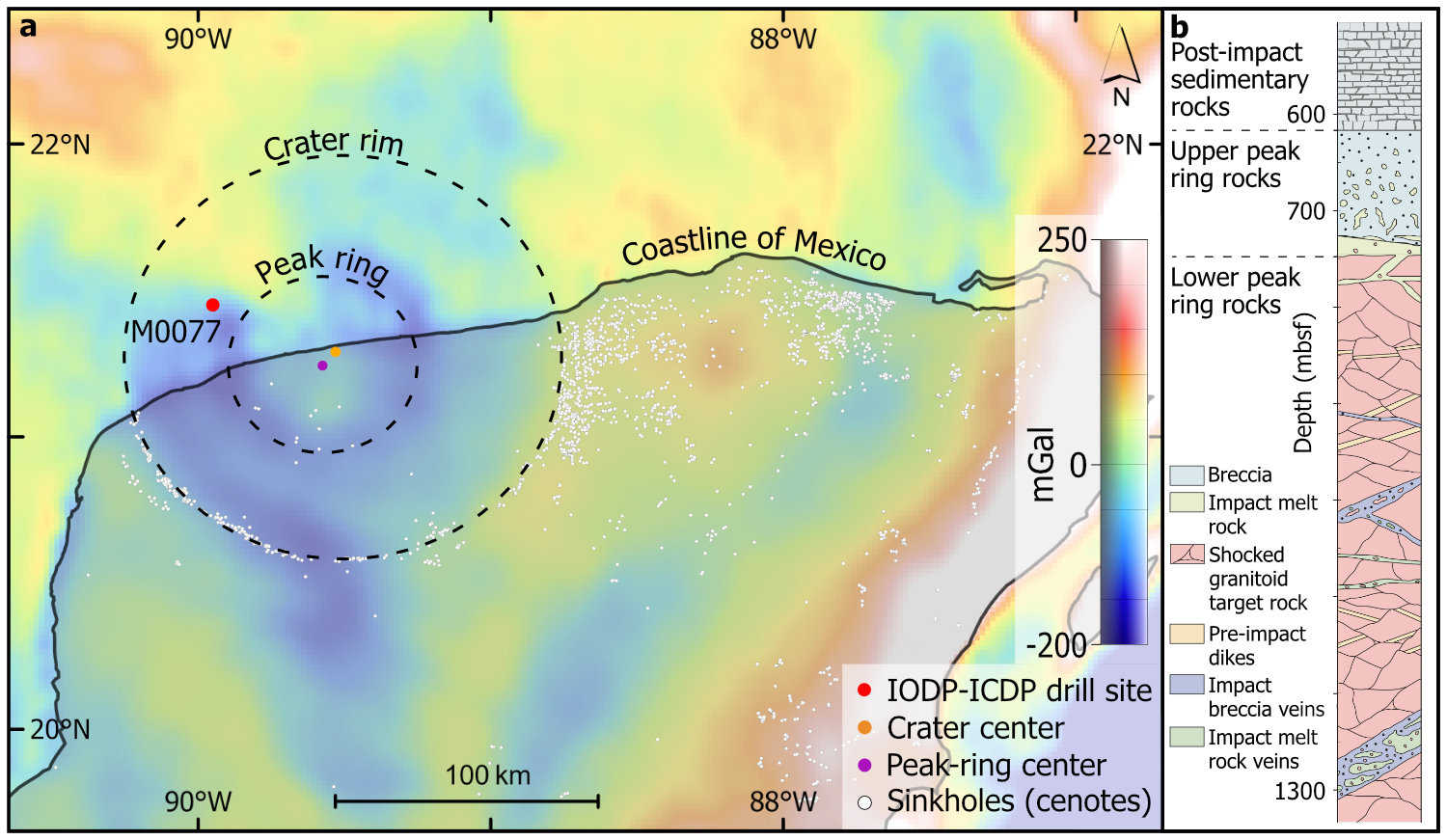
Louisa Bahr, Nele Grolms, and Ulrich Riller

Introduction: The Chicxulub hypervelocity meteorite impact crater, located on the Yucatán Peninsula in Mexico, is the remnant of one of the most significant short-term deformation processes in the younger history of our planet [1, 2]. The IODP-ICDP Expedition 364 drill core from the Chicxulub crater (Fig. 1) was instrumental in acquiring fundamental knowledge on the formation of this class of complex impact craters. The drill core is characterized by the pervasive presence of cataclasite zones in shocked target rocks underlying the peak ring of the crater [3] (Fig. 1b, 2a). Cataclasites are a category of shearing-induced fault rocks that develop in the brittle realm, leading to the formation of mostly angular grains within a fine-grained matrix (Fig. 2d). The formation of these zones during cratering is attributed to the transition from acoustic fluidization to localized shear faulting [3]. Hence, the question arises to what extent cataclasis is the result of acoustic pressure fluctuations, possibly leading to pure crushing of target rock, and comminution of rock caused by zone-parallel shearing. Pure crushing is expected to produce random orientations of fragments with diverse shapes. If cataclasite zones primarily formed through this mechanism, it would indicate that the acoustic fluidization persisted considerably longer than previously assumed. Conversely, shearing would entail cataclasis accompanied by cohesion regain, manifesting as a pronounced shape-preferred orientation of elongated fragments. The observation of a significant shape-preferred orientation within cataclasites could be interpreted as evidence for the cessation of acoustic fluidization prior to the consolidation of cataclasite zones. The quantification of the fragment orientation in cataclasite zones is, therefore, paramount to providing geological evidence for the formation mechanism of these fault rocks, which is crucial for our understanding of the progressive cratering and deformation mechanisms.

Figure 1. Drill site and lithological column of IODP-ICDP Expedition 364 drill core M0077. (a) Location of the drill site and the crater on the Yucatán peninsula, Mexico. Background colors show a Sandwell gravity anomaly map [4]. (b) Schematic stratigraphy of the recovered lithologies (modified from [5]). Depth is specified in meters below seafloor (mbsf). The lower peak ring rocks exhibit pervasive presence of cataclasite zones.


Methods: In order to characterize shapes and orientations of fragments in cataclasite zones, thin sections of cataclasite zones from drill core samples (Fig. 2) were analyzed with a revised semi-automated 2D image analysis workflow. Firstly, thin section RGB microphotographs were obtained at 5x magnification, in certain polarization configurations and with a lambda plate (Fig. 2d). Subsequently, we conducted the image analysis in the open-source Geographic Information System software SAGA [6], automatically identifying grain boundaries. The analysis ultimately generates polygon shapes from the identified fragments within the section (Fig. 2e). A variety of geometric parameters of these shapes were derived and utilized to quantify the fragments’ shape-preferred orientation (Fig. 2f), fragment sphericity (Fig. 2g) and the D-value, a measure for the degree of fragmentation, derived from the fragment-size distribution (Fig. 2h). The quantitative results from the analysis of numerous cataclasite zones spanning along the shocked target rocks of the drill core were analyzed and compared.

Results and Discussion: Comparing several thin section photographs from within one cataclasite zone indicated that the degree of fragment ellipticity can vary significantly within a cataclasite zone, while a distinct preferred orientation of elliptical fragments (Fig. 2f) remains predominantly consistent. Furthermore, cataclasite zones from different depths of the core appear to mostly exhibit shape-preferred orientations (Fig. 2f). These observations suggest that shearing may have played a significant role in cataclasite formation. This implies that zone-parallel shearing may have indeed triggered a reorientation of elliptical fragments formed by initial crushing. Therefore, acoustic fluidization may have ceased at an earlier stage than previously thought [3, 7].

Figure 2. Example of the quantitative image analysis of a cataclasite zone at 754.72 mbsf. (a) Drill core sample of shocked granitoid target rock, impact melt rock and a cataclasite zone in between (b) Bright light photograph of the sample. (c) Cross-polarized photograph of the sample with a red rectangular specifying the section in d and e. (d) Cross-polarized microphotograph at 5x magnification. (e) Cross-polarized microphotograph at 5x magnification depicting the image-analysis-derived polygon shapes of the fragments. n = number of fragments. (f) Rose diagrams depicting a shape-preferred orientation of fragments. I. = Shape-preferred orientation relative to the orientation of the microphotograph. II. = Shape-preferred orientation corrected for geographic directions. (g) Sphericity of the fragments. (h) Fragment-size distribution and respective D-value.


References:

[1] Melosh H. J. (1989) Impact cratering Oxford University Press.

[2] Gulick S. et al. (2013) Reviews of Geophysics 51:31–52.

[3] Riller U. et al. (2018) Nature 562:511–515.

[4] Sandwell D. T. et al. (2014) Science 346:65–67.

[5] Morgan J. V. et al. (2016) Science 354:878–882.

[6] Conrad O. et al. (2015) Geosci. Model Dev. 8:1991–2007.

[7] Collins G. S. et al. (2002) Icarus 157:24-33.

How to cite: Bahr, L., Grolms, N., and Riller, U.: Cataclasite formation in the Chicxulub impact crater gleaned from 2D image analysis of the IODP-ICDP Expedition 364 drill core, Europlanet Science Congress 2026, The Hague, The Netherlands, 7–11 Sep 2026, EPSC2026-120, https://doi.org/10.5194/epsc2026-120, 2026.

F2.9
|
EPSC2026-623
|
On-site presentation
Miriam Rengel and Ekko Krumstroh

Circular landforms are commonly interpreted as impact structures in planetary science, yet morphology alone can lead to ambiguous or incorrect classifications. We revisit a circular geomorphological feature in the Venezuelan Guiana Shield that was originally proposed as a possible impact crater based on aerial observations and radar imagery acquired in the 1980s.

Using modern digital elevation models from the Shuttle Radar Topography Mission (SRTM) and TanDEM-X datasets, we perform a detailed morphological analysis of the structure. The topography reveals an elevated annular plateau with discontinuous ridges surrounding a relatively flat interior, lacking diagnostic features of impact craters such as a continuous raised rim, central uplift, or ejecta distribution. Instead, the morphology is consistent with a known intrusive igneous structure, the Nuria ring dike, as supported by regional geological mapping and lithological context.

This case highlights how limited-resolution data and planform geometry can bias interpretations toward impact origin. Similar misclassifications have historically occurred in planetary exploration, where volcanic or tectonic features were initially identified as impact craters prior to higher-resolution observations.

As a terrestrial analogue, this study underscores the importance of integrating geomorphology, geological context, and multi-resolution topography when interpreting circular features on planetary surfaces. The results provide methodological insights relevant to current and future planetary missions, where data resolution and contextual information remain critical constraints.

How to cite: Rengel, M. and Krumstroh, E.: Revisiting a suspected impact structure in the Venezuelan Guiana Shield: implications for planetary remote sensing, Europlanet Science Congress 2026, The Hague, The Netherlands, 7–11 Sep 2026, EPSC2026-623, https://doi.org/10.5194/epsc2026-623, 2026.

F2.10
|
EPSC2026-1052
|
On-site presentation
Arum Jung, Jaesoo Lim, Sujeong Park, Kongtae Ra, and Chaehwan Park

Meteorite impact events are commonly observed not only on Earth but also on other planets, and have been considered as a fundamental process in planetary evolution. Understanding extreme environments that developed after meteorite impacts, especially hydrothermal activity, is crucial for tracing the evolution of life on the early Earth and other planets. In this study, we aim to investigate the elemental features in the post-impact lake sediments within the Hapcheon impact crater in Korea based on geochemical multi-proxy data obtained through inductively coupled Inductively Coupled Plasma Mass Spectrometry (ICP-MS) and X-ray Fluorescence Core Scanning (XRF). In particular, we aim to trace hydrothermal activity within the crater by focusing on the changes in manganese (Mn), europium (Eu) and cerium (Ce) anomalies. Furthermore, we suggest that Earth's impact craters can be used as natural experimental sites for studying Martian craters and environments.

How to cite: Jung, A., Lim, J., Park, S., Ra, K., and Park, C.: Reconstruction of hydrothermal activity in impact crater through elemental changes  using ICP-MS and XRF and its application to Martian research, Europlanet Science Congress 2026, The Hague, The Netherlands, 7–11 Sep 2026, EPSC2026-1052, https://doi.org/10.5194/epsc2026-1052, 2026.

F2.11
|
EPSC2026-1200
|
On-site presentation
Juergen Nussbaumer

Introduction: Paleochannels have been identified,which are interpreted to be the result of melting of ice. A 30 km diameter impact basin in the Aeolis/Zephyria region near the dichotomy boundary is characterized by small valley networks (Fig. 1) that are partly located radial to the crater rim. Large glacial deposits, interpreted to be the remains of debris covered glaciers, have been identified in the area surrounding the crater. The spatial association between the crater and the paleochannels suggest that the impact was responsible for their formation.
Ejecta deposit: The release of water is initiated by the melting of ice from the deposition of hot ejecta deposits over its surface. Such a mechanism would generate fluvial features in the absence of a climatic regime favorable for fluvial activity.
Conclusions: I propose that the valley networks originated from the release of water due to the deposition of hot ejecta over ice deposits present in the area during the impact event. Glacial deposits have been identified elsewhere on Mars [1-6]. Water sources originate from the melting of
snow/ice deposits, extensive fluvial features in close proximity to the large crater in a region interpreted to have experienced significant glacial activity. The spatial relationship between the valleys and the main crater suggest, that they are related. The hot ejecta deposit associated with the impact provides an explanation for the melting of ice deposits that were present on
the plateau at the time of impact.

Fig. 1: Themis Image V05875001(left) and terrestrial analog (right, glacier and drainage 
system, Svalbard, adapted from [7]), suggesting the action of glacial meltwater as a water 
source for fluvial channels.

References: [1] Christensen, P. R. (2003) Nature 422, 45–48. [2] Dickson, J. L. et al. (2008) Geology36(5),  411–415 [3] Head, J. W. et al. (2006) Geophys.Res. Lett. 33, doi:10.1029/2005GL024360. L08S03.[4] Levy, J. S. et al. (2007) J. Geophys. Res. 112, doi:10.1029/2006JE002852.  E08004. [5] Newsom, H.E. (1980) Icarus 44, 207–216. [6] Shean, D. E. et al.(2007) J. Geophys. Res. doi:10.1029/112,2006JE002761. E03004. [7] Evans, D. (2005), Hodder  Arnold, 544pp.

How to cite: Nussbaumer, J.: Evidence for impact into ice-rich terrain and melting to produce glaciation in the Aeolis/Zephyria region, Mars., Europlanet Science Congress 2026, The Hague, The Netherlands, 7–11 Sep 2026, EPSC2026-1200, https://doi.org/10.5194/epsc2026-1200, 2026.

F2.12
|
EPSC2026-1117
|
ECP
|
On-site presentation
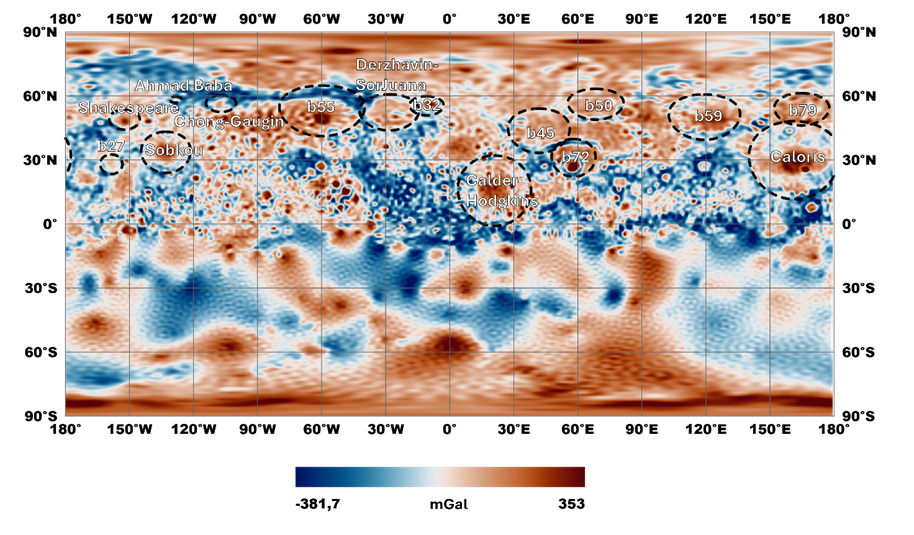
Salvatore Buoninfante, Mark A. Wieczorek, Valentina Galluzzi, Gene W. Schmidt, and Pasquale Palumbo

Introduction

The surface of Mercury is heavily shaped by large impact basins, which have been studied and characterized through the analysis of topographic, morphological, and gravity data (e.g., [1,2,3,4]). However, there is still significant uncertainty on how many impact events occurred during the early phase of the Solar System on Mercury and inner planets. Image products derived after MESSENGER have been widely used to detect impact basins on Mercury and provide a consistent database [2, 3]. Previous work has already shown the presence of peak-ring basins and estimated their size (e.g., [1]), utilising topography and morphological data. Baker et al. [1] also provided a power-law relationship between the peak ring diameter and rim crest diameter for peak-ring basins and protobasins ≥90 km in diameter.  More recently, Mercury’s gravity anomalies have been used to update this catalogue [4]. The modelling of gravity and crustal thickness data can be indeed a powerful approach in detecting hidden impact basins and estimating the diameters of their rim and peak rings [5]. Neumann et al. [6] already showed that large basins on the Moon are characterized by central gravitational anomalies, whose size is consistent with the diameter of the peak ring, while the main rim is approximatively twice the diameter of the peak ring. Buoninfante et al. [5] developed a new approach to estimate the peak ring and rim crest sizes for the Moon and Mars, based on the analysis of gravity and crustal thickness data. This approach was used to update the basin catalogue of the Moon and Mars, and is here used to investigate selected impact basins on Mercury in the northern hemisphere, based on the resolution of available gravity data. In this work we show preliminary results on peak-ring size estimates of 15 Mercury’s impact basins larger than 100 km located in the northern hemisphere, while waiting for the BepiColombo data that will be used to extend the work to the southern hemisphere.

Methods

Here we model Bouguer gravity anomalies of Mercury using the MESS160A gravity field model [7] to properly estimate the size of peak rings of selected impact basins in the northern hemisphere (Fig. 1). As first step we quantify a regional background value of the Bouguer gravity anomaly, which is defined as the average value obtained from azimuthally averaged profiles in the spatial range of 3-4 crater radii, and excluding the contributions of any other basins, in the same spatial range, which may affect the final estimates. The size of the Bouguer gravity high is then derived as the radius where the profiles first intersect the regional values (Tab. 1). The uncertainties are derived as the ±1σ values of the regional values considered at the same distances. We performed tests on filtered GRAIL gravity data, consistently with the spatial resolution of Mercury’s gravity field, to understand how the resolution affects the size estimates of certain lunar basins [6]. While for Mars we found that this method can be used to quantify the size of basins with peak ring diameters ≳ 230 km with acceptable accuracy, for Mercury reliable results are provided for peak ring diameters ≳ 70 km when considering the highest gravity resolution.

Conclusions and future work

Preliminary results are provided for selected certain impact basins and for putative or uncertain basins [2, 3, 8] in the northern hemisphere of Mercury, where the current gravity data is characterized by higher resolution. The results corroborate the existence of the investigated certain and putative basins, and provide updated estimates of peak ring sizes for 15 Mercury impact basins.

We will use the presented method to detect potential unknown impact basins on Mercury, provide an updated power-law relationship between the peak-ring and main-rim diameters, and re-evaluate the existing basin databases. We will also assess the existence and number of multi-ring basins on Mercury, together with a structural analysis approach. The approaching ESA-JAXA BepiColombo mission will provide higher-resolution gravity data in the southern hemisphere, leading to significant updates in the estimation of basins size globally. Finally, the updated database will be used to better constrain the impact rate estimates of the early Solar System.

Figure 1. Bouguer gravity anomaly of Mercury and selected impact basins taken from [2,3,8], used in this work and indicated in black dashed lines in the northern hemisphere.


Table 1. Certain and putative impact basins (from [2,3,8]) investigated in this work and respective topographic rim, and Bouguer ring diameters estimated.

(*): Rim diameters visually taken from USGS DEM.


References

[1] Baker D. M. H. et al. (2011). Planet. Space Sci., 59(15).

[2] Fassett C. I. et al. (2012). JGR: Planets, 117(E12).

[3] Orgel C. et al. (2020). JGR: Planets, 125(8).

[4] Szczech C. C. et al. (2024). Icarus, 422.

[5] Buoninfante S. et al. (2025). EPSC-DPS2025-1563.

[6] Neumann, G. A. et al. (2015). Sci. Adv., 1(9).

[7] Konopliv A. S. et al. (2020). Icarus, 335.

[8] Hall G. P. et al. (2021). JGR: Planets, 126(9).


 Acknowledgements

We gratefully acknowledge funding from the Italian Space Agency (ASI) under ASI-INAF agreement 2024-18-HH.0.

How to cite: Buoninfante, S., Wieczorek, M. A., Galluzzi, V., Schmidt, G. W., and Palumbo, P.: Quantifying the size of impact basins on Mercury through gravity data modelling., Europlanet Science Congress 2026, The Hague, The Netherlands, 7–11 Sep 2026, EPSC2026-1117, https://doi.org/10.5194/epsc2026-1117, 2026.

F2.13
|
EPSC2026-695
|
ECP
|
Virtual presentation
Keeve Lee, Aleksandra Sokolowska, and Gareth Collins

Introduction 

The sizes of small craters are sensitive to near-surface target properties, making them valuable probes of subsurface structures [1,2]. Recent studies have demonstrated that target rheology and layering can significantly modify the radial extent of the ejecta blanket [3,4]. These findings revealed that buried layers can influence ejecta dynamics and size. Ejecta facies were previously thought to reflect only excavated material, they may also indicate deeper underlying structure. However, these studies have only quantified these effects in the context of Mars.

Lunar regolith covers the surface of the Moon, with estimated average depths of 10 meters in the mare and 13 meters in the highlands [5]. Many newly discovered craters, fall within the 5- to 15-meter diameter range [6,7], implying excavation depths of 0.5 - 1.5m. Although these craters are unlikely to excavate underlying bedrock,  their ejecta size could potentially provide insights if it is shown to be sensitive to the underlying structure.

In this study, we calculate the critical regolith thickness required to decouple ejecta dynamics from the underlying material properties under lunar conditions. We use the example of a crater analogous to one that formed on March 17, 2013 (Figure 1), with a diameter of 18.8 meters [8].

Methods 

Simulations. We conducted numerical simulations using the iSALE-2D shock physics code [9,10]. Layered targets consisting of regolith over basalt were modeled with systematically increasing regolith thickness, alongside homogeneous benchmark cases. Material parameters were adapted from previous iSALE studies and laboratory studies [3,4,11,12]. The cases explored include one-layer models (“Regolith” and “Basalt”) and two-layer models (“RegXmBas”), where “X” being regolith thickness, ranging from 0.5 to 8 meters. The simulations were conducted at 5 CPPR resolution, each taking 200 hours of runtime. Solid basalt impactors hit the targets at 20 km/s.

Ejecta analysis. Ejecta trajectories were reconstructed using velocities and launch angles of tracer particles recorded at a height of one projectile radius above the pre-impact target surface. This enabled ballistic projections of ejecta distance and thickness[3]. Following the methodology outlined in [4], ‘Ejecta mobility’ (EM), was quantified at multiple ejecta thickness thresholds (1 cm, 1 mm, ,100 µm). EM is defined as the physical distance at which ejecta thickness reaches the specified threshold, scaled by crater radius.

Preliminary results

Consistency between models. The simulations considered in this study resulted in craters ranging from 5.2 - 24 meters in diameter. For two-layer subsurface models with regolith thickness of >2m, we observed no excavation of underlying bedrock. All observables progressively transitioned from basalt-like to regolith-like values with increasing regolith thickness, shown in Table 1. 

In particular, thinner reglotith layers produced basalt-like ejection veolcities and angles, wheras thicker layers behaved like regolith. This phenomenon is influenced by energy transmission through and reflection off the material boundary, which modifies the target's thermodynamic history , as illustrated in (Figure 2). At certain depths, reflections occur at lower wave amplitudes, and explains why the peak pressures for the model Reg8mBas (8 meters of regolith over basalt) resembles the “Regolith only” diagram in the target.

EM variations. At 1 µm threshold, the difference in ejecta mobility (EM) between basalt- and regolith-only models is 20 times the crater radius in physical distance. A very thin layer of regolith overlying basalt would be indistinguishable from pure basalt in the EM space, meaning that the error in calculation exceeds EM difference. However, with a regolith thickness of 2 meters or more, the relative differences in EM3 between models surpass the measurement errors, making them significant.

   For instance, differences in EM3 between Reg2mBas (2 meters of regolith) and Reg8mBas (8 meters of regolith) models is approximately EM = 15.0±4.6. For a crater measuring 18.8 meters in diameter (or 9.4 meters in radius), this implies a difference of 141±43m. If the deposit thickness threshold necessary to create an albedo feature in the Lunar Reconnaissance Orbiter’s NAC camera [12] is set at 1 µm, such an ejecta radius could be captured by 282±96 pixels.Critical regolith depth. At around 8 meters of regolith thickness, crater morphology, ejecta velocity distribution, and EM values become nearly indistinguishable from those observed in a homogeneous regolith scenario. This suggests in this specific scenario ∼8m is a critical depth beyond which ejecta dynamics become decoupled from underlying material properties.

Preliminary conclusions 

Results indicate that the ejecta size of new impact craters on the Moon, similar to findings on Mars [4], can be sensitive to the underlying subsurface structure. We identified significant differences in ejecta radii (EM) even in cases where the underlying bedrock was not excavated. Furthermore, we demonstrated the existence of a critical thickness within lunar regolith, beyond which, properties of the underlying bedrock have little to no significant influence on ejecta dynamics for small lunar craters. The fact that 1) this threshold is measured in several meters of depth, and 2) it exceeds the crater excavation depth, supports the potential use of ejecta radius as a diagnostic tool for constraining near-surface lunar structure.


Figure 1. An example of a new impact site on the Moon, featuring a crater surrounded by extensive ejecta (image credit: NASA/GSFC/Arizona State University).

Figure 2. Diagrams illustrating the maximum shock pressures attained during impact as a function of their provenance (i.e., original pre-impact positions) .

Simulation Dcr [m] d [m] EM1 EM2 EM3 ΔEM3
Regolith 24 8 5.56 12.8 30.5 2.05
Basalt 5.5 2 3.26 14.14 >50 1.82
Reg05mBas 5.2 2.65 6.52 18.5 >50 1.81
Reg2mBas 18 2 4.44 15.5 41.07 3.86
Reg3mBas 20 3 5.55 17.8 39.4 4.23
Reg6mBas 22 6 4.44 13.8 31.1 2.10
Reg8mBas 22 7 6.11 12.22 26.1 0.73

Table 1.  Results of size measurements of craters and ejecta. Dcr: crater diameter, d : crater depth, EM1/2/3 : ejecta mobility at 1cm, 1mm and 1µm ejecta thickness cutoff, and ∆EM: error term of EM3 calculation.


References: [1] Housen & Holsapple (2011) [2] Prieur et al. (2018), 10.1029/2017JE005463 [3] Sokołowska et al. (2024), 10.1016/j.icarus.2024.116150 [4] Sokołowska et al. (2025), 10.1029/2024JE008561 [5] Venkatraman et al. 2023, 10.1016/j.pss.2023.105662 [6] Speyerer et al. (2016) [7] Sokolowska A. (2025), 10.5281/zenodo.15755155 [8] Robinson et al. (2015), 10.1016/j.icarus.2015.01.019 [9] Wuennemann et al.  (2006), 10.1016/j.icarus.2005.10.013 [10] Collins et al. (2011), 10.1016/j.ijimpeng.2010.10.013 [11] Plescia et al. (2023), 10.2138/rmg.2023.89.15 [12] Robinson et al. (2010),10.1007/s11214-010-9634-2 [13] Gao & Sokołowska LPSC 2025, Abst.#2692 

Acknowledgements: A.J.S. is funded by a UKRI Fellowship & Horizon Europe Guarantee EP/Z003180/1. We thank iSALE developers, including G. Collins, K. Wünnemann, D. Elbeshausen, T. Davison, B. Ivanov and J. Melosh.

How to cite: Lee, K., Sokolowska, A., and Collins, G.: Critical lunar regolith depth for decoupling ejecta dynamics from properties of underlying substrate, Europlanet Science Congress 2026, The Hague, The Netherlands, 7–11 Sep 2026, EPSC2026-695, https://doi.org/10.5194/epsc2026-695, 2026.

F2.14
|
EPSC2026-272
|
ECP
|
Virtual presentation
Dimitrios Athanasopoulos, Alexios Liakos, Alceste Zoe Bonanos, Kosmas Fritzalas, Detlef Koschny, Juan Luis Cano, Maxime Devogèle, Richard Moissl, and Athanasios Maroussis

Introduction

Hypervelocity impacts are among the most violent processes in the Solar System. On the Moon, impacts of meteoroids produce luminous transient events in the visible and near-infrared, known as lunar impact flashes (LIFs). During the initial stages of the cratering process, the LIF is generated by the partial conversion of the impactor’s kinetic energy into thermal radiation, a process governed by the critical parameter known as luminous efficiency [1]. Current models generally assume this is solely dependent on impactor velocity[2, 3], overlooking the target’s composition. While lunar surface lithology is known to shape late-stage crater morphology, its influence on the initial stages of impact and the resulting lunar impact flashes (LIFs) has remained elusive.


A LIF lightcurve dichotomy

The extensive catalogue of LIFs, resulting from nine years of systematic monitoring by the ESA-funded NELIOTA programme [4, 5, 6, 7], provides a unique opportunity to investigate flash decay across different terrain types. Similar to the study in [8] on lunar craters, LIFs can be classified according to their location into three lunar terrain types: mare, highland, and ‘border’. The latter refers to regions near the interface between mare and highland, where both types of target material may be involved.

By analysing a sample of 124 light curves of multi-frame LIFs, we identify a clear dichotomy between events occurring on lunar mare and highland terrains (Fig. 1). Specifically, highland LIFs exhibit a shallower and longer-lasting decay than those on the maria, which show a faster and steeper decay. ‘Border’ LIFs display decay profiles that are closer to those of mare LIFs. This extended emission in the highlands results in approximately 30% higher total luminous energy. Assuming that the initial peak brightness is directly linked to impactor’s kinetic energy, these results indicate that luminous efficiency is influenced by lunar lithology. Our findings provide a predictive framework for estimating luminous energy based on impact location and establishing a critical foundation for the forthcoming ESA LUMIO mission [9, 10].


NELIOTA database

NELIOTA-III aims to broaden participation and foster collaborations by expanding its database to allow the wider astronomy community to contribute their own observations. Through this system, professional and citizen astronomers can register specific details of their telescope setup and location and share their planned observation sessions. Along with observation reports, the observational data of detected potential LIFs can be uploaded and undergo expert review. The accepted candidate LIFs will be integrated into the NELIOTA database and possibly linked with other reports.

Acknowledgments

This project is funded by the Horizon Europe Programme of the European Union and implemented by ESA. Views and opinion expressed are however those of the authors only and the European Commission cannot be held responsible for any use which may be made of the information contained therein.


References

[1] Bouley, S., et al. "Power and duration of impact flashes on the Moon: Implication for the cause of radiation." Icarus 218.1 (2012): 115-124.

[2] Swift, W. R., et al. "An exponential luminous efficiency model for hypervelocity impact into regolith." Meteroids 2010: An International Conference on Minor Bodies in the Solar System. No. M10-0209. 2010.

[3] Fuse, R., et al. "An experimental study of the impact flash: the relationship between luminous efficiency and vacuum level." Planetary and Space Science 187 (2020): 104921.

[4] Bonanos, A. Z., et al. "NELIOTA: First temperature measurement of lunar impact flashes." Astronomy & Astrophysics 612 (2018): A76.

[5] Xilouris, E. M., et al. "NELIOTA: The wide-field, high-cadence, lunar monitoring system at the prime focus of the Kryoneri telescope." Astronomy & Astrophysics 619 (2018): A141.

[6] Liakos, A., et al. "NELIOTA: methods, statistics, and results for meteoroids impacting the Moon." Astronomy & Astrophysics 633 (2020): A112.

[7] Liakos, A., et al. "NELIOTA: New results and updated statistics after 6.5 years of lunar impact flashes monitoring." Astronomy & Astrophysics 687 (2024): A14.

[8] Osinski, G. R., et al. "Transitional impact craters on the Moon: Insight into the effect of target lithology on the impact cratering process." Meteoritics & Planetary Science 54.3 (2019): 573-591.

[9] Cervone, A., et al. "LUMIO: A CubeSat for observing and characterizing micro-meteoroid impacts on the lunar far side." Acta Astronautica 195 (2022): 309-317.

[10] Ferrari, F., et al. ESA's LUMIO Mission: detecting meteoroid impacts on the lunar farside. No. EPSC-DPS2025-1514. Copernicus Meetings, 2025.

How to cite: Athanasopoulos, D., Liakos, A., Bonanos, A. Z., Fritzalas, K., Koschny, D., Cano, J. L., Devogèle, M., Moissl, R., and Maroussis, A.: NELIOTA: A Terrain-Dependent Dichotomy of Lunar Impact Flashes, Europlanet Science Congress 2026, The Hague, The Netherlands, 7–11 Sep 2026, EPSC2026-272, https://doi.org/10.5194/epsc2026-272, 2026.

F2.15
|
EPSC2026-324
|
ECP
|
On-site presentation
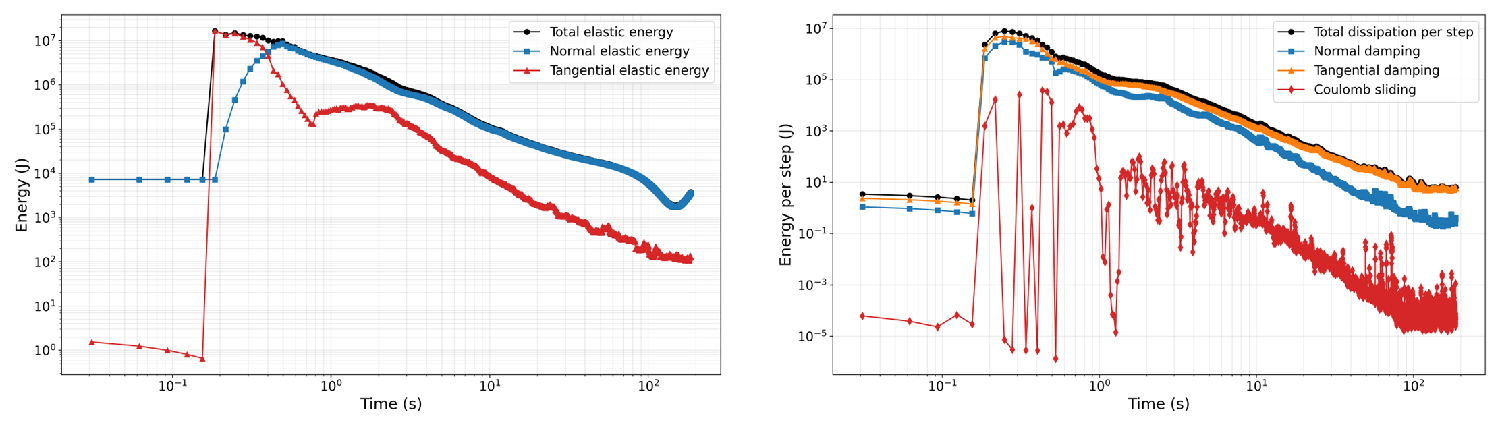
Eric Frizzell, Irina San Sebastián, John Wimarsson, Iosto Fodde, and Fabio Ferrari

Introduction

The DART impact into Dimorphos demonstrated that kinetic impacts can strongly modify rubble-pile asteroids and produce substantial momentum enhancement [1,2]. Hera will provide new constraints on the impact outcome, target morphology, and mechanical state of Dimorphos [3]. Interpreting these observations requires understanding not only the final crater, ejecta field, or momentum-transfer efficiency, but also how the impact impulse is stored, transmitted, and dissipated within a weakly confined granular body. This is especially important for rubble piles, where the internal contact network and pre-impact confinement control both wave propagation and mechanical relaxation [4].

Methods

We investigate these processes using discrete element method (DEM) simulations of rubble-pile asteroid analogs using GRAINS [5]. The aggregates are composed of nonspherical particles subject to self-gravity, Hertzian contact forces, and friction. This particle-based approach allows the impact response to be decomposed at the contact scale. Normal elastic energy represents reversible compression at grain contacts, while tangential elastic energy represents recoverable shear deformation stored in the contact history. Dissipative terms represent energy removed through dashpot damping and frictional slip: normal damping approximates imperfect compression and rebound, tangential damping captures shear-motion losses, and Coulomb sliding occurs when the trial tangential contact force  exceeds the frictional limit set by the normal contact force and friction coefficient , i.e., when this criterion is exceeded, the tangential spring slips rather than continuing to store elastic energy.

We apply controlled low-speed impacts to surface particles directed through the barycenter, allowing the post-impact mechanical response of the body to be isolated from the unresolved details of hypervelocity fragmentation and ejecta production. Across stiffness cases, with particle elastic moduli from approximately 1 MPa to 100 GPa, we track the evolution of translational and rotational kinetic energy, gravitational potential energy, normal and tangential elastic contact energy, candidate dissipative pathways, linear and angular momentum, and the propagation of the impact-induced disturbance through pressure and body-frame velocity.

Results

The impact produces a two-stage elastic response: tangential elastic energy rises sharply during initial penetration, while normal elastic energy becomes more important as the disturbance propagates through the aggregate. Immediately after impact, the tangential component dominates the contact response, reflecting shear deformation through newly formed and rearranged grain contacts (Fig. 1, left). The normal component is the dominant storage mechanism over longer timescales as the remaining impact energy disperses through body waves. This separation reflects the granular contact network’s role in storing and redistributing impact energy and suggests that an impact transient can carry information about the internal contact state, effective stiffness, and precompression of the body. The candidate dissipation diagnostics show that damping losses can dominate the early post-impact response, with tangential damping reflecting the strong shear component of the initial disturbance (Fig. 1, right). We treat these dissipative terms as developing diagnostics rather than a closed energy budget: ongoing work focuses on separating normal damping, tangential damping, and Coulomb sliding losses while closing the full contact-work residual. This bookkeeping is important because the same bulk kinetic-energy change can arise from different contact-scale pathways, each with different implications for regolith stiffness, frictional state, and internal structure.

Figure 1. Left) Global elastic contact energy response following impact, separated into normal and tangential components. The initial spike corresponds to impact-energy injection, while the later decay records redistribution and relaxation through the aggregate contact network. Right) Candidate dissipative pathways tracked in the DEM contact model, including normal damping, tangential damping, and Coulomb sliding. Full contact-work closure is ongoing.


These diagnostics provide a bridge between grain-scale DEM physics and asteroid-scale observables. Rather than treating the impact-generated disturbance only through a bulk seismic efficiency or effective wave speed, the time history of elastic storage, dissipation, and wave propagation may help constrain the mechanical state of rubble-pile asteroids. This approach is directly relevant to interpreting DART/Hera observations and to future kinetic-impact or seismic experiments on small bodies.


Acknowledgement: The authors acknowledge funding of the European Union’s Horizon Europe research and innovation programme under grant agreements No. 101264707 (Marie Skłodowska-Curie Actions Postdoctoral Fellowship, SEISMOR: EF) and No. 101077758 (ERC, TRACES: IS, FF). Views and opinions expressed are however those of the authors only and do not necessarily reflect those of the European Union, the European Research Council Executive Agency, or the European Research Executive Agency. Neither the European Union nor the granting authorities can be held responsible for them. JW acknowledges funding from the Swiss National Science Foundation (SNSF) Ambizione grant No. 193346.

References

[1] Daly R.T., Ernst C.M., Barnouin O.S., et al., Nature 2023, 616, 443-447.

[2] Cheng A.F., Agrusa H.F., Barbee B.W., et al., Nature 2023, 616, 457-460.

[3] Michel P., Kueppers M., Sierks H., et al., Planet. Space Sci. 2022,  

[4] Sánchez P., Scheeres D.J., Quillen A.C., Planet. Sci. J. 2022, 3, 245.

[5] Ferrari F., Lavagna M., Blazquez E., Mon. Not. R. Astron. Soc. 2020, 492, 749-761.

How to cite: Frizzell, E., San Sebastián, I., Wimarsson, J., Fodde, I., and Ferrari, F.: Impact-Induced Elastic and Dissipative Response in Rubble-Pile Asteroid Analogs, Europlanet Science Congress 2026, The Hague, The Netherlands, 7–11 Sep 2026, EPSC2026-324, https://doi.org/10.5194/epsc2026-324, 2026.

F2.16
|
EPSC2026-580
|
ECP
|
Virtual presentation
Robert Silber and Elizabeth Silber

Impact cratering into terrestrial ice sheets represents a critical and complex problem in planetary science, as ice masses several kilometers thick create target conditions that diverge fundamentally from standard impacts into exposed rock. On Earth, these settings involve ice sheets overlying diverse geologic substrate, where the final cratering outcome is dictated by the mechanical coupling between ice and rock, target layering, and the unique partitioning of impact energy within volatile-rich environments. This study presents a comprehensive numerical investigation using the iSALE shock physics hydrocode to explore how systematic variations in pre-impact ice thickness and substrate properties influence the fundamental outcomes of hypervelocity events. We focus on diagnostic trends to characterize the transition between subaerial and ice-shielded cratering regimes.

Our sensitivity analysis evaluates how the presence of a low-impedance ice layer modifies shock transmission into the underlying substrate, changes the depth of excavation relative to the ice-rock interface, and alters the partitioning of melt and ejecta between ice and bedrock. Increasing ice thickness systematically subdues the expression of the rocky crater rim and alters the depth-to-diameter ratio, as a larger fraction of impact energy is expended in displacing and melting the ice layer. Furthermore, the ice sheet serves as a substantial barrier to the transport of rocky material, favoring the early, high-velocity ejection of ice and thus limiting the distal distribution of rocky ejecta. Figure 1 shows a conceptual diagram of several possible scenarios.

This investigation also quantifies the relative production of ice versus substrate melt, providing a basis for understanding how impact-generated meltwater may influence post-impact hydrothermal activity and the long-term preservation of subglacial structures. Ultimately, this work establishes a foundation for interpreting impact processes in ice-rich terrains on Earth and Mars, emphasizing how current or former ice cover complicates the morphological and geochemical interpretation of the terrestrial impact record.

Figure 1: Conceptual impact-cratering scenarios for increasing terrestrial ice-sheet thickness. Panels show impacts into (A) exposed bedrock; (B) thin ice cover; (C) moderate ice sheet; and (D) thick ice sheet. The schematic is intended to illustrate target-state end members rather than quantitative model results. Diagram not to scale.

How to cite: Silber, R. and Silber, E.: Impact cratering into terrestrial ice sheets, Europlanet Science Congress 2026, The Hague, The Netherlands, 7–11 Sep 2026, EPSC2026-580, https://doi.org/10.5194/epsc2026-580, 2026.

F2.17
|
EPSC2026-726
|
ECP
|
On-site presentation
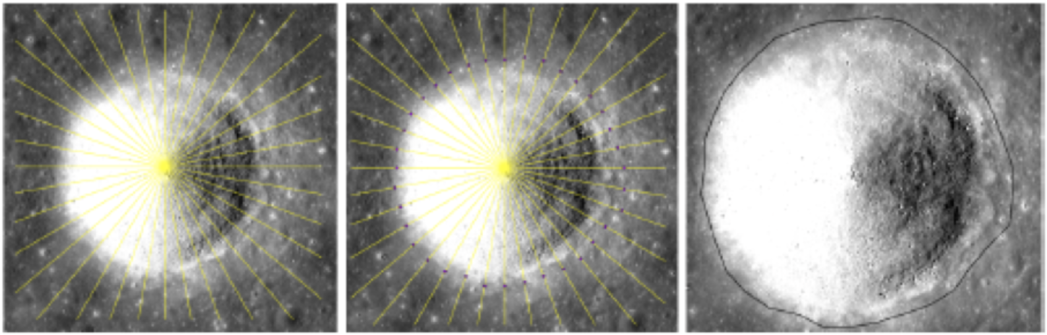
Leonard Martinez, Myriam Lemelin, Guilhem Calas, Abigaëlle Lagneaux, Gaëlle Belleau-Magnat, and Valentin T. Bickel

Introduction

Impact craters are fundamental geological features on planetary surfaces, serving as primary markers for reconstructing the geological history and surface evolution of Solar System bodies [Hartmann, 1965]. Their morphology, particularly depth-to-diameter (d/D) ratios and degradation states, encode critical information about target surface properties [Melosh, 1999], impactor characteristics [Barlow,2005], and terrain age [Neukum &al.,2001]. However, manual identification and measurement of these features remain subjective, time-consuming, and inconsistent [Stopar & al.,2017]. This abstract presents MorphoPy, a new Python-based tool for the automated calculation of morphometric parameters, including d/D values, and a new  “freshness parameter” to estimate crater degradation state [Lemelin et al.,2026].

Data & Methods

MorphoPy uses two elements as input: a Digital Terrain Model (DTM) and a crater identification file that contains the coordinates of the approximate center of each crater as well as their approximate diameter. It outputs a file containing the derived morphological metrics and a shapefile containing the crater locations and geometry. The crater identification file can be derived from a machine learning model, manual crater identification, or “OpenCraterTool” [Heyer & al.,2023]. MorphoPy, first a buffer around each crater and clips the DTM to this buffer. It then identifies the lowest elevation point near the crater center as the crater floor and generates 36 radial profiles (every 10°) through this point (Fig. 1). The highest elevation points on either side of the lowest point for each profile are identified as the crater rim crest. Then, by analysing each crater profile MorphoPy derives morphometric parameters such as the mean depth, mean diameter, median wall slope, circularity, eccentricity, and crater “freshness”. These metrics are stored for craters having a diameter ≥20 DTM pixels and 36 complete radial profiles.

Figure 1. Method used to identify the crater rim. Left) Profiles run through the lowest elevation point are created every 10˚. Middle) The highest elevation points on either side of the lowest elevation point for each profile are identified as belonging to the crater rim crest. Right) The crater rim crest polygon runs through the 36 rim points identified.

Basilevsky (1976) originally proposed to classify craters into five morphological classes (A, AB, B, BC, C). These classes correspond to different degradation states, ranging from fresh (class A) to degraded (class C) [Basilevsky, 1976]. This classification scheme has been adapted through the years to include visual interpretation (e.g., the presence of a visible ejecta) which introduces some subjectivity and manual labor (e.g., Stopar et al., 2017). In this work, we introduce a new “freshness” parameter, with values ranging from 0 to 1 (Figure 2) derived from DTM values, eliminating inter-class effects, subjectivity and manual labor. The freshness parameter aligns with previous classifications schemes [Basilevsky & al.,1976; Stopar & al.,2017], where a value of 0 represents degraded craters (e.g., class C) and a value of 1 fresh craters (e.g., class A). Our Freshness parameter is calculated as follows : 

With n the number of half profiles (which is always paired by construction), θmax the maximum angle of repose and si and RHi respectively the slope and the Rim height of the i th profile.

If a crater exhibits a continuous visible rim (i.e., Class A), its freshness parameter value will be ≥0.66. If a crater has no visible rim (i.e., Class C), its freshness parameter value cannot exceed 0.34. If a crater has 50% of its rim visible and a median slope close to θmax​, its freshness parameter value will be approximately 0.66 (i.e., Class BC) (Figure 2).

Figure 2. Evolution of the freshness parameter, from degraded craters (freshness <0.10, left) to well-preserved craters (freshness ∼1, right), with an intermediate example (freshness ∼0.5, middle). For each crater, two rim profiles were computed: north--south (top) and east--west (bottom). High freshness parameter values correspond to craters with fully visible rims and wall slopes exceeding 20°. Conversely, low freshness parameter values are associated with craters exhibiting no visible rim and very gentle slopes.

Application example at Reiner Gamma

We used Digital Terrain Models (DTMs) derived from Lunar Reconnaissance Orbiter Camera (LROC NAC) stereo images, with spatial resolutions from 2 to 5 meters, to study crater morphology in the Reiner Gamma and Mare Ingenii regions [Lemelin & al., 2026]. We used a YOLOv5-based model to automatically detect craters in hillshade images derived from the DTMs and ran MorphyPy on the craters detected. The depth-to-diameter (d/D) ratios of small lunar craters (D<400 m) is particularly important for constraining upper regolith properties. In the Reiner Gamma area, we have shown that fresh craters (between 0.8 and 1 freshness parameter) exhibit d/D ratios of ~0.1–0.19, while larger more degraded craters (freshness parameter ≤0.5) display ratios with less than 0.08. In the Mare Ingenii region, we found almost the same results with a d/D ratio 10% lower. Those preliminary results are consistent with what is found in the literature [Stopar & al.,2017, Basilevsky,1976]. 

Figure 3. Depth versus diameter for all craters detected by Lemelin et al. (2026) at Reiner Gamma with respect to freshness scale.


Figure 4. Crater detected by Lemelin et al. (2026) in the Reiner Gamma area with freshness parameter values represented in the purple color gradient.


Conclusion

MorphoPy represents a significant advancement in the standardized, automated analysis of impact crater morphology, including d/D calculations and a new robust freshness parameter. MorphoPy’s standardized depth-to-diameter (d/D) ratio calculations enable the confident use of these ratios in planetary surface analyses. This is particularly valuable when processing large datasets, such as those required for topographic diffusion models, which describe how erosive processes modify crater morphology over time. With the increased availability of high spatial resolution DTMs generated from LROC NAC images, MorphoPy will provide new valuable insights regarding the morphology of small impact craters on the Moon. MorphoPy could also be used to characterize larger craters on the Moon using coarser DTMs, and craters elsewhere in the Solar System such as on Mars or Mercury. Consequently, MorphoPy could be a highly valuable tool to conduct comparative impact cratering research across the Solar System, improving our understanding of planetary surface evolution.


How to cite: Martinez, L., Lemelin, M., Calas, G., Lagneaux, A., Belleau-Magnat, G., and Bickel, V. T.: Morphopy: A new tool for impact crater morphological analyses, Europlanet Science Congress 2026, The Hague, The Netherlands, 7–11 Sep 2026, EPSC2026-726, https://doi.org/10.5194/epsc2026-726, 2026.

F2.18
|
EPSC2026-151
|
ECP
|
On-site presentation
Thomas Meier, Christian Reinhardt, Martin Jutzi, Douglas Potter, and Joachim Stadel

Introduction:

Collisions are a fundamental driver of planetary system formation and evolution, shaping bodies from planetesimals to fully formed planets. Smoothed Particle Hydrodynamics (SPH) is a commonly used tool for modeling these highly non-linear, energetic events. At the same time, advances in high-performance computing (HPC) enable much higher resolution simulations, provided codes can efficiently exploit modern GPU-accelerated architectures, which have become ubiquitous especially due to the AI boom.

Most existing approaches specialize in either large-scale, gravity-dominated impacts or small-scale, strength-dominated collisions. Giant impact simulations typically neglect material strength, while small-body studies include increasingly sophisticated solid mechanics. Indeed, the transition between these regimes is gradual and depends on size, impact conditions, and material properties. Bridging this gap requires a single scalable framework that can model both hydrodynamic and solid behavior consistently at high resolution.

Here, we present such a framework within the massively parallel N-body code pkdgrav3 [1,2]. Rather than focusing on individual model components, we emphasize the range of problems accessible with this approach, drawing on both published [3–5] and ongoing work.

Methods:

Our implementation uses a density–energy formulation of SPH [6], ensuring conservation of mass, momentum, and energy, and compatibility with standard equations of state for planetary materials. The hydrodynamics module is designed for strongly shocked regimes while remaining stable at free surfaces and material interfaces. We include an interface correction [7] to suppress spurious surface tension, and we recover entropy conservation in adiabatic flows without explicitly evolving entropy [8].

The method is implemented within pkdgrav3 and directly leverages its domain decomposition, tree-based gravity solver, and GPU-accelerated particle interactions. The novel approach for neighbor finding uses the same tree as the FMM gravity, improving efficiency and scalability to very large particle numbers.

This hydrodynamics configuration already provides a robust tool for large-scale impacts between differentiated bodies and gas-rich systems where strength effects are minor. We extend this with a pressure-dependent strength model to represent solid materials. Instead of assuming purely fluid behavior, this allows material to sustain shear stresses and provides a continuous transition from strength- to gravity-dominated regimes. The strength model follows the same parallelization and GPU execution strategy, preserving scalability.

Results and Applications:

The hydrodynamics implementation was validated against standard test problems (e.g., Sod shock tube, Sedov-Taylor blast wave, Evrard collapse, Gresho-Chan vortex), showing excellent agreement with reference solutions and previous studies. We do not present these tests here and instead focus on the new applications the code enables.

From a computational perspective, the code shows good strong and weak scaling on modern GPU systems, maintaining high parallel efficiency from moderate problem sizes suitable for parameter studies up to simulations with billions of particles. This level of performance enables systematic studies of planetary collisions at intermediate resolutions, instead of limiting such simulations to individual cases.

At intermediate resolution, the code supports large parameter surveys that were previously limited to either low resolution or a small number of runs. We present two such studies [3,5] exploring the dependence of collision outcomes on impact angle, velocity, and material properties across broad parameter ranges. These simulations already reach what was considered high resolution in earlier work while allowing a much broader exploration of initial conditions.

At the same time, the framework enables ultra-high-resolution simulations for selected cases. We show three examples [4], (Meier et al., in prep), and (Reinhardt et al., in prep) reaching particle numbers sufficient to resolve ultra-low-mass components such as crusts, atmospheres, surface oceans and debris disks. These components, though small in mass, are often critical for the outcome of the collision and are poorly captured at lower resolution.

A key advantage of the framework is that it combines very high computational performance with material strength models, allowing different physical assumptions to be compared within the same numerical setup. Previous strength-capable codes were typically limited to only a few million particles, whereas the present framework enables substantially higher-resolution simulations without sacrificing physical realism. In particular, we compare simulations with and without material strength across several regimes. While large-scale outcomes in gravity-dominated impacts remain broadly similar, including strength systematically shifts the catastrophic disruption threshold. These effects persist to larger scales than often assumed and influence both small-body and planetary-scale collision outcomes.

Conclusions:

We present an SPH-based framework within pkdgrav3 that combines efficient GPU-accelerated hydrodynamics with pressure-dependent material strength. This enables consistent modeling of collisions across regimes typically treated separately, from strength-dominated small-body impacts to gravity-dominated planetary events.

The examples highlight the flexibility of the approach: the same code supports both large parameter studies at intermediate resolution and targeted ultra-high-resolution simulations. This makes it possible to move beyond single “representative” impacts toward systematic exploration of parameter space while retaining the ability to zoom in on specific cases.

Our results also show that material strength affects collision outcomes over a wider range of conditions than commonly assumed, particularly through its impact on the catastrophic disruption threshold. This underscores the importance of treating strength and gravity within a unified framework rather than switching between fundamentally different models.

Overall, the framework combines physical consistency with computational scalability, providing a practical tool for studying planetary collisions across a wide range of scales and conditions. Future work will extend the physical models and apply the code to a broader set of problems in planetary formation and evolution.

References:

[1] Meier, T. Potter, D., Reinhardt, C., Stadel, J., ApJ 1000, 266 (2026).

[2] Meier, T., Reinhardt, C., Jutzi, M., Potter, D., Stadel, J., https://doi.org/10.48550/arXiv.2603.19764 (2026).

[3] Matzkevich, Y., Reinhardt, C., Meier, T., Stadel, J., Helled, R., A&A 961, A184 (2024)

[4] Meier, T., Reinhardt, C., Shibata S., Müller, S., Stadel, J., Helled, R., ApJ 988, 7 (2025)

[5] Bussmann, M., Reinhardt, C., Gillmann, C., Meier, T., Stadel, J., Tackley, P., Helled, R., A&A 702, A106 (2025)

[6] Springel, V., & Hernquist, L., MNRAS 333 (2002)

[7] Ruiz-Bonilla, S., Borrow, J., Eke, V., Kegerreis, J., Massey, R., Sandnes, T., Teodoro, L., MNRAS 512.3 (2022)

[8] Reinhardt, C., & Stadel, J., MNRAS 467 (2017)

How to cite: Meier, T., Reinhardt, C., Jutzi, M., Potter, D., and Stadel, J.: Smoothed Particle Hydrodynamics in pkdgrav3 for Shock Physics Simulations, Europlanet Science Congress 2026, The Hague, The Netherlands, 7–11 Sep 2026, EPSC2026-151, https://doi.org/10.5194/epsc2026-151, 2026.

F2.19
|
EPSC2026-1143
|
On-site presentation
David Nestle and the Dust Group HVI Ice

The JUICE (ESA) and Europa Clipper (NASA) missions will study the Jovian system and investigate the habitability of the Jovian moons. The focus of both missions is to characterize the conditions that may have led to the emergence of a habitable environment for life as we know it in the interior of Ganymede, Europa and Callisto. To this end, these missions will explore and investigate the icy moons exospheres, their surfaces and use this characterization to draw conclusions on possible global, sub-surface oceans.

Understanding the physical and chemical properties of the area where ocean material may be upwelling through the surface is key to constraining the ocean’s composition. However, the harsh weathering of the icy moons’ surfaces by the Jovian magnetospheric radiation and by the hyper-velocity impacts of micro-meteoroids modifies the exposed surface material, complicating our understanding of the endogenic material’s evolution. 

The activity to be presented focuses on micro-meteoroids as ice weathering agents in the Jovian system - 
The main goal is to understand how micro-meteoroids impacts alter the icy moon’s surface and contribute to the formation of volatiles injected into the moon’s exospheres, by performing suitable hyper-velocity impact experiments onto representative ice-silicate targets. 

This is achieved by accelerating suitable micron and submicron-sized solar system analogue dust particles with the 2MV dust accelerator of the IRS at the MPA of the University of Stuttgart to speeds in excess of 100 km/s.

Such experiments have not been performed so far as they require a highly specialized experimental environment and equipment:  

The set up must provide the capability for the ice-silicate sample production of suitable dimensions (diameter and height) with compositions and structures matching those of the current best knowledge of those of Callisto, Ganymede and Europa and for the acceleration of suitable dust particles under very controlled conditions at the same location. 

In addition, the complete laboratory layout and experimental set up must allow the safe and controlled transfer of the produced sample into the experimental set up.  

Furthermore, the experimental set up has to provide suitable and reliable cooling for the ice-silicate targets for the whole duration of the measurements as well as the suitable environment for the detectors needed for the conduction of the planned measurements. 

The newly developed experimental set up at the dust accelerator laboratory in Stuttgart meets these requirements: 


The ice-dust samples are produced in a specific process ensuring smoothness of the target upper surface and homogenous distribution of the ice-dust mixture in an protected environment set up in a compact off-the-shelf glove box ("Glove-Bubble").

The safe transport to the vacuum chamber is achieved by covering the sample with a protective capsule mechanism to minimize contamination during transfer into a small vacuum vessel (airlock) located in front of the experimental chamber. 

After the airlock is evacuated and the pressures in the airlock and experimental chamber are matched, the capsule is removed, the gate between the airlock and the chamber opened. 

The sample is moved into its final position with the linear feedthrough supporting the sample mount as well as the cooling and electrical infrastructure. The vacuum chamber’s design (down to 10-7 mbar and -100°C) allows for simultaneous measurements of the ions and neutral elements generated upon impacts on the ice target as well as the emerging secondary particles (ejecta).

How to cite: Nestle, D. and the Dust Group HVI Ice: A newly developed experimental set up to simulate icy moons weathering by micro-meteoroid hyper-velocity impacts, Europlanet Science Congress 2026, The Hague, The Netherlands, 7–11 Sep 2026, EPSC2026-1143, https://doi.org/10.5194/epsc2026-1143, 2026.

F2.20
|
EPSC2026-1148
|
On-site presentation
Anna Mocker, Florian Behrens, Benedict Dillmann, Simon Dürrstein, Elias Ehrhard, Chanjeev Jeyecumar, David Nestle, Yan-Wei Li, Benedict Ngyuen, Johannes Schmid, Marvin Sychold, and Ralf Srama

Background and motivation

Hypervelocity impacts with impact speed above about 3-4 km-1 of micro-meteoroites onto solid surfaces are an ubiquitous phenomenon throughout the Solar System. 

These particles are between a few nm up to several µm in size and are comprised by interstellar and interplanetary dust. Impacts at such high speeds exceeding the speed of sound within the materials in question lead to inertial stresses upon impact that are very high compared to the strength of these materials. This causes the material to behave like fluids under the impact.

Due to the their ubiquity and the high impact energy leading to extremely high temperatures and pressures in the affected materials, the physical processes caused by HVIs play an important role in a variety of fields such as the investigation of matter at extreme pressures and temperature, shock waves in solid bodies or even Solar System research, planetology, cosmic dust research and space engineering.

An 2MV electrostatic dust accelerator

A major part of what we know today of HVIs of micro meteoroids was obtained in the

process of developing, calibrating and operation of in situ instruments for the investigation

of dust in the Solar System.

These particles are between a few nm up to several µm in size and interact with the

solid surface of the instrument: they impact at speeds of several hundred m s−1 to several

hundred km s−1. Thereby induced physical processes generate measurable signals which

are then transmitted to Earth and can be analysed afterwards.

There are a variety of methods for in situ dust measurements such as the detection of

thin foil penetration, the particle charge, the emerging impact flash or ions generated upon

impact, revealing the particles’ velocity, trajectory, mass and even chemical composition

To calibrate in-situ dust  instruments and to get a deeper understanding of the processes involved, hypervelocity impact measurements under similar and well defined conditions are required. For this purpose, a Van-de-Graaff type ion accelerator was modified at the MPI-K/HD in the late 1960ies. The accelerator was equipped with a dust source capable of charging and accelerating dust particles.

The accelerator covers a large portion of the speed and size ranges needed for most cosmic applications with velocities between 1 to about 80 km s−1 .

Impacts onto solid surfaces and the partition of energy

A fast particle impacting a solid surface causes mechanical stress in the particle and the target body, generating compression and even shock waves depending on the impact velocity. Subsequently the particles and the affected target area are compressed to high pressures and temperatures. 

This increase in internal specific energy is then partitioned into a variety of processes leading to a number of phenomena:

  • Surface alteration and cratering,
  • generation of ions and neutral gas atoms (impact plasma)
  • glow of the impact plasma cloud
  • generation of secondary particles (ejecta).

The resulting observables of HVIs (Fig. 1) are a function of projectile and target material, impact velocity, incident angle and the mass and shape of the projectile. This allows to use the quantitative investigation of these phenomena to deduce information about the impacting particles and the impact parameters and to gain a deeper understanding of the impact and its subsequent processes.

An experimental set up to study simultaneously the impact plasma and the generation of secondary particles


We will present a new experimental set up designed and build to allow to measure as many  resulting  observables as possible simultaneously. Furthermore, it allows for a wide variety of target materials form metal and silicate materials to even ice and ice-silicate mixtures.

The experimental  set up is implemented into the beam line of the dust accelerator in an angle of 45 degree and consists of

  • a cylindrical vacuum camber allowing attach additional detectors to the chamber in addition to the linear time-of-flight mass spectrometer set up in the chamber. A newly designed and built high-vacuum chamber allows simultaneous measurements of the ion and neutral generation and the simultaneous recording of the surface alteration. Eight flanges are provided for feed-throughs, windows and interface for the particle beam.
  • A small cubic vacuum chamber serving as an airlock to insert various target materials in ti the vacuum of the set up.
  • A linear feedthrough to move the target from the airlock very precisely into the detector set up as well as providing a cooling channel to allow the use of ices and ice-silicate mixtures as targets.

This unique set up allows to

  • Characterise of the emerging plasma, with a linear TOF mass spectrometer. This allows to investigate the thermodynamical properties of the impact plasma leading to a deeper understanding of the process of impact ionisation and the behaviour of matter under extreme conditions.
  • The generation of secondary particles is characterised by measuring the  number of generated particles, their mass and velocity distribution as well as their angular distribution with a delay line detector.
  • Additionally a residual gas analyser will be used to measure the neutral component of the impact plasma

Conclusion and outlook

We would like to present: 

  • A short overview the simulation of HVIs of micrometeorites  in the laboratory using a 2MV electrostatic dust accelerator at the University of Stuttgart.
  • The overall design of the experimental set up
  •  A report of the first test of the set up.
  • -The status and outlook  for the planned experimental programme for the characterisation and description of the HVI onto silicate-ice mixtures due to the generation of ions and their properties 

    with a linear time-of-flight mass spectrometer, as well a the generation of secondary particles and of neutral gas production.

    This experimental work in combination with future theoretical studies of the impact process and the subsequent expansion of the impact generated plasma could also open a new door to investigate the state of hot compressed matter.

How to cite: Mocker, A., Behrens, F., Dillmann, B., Dürrstein, S., Ehrhard, E., Jeyecumar, C., Nestle, D., Li, Y.-W., Ngyuen, B., Schmid, J., Sychold, M., and Srama, R.: A new experimental set up to study the partition of energy upon hypervelocity impacts of micrometeorites onto a variety of solid targets, Europlanet Science Congress 2026, The Hague, The Netherlands, 7–11 Sep 2026, EPSC2026-1148, https://doi.org/10.5194/epsc2026-1148, 2026.

F2.21
|
EPSC2026-55
|
ECP
|
On-site presentation
Miguel Cruz, Penelope Wozniakiewicz, Jon Tandy, and Luke Alesbrook

An experimental study is presented aimed at understanding the formation and morphology of impact craters on Mars, with particular emphasis on the role of hydrated and stratified materials representative of conditions similar to those of the Noachian period. The Martian hemispheric dichotomy and the possible past existence of liquid water suggest that factors such as transient layers, clay deposits, and salts significantly influenced crater evolution and the preservation of geological and mineralogical evidence [1].

To simulate hypervelocity impacts, a two-stage light gas gun at the University of Kent [2] was used to accelerate 2 mm aluminium spheres to velocities between 2 and 5 km s-1 toward clay targets with different configurations: variations in water content, iron (III) oxide content, and surface layers with differing degrees of hydration or salinity. 8 shots with unique target material composition were conducted, allowing analysis of the relationship between impact velocity, target composition, and the resulting crater geometry.

The results show that, in general, crater depth follows expected trends based on the degree of material hydration, with less hydrated clays producing deeper craters. Contrary to initial predictions, a deviation was observed by the formation of deeper and wider craters in the presence of a surface salt layer. Additionally, the inclusion of iron increased crater dimensions. These findings suggest that the compositional and stratigraphic heterogeneity of the Martian subsurface plays a key role in impact processes, affecting both crater morphology and the preservation of records of water and potential biosignatures. This study contributes to a better interpretation of Mars’ geological history and highlights the importance of using realistic analogue materials in laboratory experiments.

[1] Anderson et al., 2022, Icarus; [2] Hibbert et al., 2017, Procedia Engineering.

How to cite: Cruz, M., Wozniakiewicz, P., Tandy, J., and Alesbrook, L.: Hypervelocity Impacts on Ancient Martian Distinct Clays, Europlanet Science Congress 2026, The Hague, The Netherlands, 7–11 Sep 2026, EPSC2026-55, https://doi.org/10.5194/epsc2026-55, 2026.