
 1,2,1,3,3,4,1,5,3,1
- 1Department of Physical Geography, Utrecht University, Utrecht, The Netherlands (s.j.m.diamant@uu.nl)
- 2Laboratoire de Planétologie et Géosciences, LPG UMR 6112, 44000 Nantes, France.
- 3HVI & SPE labs, School of Physical Sciences, The Open University, Milton Keynes, United Kingdom
- 4Institute of Physics and Astronomy, Aarhus University, Aarhus, Denmark
- 5Woods Hole Oceanographic Institution, MA, USA
Introduction
The surfaces of terrestrial bodies are continuously modified by erosional processes throughout the Solar System (Crosta et al. (2018); Conway (2022)). Among these, mass wasting transports loose material downslope under gravity, forming slides, avalanches or flows depending on conditions (Hungr et al. (2014)). How these landforms are formed, and the potential involvement of volatiles, have been widely debated for decades. Current understanding of extraterrestrial mass wasting is mainly derived from Earth analogues; however, these are predominantly shaped by liquid water, which is generally unstable on other planetary surfaces. Yet, numerous extraterrestrial landforms occur where (seasonal) ice or frost is present, and on slopes too gentle for dry material to move by itself. Ice sublimation (solid- gas transition) may drive extra-terrestrial mass wasting by mobilising sediment and reducing friction between particles (de Haas et al. (2019); Roelofs et al. (2024)). However, the effects of sublimation and environmental conditions (e.g., ambient pressure and gravity) on flow behaviour remain poorly understood. This limits our ability to recognise mass-wasting landforms formed by ice sublimation. Here we study the roles of volatiles and environmental conditions, such as ambient pressure and reduced gravity, on the mobility, behaviour, dynamics and deposit morphology of sublimation-driven mass wasting using laboratory experiments in low-pressure chambers.
Methods
Over the past two years, we generated flows driven by sublimating CO2 and H2O ice using two flume set-ups in low-pressure chambers at the Open University and Aarhus University (Figure 1a-b). The flumes consisted of (i) a reservoir containing the material to be released via remote control, (ii) a chute through which the flow travelled, and (iii) an outflow plane onto which the material was deposited (Figure 1c-d) (Roelofs et al. (2024)). The chute was used to measure flow velocity, depth, weight and pore pressure, while the outflow plane allowed examination of the deposit morphology and runout. Ambient pressure ranged from 0.1 to 1000 mbar to simulate pressures on multiple planetary bodies. To assess the effect of different gravities, the mass flows, released from a reservoir at the top of a chute, consisted of ice mixed with either high-density (sand) or low-density granular material (hollow glass beads or nutshells). Because gravitational acceleration and density have the same effect on the force needed to lift the flowing sediment, we utilise low-density sediments to simulate low-gravity bodies.
Results and Discussion
The sublimation-driven granular flows became increasingly fluidised at decreasing ambient pressures for both ice species. Lower pressures increased gas volume flux, reducing the internal particle friction, which enhanced the runout length and flow mobility. This effect was more pronounced in low-density flows (Figure 2), suggesting that sublimation-driven granular flows are likely more mobile on low gravity bodies. The flows also changed behaviour through the sediment density and pressure range, producing transitions across distinct behavioural fluidisation regimes consistent with fluidised bed theory and pyroclastic density currents on Earth (Breard and Lube (2017)).
To analyse the internal particle dynamics of these flow regimes in detail, particle image velocimetry (PIV) was applied to compute the velocity and granular temperature profiles across the flow depth. Figure 4 displays the velocity profiles of the horizontal velocity component of the hollow glass beads at four distinct ambient pressures. The other sediments exhibited similar profiles; for conciseness, the shapes of the velocity and granular temperature profiles are summarised by fluidisation regime in Figure 5. At higher pressures (> 20 mbar), the flows remained in the steady minimum fluidisation regime, characterised by coherent motion and limited particle diffusion (Figure 5a). Between 20 and 1 mbar, bubbles developed within expanded pore spaces, producing shearing and deformation in the basal layers, whereas the upper layers travelled more coherently (Figure 5b). At lower pressures within this range, larger bubble structures known as slugs developed, causing surges and outbursts that temporarily separated the upper layers from the basal layers before settling back into the bulk flow (Figure 5c). Below 1 mbar, a turbulent regime emerged, with a diffuse particle suspension which travelled above a dense, shearing layer. Our analysis concludes that the velocity profile shapes vary systematically across the investigated pressure range, coinciding with transitions between distinct fluidisation regimes, acting as a regime identifier.
In short, sublimation of CO2 and H2O ice can drive mass wasting on bodies with low ambient pressures and low gravity. Distinct fluidisation regimes occur depending on local pressure, gravity and sediment density, affecting deposit shape and size, which might help identify landforms formed by ice sublimation.
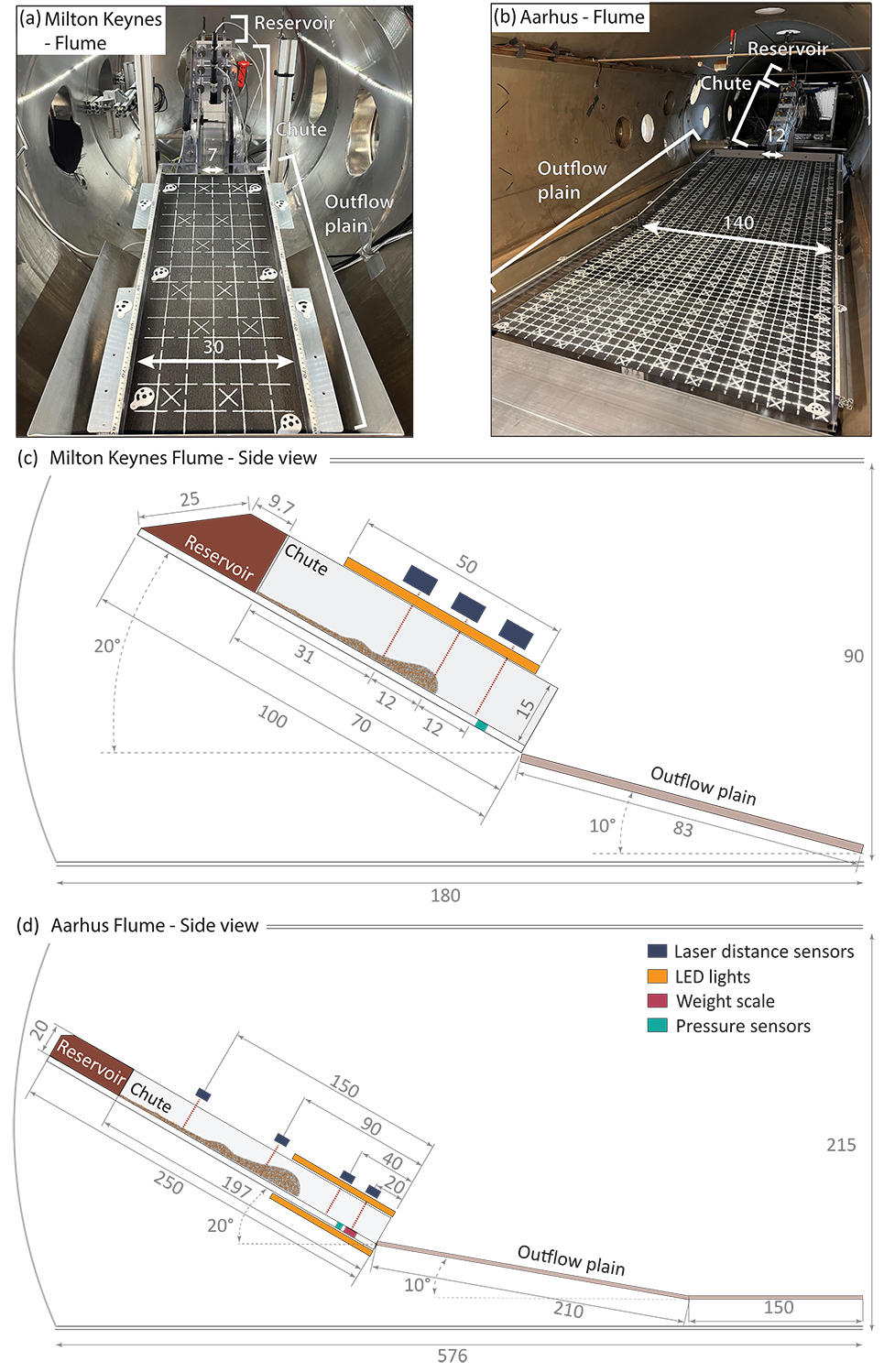
Figure 1: The debris flow flumes in (a) the Dirty Mars chamber at the Open University (UK) and (b) the Aarhus Wind Tunnel Simulator at Aarhus University (DK). (c-d) display the side views of the flume composed of a reservoir, chute and outflow plain, including the instruments. The measurements are in centimetres.
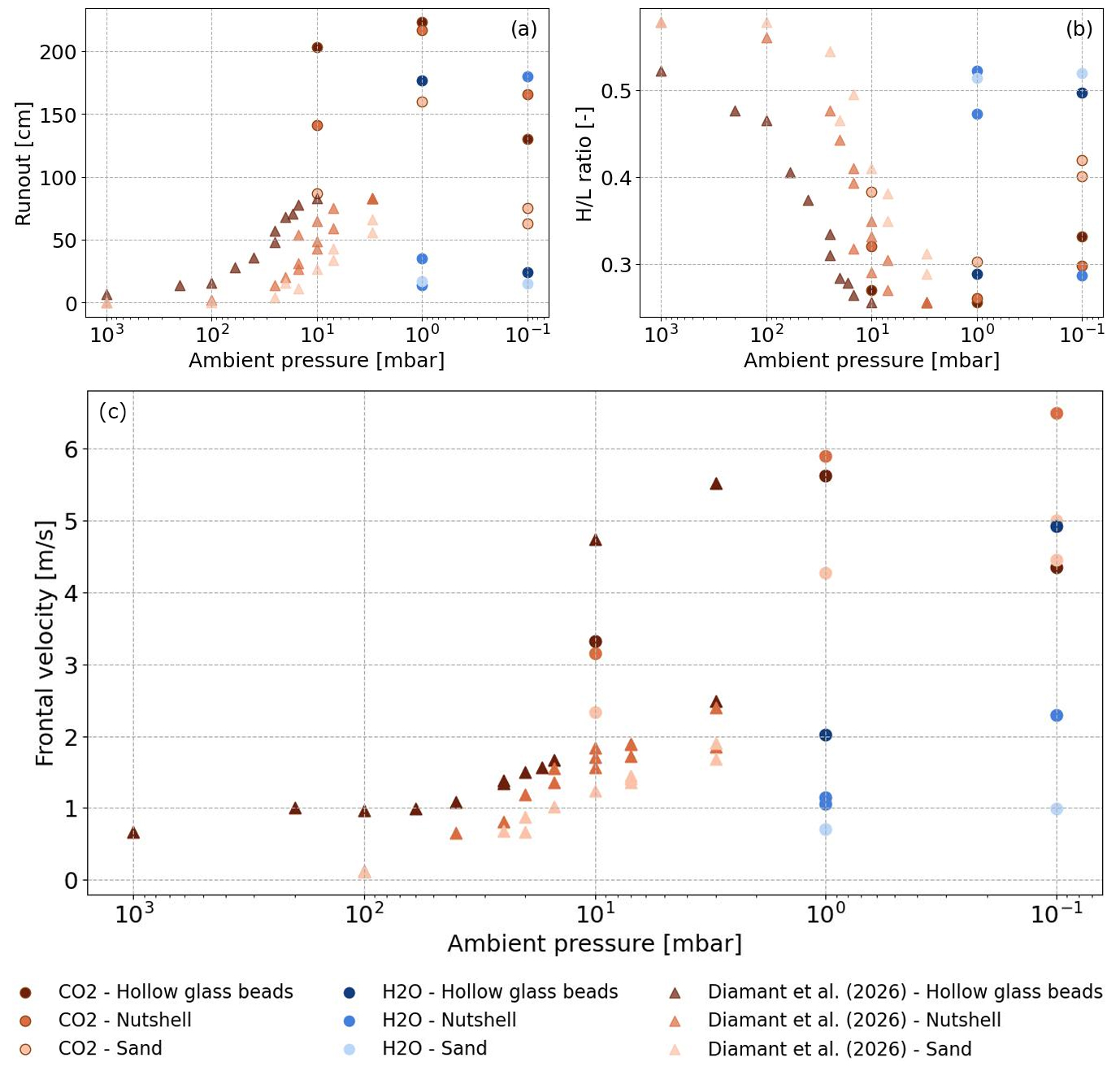
Figure 2: Deposit runout (a-b) and frontal flow velocity (c) of CO2 (orange) and H2O (blue) ices over ambient pressure.
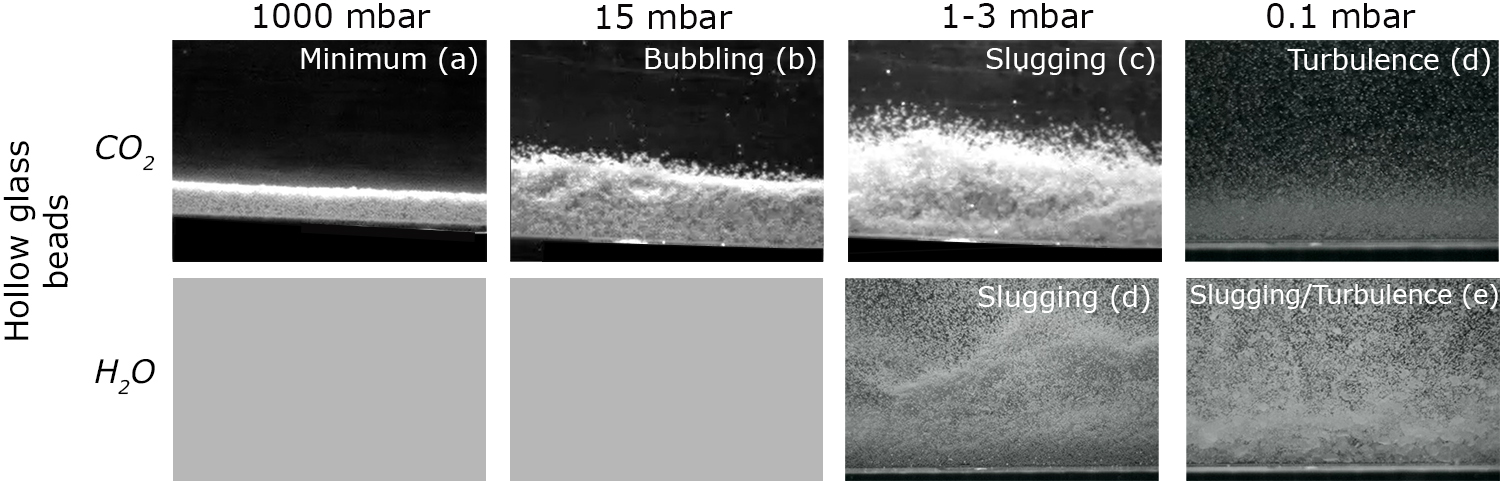
Figure 3: High-speed camera screenshots of the flows showing the surges throughout the flows of each ice and hollow glass beads at four ambient pressures. Similar regimes are observed for the other sediments, although they occur at different pressure onsets.
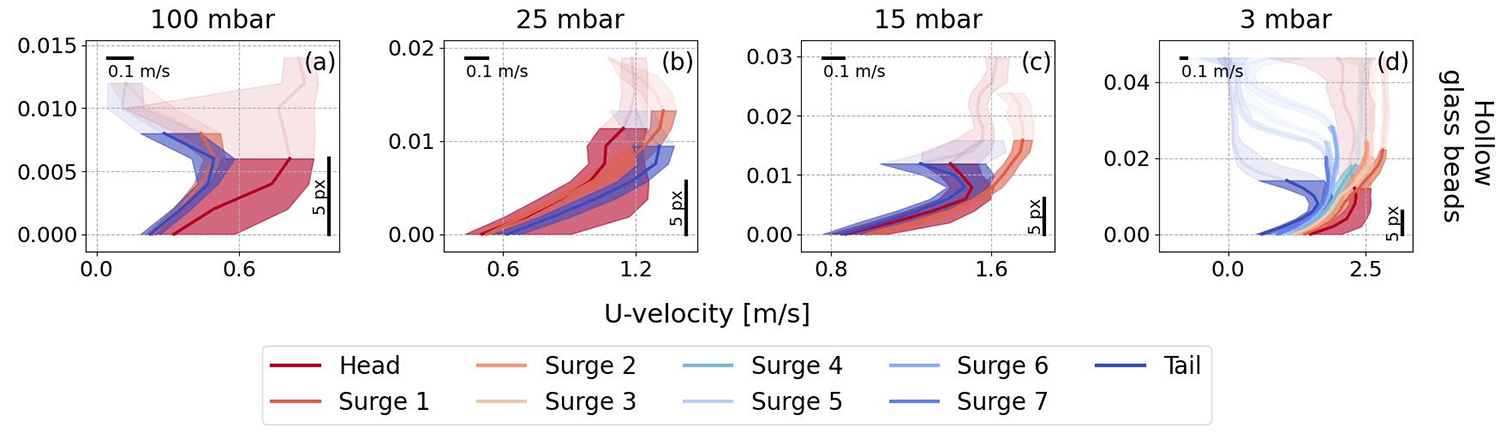
Figure 4: The horizontal (parallel flow) velocity profiles plotted against the flow height for the hollow glass beads at four distinct pressures. The other sediments displayed similar profile shapes. The entire flow is divided into three profile categories: the head, surge(s) and tail of the flow. The solid-coloured profiles represent the flow, whereas the more transparent profiles are the suspended particles atop the flow.
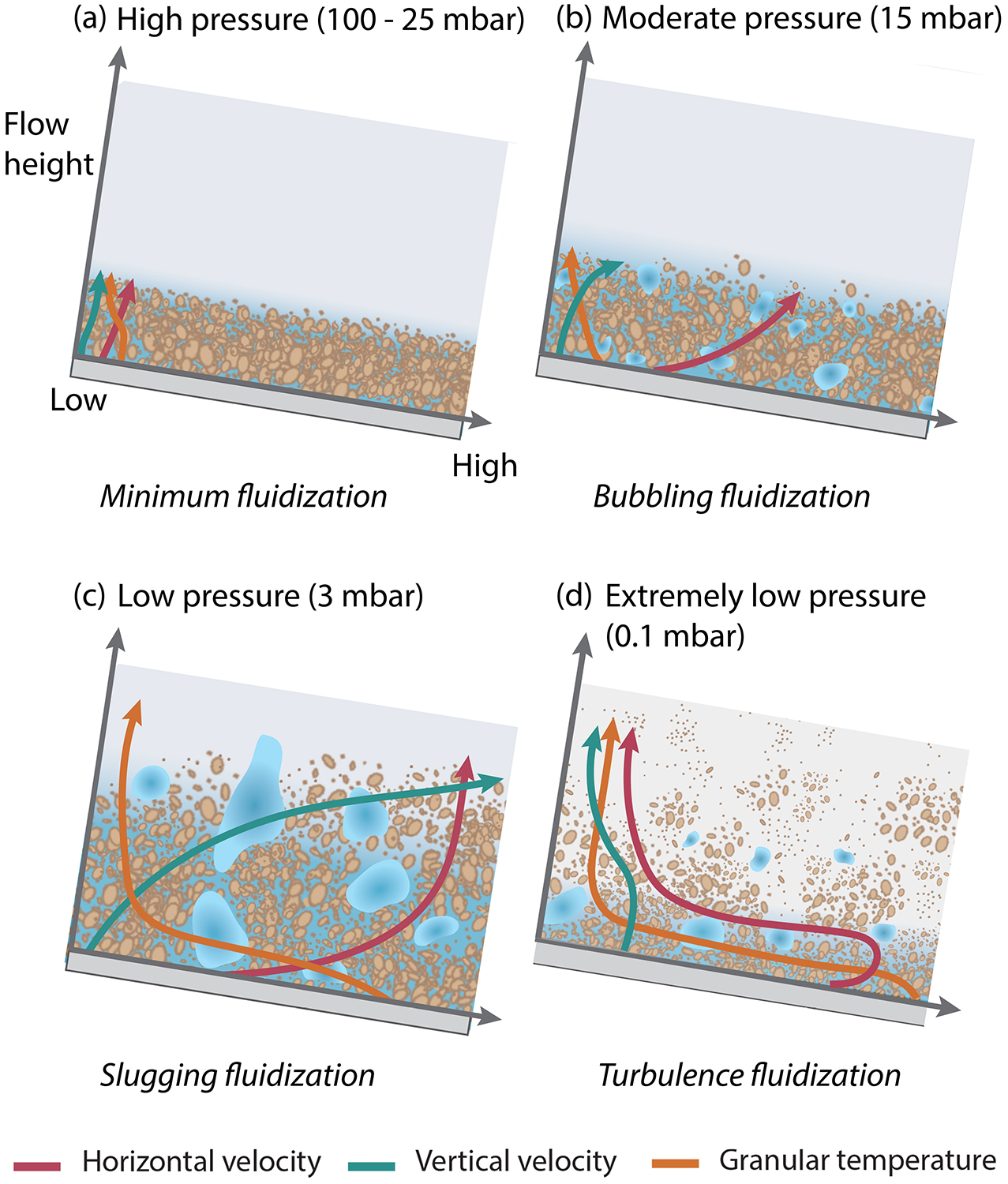
Figure 5: Fluidisation regimes with their associated velocity and granular temperature profiles (a) Minimum fluidization; granular material is sufficiently fluidised to travel downslope. (b) Bubbling fluidization; bubbles develop inside the flow. (c) Slugging regime; bubbles coalescence into larger bubbles and escape the flows through gas outbursts. (d) Turbulent fluidization: consists of a dense bottom layer and a diffuse upper particle cloud.
How to cite: Diamant, S., Conway, S., Roelofs, L., Sylvest, M., Emerland, Z., Merrison, J., Iverson, J. J., Kleinhans, M., McElwaine, J., Patel, M., and de Haas, T.: How Ice Sublimation Drives Extraterrestrial Mass Flows: Dynamics and Environmental Controls, Europlanet Science Congress 2026, The Hague, The Netherlands, 7–11 Sep 2026, EPSC2026-1035, https://doi.org/10.5194/epsc2026-1035, 2026.


