
 3,4,6,
- 1(erica.bisesi@inaf.it)
- 2giuseppe.murante@inaf.it
- 3antonello.provenzale@cnr.it
- 4jost.hardenberg@polito.it
- 5michele.maris@inaf.it
- 6laura.silva@inaf.it
- 7caballero@cab.inta-csic.es
- 8mariano.battistuzzi@inaf.it
- 9nicoletta.larocca@unipd.it
- 10billi@uniroma2.it
- 11gianluigi.granato@inaf.it
- 12emiliano.munari@inaf.it
To characterize the habitability of rocky exoplanets, it is essential to evaluate the entire network of feedback loops that govern the energy balance. Vegetation modifies the surface albedo via the “Charney mechanism” (Charney et al., 1975; Baudena et al., 2009): being typically darker than bare continental soil, vegetation increases solar absorption. Bisesi et al. (2024) updated the EBM ESTM (Vladilo et al., 2013; 2015) to quantify how such a feedback influence the habitability of Earth-like exoplanets. By adopting different planetary configurations, and two competing types of vegetation, the authors estimated how the warming effect of vegetation can counteract the Snowball tendency, extending the circumstellar habitable zone beyond its traditional external border (Figure 1). In all cases, the biological feedback shifts the system from a state of total non-habitability to intermediate habitable values.
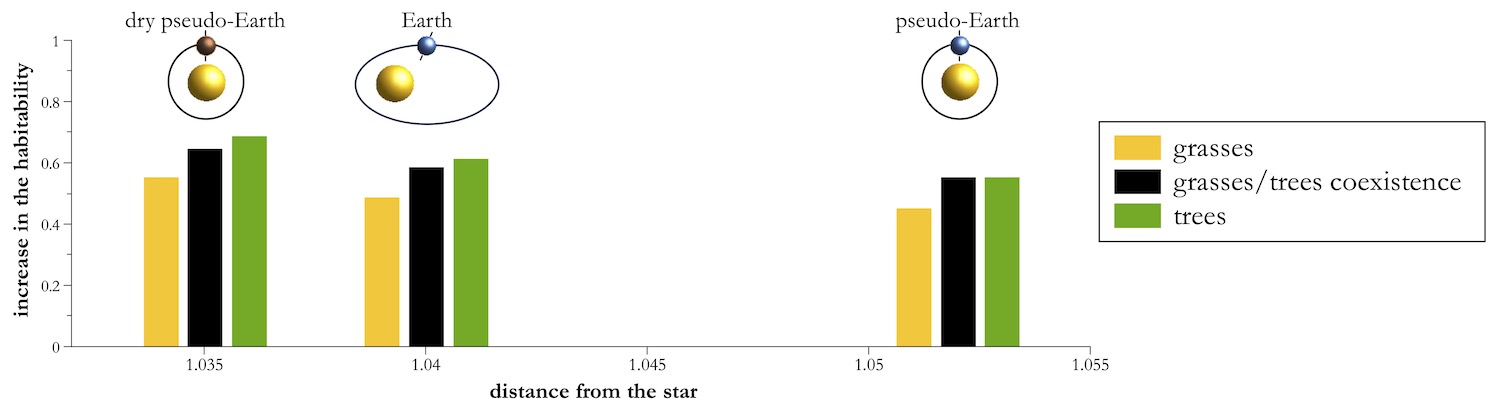
Figure 1. Distance thresholds where vegetation makes habitability shift from null to positive values, for the three planetary configurations of the Earth, the pseudo-Earth (zero inclination and eccentricity) and the dry pseudo-Earth (30% ocean coverage). Orbital parameters not in scale.
This theoretical framework provides a crucial lens through which to interpret the dramatic climatic shifts observed in Earth’s deep past, where the delicate balance between stabilizing and destabilizing feedbacks was repeatedly tested. Throughout geological history, fluctuations in atmospheric composition, solar luminosity, and the emergence of life itself have acted as perturbations that forced the climate system toward extreme states. Indeed, our research explores how the co-evolution of the biosphere and geosphere—from the rise of ancient cyanobacteria to the expansion of land vegetation—determined the planetary thresholds for global glaciation.
The most prominent and well-documented of these glaciations occurred roughly 635 million years ago, just prior to the onset of the Cambrian Period (Kirschvink, 1992; Hoffman and Schrag, 2002). A subsequent study further investigated the dynamics of rocky planets approximately 700 Ma ago, specifically examining the impact of terrestrial vegetation across diverse continental configurations—including both the modern Earth and the equatorial Rodinia arrangement—under varying greenhouse gas concentrations (Bisesi et al., 2026). To this end, ESTM was coupled with the atmospheric radiative-convective code petitRADTRANS (Mollière et al., 2019) to provide an integrated and robust tool (pRT-ESTM; Silva et al., in preparation) for analyzing the threshold conditions of global glaciation on rocky planets. Results indicate that: (a) reduced solar output is a fundamental driver of the Snowball transition; (b) the presence of terrestrial vegetation is a critical factor in mitigating the probability of global glaciation; (c) low CO2 concentrations were not a prerequisite for triggering a Snowball state under bare Rodinia-like conditions and reduced solar luminosity; and (d) current solar output effectively precludes Snowball states—even with equatorial continents—unless continental albedo remains as high as granite and CO2 levels are at 100 ppm or less.
Moving further back in time to the Late Archean (2.5 Ga ago), a prior Snowball Earth event—the Huronian glaciation—is thought to have occurred following the Great Oxidation Event (GOE). By incorporating the optical properties of cyanobacteria Synechocystis sp. PCC 6803 (Battistuzzi et al., 2023; Behrendt et al., 2003) into the pRT-ESTM framework to examine their specific impact on surface albedo and temperature, it can be shown that—if atmospheric CH4 concentration is low (8 ppm)—an oceanic cyanobacterial coverage of ≥15% is sufficient to trigger a Snowball Earth state (Figure 2; Bisesi et al., in preparation). This transition is driven solely by the increased surface albedo, without requiring further CO2 reduction. While increasing CH4 to 60 ppm prevents global glaciation, all other scenarios show that extensive cyanobacterial coverage reduces global mean temperatures by 1–4 K. This cooling effect is driven by a three-fold feedback mechanism: CO2 drawdown, CH4 oxidation (via O2 production), and enhanced oceanic albedo. Notably, this mechanism would have been ineffective during the Meso-Archean (3–3.5 Ga) due to the absence of continents, but it remains a crucial, yet often overlooked, factor for later eras. These results are currently being expanded to include a broader range of atmospheric compositions and additional microorganism species.
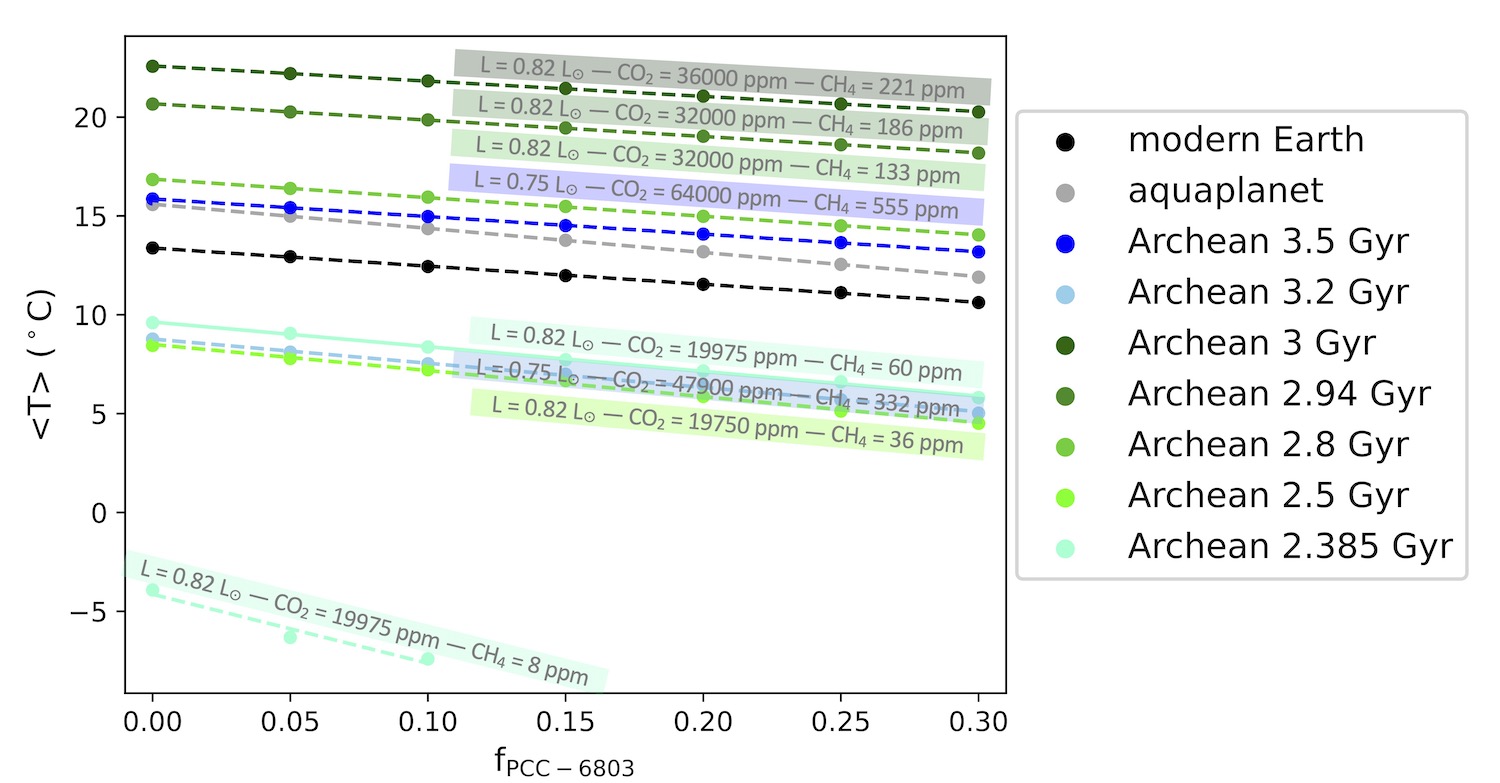
Figure 2. Global average surface temperature versus fraction of oceans covered by a cyanobacteria bloom for different periods of the Archean Earth. Solar luminosity is standardized for comparative purposes.
To complete this characterization, future research must incorporate a comprehensive assessment of the feedback mechanisms between vegetation and climate. On the one hand, plants significantly influence the hydrological cycle through evapotranspiration, which substantially enhances the release of atmospheric water vapor from continental masses compared to simple evaporation from bare soil (Cresto-Aleina et al., 2013; Porporato, 2022). To capture this effect, the Trieste/Torino group is currently working to integrate a dedicated humidity mechanism into the pRT-ESTM.
On the other hand, vegetation and soil microbiota act as active drivers of the biological carbon cycle, regulating the overall carbon balance through the complex interplay of photosynthesis, respiration, and the decomposition of organic matter (Williamson et al., 2006). These metabolic processes directly modulate atmospheric composition and, consequently, the long-term climatic stability of rocky planets. It is important to note that this biological feedback exerts an effect opposite to that of the Charney mechanism. Thus, while the vegetation-albedo feedback can extend planetary habitability beyond the outer edge of the circumstellar habitable zone, carbon sequestration could potentially influence habitability thresholds near the inner boundary. Since the timescale of these processes aligns with the vegetation life cycle (spanning tens to hundreds of years), this ‘fast carbon cycle’ feedback can be effectively studied using pRT-ESTM.
Looking toward a longer-term perspective, future applications of pRT-ESTM could investigate the carbonate-silicate cycle (the ‘slow carbon cycle’; Berner, 2003), which operates on timescales of tens to hundreds of millions of years. Achieving this objective will require a different numerical approach, as running the current framework over such vast timescales would be computationally prohibitive. The ultimate goal will be to determine how the carbonate-silicate cycle is modulated by diverse planetary and astrophysical parameters—such as those characterizing the early Earth, early Mars, or specific classes of exoplanets.
How to cite: Bisesi, E., Murante, G., Provenzale, A., von Hardenberg, J., Maris, M., Silva, L., Caballero, J., Battistuzzi, M., La Rocca, N., Billi, D., Granato, G. L., and Munari, E.: Role of different biological albedo feedbacks on the climate and habitability of rocky exoplanets, Europlanet Science Congress 2026, The Hague, The Netherlands, 7–11 Sep 2026, EPSC2026-1037, https://doi.org/10.5194/epsc2026-1037, 2026.


