EXOA6 | Astrobiology and Planetary Habitability

EXOA6

Astrobiology and Planetary Habitability
Conveners: Felipe Gómez, Paolo Simonetti | Co-conveners: Lorenzo Biasiotti, Giovanni Vladilo, Stavro Lambrov Ivanovski
Orals FRI1
| Fri, 11 Sep, 08:30–10:00 (CEST)|Room Uranus (Swing)
Orals FRI2
| Fri, 11 Sep, 11:00–12:30 (CEST)|Room Uranus (Swing)
Posters THU-POS
| Attendance Thu, 10 Sep, 18:00–19:30 (CEST) | Display Thu, 10 Sep, 08:30–19:30|Foyer 2, F2.54–56
Fri, 08:30
Fri, 11:00
Thu, 18:00
Astrobiology is the study of whether present or past life exists elsewhere in the universe. Planetary Habitability refers to the conditions of a planetary body to be habitable. To understand how life can begin in space, it is essential to know what organic compounds were likely available, and how they interacted with the planetary environment. This session seeks papers that offer existing/novel theoretical models or computational works that address the chemical and environmental conditions relevant to astrobiology on terrestrial planets/moons or ocean worlds, along with other theoretical, experimental, and observational works related to the emergence and development of Life in the Universe. This includes work related to prebiotic chemistry, the chemistry of early life, the biogeochemistry of life’s interaction with its environment, chemistry associated with biosignatures and their false positives, and chemistry pertinent to conditions that could possibly harbor life (e.g. Titan, Enceladus, Europa, TRAPPIST-1, habitable exoplanets, etc.).
Understanding how the planetary environment has influenced the evolution of life and how biological processes have changed the environment is an essential part of any study of the origin and search for signs of life. A central issue in the research on the emergence of life is the paradoxical role of water in pre-biotic chemistry. In fact,on the one hand, water is essential for all known life, on the other hand it is highly destructive for key biomolecules such as nucleic and polypeptides. Earth analogues experiments/instruments test and/or simulation campaigns and limits of life studies are included as well as one of the main topics of this session.

Major Space Agencies identified planetary habitability and the search for evidence of life as a key component of their scientific missions in the next two decades. The development of instrumentation and technology to support the search for complex organic molecules/sings of life/biosignatures and the endurance of life in space environments is critical to define unambiguous approaches to life detection over a broad range of planetary environments. A truly interdisciplinary approach is needed to delve into the core of the issue of emergence of life, because in addition to physics and chemistry it is also need to deploy a number of other sciences. We rely on contribution coming from mathematical or philosophical perspectives not only on astrobiology moreover we think that a part of the answers may lie in scientists who working on cancer research, genetics, space exploration paleontology who are not necessarily involved in this field.

Orals FRI1: Fri, 11 Sep, 08:30–10:00 | Room Uranus (Swing)

Chairpersons: Felipe Gómez, Paolo Simonetti, Lorenzo Biasiotti
08:30–08:45
|
EPSC2026-921
|
ECP
|
On-site presentation
Zoé Lloret and Aiko Voigt
Recent advances have made kilometer-scale Earth climate modeling possible, yet global exoplanet simulations still rely on coarse resolution models (>100 km) that require explicit parametrization of convection and clouds that introduce significant uncertainties. These parameters are critical for tidally locked planets, where we can only observe the terminator: the boundary between the day and night side. The presence or absence of high clouds at this location can determine our ability to characterize a planet’s atmosphere [1].

A study with ICON-Sapphire, an Earth Global Storm Resolving model exhibited a convergence of different climate statistics when reaching kilometer scale on an aquaplanet [2]. Resolution was shown to strongly impact the tropical circulation and humidity as well as the amount of cloud liquid water and ice content in the simulated climate. In this study we look at the changes that kilometer scale modeling brings to a tidally locked exoplanet.

We focus on TRAPPIST-1e, a rocky planet slightly smaller than Earth orbiting in the habitable zone of an ultra-cool red dwarf star 40 light-years away. We simulate its atmosphere at 5 km horizontal resolution using ICON-Sapphire [3]. To do so, we adapted the model to reflect TRAPPIST‑1e’s size, rotation, stellar irradiation, and an idealized
atmospheric composition consistent with the THAI model intercomparison project [4]. To ensure long-term stability, we incorporated other modifications, including the use of artificial ozone heating to stabilize the temperature of the stratosphere.

We examine how planetary parameters shape the simulated climate of a tidally locked exoplanet, with emphasis on high clouds at the terminator. Comparing our convection-resolving simulation with lower resolution simulations from the existing literature and our own experiments, we assess how kilometer-scale modeling alters atmospheric circulation and cloud processes. We also look at the general energy balance of the planet since we know from aquaplanet simulations that kilometer scale resolution can influence it through albedo due to changes in the cloud cover.

Development and model spin-up were done at around 100 km resolution on the VSC-5 system of Austrian Scientific Computing (ASC) running on 20 to 48 CPU nodes at a decadal timescale to reach a steady atmospheric state from which to start the high resolution simulations. The computationally demanding kilometer-scale simulations are being executed on GPUs on Leonardo, the pre-exascale EuroHPC supercomputer, hosted by CINECA. To facilitate this cross-platform development and ensure performance portability, we developed and deployed containerized versions of ICON, enabling seamless compilation and execution on diverse CPU and GPU architectures.

This work highlights the potential of high resolution exoplanet climate modeling to help refine the interpretation of future observational data and shows how an already existing complex earth system model can be reshaped and used for new applications with a relatively low development effort.

[1] Komacek, Thaddeus D., Thomas J. Fauchez, Eric T. Wolf, and Dorian S. Abbot. The Astrophysical Journal Letters 888, no. 2 (2020).
[2] Peinado Bravo, A., D. Klocke, and B. Stevens. Journal of Advances in Modeling Earth Systems 18 (2): (2026).
[3] Hohenegger, Cathy, Peter Korn, Leonidas Linardakis, et al. Geoscientific Model Development 16 (2): 779–811 (2023).
[4] Fauchez, Thomas J., Martin Turbet, Eric T. Wolf, et al. Geoscientific Model Development 13 (2): 707–16. (2020).

How to cite: Lloret, Z. and Voigt, A.: Climate Modeling of TRAPPIST-1e with a Global Storm Resolving model: high resolution for habitability studies, Europlanet Science Congress 2026, The Hague, The Netherlands, 7–11 Sep 2026, EPSC2026-921, https://doi.org/10.5194/epsc2026-921, 2026.

08:45–09:00
|
EPSC2026-196
|
solicited
|
On-site presentation
Frances Westall, Jean Breheret, Keyron Hickman-Lewis, Frédéric Foucher, Kathy Campbell, Diego Guido, and Laura Clodoré

Introduction and summary

Habitable environments presently under study on Mars are principally in shallow water, volcanic settings and influenced by later sabkha to fluvial and/or pedogenic conditions. Both Gale (MSL) and Jezero (Mars2020) craters host such sediments in which potential biosignatures have been detected [1,2]. Oxia Planum (ExoMars 2028) appears to be a mainly lacustrine-pedogenic setting [3]. Similar shallow water, volcanoclastic environments were common on the early Earth and they host abundant traces of past life. As such, they are good analogues for understanding potential traces of life on Mars, within specific sedimentary contexts. One such example is the 3.33 Ga Josefsdal Chert in the Barberton greenstone belt, South Africa [5,6]. This deposit records sediments formed in shallow water to littoral environments in an ultramafic volcanic setting. The overall geological context is that of an infilling, shallow sedimentary basin evolving into a fluvial environment, influenced by periodic volcanic episodes with which hydrothermal activity was associated. Geochemistry documents the fluctuating influences of marine and terrestrial (fluvial) influences. Within this sedimentological context, traces of both phototrophic and chemotrophic life abound. Their styles of preservation and the resulting biosignatures varied depending upon the local diagenetic conditions. The variety of sedimentological environments and types of biosignatures found in the Josefsdal Chert provide useful information in the search for life on Mars.

Josefsdal Chert sedimentology and geochemistry

The Josefsdal Chert in the Barberton greenstone belt (Fig. 1) is, with the Pilbara in Australia, one of the two, oldest and best preserved, Palaeoarchaean volcano-sedimentary environments on Earth. It is close in age (3.33 Ga) to the sedimentary deposits being explored on Mars at the present time. The area was subjected to later greenschist facies metamorphism and tectonically folded; the sedimentary sequences now dip at angles between 80-90°.

The sediments were deposited in a shallow basin, originally possibly similar to a collapse basin [6]. The sedimentary sequence varies in thickness from about 8m to more than 30m owing to an uneven, faulted pillow basalt base and to tectonic cutting out of the upper portions of the sequence (Fig. 1). The sediment composition varies depending upon volcanic activity. Graded, volcanoclastic sediments represent volcanic ash outfall, either proximal (coarser) or more distal (finer)(Fig. 2A). They fell into upper offshore to foreshore settings that were affected by periodic storms and were episodically exposed as in sabkha settings. The ultramafic sediments were first rapidly altered to phyllosilicates (initially probably smectite, now muscovite) and anatase. They were then rapidly silicified during early diagenesis owing to high silica saturation levels in the sea water, hydrothermal influx, and also through in situ devitrification of the volcanic ashes. The volcanoclastic facies record mixed marine/fluvial geochemical influences (Fig.2)[5].

In between episodes of volcanism, the sedimentary basin presented a relatively stable, long-lived (some 105 years up to a million years) very shallow water to sabkha-type (volcanic particle free) environment, as indicated by exposure, erosion, and evidence of desiccation. Sediments formed in this setting comprise Fe-rich, biogenic mats and chemically-deposited silica gel (jaspilite facies)(Fig. 2B). Rare volcanic particles represent wind-blown elements. Bulk REY compositions indicate overall marine conditions (HREY), although there is a hint of increased fluvial input (LREY) during deposition of the chemical silica layers [5].

Josefsdal biosignatures

The biosignatures preserved in the Josefsdal Chert sediments are of two main types. Phototrophic biofilms and mats are the only traces of life occurring during volcanically quiet periods (Fig. 3C). The biogenic films were completely oxidised (by the activity of heterotropic microbes) and replaced by microcrystalline siderite before silicification. They exhibit evidence of frequent exposure and desiccation (cracks, tearing of the soft laminae, erosion), suggesting a sabkha-like environment. These mats were periodically but frequently interspersed with chemically-precipitated silica gel, possibly related to seasonal climatic events [4,5]. These non-carbonaceous phototrophic mats contrast with carbonaceous biofilms that formed during brief interludes of eruption during the volcanic periods (Figs. 3A). Generally poorly preserved in the sandy sediments (similar to MISS, microbially induced sedimentary structures, formed on top of bedding planes), there is nevertheless evidence of ephemeral subaerial exposure of some of the phototrophic biofilms as documented by desiccation, cracking and the formation of evaporite crystal layers in between biofilm laminae (Fig. 3A)[7,8]. However, in hydrothermal silica facies, phototrophic biofilms were well-preserved due to very early diagenetic silicification (less time for further diagenetic degradation)(Fig. 3B).

Chemotrophic biosignatures are of two kinds. There is organo-geochemical evidence of chemotrophic degradation of the phototrophic microbial mats: the organic matter of the siderite-replaced mats in the jasperlite sediments was completely oxidised, while in situ aragonite and sulphate precipitation in a carbonaceous biofilm suggests SRB (sulphur-reducing bacteria) activity (W 2011). However, particularly in the parts of the volcanic facies that were strongly influenced by hydrothermal fluids, chemotrophs formed colonies around volcanic particles and within volcanic dusty silica gel (Fig. 3D). Their identification is based on in situ geochemical signatures, as well as morphological features, all associated with the sedimentary context [4, 9].

Conclusion

The Mars-analogue, Josefsdal sediments comprise volanoclastic facies, as well as hydrothermal, chemical and biogenic components, whose differential contributions changed with time and position, depending upon volcanic activity. The nature and preservation of phototrophic and chemotrophic biosignatures in this high water/rock ratio, early terrestrial, shallow water basin were controlled by the local sedimentary and volcanic environment.

[1] Freissinet + 2025, PNAS 122, e2420580122 ; [2] Hurowitz + 2025 Nature, 64, 332 ; [3] Fawdon + 2024 J Maps, 17, 621-637. [4] Westall + 2015 Geology 43, 615; [5] Westall+ 2026, in prep; [6] Nijman + 2017. J Geol Soc, 174, 1090; [7] Westall + 2006 Phil. Trans. Roy. Soc Series B., 361, 1857; [8] Westall + EPSL 310, 468; [9] Hickman-Lewis + Sci Rep 10, 4965.


How to cite: Westall, F., Breheret, J., Hickman-Lewis, K., Foucher, F., Campbell, K., Guido, D., and Clodoré, L.: Planetary habitability: volcano-sedimentological settings for biosignatures on Earth and Mars, Europlanet Science Congress 2026, The Hague, The Netherlands, 7–11 Sep 2026, EPSC2026-196, https://doi.org/10.5194/epsc2026-196, 2026.

09:00–09:12
|
EPSC2026-340
|
On-site presentation
Oleg Abramov, Stephen J. Mojzsis, Anna Medvegy, and Barbara Kremer

Estimates for when life first appeared range from ca. 3.8 Ga (Eoarchean) to sometime in the Hadean eon (≥4.0-4.5 Ga). Such approximations arise from interpretations of the oldest (albeit fragmentary) paleontological records, cryptic isotopic traces arguably interpreted as biosignatures, and phylogenetic analyses of extant microbial genomes. Here, we infer that a proposed early stage of life – the RNA World – could emerge at ca. 4.33 Ga by modelling the near-surface thermal stability of key biomolecules comprising postulated RNA organisms. We apply a global three-dimensional numerical model to analyse the thermal evolution profile of Hadean crust in response to late accretion bombardment in the time interval 4.5-3.5 Ga. Results show that frequent global sterilization events persisted up until 4.4 Ga owing to hot ejecta deposition, rock vapour condensation, and enhanced geothermal gradients. Later, conditions at or near the Hadean surface became favourable to persistent biochemistry by harbouring interconnected zones of biomolecule stability and extensive energy-rich hydrothermal oases. We identify an optimal time (a temporal ‘sweet spot’) for the RNA World that dovetails with the emergence of the Last Universal Common Ancestor (LUCA) population 150 Myr later. 

How to cite: Abramov, O., Mojzsis, S. J., Medvegy, A., and Kremer, B.: A Hadean timeline for the emergence of the RNA World, Europlanet Science Congress 2026, The Hague, The Netherlands, 7–11 Sep 2026, EPSC2026-340, https://doi.org/10.5194/epsc2026-340, 2026.

09:12–09:24
|
EPSC2026-211
|
ECP
|
On-site presentation
Stefano Rubino, Francesca Furnari, Stefania Stefani, Giuseppe Piccioni, Federico Tosi, Giorgia Di Stefano, Daniela Billi, Luca Tonietti, and Alessandra Rotundi

Introduction. The presence of liquid water is a fundamental parameter when discussing the potential habitability of space environments, coupled with the availability of the elements of life, C-H-O-N-P-S, and of an energy source. The interiors of the Jovian icy moons, Callisto, Ganymede and Europa,  are of particular exobiological interest specifically due to the presence of liquid water oceans. For some of these icy moons, such as Europa, this liquid water is also in contact with a potentially geothermally active sub-surface, enabling chemical reactions which may be able to sustain life [1-2-3]. The JUICE (Jupiter Icy Moons Explorer) probe (ESA) and the Europa Clipper  mission  (NASA)  [4, 5] will both be exploring the Jovian moons system, with particular focus on Ganymede and Europa respectively. Prior to the probes’ arrival in the system, it is of great importance to investigate if life may be compatible with these environments and which “type” of life and associated bio-signatures could be detectable with the spectroscopic instruments onboard the two spacecrafts (MAJIS [6, 7] for JUICE and MISE [8] for Europa Clipper). The work presented here focuses on testing the survivability of visible and far-red light absorbing cyanobacteria to the cryogenic and low pressure conditions at the surface of icy moons, as well as the eventual detectability of pigments and other relevant spectral features associated with life via visible to near-infrared spectroscopy.

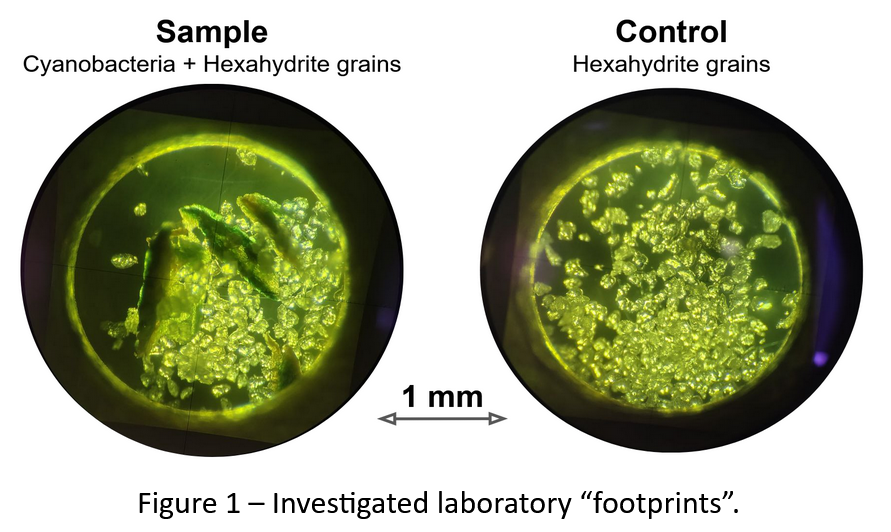
Materials and Methods. Desert Cyanobacteria (Chroococcidiopsis spp.) is an extreme-tolerant bacterium, capable of oxygenic photosynthesis using both visible and far-red light (after acclimatization) [9]. The use of far-red light for photosynthesis would allow this strain to survive where visible light does not reach, for instance at geothermally active ocean floors, using the far-red light emitted by the thermal glow of hydrothermal vents. The survivability of this particular strain has already been tested for space environments, in particular at low-Earth orbit conditions and Mars-like conditions, with other laboratory works testing specific properties such as the limits of its photosynthetic performance and its radioresistance [10-11-12-13]. In this work, we built “laboratory footprints” simulating an inhabited icy moon surface, by “contaminating” magnesium sulfate hexahydrite grains— a hydrated salt relevant for the Jovian icy moon — with cyanobacteria. The mixture is then exposed to vacuum down to 1E⁻³ mbar and to cryogenic temperatures close to 100 K. All the while, the spectral properties of the mixture are being monitored using an infrared microscope via spectral imaging in a range from 0.5 to 12 μm.

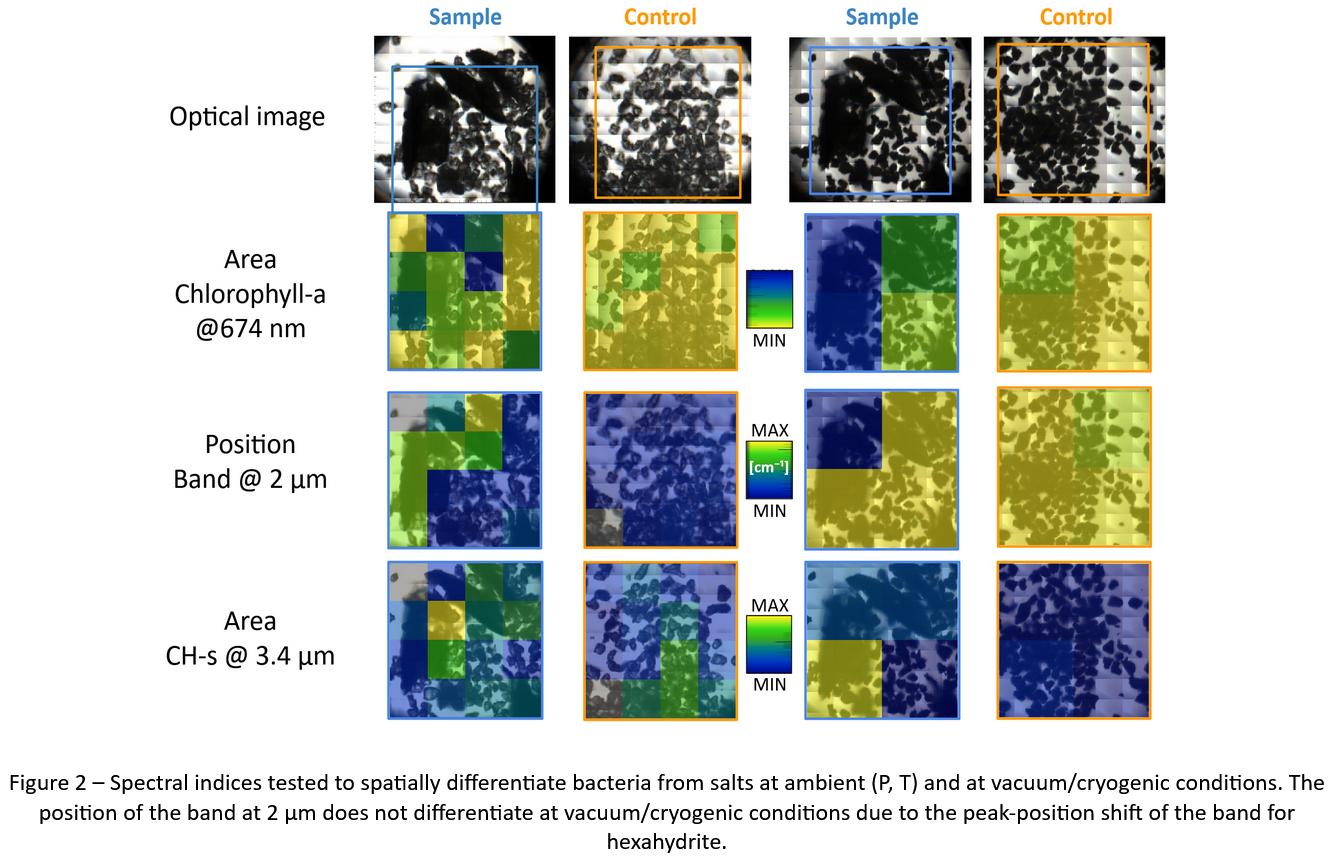
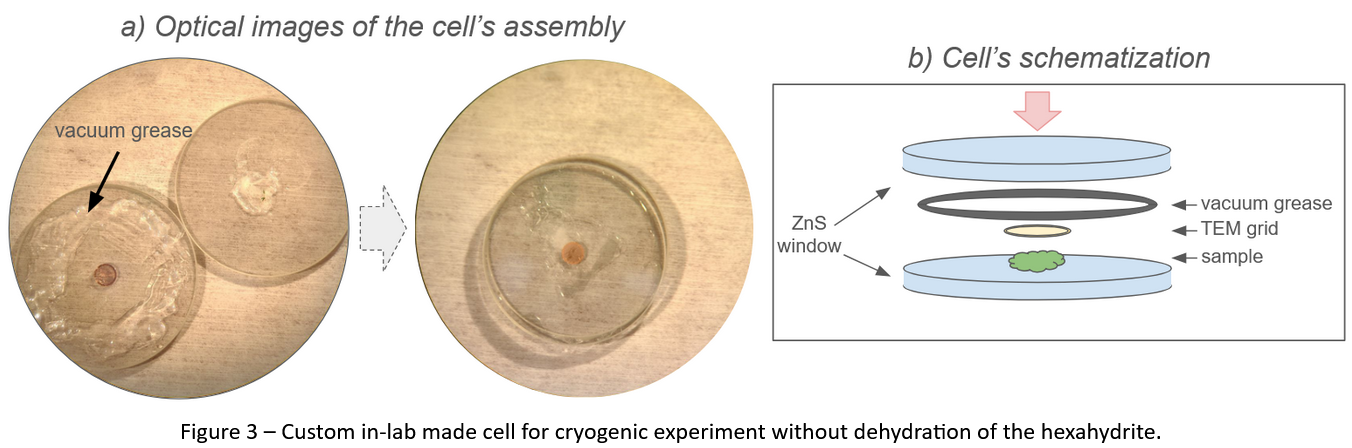
Results and Discussion. The experimental work on the far-red light acclimated strain is still ongoing. The results on the visible light absorbing strain have shown that in the visible spectral range, the spectral features of the cyanobacterium (associated with the Chl-a pigment, cf. Figure 2) and that of hexahydrite are well separated, enabling a direct spatial differentiation at both ambient conditions and cryogenic/vacuum conditions. In the near-IR range, the spectral features of the cyanobacteria get lost in the features of the hydrated salt due to spectral overlap with the water-associated features. Spectral indices such as peak-position, which work for spatial differentiation at ambient (T, P) do not work at cryogenic/vacuum conditions due to changes in the position of the spectral features of hexahydrite (Figure 2). In the mid-IR range, the aliphatic C-H stretching band at 3.4 μm is efficient for spatial differentiation at both ambient and cryogenic conditions (Figure 2), although it is not in itself a biosignature. In this experiment, samples were first put under vacuum and subsequently under cryogenic conditions. The pressure descent resulted in the dehydration of the hexahydrite salt, which is associated with the shift of the peak position of the hydration features [14] and their overlap with the ones of the cyanobacteria. A second experiment has been done where cryogenic conditions were achieved prior to the pressure descent, using a custom-made cell “trapping” water from escaping the system (Figure 3) when decreasing the pressure. The analysis of the spectral monitoring from this second experiment is still ongoing. Meanwhile, all biological samples which have undergone vacuum and cryogenic conditions have been recovered to ascertain their survivability.

References. [1] Belton, M. J. S. et al. Science 274, 377–385 (1996). [2] Smith, B. A. et al. Science 206, 927–950 (1979). [3] Pappalardo, R. T. et al. J. Geophys. Res. 104, 24015–24055 (1999). [4] Phillips, C. B. & Pappalardo, R. T. Eos (Washington DC) 95, 165–167 (2014). [5] Grasset, O. et al. Planet. Space Sci. 78, 1–21 (2013). [6] Poulet F. et al. Space Science Reviews, 2020, 2024. [7] Piccioni G. et al. IEEE pp. 318-323, 2019. [8] Blaney, D. L. et al. Space Science Reviews, 220, 2024. [9] Billi, D., Baqué, M., Verseux, C., Rothschild, L. & de Vera, J.-P., Adaption of Microbial Life to Environmental Extremes 133–146 ( 2017). [10] de Vera, J.-P. et al. Planet. Space Sci. 74, 103–110 (2012). [11] Baqué, M. et al. Orig. Life Evol. Biosph. 43, 377–389 (2013). [12] Di Stefano, G. et al. Life (Basel) 15, 622 (2025). [13] Billi, D. et al. Applied and Environmental Microbiology 66, 1489–1492 (2000). [14] Furnari et al., in preparation.

Acknowledgements. This work is funded through the European Union and Regione Campania’s FESR 2007/2013 O.O.2.1 initiative. SR is supported by the ASI-INAF agreement n.2023-6-HH.0 (Resp.: G. Piccioni).

How to cite: Rubino, S., Furnari, F., Stefani, S., Piccioni, G., Tosi, F., Di Stefano, G., Billi, D., Tonietti, L., and Rotundi, A.: Visible and Far-red light absorbing cyanobacteria settled in salty brines: survivability and detectability on icy moons surfaces, Europlanet Science Congress 2026, The Hague, The Netherlands, 7–11 Sep 2026, EPSC2026-211, https://doi.org/10.5194/epsc2026-211, 2026.

09:24–09:36
|
EPSC2026-641
|
ECP
|
On-site presentation
Phosphorus as a tracer of redox-driven diagenesis in Martian leopard spot analogues
(withdrawn)
Fuencisla Cañadas Blasco, Simon W Poulton, Jen C Stern, and María Paz Zorzano
09:36–09:48
|
EPSC2026-787
|
On-site presentation
Akos Kereszturi and Anna Bognar

The activity potential of hypothetical life forms depends on a number of environmental factors beyond the Earth. The dryness of the Martian surface poses significant challenges to any hypothetic orgaism there. One possible mitigating factor is the presence of hygroscopic salts, which have the ability to absorb atmospheric water vapour and form liquid solutions (Gough et al., 2016, Martín-Torres et al., 2015 and Zorzano et al., 2009). Such brine solutions can form for several hours during the night on the Martian surface (Pál and Kereszturi, 2017). Various observations indicate that salt crystals are present in many locations on Mars, particularly near the equator (Carter et al., 2013 and Osterloo et al., 2008).

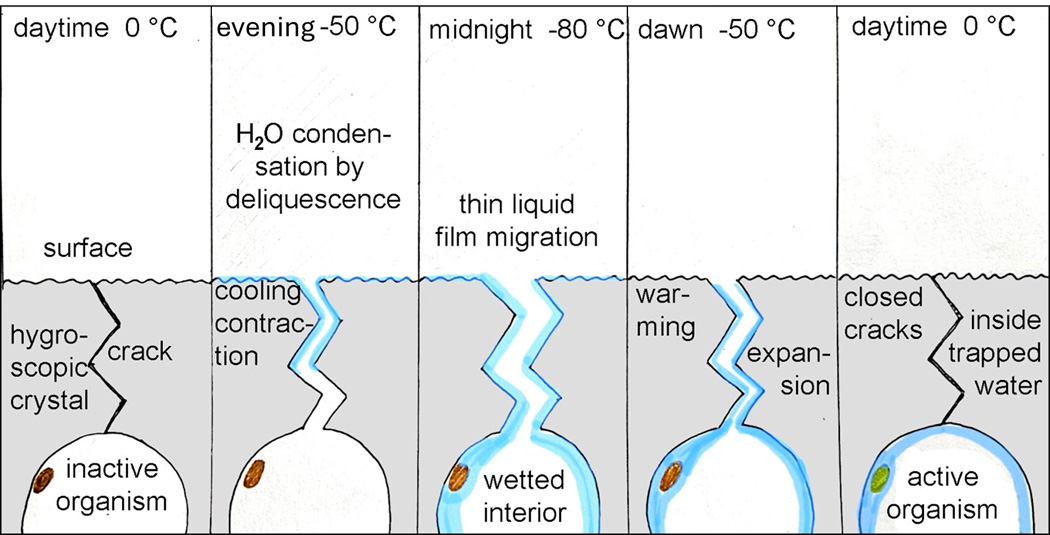
However warmer daytime periods even hygroscopic salts could not keep their nighttime condensed water. Temperature fluctuations can lead to significant volume changes of such minerals. But such significant temperature fluctuations cause volumetric thermal expansion and contraction in the crystals, which can generate mechanical stress and fractures. The salt crystals of interest have been detected around the equator, within a band of about 40o, where the pronounced temperature variations occur. The average daytime maximum temperature is around 273 K, while the nighttime minimum can drop to approximately 150 K (Kuti et al., 2007).

Based on the work of Drebushchak and Wallace (Drebushchak, 2020 and Wallace, 1972), we used NaCl to calculate volume change by numerical integration between 150 and 300 K. The resulting relative volume change is 1.64%, meaning that a 1 cm diameter NaCl crystal can expand by 0.16 mm during the day and contract by the same amount overnight on Mars.

This process may result in a phenomenon whereby cracks in the crystal surface close during the daytime due to expansion (to inhibit H2O loss from internal voids), and reopen at night as the crystal contracts (to allow H2O migration inside.

Beside dryness another important factor is UV radiation, which can cause severe damage in any organism due to Mars' thin atmosphere. According to Schuerger's measurements, a habitable environment shielded against UV would require an additional layer of dust or rock to shield against UV radiation. There is an optimal zone, approximately 3 - 4 mm below the surface, which effectively blocks radiation while still allowing enough sunlight to penetrate for photosynthesis (Marschall et al., 2012).

Figure 1. Flowchart of the proposed phases in the model.

Based on these parameters, salt crystals may offer potential microhabitats for microorganisms. In the evening, lower local temperatures may cause cracks in the crystals to open due to shrinkage, allowing contact with the surrounding atmosphere of the crystal’s interior. Rising relative humidity levels at night can cause hygroscopic salts to liquefy and water to seep into deeper cavities along the hygroscopic surface in the form of a microscopic liquid layer, allow wetting of the internal voids inside a crystal. As temperature rises during the day, the crystal expands and the cracks close possibly before the internal cavity fully dries out. This could allow a hypothetical organism to access liquid water throughout the day if it is situated inside such a crystal, partly similar to what has been identified in the Atacama desert on the Earth for example. Additionally, this process provides protection against  UV radiation too.

References:

  • Carter, J., Poulet, F., Bibring, J.-P., Mangold, N. and Murchie, S. Hydrous minerals on Mars as seen by the CRISM and OMEGA imaging spectrometers: Updated global view. Journal of Geophysical Research: Planets, 118, 831–858, 2013.
  • Gough, R.V., Chevrier, V. és Tolbert, M.A. Formation of liquid water at low temperatures via the deliquescence of calcium chloride: Implications for Antarctica and Mars. Planetary and Space Science, 131:79-87, 2016, doi: 10.1016/j.pss.2016.07.006.
  • Kuti, A. and Kereszturi, A. Daily temperature fluctuation on Mars at aphelion. Workshop on Planetary Atmospheres, 2007.
  • Martín-Torres, F.J., Zorzano, M.P., Valentín-Serrano, P., Harri, A.M., Genzer, M., Kemppinen, O., Rivera-Valentin, E.G., Jun, I., Wray, J., Madsen, M.B., Goetz, W., McEwen, A.S., Hardgrove, C., Renno, N., Chevrier, V.F., Mischna, M., Navarro- González, R., Martínez-Frías, J., Conrad, P., McConnochie, T., Cockell, C., Berger, G., Vasavada, A.R., Sumner, D. és Vaniman, D. Transient liquid water and water activity at Gale crater on Mars. Nature Geoscience, 8:357-361, 2015, doi: 10.1038/ngeo2412.
  • Marschall, M., Dulai, S. and Kereszturi, Á. Migrating and UV screening subsurface zone on Mars as target for the analysis of photosynthetic life and astrobiology. Planetary and Space Science, 72:146–153, 2012, doi: 10.1016/j.pss.2012.06.011.
  • Mickol, R.L., Page, J.L. and Schuerger, A.C. Magnesium sulfate salt solutions and ices fail to protect Serratia liquefaciens from the biocidal effects of UV irradiation under Martian conditions. Astrobiology, 17(5):387–400, 2017, doi: 10.1089/ast.2015.1448.
  • Osterloo, M.M., Hamilton, V.E., Bandfield, J.L., Glotch, T.D., Baldridge, A.M., Christensen, P.R., Tornabene, L.L. and Anderson, F.S. Chloride-bearing materials in the southern highlands of Mars. Science, 319(5870):1651–1654, 2008, doi: 10.1126/science.1150690.
  • Pál B. és Kereszturi Á. Possibility of microscopic liquid water formation at landing sites on Mars and their observational potential. Icarus, 282:84-92, 2017, doi: 10.1016/j.icarus.2016.09.006.
  • Titov, D.V. Water vapour in the atmosphere of Mars. Advances in Space Research, 29(2):183–191, 2002, doi: 10.1016/S0273-1177(01)00568-3.
  • Zorzano, M.P., Mateo-Martí, E., Prieto-Ballesteros, O., Osuna, S és Renno, N. Stability of liquid saline water on present day Mars. Geophysical Research Letters, 36, 2009, doi:10.1029/2009GL040315.

How to cite: Kereszturi, A. and Bognar, A.: Volume change supported micro-habitat model of salt crystals on the Martian surface, Europlanet Science Congress 2026, The Hague, The Netherlands, 7–11 Sep 2026, EPSC2026-787, https://doi.org/10.5194/epsc2026-787, 2026.

09:48–10:00
|
EPSC2026-344
|
Virtual presentation
Mária Hajduková, Tomáš Paulech, Roman Nagy, Zlatica Plašienková, and Silvia Vertánová

The exchange of material between stellar systems is unlikely because of the vast distances between stars, but it is not impossible [1]. During their formation, stellar systems eject small bodies that initially continue to move along the trajectory of their parent star, but over long timescales their motion in the Galactic potential can be altered, and some of them may eventually become free-floating objects in interstellar space orbiting the center of the Galaxy [2]. These objects may later encounter neighboring stellar systems.

Three such objects confirmed as originating in interstellar space [3, 4, 5] have recently passed through the Solar System. This implies that the opposite scenario may also occur and that Solar System material may approach other stellar systems. An encounter at relatively low velocities would allow the Solar System material to pass through the inner planetary regions of the exoplanetary system and potentially interact with planets in the habitable zone, if such planets are present in the target system. Here, we investigate several candidate stars reported in the recent works [6, 7, 8] for which material exchange with the Solar System has been proposed. This raise the possibility that prebiotic material could be transferred between stellar systems, and in more speculative scenarios, that microorganisms capable of extreme survival might also be transported, potentially contributing to chemical evolution relevant to the emergence of life.  

We examine whether the selected candidate systems provide conditions that could support the preservation or accumulation of prebiotic material rather than its destruction or prevent its formation [9]. We also aim to estimate the probability of Solar System ejecta reaching a planet in the habitable zone. We plan to integrate dynamical delivery pathways with confirmed planetary systems to identify the most viable landing sites for biological precursors originating from our system and we discuss the potential for reciprocal interstellar material exchange.

It, however, should be noted that these estimates are subject to large uncertainties arising from uncertainties in the initial conditions, limitations in the observational characterization of exoplanetary systems, and incomplete knowledge of the processes governing interstellar capture and subsequent penetration into inner planetary systems.

We also present, from a philosophical perspective, the consequences of the potential transport of biological precursors originating from the Solar System into interstellar space. The following considerations should be understood as conceptual reflections on humanity’s place in a broader cosmic context rather than as empirically testable claims.  

If the transfer of solid material—and potentially microorganisms—between stellar systems is considered physically plausible, the panspermia hypothesis provides a broader framework for interpreting the origin and distribution of life, proposing that such material may be exchanged through natural dynamical processes [10–12].

Within this broader context, humanity may be regarded as a cosmic phenomenon arising from physical and chemical processes that extend beyond a single planet or even a single stellar system. A second way of understanding humanity as a cosmic phenomenon is through its technological advancement, which enables its gradual expansion into space beyond its home planet—that is, the transformation of planetary humanity into an interplanetary species. A third, epistemic perspective on humanity as a cosmic phenomenon is linked to the view that conscious life represents a way in which the universe acquires the capacity for self-reflection [13]. This threefold understanding of humanity raises ethical questions about regulating space activities and the possible interference with independent evolutionary processes in other systems, particularly in relation to planetary protection and the risk of irreversible contamination or suppression of indigenous life [14]. On the other hand, if we are part of a broader—and possibly “conscious”—cosmic process, should this in turn affect how we understand our identity? Does it make sense to speak of a “cosmic role” for humanity?

Acknowledgements. This work was supported by VEGA - the Slovak Grant Agency for Science, grants Nos. 2/0041/26 and 1/0089/25

References

[1] Adams, F.C. & Napier, K., 2022, Astrobiology, 22,12, 1429.

[2] Portegies Zwart, S., 2021, A&A, 647, A136.

[3] Meech, K. J., Weryk, R., Micheli, M., et al., 2017, Nature, 552, 378.

[4] Guzik, P., Drahus, M., Rusek, K., et al., 2020, Nat. Astron., 4, 53.

[5] Seligman, D. Z., Micheli, M., Farnocchia, D., et al., 2025, ApJ, 989, L36.

[6] Neslušan, L., Janák, F., Nagy, R., & Hajduková, M., 2026, A&A, 708, A309

[7] Gregg, C. & Wiegert, P., 2025, PSJ, 6, 12, 56

[8] Gregg, C. & Wiegert, P., 2025, PSJ, 6, 12, 309

[9] Cao, D., Plavchan, P., & Summers, M., 2024, ApJ, 971, 160

[10] Hoyle, F. & Wickramasinghe, N. C., 1981, Evolution from Space, London: J. M. Dent & Sons.

[11] Napier, W. M., 2004, MNRAS, 348, 46

[12] Belbruno, E., Moro-Martín, A., & Malhotra, R., 2012, Astrobiology, 12, 754

[13] Sagan, C., 1980, Cosmos, New York: Random House.

[14] McKay, C. P., 2003, P&SS, 51, 1087

How to cite: Hajduková, M., Paulech, T., Nagy, R., Plašienková, Z., and Vertánová, S.: Dispersal of Solar System material into interstellar space and the emergence of life in nearby planetary systems: humanity as a cosmic phenomenon, Europlanet Science Congress 2026, The Hague, The Netherlands, 7–11 Sep 2026, EPSC2026-344, https://doi.org/10.5194/epsc2026-344, 2026.

Orals FRI2: Fri, 11 Sep, 11:00–12:30 | Room Uranus (Swing)

Chairpersons: Giovanni Vladilo, Stavro Lambrov Ivanovski
11:00–11:15
|
EPSC2026-704
|
ECP
|
On-site presentation
Ylenia Mascolo, George Zhou, Chelsea Huang, Jennifer Burt, Andre Silva, and Tiziano Zingales

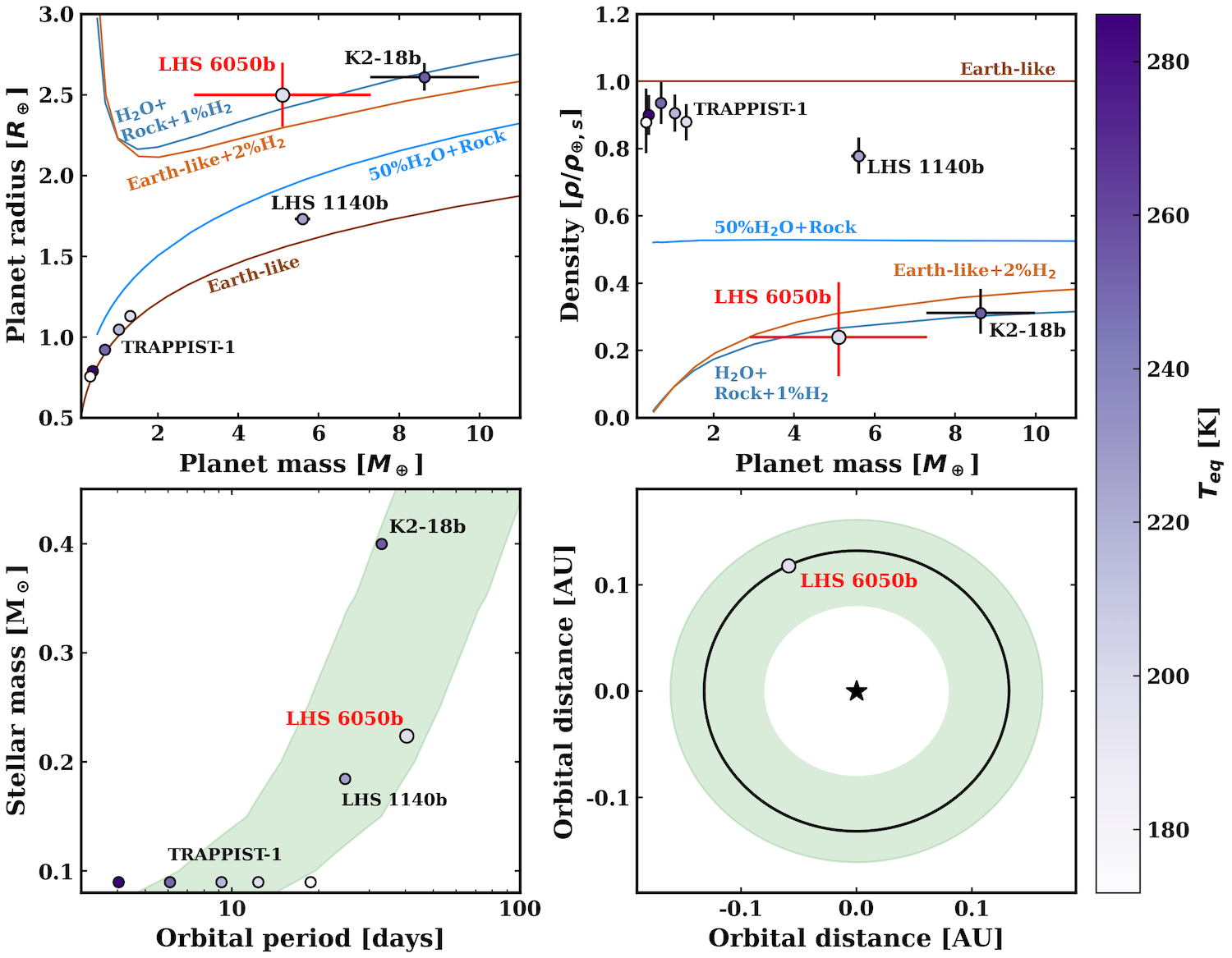
Cool sub-Neptunes orbiting mid to late M dwarfs provide exceptional laboratories for testing potentially habitable scenarios with current facilities. LHS 6050 b is one of only two known sub-Neptunes within the habitable zone with an equilibrium temperature <300K (see Fig.1). 

Fig. 1: Upper panels show mass–radius and mass–density diagrams for known low-mass exoplanets with equilibrium temperatures below 300 K. The densities are expressed relative to the Earth-like interior model proposed by Zeng et al. (2019). In the lower left panel, this same set of planets is plotted within the conservative habitable zone as defined by Kopparapu et al. (2014), while the lower right panel presents a top-down view of the LHS 6050 system, illustrating the circular orbit of LHS 6050 b within the habitable zone.

We determine that LHS 6050 b orbits in 40-day around a low-mass M4V star, located only 20 parsecs from the Sun. The planet has a mass  5.1 times that Earth masses and a radius 2.5 times that of Earth, consistent with being a small planet with a bulk density of 1.8 g cm-3. With an equilibrium temperature of about 200 K and an insolation flux of 0.32 times the one received by the Earth, LHS 6050 b places among the coolest known sub-Neptunes orbiting a mid M dwarf within its habitable zone and nearer to the water snow line than any previous confirmed sub-Neptune planet.

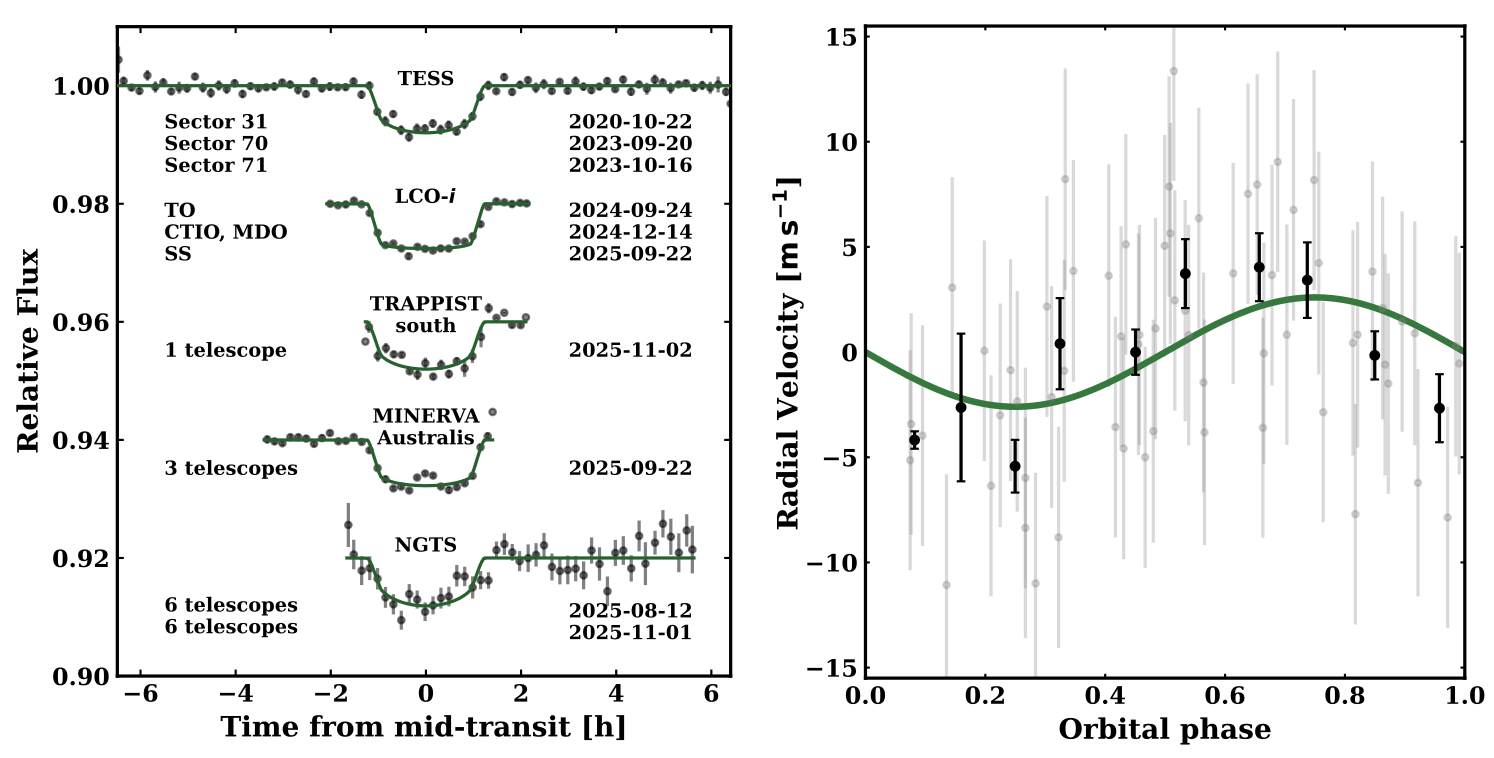
In this work, we present the discovery of LHS 6050 b by the Transiting Exoplanet Survey Satellite (TESS). This planet is confirmed via 65 epochs of radial velocity observations, obtained with the ESPRESSO high resolution spectrograph (see Fig. 2, right panel). We verified possible variations in transit depth and refined the transit ephemerides through photometric ground-based follow-up observations from LCO, Minerva-Australis, NGTS, and TRAPPIST-south (see Fig. 2, left panel). In addition, we perform a vetting campaign that incorporates reconnaissance spectroscopy from CHIRON and TRES, high-resolution imaging from Gemini, and archival data, to exclude astrophysical false-positive scenarios and confirm that the transit signals originate from the planet LHS 6050 b.

Fig. 2: The left panel presents phase-folded transit observations (with data binned in phase at a 10-minute cadence) from TESS and various ground-based facilities, with our transit model overlaid as a green curve. The right panel displays 65 radial velocity measurements of LHS 6050 obtained with the ESPRESSO spectrograph, together with data binned at uniform phase intervals. Our best-fit model, assuming a circular orbit, is shown as the green curve.

Due to its low density, LHS 6050 b requires the presence of a substantial gaseous envelope. This envelope is not expected to be completely strip away from photoevaporation, despite the high stellar XUV irradiation the planet receives (about 4700 times the Earth X-rays radiation). In this way, LHS 6050 b provides meaningful tests on the role early atmospheric erosion plays in the evolution of small temperate planets. Furthermore, LHS 6050 b is cool enough that it may host a more compact atmospheric envelope than other sub-Neptune planets, to the point where steam-dominated atmospheres might no longer be possible,  allowing a clearer comparison with rocky planets and those with gaseous envelopes, in the habitable zones of their host stars. At sufficiently low temperatures, water vapour condenses to liquid and then freezes out of the atmosphere of sub-Neptunes, potentially leaving a thin hydrogen-dominated atmosphere, surrounding a large liquid-water or magma ocean. In low-density cold sub-Neptunes, possible atmosphere–surface interactions can be probed by measuring the abundances of CH4, CO2, NH3, and sulfur-bearing species. LHS 6050 b is the only confirmed sub-Neptune that may host an atmosphere cold enough to break the steam degeneracy, potentially allow a precise identification of a unique interior structure model. This prospect, combined with its TSM of 136, makes LHS 6050 b one of the most promising targets for future JWST observations. 

How to cite: Mascolo, Y., Zhou, G., Huang, C., Burt, J., Silva, A., and Zingales, T.: LHS 6050 b: a cool sub-Neptune within the habitable zone of a nearby M-dwarf star, Europlanet Science Congress 2026, The Hague, The Netherlands, 7–11 Sep 2026, EPSC2026-704, https://doi.org/10.5194/epsc2026-704, 2026.

11:15–11:30
|
EPSC2026-978
|
On-site presentation
Anna V. Shapiro, Christoph Brühl, Klaus Klingmüller, Benedikt Steil, Alexander Shapiro, Veronika Witzke, Nadiia Kostogryz, Laurent Gizon, Sami K. Solanki, and Jos Lelieveld

Whether complex life can survive on the surface of a habitable-zone planet depends strongly on the balance between harmful stellar ultraviolet radiation and atmospheric UV shielding. On Earth, oxygen and ozone provide this protection: O₂ absorbs much of the most energetic UV-C radiation, while O₃ shields the surface from damaging UV-B. However, the ozone layer is itself controlled by stellar UV radiation, because different UV wavelength ranges drive ozone production and ozone destruction. This means that the surface UV environment of an Earth-like planet cannot be predicted from the total stellar UV flux alone; it depends on the detailed stellar spectrum, including the star’s metallicity.

We model Earth-like planets with N₂/O₂ atmospheres around stars with effective temperatures of 5300–6300 K and metallicities −1 ≤ [Fe/H] ≤ 0.9. Using a photochemical radiative-convective atmosphere model, we compute ozone columns, oxidation capacity, and surface UV-B/UV-C fluxes as functions of atmospheric oxygen abundance.

Our results reveal a counter-intuitive metallicity effect. Although metal-rich stars emit less UV radiation overall, their spectra reduce ozone production more strongly than ozone destruction. Consequently, increasing stellar metallicity weakens the ozone shield and increases surface UV-B. For solar effective temperature, changing [Fe/H] from −1 to 0.9 approximately doubles UV-B at the surface of an oxygenated Earth-like planet. Across the considered parameter space, metallicity has a larger impact on surface UV than effective temperature. We also find that UV-C shielding and life-supporting oxidation capacity become robust above 1–3% O₂, making low-metallicity stars especially favourable targets in searches for complex land life.

How to cite: Shapiro, A. V., Brühl, C., Klingmüller, K., Steil, B., Shapiro, A., Witzke, V., Kostogryz, N., Gizon, L., Solanki, S. K., and Lelieveld, J.: Metal-rich stars provide less favourable UV environments for complex life on their planets, Europlanet Science Congress 2026, The Hague, The Netherlands, 7–11 Sep 2026, EPSC2026-978, https://doi.org/10.5194/epsc2026-978, 2026.

11:30–11:42
|
EPSC2026-1037
|
Virtual presentation
Erica Bisesi, Giuseppe Murante, Antonello Provenzale, Jost von Hardenberg, Michele Maris, Laura Silva, José Caballero, Mariano Battistuzzi, Nicoletta La Rocca, Daniela Billi, Gian Luigi Granato, and Emiliano Munari

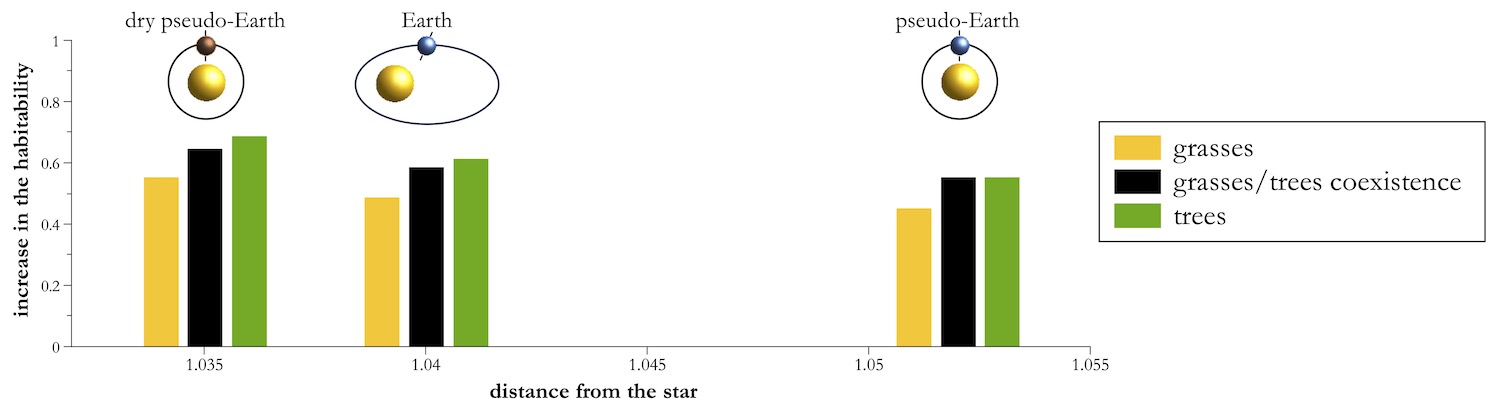
To characterize the habitability of rocky exoplanets, it is essential to evaluate the entire network of feedback loops that govern the energy balance. Vegetation modifies the surface albedo via the “Charney mechanism” (Charney et al., 1975; Baudena et al., 2009): being typically darker than bare continental soil, vegetation increases solar absorption. Bisesi et al. (2024) updated the EBM ESTM (Vladilo et al., 2013; 2015) to quantify how such a feedback influence the habitability of Earth-like exoplanets. By adopting different planetary configurations, and two competing types of vegetation, the authors estimated how the warming effect of vegetation can counteract the Snowball tendency, extending the circumstellar habitable zone beyond its traditional external border (Figure 1). In all cases, the biological feedback shifts the system from a state of total non-habitability to intermediate habitable values. 

Figure 1. Distance thresholds where vegetation makes habitability shift from null to positive values, for the three planetary configurations of the Earth, the pseudo-Earth (zero inclination and eccentricity) and the dry pseudo-Earth (30% ocean coverage). Orbital parameters not in scale.

This theoretical framework provides a crucial lens through which to interpret the dramatic climatic shifts observed in Earth’s deep past, where the delicate balance between stabilizing and destabilizing feedbacks was repeatedly tested. Throughout geological history, fluctuations in atmospheric composition, solar luminosity, and the emergence of life itself have acted as perturbations that forced the climate system toward extreme states. Indeed, our research explores how the co-evolution of the biosphere and geosphere—from the rise of ancient cyanobacteria to the expansion of land vegetation—determined the planetary thresholds for global glaciation.

The most prominent and well-documented of these glaciations occurred roughly 635 million years ago, just prior to the onset of the Cambrian Period (Kirschvink, 1992; Hoffman and Schrag, 2002). A subsequent study further investigated the dynamics of rocky planets approximately 700 Ma ago, specifically examining the impact of terrestrial vegetation across diverse continental configurations—including both the modern Earth and the equatorial Rodinia arrangement—under varying greenhouse gas concentrations (Bisesi et al., 2026). To this end, ESTM was coupled with the atmospheric radiative-convective code petitRADTRANS (Mollière et al., 2019) to provide an integrated and robust tool (pRT-ESTM; Silva et al., in preparation) for analyzing the threshold conditions of global glaciation on rocky planets. Results indicate that: (a) reduced solar output is a fundamental driver of the Snowball transition; (b) the presence of terrestrial vegetation is a critical factor in mitigating the probability of global glaciation; (c) low CO2 concentrations were not a prerequisite for triggering a Snowball state under bare Rodinia-like conditions and reduced solar luminosity; and (d) current solar output effectively precludes Snowball states—even with equatorial continents—unless continental albedo remains as high as granite and CO2 levels are at 100 ppm or less.

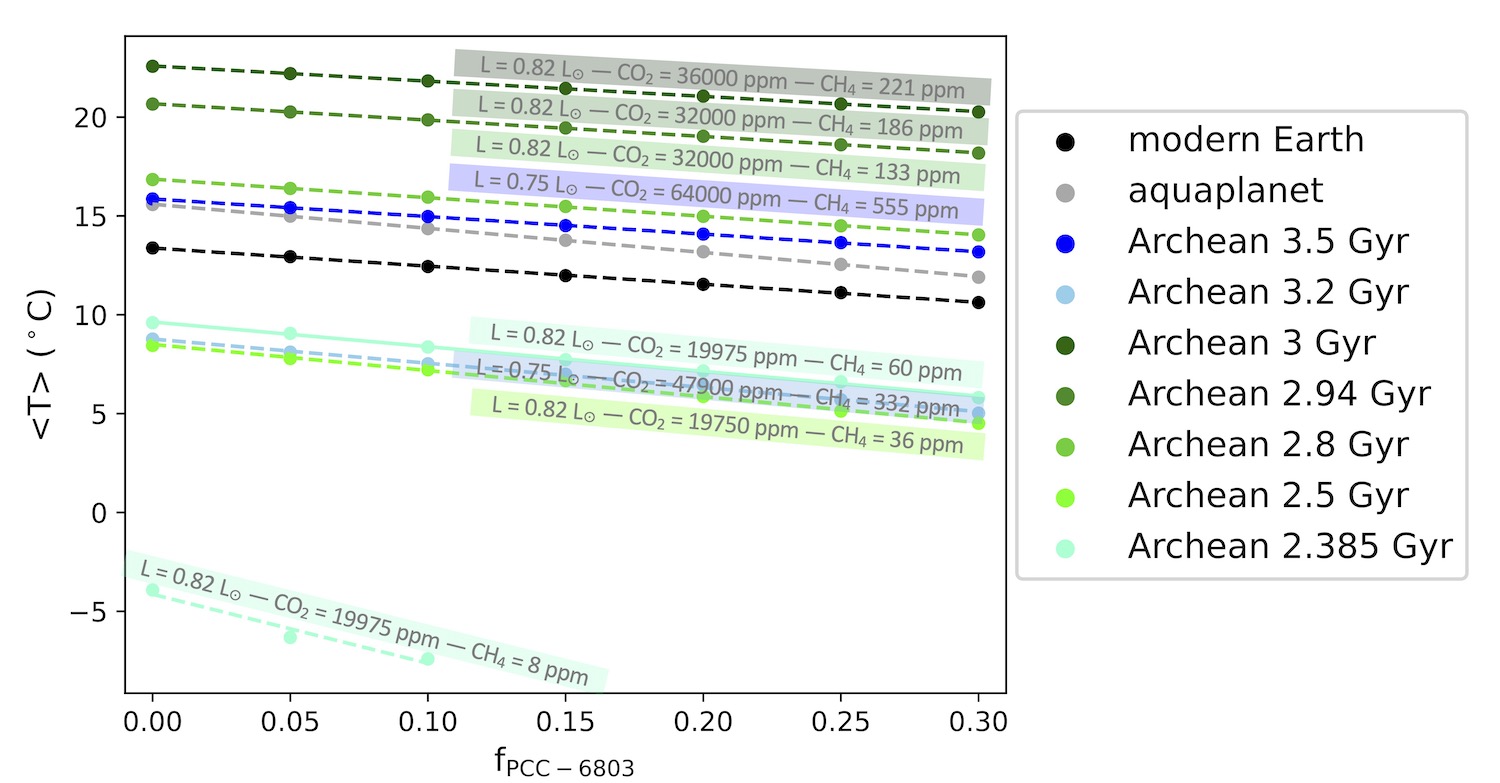
Moving further back in time to the Late Archean (2.5 Ga ago), a prior Snowball Earth event—the Huronian glaciation—is thought to have occurred following the Great Oxidation Event (GOE). By incorporating the optical properties of cyanobacteria Synechocystis sp. PCC 6803 (Battistuzzi et al., 2023; Behrendt et al., 2003) into the pRT-ESTM framework to examine their specific impact on surface albedo and temperature, it can be shown that—if atmospheric CH4 concentration is low (8 ppm)—an oceanic cyanobacterial coverage of ≥15% is sufficient to trigger a Snowball Earth state (Figure 2; Bisesi et al., in preparation). This transition is driven solely by the increased surface albedo, without requiring further CO2​ reduction. While increasing CH4​ to 60 ppm prevents global glaciation, all other scenarios show that extensive cyanobacterial coverage reduces global mean temperatures by 1–4 K. This cooling effect is driven by a three-fold feedback mechanism: CO2​ drawdown, CH4​ oxidation (via O2​ production), and enhanced oceanic albedo. Notably, this mechanism would have been ineffective during the Meso-Archean (3–3.5 Ga) due to the absence of continents, but it remains a crucial, yet often overlooked, factor for later eras. These results are currently being expanded to include a broader range of atmospheric compositions and additional microorganism species.

Figure 2. Global average surface temperature versus fraction of oceans covered by a cyanobacteria bloom for different periods of the Archean Earth. Solar luminosity is standardized for comparative purposes.

To complete this characterization, future research must incorporate a comprehensive assessment of the feedback mechanisms between vegetation and climate. On the one hand, plants significantly influence the hydrological cycle through evapotranspiration, which substantially enhances the release of atmospheric water vapor from continental masses compared to simple evaporation from bare soil (Cresto-Aleina et al., 2013; Porporato, 2022). To capture this effect, the Trieste/Torino group is currently working to integrate a dedicated humidity mechanism into the pRT-ESTM.

On the other hand, vegetation and soil microbiota act as active drivers of the biological carbon cycle, regulating the overall carbon balance through the complex interplay of photosynthesis, respiration, and the decomposition of organic matter (Williamson et al., 2006). These metabolic processes directly modulate atmospheric composition and, consequently, the long-term climatic stability of rocky planets. It is important to note that this biological feedback exerts an effect opposite to that of the Charney mechanism. Thus, while the vegetation-albedo feedback can extend planetary habitability beyond the outer edge of the circumstellar habitable zone, carbon sequestration could potentially influence habitability thresholds near the inner boundary. Since the timescale of these processes aligns with the vegetation life cycle (spanning tens to hundreds of years), this ‘fast carbon cycle’ feedback can be effectively studied using pRT-ESTM.

Looking toward a longer-term perspective, future applications of pRT-ESTM could investigate the carbonate-silicate cycle (the ‘slow carbon cycle’; Berner, 2003), which operates on timescales of tens to hundreds of millions of years. Achieving this objective will require a different numerical approach, as running the current framework over such vast timescales would be computationally prohibitive. The ultimate goal will be to determine how the carbonate-silicate cycle is modulated by diverse planetary and astrophysical parameters—such as those characterizing the early Earth, early Mars, or specific classes of exoplanets.

How to cite: Bisesi, E., Murante, G., Provenzale, A., von Hardenberg, J., Maris, M., Silva, L., Caballero, J., Battistuzzi, M., La Rocca, N., Billi, D., Granato, G. L., and Munari, E.: Role of different biological albedo feedbacks on the climate and habitability of rocky exoplanets, Europlanet Science Congress 2026, The Hague, The Netherlands, 7–11 Sep 2026, EPSC2026-1037, https://doi.org/10.5194/epsc2026-1037, 2026.

11:42–11:54
|
EPSC2026-1054
|
On-site presentation
Tilman Spohn, Craig Walton, and Peter Cawood

Plate tectonics is widely considered an essential factor in the present habitability of Earth. The weathering of the continental crust and the exchange of volatiles with the interior help maintain favorable climate conditions through the carbonate-silicate cycle and provide essential nutrients, particularly phosphorous, to the biosphere. The subaerial emergence of continents and their lateral motion during continental drift have also furthered the evolution of life. However, plate tectonics may have emerged relatively late in Earth's history, after life began and proto-continents (cratons) formed, with the planet's habitability independent of its tectonic mode. Estimates of when plate  tectonics emerged range from the Archean to the early Phanerozoic, while LUCA, the last universal common ancestor, has been dated to 4.2 Ga b.p. Pre-plate tectonic modes may have included stagnant lid and squishy lid (or sluggish mobile lid) tectonics, which may thus have supported the biosphere for significant periods of geological time. During this time, the lid may have increased in mobility and plateness to eventually reach modern values. These tectonic scenarios may also apply to Earth-like exoplanets, though they may be difficult to infer. This complicates the interpretation of possible biosignatures. We may attempt to infer tectonic modes from exoplanetary observables using indirect evidence, such as atmospheric composition, albedo variations, and magnetic fields, which are even more challenging to observe.


How to cite: Spohn, T., Walton, C., and Cawood, P.: Habitability and Life, With and Without Plate Tectonics, Europlanet Science Congress 2026, The Hague, The Netherlands, 7–11 Sep 2026, EPSC2026-1054, https://doi.org/10.5194/epsc2026-1054, 2026.

11:54–12:06
|
EPSC2026-583
|
On-site presentation
Aiko Voigt and Johannes Hörner

During the Neoproterozoic, Earth experienced at least two extreme glaciations with ice extending to tropical latitudes. While the Snowball Earth hypothesis proposes a fully ice-covered planet, geological evidence and the persistence of life suggest that parts of the ocean may have remained ice-free. This has motivated the concept of Waterbelt states: alternative climate equilibria featuring open equatorial oceans that could act as refugia for early life and expand the range of habitable climates relevant to Earth-like exoplanets. Despite their appeal, Waterbelt states remain disputed due to uncertainties in the mechanisms required to halt the ice–albedo feedback at low latitudes, including the role of bare sea-ice albedo and cloud radiative effects.

Here, we investigate whether Waterbelt states are robust solutions of the coupled climate system and identify the processes controlling the stability of low-latitude ice margins. Using a hierarchy of climate models, this work combines mechanistic insights from a Budyko–Sellers energy balance model with an ensemble of global climate models. In particular, we present results from a coordinated model intercomparison that includes three versions of the ICON model and five versions of the CAM model, all run in the same aquaplanet slab-ocean setup. The simulations are analyzed with respect to three key factors that have been proposed to influence Waterbelt stability: the area of exposed bare sea ice, cloud masking of the ice–albedo feedback, and shortwave cloud radiative feedbacks.

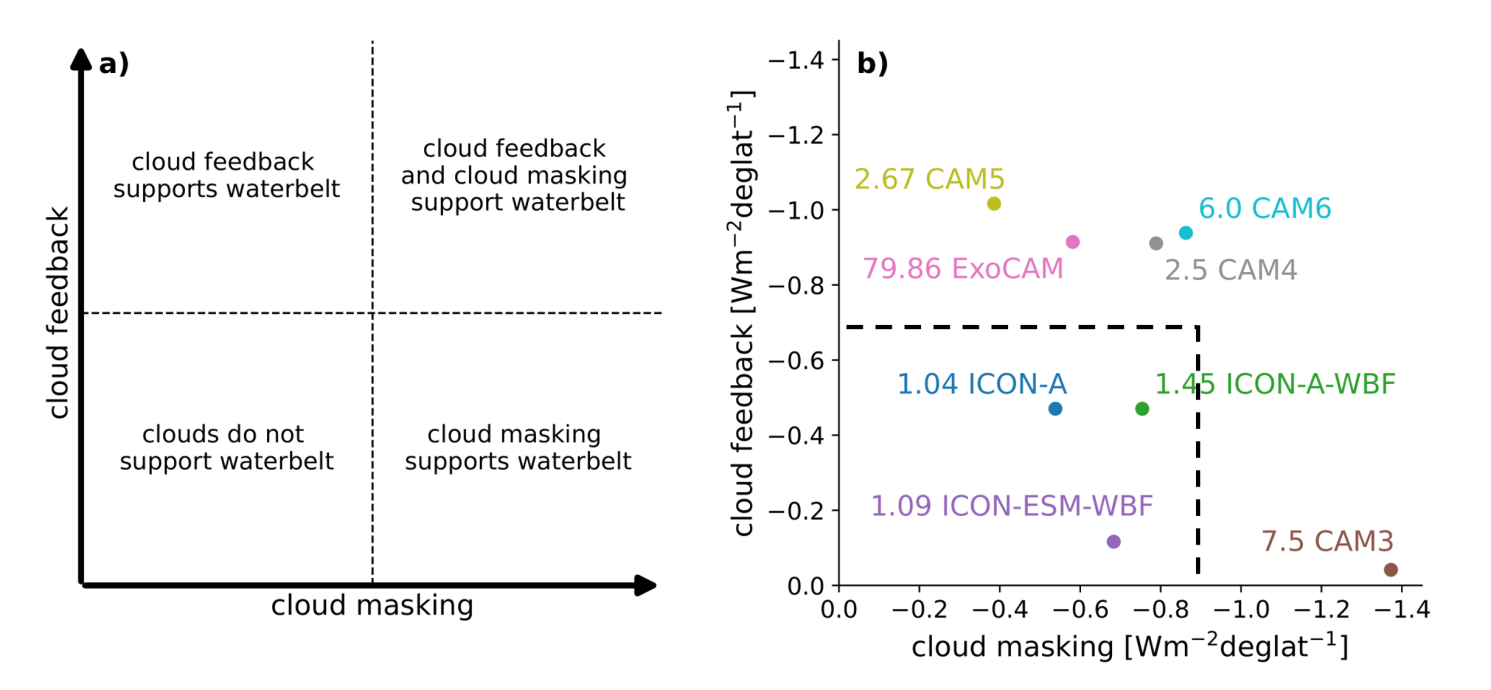
We demonstrate that stable Waterbelt states can be found in a wide variety of climate models. While ICON Waterbelt states depend on cloud tuning, all CAM models readily simulate stable Waterbelt states over a substantial range of CO2 radiative forcing. These differences are primarily due to cloud radiative effects: the CAM models exhibit stabilizing shortwave cloud feedbacks and stronger cloud masking than ICON (Fig. 1). Overall, this suggests that clouds do not present a fundamental obstacle to Waterbelt climates, but instead play a modulatory role that varies across models. This implies that Waterbelt states may be more physically plausible than studies based on single models have suggested, while at the same time emphasizing the importance of clouds for deep-time climate and exoplanet habitability.


Fig. 1: Summary of Waterbelt states and their dependence on cloud-radiative interactions across the ensemble of eight global climate models. The numbers next to the model names in the right panel measure the range of atmospheric CO2 levels over which Waterbelt states exist.

How to cite: Voigt, A. and Hörner, J.: Waterbelt solutions as a habitable climate state of Earth-like exoplanets, Europlanet Science Congress 2026, The Hague, The Netherlands, 7–11 Sep 2026, EPSC2026-583, https://doi.org/10.5194/epsc2026-583, 2026.

12:06–12:18
|
EPSC2026-897
|
Virtual presentation
Laura Silva, Michele Maris, Erica Bisesi, Giuseppe Murante, Daniela Billi, José A. Caballero, Nicoletta La Rocca, Mariano Battistuzzi, and Jost von Hardenberg

The search for life beyond the Solar System requires operational definitions of planetary habitability that can be used both to rank promising exoplanets and to predict the conditions under which atmospheric biosignatures may arise and be detected. Climate models provide the physical framework to quantify surface habitability by describing the spatial and temporal distribution of temperature, liquid water availability, and radiation environments. Yet the production of biosignatures depends on biological processes that operate at much smaller scales. By coupling climate physics with biological response functions to temperature and radiation, we aim to link local biological limits to planetary-scale habitability and observable biosignature potential. 

Here we present the work carried out within the Italian Space Agency-funded ASTERIA collaboration, which brings together astrophysicists, biologists, and climatologists. The project measures the responses of cyanobacteria to non-Earth-like environmental conditions (Barbisan et al., 2026) and explores how these biological responses can be integrated into climate-based estimates of photosynthetic habitability, oxygen production potential, and biosignature detectability. The work is focused on both tidally-locked rocky planets orbiting M-dwarf stars, and Earth-like analogues, in view of next generation instruments.

For rocky planets orbiting M-dwarf stars, we have performed a systematic study of the potential habitability over a representative sample of observed exoplanets (Bisesi et al., 2026a), by applying our version of the 3D climate model PLASIM. We have linked the predicted surface temperature and irradiance maps to cyanobacterial response functions (Maris et al., 2026 in prep), thereby translating local biological limits into planetary-scale estimates of photosynthetic habitability and oxygen production potential. The irradiance response of photosynthetic activity  (here based on Mycrocistis aeruginosa and M. weisembergii cyanobacteria) is modulated by a biological temperature response. To simplify the calculation, in the current implementation, we considered the two cases of a mesophile and thermophile-like cyanobacterial.
A representative case is shown in Fig. 1 for an aquaplanet with parameters of TOI-700 d. Preliminary results extended to the full sample of considered exoplanets, indicate that surface temperature is more limiting the potential oxygenic productivity than the irradiance: under-illuminated regions are generally frozen and therefore non-productive, while sub-stellar cloud cover can mitigate excessive irradiation. We have also explored the potential detrimental effects on photosynthetic productivity by stellar UV radiation (Billi et al., in prep).

Fig.1 Averaged Oxygen productivity profiles (μmoles of O2/g of Chl a/h), as a function of the angular distance from the substellar point, for the irradiance-only response (blue) and irradiace and temperature responses (green and red). 


For Earth analogues we adopt a lower complexity model pRT-ESTM (Bisesi et al., 2026b). In this model we have interfaced the radiative transfer code petitRADTRANS (Mollière et al., 2019) with our EBM-class climate model ESTM (originally interfaced with the radiative transfer code CCM, Vladilo et al., 2015; Silva et al., 2017). This new model allows us to explore any atmospheric composition and directly link climate and habitability explorations with the corresponding observables. Given the current lack of confirmed detections, we have performed large parametric studies aimed at expanding our understanding of potential habitability under a wide range of orbital, planetary, atmospheric and biological assumptions. In particular, we introduced a temperature-based habitability index (Silva et al., 2017), which provides a quantitative measure of the fraction of the planetary surface compatible with temperature limits suitable for oxygen producers and consumers (Fig.2  left). This index has served as the basis for our habitability studies, and, combined with different biological responses, allows to link habitability to potential observables. We present recent results concerning systematic studies of photosynthetic potential and corresponding biosignatures  (see Fig. 2, right) obtained by considering a large range of atmospheric compositions.


Fig.2 Left: Range of habitable solutions (vs pressure and insolation, and two CO2 abundances) by adopting a biologically motivated temperature range of 0–50◦C, representative of conditions potentially suitable for the activity of oxygen-consuming and -producing organisms (Silva et al., 2017). Shaded region indicates the range of surface pressures for which the surface dose rate due to secondary particles produced by Galactic Cosmic Rays exceeds 100 mSv yr−1.  Right: Transit spectra for a CO2-rich Earth analogue and 100 ppm O2 (up), compared with that for a modern Earth composition.

References

  • Barbisan, M. Barbato, M. Maris, L. Silva, B. Boccia, N. La Rocca, L. Coccola, L. Poletto, N. Trivellin, F. Peron. UV LED-based solar flare simulator for space environment studies, Proc. SPIE 13913, Light-Emitting Devices, Materials, and Applications XXX, 139130G, 4 March 2026; https://doi.org/10.1117/12.3077482
  • Bisesi, G. Murante, J. von Hardenberg, J. A. Caballero, M. Maris, D. Billi, N. La Rocca, and L. Silva. Assessing the Climate and Habitability of Tidally Locked Rocky Exoplanets. Astrobiology, under review, 2026a.
  • Bisesi, G. Murante, A. Provenzale, J. von Hardenberg, M. Maris, and L. Silva. Interaction between vegetation and Snowball phases in the late Proterozoic Earth. IJA, accepted, arXiv e-prints, art. arXiv:2603.25321, March 2026b. doi:10.48550/arXiv.2603.25321.
  • Molliére, J. P. Wardenier, R. van Boekel, Th. Henning, K. Molaverdikhani, and I. A. G. Snellen. petitRADTRANS. A Python radiative transfer package for exoplanet characterization and retrieval. , 627:A67, July 2019. doi: 10.1051/0004-6361/201935470.
  • Silva, G. Vladilo, P. M. Schulte, G. Murante, and A. Provenzale. From climate models to planetary habitability: temperature constraints for complex life. International Journal of Astrobiology, 16(3):244–265, July 2017b. doi: 10.1017/S1473550416000215.
  • Vladilo, L. Silva, G. Murante, L. Filippi, and A. Provenzale. Modeling the Surface Temperature of Earth-like Planets. , 804 (1):50, May 2015. doi: 10.1088/0004-637X/804/1/50.


How to cite: Silva, L., Maris, M., Bisesi, E., Murante, G., Billi, D., Caballero, J. A., La Rocca, N., Battistuzzi, M., and von Hardenberg, J.: Coupling Biological Responses and Climate Physics to Assess Exoplanet Habitability and Biosignatures, Europlanet Science Congress 2026, The Hague, The Netherlands, 7–11 Sep 2026, EPSC2026-897, https://doi.org/10.5194/epsc2026-897, 2026.

12:18–12:30
|
EPSC2026-1405
|
ECP
|
On-site presentation
Jitse Alsemgeest, Frank van Ruitenbeek, Inge Loes ten Kate, Maarten Kleinhans, Sebastiaan de Vet, Lisanne Braat, Boris Jansen, Tim Lichtenberg, Lonneke Roelofs, Monica Sánchez Román, Shashwat Shukla, and Floris van der Tak

Introduction

The question if life exists outside of Earth has been an important driver of Solar system exploration and exoplanet research in the last few decades [1-3]. Although terrestrial analogue research provides insight into this question [4-5], no definitive evidence of life outside Earth has been found at this moment [6]. This raises the question whether the current methodology for analogue research is sufficient, or needs changes.

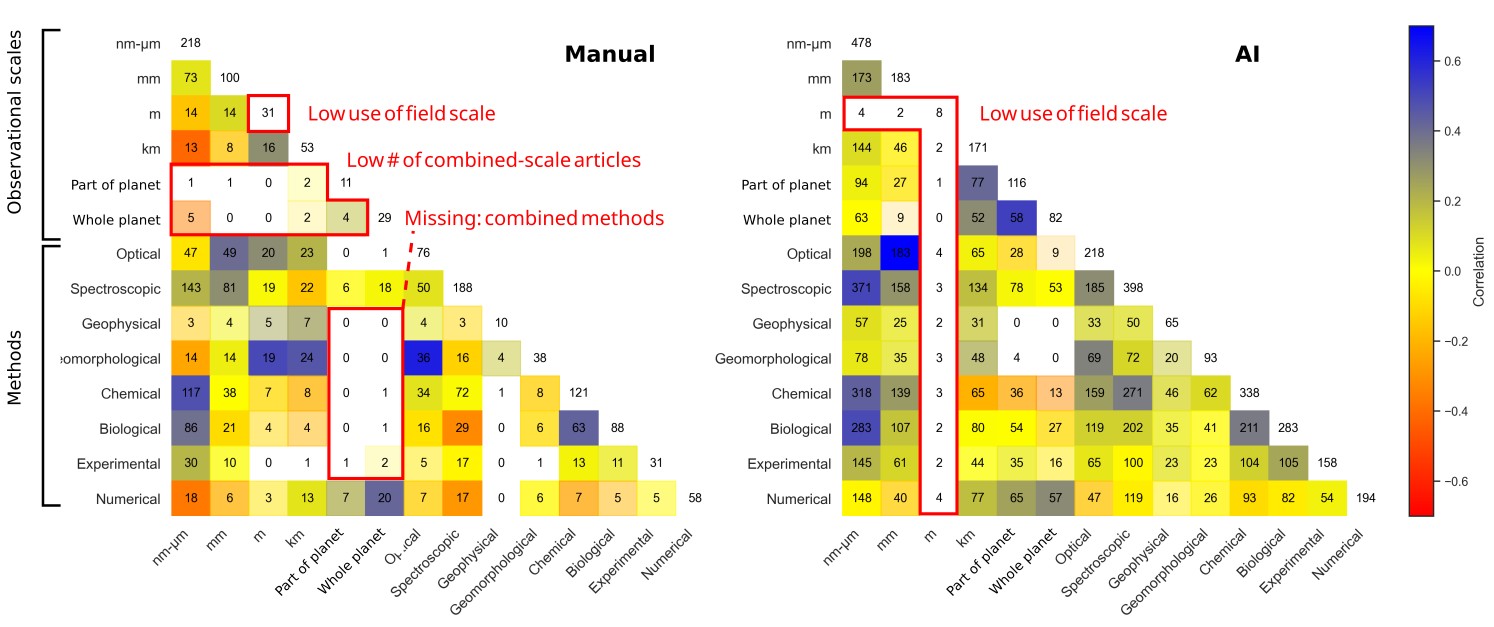
To answer this, we use AI to systematically analyse 2500 papers that use terrestrial analogues or analogue research methods to study life outside Earth. For each, we determined the used methods, scales at which they are applied, and investigated research questions. This gives new insights in which methods are used and underused, and which methods should be used in combination to improve the methodology towards understanding and detection of life outside Earth


Methods

A systematic literature search was performed for analogue research related to life outside Earth. The resulting initial set of articles were analysed manually to determine the used methods, scales, and research questions. Then, articles referred to in review papers were collected to complete the literature compilation.

This literature compilation was then analysed by using the Ollama framework [7] in combination with Langchain [8] to run the qwen3:0.6b LLM [9]. Analysis uses the following pipeline: 1) conversion to text-containing pdfs, 2) extraction of text sections 3) extraction of method sections from other sections 4) asking a series of binary question on sections relevant for methods, scales, and research questions to check the usage within each single article.


Results

The initial compilation included ~700 articles, ~100 of which could be classified as reviews. The manual analysis showed the following:

  • Interdisciplinary research is done, but remains limited. This hinders finding connections between biosignatures and other observables.
  • Research on how to span different spatial scales, ranging from molecular to planetary scales and exoplanetary scales, is lacking. Here, especially the field-scale is underutilised, which may provide importance in linking potentially habitats to actual biosignatures.
  • There is no clear separation between inhabited, uninhabited, and previously inhabited but no longer habitable environments. This affects the reliability of biosignature interpretation. Both false negatives and false positives are overlooked, with almost no research focusing on false negatives.

The reviews increased the dataset to a total of ~2500 articles. These were all analysed by AI, with the initial set functioning as a control. AI-analysis deviates significantly from manual analysis, overall indicating higher numbers for each used method, scale, and research question. However, AI confirms that there is a small number of papers that utilises the field scale, indicating at least an agreement with the manual analysis that this scale is underutilised.

Figure 1 Correlation diagram showing usage of observational scales and methods. Colours represent that certain methods or scales are used in the same paper (blue) or that they tend to be used separately (red). Light colours to white indicate underused methods and scales. Note that the AI tends give overall higher usage of methods and scales throughout papers, but does not find the same relationships as in the manual analysis.


Discussion and conclusion

The research gaps resulting from the manual analysis indicate the need for an integrated, multi-scale framework to advance life-detection strategies. This is partially supported by AI, although improvement of the AI-analysis is needed before final conclusions can be drawn. As examples of suggestions for future research, biologists or biochemists should collaborate with geomorphologists, geophysicists, and imaging spectroscopists, in order to determine the relations between biosignatures on laboratory to field and remote-sensing scales. Futhermore, geologists and biologists should work with exoplanet researchers, to give them insights into the atmospheric processes and exclude false positives and negatives in exoplanetary signs of life. Such collaborations will prove essential to improving the methodology for the search for extraterrestrial life.


References

[1] C. S. Cockell et al. Astrobiology, 9, 1. (2009). [2] J. Matthey, Platin. Met. Rev., 20, 3. (1976). [3] D. Schulze-Makuch, J. M. Dohm, A. G. Fairén, V. R. Baker, W. Fink, and R. G. Strom Astrobiology, 5, 6. (2005). [4] A. G. Fairén et al. Astrobiology, 10, 8. (2010). [5] F. Biagioli, S. Bay, A. Zerboni, and C. Coleine Int. J. Astrobiol., 24, e29. (2025). [6] J. E. Brandenburg “The Discovery of Microbial Life on Mars.” Int. J. Immunol. Microbiol., 2, 2. (2025). [7] Ollama, Ollama’s documentation. Retrieved from: https://docs.ollama.com (2025). [8] H. Chase LangChain. Retrieved from: https://github.com/langchain-ai/langchain (2022). [9] Qwen Team “Qwen3 Technical Report.” Retrieved from: https://arxiv.org/abs/2505.09388 (2025).

How to cite: Alsemgeest, J., van Ruitenbeek, F., ten Kate, I. L., Kleinhans, M., de Vet, S., Braat, L., Jansen, B., Lichtenberg, T., Roelofs, L., Sánchez Román, M., Shukla, S., and van der Tak, F.: Terrestrial analogue research for finding extraterrestrial life and how to use AI to find research gaps, Europlanet Science Congress 2026, The Hague, The Netherlands, 7–11 Sep 2026, EPSC2026-1405, https://doi.org/10.5194/epsc2026-1405, 2026.

Posters: Thu, 10 Sep, 18:00–19:30 | Foyer 2

Display time: Thu, 10 Sep, 08:30–19:30
Chairpersons: Felipe Gómez, Paolo Simonetti, Lorenzo Biasiotti
F2.54
|
EPSC2026-901
|
ECP
|
On-site presentation
Shijil Umer and Aiko Voigt

The Habitable Zone (HZ) is classically thought of as a continuous orbital space surrounding a star. Most studies that try to estimate the extent of the HZ ignore the evolutionary history of the star during its Pre-Main-Sequence (PMS) and how the decreasing stellar luminosity during this era can affect the composition of planets at different orbital distances. The carbonate-silicate weathering cycle could have particularly interesting consequences when the PMS of the star is taken into account. This process consumes atmospheric CO2 depending on surface water availability and surface temperatures with warmer conditions allowing faster removal of CO2 .

During the PMS, the star derives most of its energy from gravitational contraction. Low mass stars such as M-Dwarves tend to have much higher luminosity during this phase compared to their Main Sequence (MS). Hence as the star undergoes the PMS to MS transition (hereafter referred to as the P2M transition), their luminosity decreases and the HZ shifts closer to the star due to the drop in stellar flux received at a certain orbital distance. The P2M transitions lasts for an order of 100 Myrs for early M-Dwarfs to 1 Gyr for late M-Dwarfs (Baraffe et al 2015, Ramirez and Kaltenegger 2014} - longer than the planet formation timescales. Thus, during this transition, the atmospheres of the orbiting planets will experience a considerable change in forcing from its host star, potentially leading to changes in atmospheric composition (Luger and Barnes 2015).


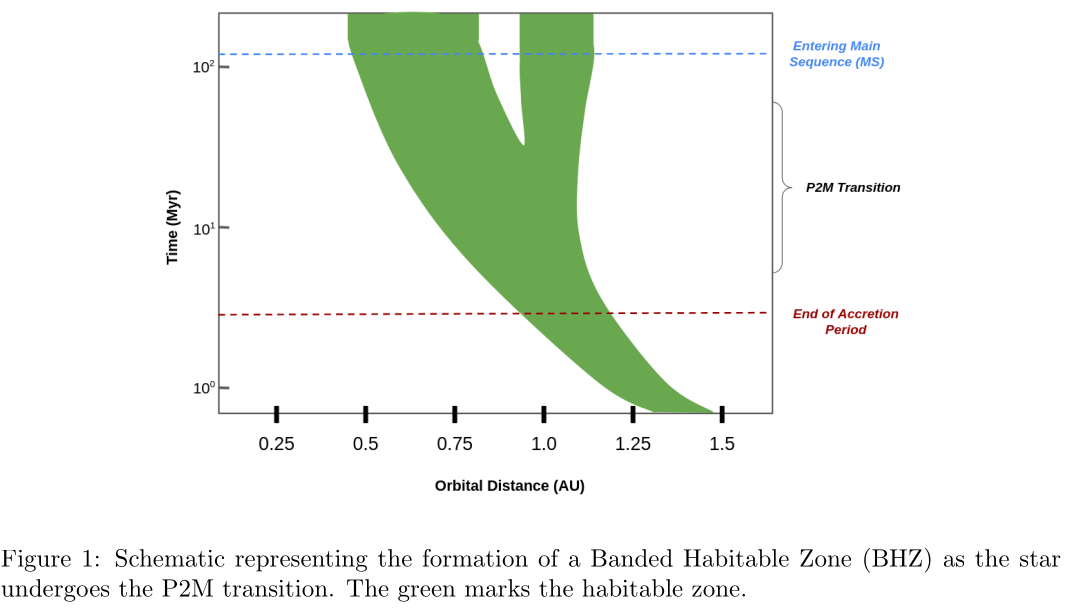
In this study, we take into account the P2M transition and assume that the planet is sufficiently tectonically inactive to have insignificant CO2  outgassing compared to modern Earth. Planets closer to the star experience higher surface temperatures (due to increased insolation throughout the P2M) and thus lose their atmospheric CO2 more rapidly. However, their proximity to the star allows the surface to be habitable. The planets much farther from the star (experiencing lower insolation) retain sufficient atmospheric CO2  allowing the greenhouse effect to make the planetary surface habitable in the MS. However, some planets orbiting the star between these two extremes will receive too little stellar flux and possess insufficient atmospheric CO2  to make the surface habitable. This forms the crux of the Banded Habitable Zone (BHZ) hypothesis. BHZ means that the HZ is split into two - with a region of space in between the two segments that is in a snowball state incapable of hosting surface liquid water (see Figure 1). 

A two-column model constrained by top-of-atmosphere radiative balance and a simple one-dimensional radiative-convective scheme is constructed to calculate the day-side surface temperatures of the planets. The planets are all assumed to be tidally-locked. The stellar spectra of M-Dwarfs peak in the near-IR part of the spectrum where the absorption bands of water vapour and CO2  dominate. Thus, the atmosphere can be expected to absorb a significant amount of the incoming stellar radiation, reducing the lapse rate of the atmosphere and suppressing convection (Eager-Nash et al 2020). The 1-D radiative-convective model takes into account the atmospheric absorption of both the downward flux of the near-IR stellar radiation, as well as the upward flux of the long-wave radiation emitted by the surface. This simple, computationally inexpensive model provides a valuable approach for calculating the atmospheric evolution during the multi-million-year-long P2M transition.

Results obtained using this simple model indicate that the non-linear behaviour of the atmospheric CO2  removal, coupled with the competition between the planetary atmosphere's greenhouse effect and the decreasing insolation of the host star during the P2M transition, can potentially generate a BHZ.

References:

  • Isabelle Baraffe, Derek Homeier, France Allard, and Gilles Chabrier. New evolutionary models for pre-main sequence and main sequence low-mass stars down to the hydrogen-burning limit. Astronomy & Astrophysics, 577:A42, 2015. doi: https://doi.org/10.1051/0004-6361/201425481.
  • Jake K. Eager-Nash, David J. Reichelt, Nathan J. Mayne, F. Hugo Lambert, Denis E. Sergeev, Robert J. Ridgway, James Manners, Ian A. Boutle, Timothy M. Lenton, and Krisztian Kohary. Implications of different stellar spectra for the climate of tidally locked Earth-like exoplanets. Astronomy & Astrophysics, 639:A99, 2020. doi: 10.1051/0004-6361/202038089.
  • R. Luger and R. Barnes. Extreme Water Loss and Abiotic O2 Buildup on Planets Throughout the Habitable Zones of M Dwarfs. Astrobiology, 15(2):119–143, 2015. doi: 10.1089/ast.2014.1231.
  • Ramses M Ramirez and Lisa Kaltenegger. The habitable zones of pre-main-sequence stars. The Astrophysical Journal Letters, 797(2):L25, 2014. doi: 10.1088/2041-8205/797/2/L25.

How to cite: Umer, S. and Voigt, A.: Possibility of Banded Habitabile Zones around M-Dwarf Stars, Europlanet Science Congress 2026, The Hague, The Netherlands, 7–11 Sep 2026, EPSC2026-901, https://doi.org/10.5194/epsc2026-901, 2026.

F2.55
|
EPSC2026-705
|
On-site presentation
David Dubois, Lauren Scovel, Partha P. Bera, Lora Jovanović, Arnaud Salvador, Thomas Drant, Claire L. Ricketts, Gordon J. Hedley, Farid Salama, and Ella Sciamma-O'Brien


  • Introduction

The anoxic Archean atmosphere was likely rich in CH4, but the detailed composition remains difficult to assess from the limited geological records. CH4-driven photochemistry may have produced haze particles, influencing the early Earth's atmospheric energy budget and gas-to-solid conversion[1]. Precursors to haze particles such as HCN, CO2, CH4 or CO have been proposed, their reactivity in high-altitude photochemical regions remains largely unconstrained[2].

Experimental simulations of early Earth and (exo)planet atmospheres have mostly focused on organic aerosol analogues (tholins). Previously, tholins formed from electrical discharges of N2:CH4:CO2 gas mixtures containing low CH4 abundances showed a negative correlation between CO2 concentration and tholin yield[1]. Seminal UV photolysis gas-phase experiments demonstrated the possibility for amino acid formation[3] but gas-phase studies have been limited since. Recently, HCN formation pathways to tholin formation in the absence of oxygen were investigated but neutral-neutral pathways only were considered[4].

In the present work, we performed low-temperature (150 K) plasma discharge experiments using an N2:CH4:CO2 (95:4:1) gas mixture to reproduce conditions relevant to the ionized upper atmosphere of the Archean Earth and CO2-containing exoplanets, and measured the formed molecular products with a quadrupole mass spectrometer (QMS). Our goals were to (i) evaluate the chemical impact of a small (1%) concentration of CO2 on the gas-phase products in a largely reduced environment, and (ii) investigate an atmosphere with a C/O of 2.5, where CH4-driven polymerization can occur despite partial CH4 oxidation. Such transient reducing states - potentially induced by asteroid impacts - may have episodically raised atmospheric CH4 concentration on the early Earth.

Methods

Plasma configuration and operation

Experiments were conducted using the COsmic SImulation Chamber (COSmIC) facility at NASA Ames Research Center[5]. The COSmIC chamber uses a pulsed discharge nozzle (PDN) which cools down gas mixtures by expanding gases through a slit and generates a pulsed direct-current (DC) plasma discharge (600 𝜇s) within the jet-cooled gas expansion. The PDN consists of a copper slit plate anode, an insulator slit plate, and two cathode electrodes placed along the slit downstream of the alumina plate. Gas residence inside the plasma volume is ~4 𝜇s. A -1000 V high voltage generates the plasma discharge, producing electrons with energies ~2-12 eV. The gas is jet-cooled to ~150 K in the plasma cavity, enabling experimental simulation of atmospheric chemistry, resulting in the formation of complex organic molecules, at low temperature. Experiments were run using a N2:CH4:CO2 (95:4:1) ultra-high purity (99.999%) gas mixture, controlled by an MKS 1479 mass flow controller at a rate of 2000 sccm.

Time-resolved quadrupole mass spectrometry (QMS):

Time-resolved measurements were performed by synchronizing spectra acquisition with the plasma frequency (10 Hz) through a TTL signal gating input. The QMS was placed to face the molecular beam resulting from the supersonic jet. Once extracted through the QMS, the gas phase products were then guided through a series of electromagnetic lenses before reaching the QMS microchannel plate detector.

Production and characterization of tholins:

A N2:CH4:CO2 (95:4:1) plasma experiment was run for 18 hours in the COSmIC chamber to produce an early Earth/exoplanet tholin sample. The sample was deposited on silicon substrate, then collected in an argon-filled glovebox to minimize air exposure. After collection, mid-infrared spectra (4000–1000 cm-1) were acquired using a Fourier transform Infrared spectrometer with a spectral resolution of 4 cm-1.

Reaction network modeling and quantum chemistry calculations:

We used the multi-fluid physics 1D COSmIC Plasma Reactivity Simulation Model (CO-PRISM[6]) to compute molecular abundances based on known reaction rates and branching ratios. CO-PRISM consists of a chemical network comprising 435 reactions, including 72 newly-added oxygen-bearing pathways. Species include radicals, neutrals, cations, and anions. In addition, ab initio calculations were conducted to study the pathways and structures of key molecular products. We determined the equilibrium structures with the coupled cluster singles and doubles with perturbative triples method. The harmonic vibrational frequencies were also computed to ensure global minima on the potential energy surfaces.


  • Results

For the first time in an N2:CH4:CO2 (95:4:1) gas mixture, neutral, cation, and anion gas phase products were probed by mass spectrometry at low temperature (150 K). Utilizing simultaneous modeling and quantum computations, our measurements have unveiled key ion-neutral pathways and molecular products. These include CH3+, HCNH+, CH3CH2CNH+, H-, CH3-, C2H- and CN-. Furthermore, cyclic molecules (e.g., C6H5⁺ and C6H5O) were also detected, along with the unexpected formation of the dication N22+ and dianion NO22-. This study highlights the essential role ion-neutral reactions, often largely neglected in photochemical models, play in atmospheric chemistry. Main results and interpretation for the chemistry of volatiles on the early Earth and CO2-containing exoplanetary atmospheres will be discussed.


Acknowledgements

Funding for this project is provided through NASA SMD “Cold Solar System Objects” and “Laboratory Astrophysics Directed Work Package” Internal Scientist Funding Models. LS acknowledges support provided by the Tennessee Space Grant Consortium.


References

[1] Trainer, M.G. et al.  2004, Astrobiology 4.

[2] Carrasco, N. and Gautier, T. 2021, Chapter 4. Prebiotic Photochemistry: From Urey–Miller-like Experiments to Recent Findings, RSC.

[3] Sagan, C., and Khare, B.N. 1971, Science 173, 417-420.

[4] Pearce, B.K. et al. 2022, ACS Earth and Space Chemistry 6, 2385-2399.

[5] Sciamma-O’Brien, E. et al. 2014, Icarus, 243, 325-336.

[6] Dubois et al. 2025, The Planetary Science Journal, 6, 241.

How to cite: Dubois, D., Scovel, L., P. Bera, P., Jovanović, L., Salvador, A., Drant, T., L. Ricketts, C., J. Hedley, G., Salama, F., and Sciamma-O'Brien, E.: Ion Chemistry and Composition of Planetary Atmospheres: Towards a Characterization of the early Earth and CO2-bearing Exoplanets, Europlanet Science Congress 2026, The Hague, The Netherlands, 7–11 Sep 2026, EPSC2026-705, https://doi.org/10.5194/epsc2026-705, 2026.

F2.56
|
EPSC2026-720
|
ECP
|
On-site presentation
Sujeong Park, Gwonui Jeon, Sujin Kang, Arum Jung, Kyung-Hoon Shin, and Jaesoo Lim

Impact-generated hydrothermal systems are regarded as prime environments for habitability and biosignature preservation on early Earth and other planetary bodies. However, the reliability of lipid biomarkers for reconstructing such environments in dynamically evolving crater lakes remains poorly constrained. Here we investigate the distributions of glycerol dialkyl glycerol tetraethers (GDGTs) and glycerol trialkyl glycerol tetraethers (GTGTs) in lacustrine sediments from the Hapcheon impact crater, South Korea, to evaluate their utility as tracers of post-impact hydrothermal evolution. Radiocarbon ages indicate deposition during the late Pleistocene (~35–50 ka) within a highly unstable crater-lake system characterized by frequent slumping, soft-sediment deformation, and sediment remobilization. GTGT abundances closely track independent hydrothermal indicators, including calcite enrichment, and record the most intense hydrothermal conditions in the lowermost sediments, followed by a progressive long-term decline and sporadic persistence in younger intervals. In contrast, crenarchaeol shows repeated anti-covariation with GTGT, indicating transient shifts between hotter thermophilic habitats and cooler mesophilic conditions. These opposing trends suggest that the Hapcheon biomarker record captures both gradual post-impact cooling and short-lived environmental perturbations linked to basin-margin instability and water-column mixing. By contrast, conventional GDGT-based indices such as RI, RI-OH′, MBT and CBT display weak or inconsistent relationships with hydrothermal signals, particularly in disturbed intervals. We attribute this decoupling to hydrothermal overprinting, mixed microbial sources, and recurrent sedimentary reworking, which violate the ecological and depositional assumptions underlying standard GDGT calibrations. GTGT therefore emerges as a more sensitive and robust tracer of hydrothermal activity in extreme post-impact lake settings. These findings provide new insights into biomarker behaviour in impact-generated environments and demonstrate that proxy performance depends strongly on environmental stability. More broadly, GTGT may offer a valuable molecular tool for detecting hydrothermal niches and assessing habitability in ancient terrestrial and extraterrestrial crater systems.

How to cite: Park, S., Jeon, G., Kang, S., Jung, A., Shin, K.-H., and Lim, J.: Assessing the Potential of GTGT for Tracing Post-Impact Hydrothermal Activity: A Case Study from the Hapcheon Impact Crater, South Korea, Europlanet Science Congress 2026, The Hague, The Netherlands, 7–11 Sep 2026, EPSC2026-720, https://doi.org/10.5194/epsc2026-720, 2026.