
 1,2,3,3,4,5,1,6,
- 1Instituto de Astrofísica e Ciências do Espaço and Departamento de Física, Faculdade de Ciências, Universidade de Lisboa, Edifício C8, Campo Grande, 1749-016 Lisbon, Portugal (dfquirino@fc.ul.pt)
- 2IDL - Instituto Dom Luiz e Departamento de Ciências da Terra e Energia, Faculdade de Ciências, Universidade de Lisboa, 1749-016 Lisbon, Portugal
- 3School of Ocean Sciences, Bangor University, Menai Bridge, LL59 5AB, United Kingdom
- 4Theoretical Astrophysics, Department of Physics and Astronomy, Uppsala University, Uppsala, SE-75120, Sweden
- 5NASA Goddard Institute for Space Studies, 2880 Broadway, New York, NY 10025, USA.
- 6Institute of Geophysics, Department of Earth Sciences, ETH Zurich, Zurich, 8092, Switzerland
Introduction: The possibility of oceans on early Venus remains at the centre of a wider debate about the evolution of climate divergence with Earth. Modern Venus’s atmosphere presents low water vapour abundance (e.g.,Bézard et al., 2011; Cottini et al., 2015; Encrenaz et al., 2015) and a substantially enriched deuterium-to-hydrogen D/H ratio relative to Earth (Fedorova et al., 2008; Taylor & Grinspoon, 2009; Krasnopolsky et al., 2013; Encrenaz et al., 2015; Wilson et al., 2021; Westall et al., 2023; Mahieux et al., 2024). This high D/H ratio might constitute evidence for loss of a substantial water reservoir (Taylor & Grinspoon, 2009; Way et al., 2016; Gillmann et al., 2020; Wilson et al., 2021). Climate modelling studies have also shown two possible scenarios. Some models argue that a temperate climate is possible from the combination of slow rotation and dayside cloud-albedo feedback (Yang et al., 2014; Way et al., 2016; 2020). Other models suggest that water condensation from the steam atmosphere was prevented by nightside stratospheric clouds (Turbet et al., 2021). Another line of evidence comes from tidal dissipation in a putative ocean. Green et al., 2019 showed a similar magnitude effect to the present-day torque exerted by the modern dense atmosphere can be produced by ocean tides on Venus in a 330-m mean depth ocean. Here, we explore a possible evolutionary branch on early Venus, assuming water condensation from the steam atmosphere, to examine ocean circulation, tides, and their transfer of angular momentum from the ocean to the solid body.
Ocean circulation: Assuming water condensation from the steam atmosphere, we will explore the ocean circulation and heat redistribution on a putative ocean on Venus at 2.9 Ga. We simulate the ocean using the 3D General Circulation Model (GCM), the ROCKE-3D (Resolving Orbital and Climate Keys of Earth and Extraterrestrial Environments with Dynamics), developed at the NASA Goddard Institute for Space Studies (Way et al., 2017). We use a spatial resolution of 4º x 5º (latitude by longitude), a 40-layer atmosphere (top pressure, 0.1 hPa), and a 13-layer fully dynamic ocean (Russel et al., 1995) coupled to the atmosphere. All simulations use an isolation of 2001 W/m2, 1.47x times that of modern Earth, representing conditions at 2.9 Ga. Atmospheric composition is Earth-like, with a 1-bar N2 atmosphere (400 ppm CO2 and 1 ppm CH4) (Way et al., 2020). Modern values of Venus’s surface gravity, radius, obliquity, eccentricity and rotation rate (retrograde slow-rotator: -243 days) are used (Way et al., 2016).
Here we present results of four ocean scenarios, with different global equivalent layers (GEL): two using a modern Venus-like topography, 310-m and 1000-m, provided by the NASA/Magellan archive; one with a 1360-m bathtub ocean (subareal topography equal to the 310-m Venus, no bathymetry); and a 158-m aquaplanet. In the 310-m scenario (reference), the ocean covers about 60% of the surface and has a volume of 1.4 x 10¹⁷ m3, one order of magnitude below that of modern Earth’s Ocean or 10% its volume (Way et al., 2016). The 1000-m scenario explores a deeper ocean on Venus, with a volume of 35% of Earth’s Ocean and a surface area of about 88%. The 1360-m bathtub Venus explores the impacts of bathymetry and land distribution on the ocean circulation. The 158-m aquaplanet is used as a control case. Main results show a significant monthly-long diurnal cycle, leading to the day-night reversal of ocean and atmospheric circulations (see Figure 1) in all cases.
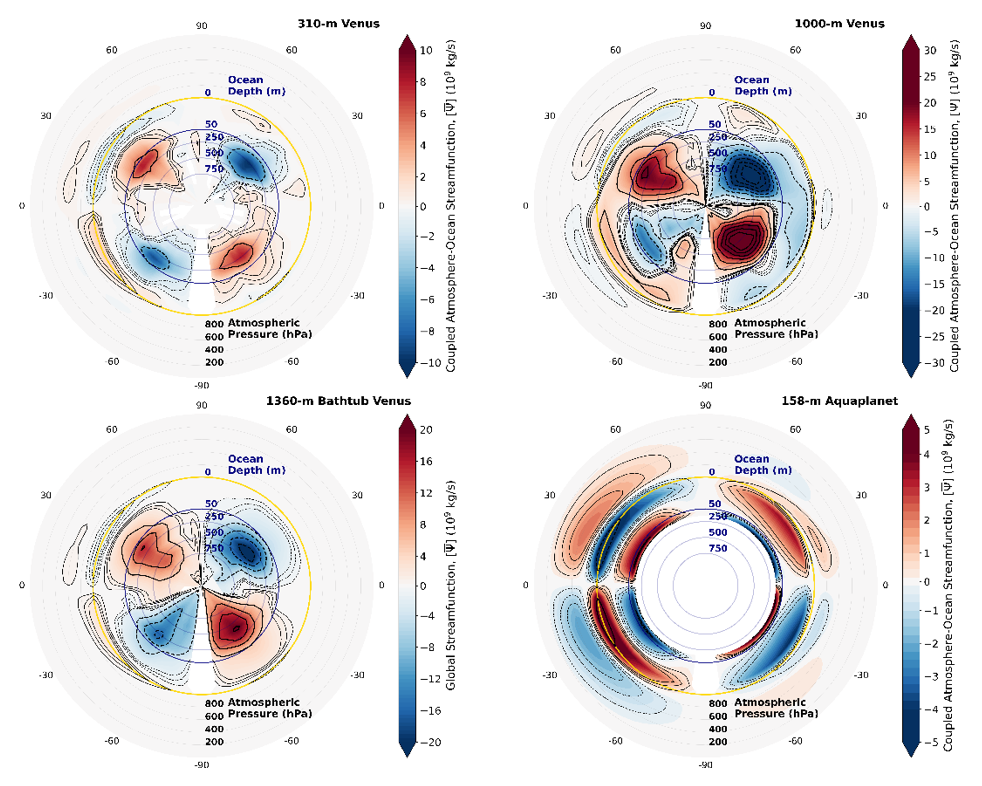
Figure 1. Coupled Ocean-Atmosphere stream functions for the four ocean scenarios. The left (right) part of each diagram depicts the day (night) circulation. The yellow circle represents the ocean surface.
This diurnal cycle also leads to the development of a considerable mixed layer at the equator, largely impacting global patterns of subsidence and upwelling. Our results also show that, due to the albedo feedback, lower sea surface area, the 310-m Venus has a colder global temperature: 15ºC colder than the 158-m Aquaplanet despite having the same water volume, highlighting the importance of land/sea surface in controlling climate and the longevity of this climate state. In the case of the 310-m Venus, a highly saline Southern Ocean forms controlled by a mass balance favouring evaporation and limited exchange with the remaining global ocean.
Ocean tides: Tides on a Venusian ocean are simulated using the Oregon State University Tidal Inversion Software (OTIS), which solves the linearised shallow-water equations (Egbert et al., 2004), and is extensively used to simulate tides on Earth (Green et al., 2017; 2018; Wilmes et al., 2017). Previous simulations assume a modern topography on Venus (Green et al., 2019). However, the present-day volcanic topographic rises might not have formed on early Venus, as geodynamic studies suggest (e.g.,Tian et al., 2023). In this work, we replace the volcanic rises with topography generated by geodynamic model evolution, while keeping the highlands as Aphrodite and Ishtar Terrae (see Figure 2). We explore the impact of multiple rotation rates (from prograde to retrograde, including fast- and slow-rotator cases), stratification, and ocean depth.
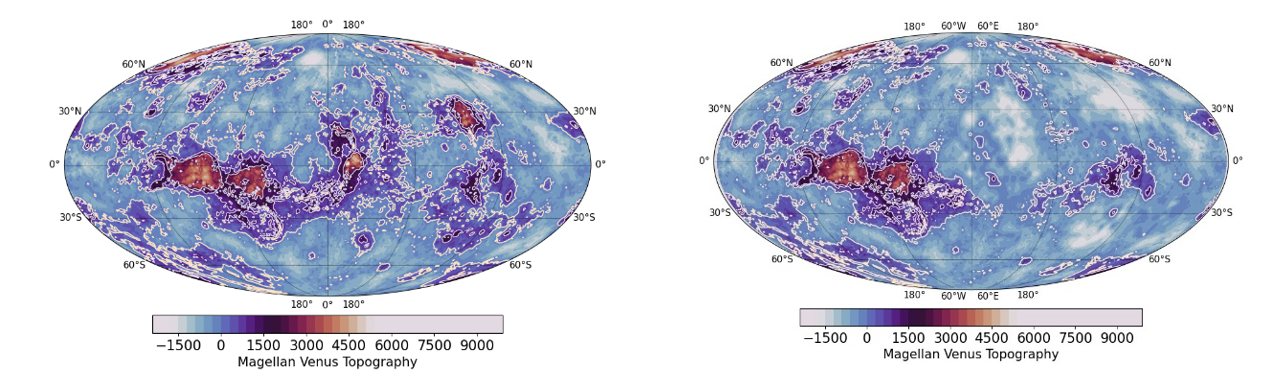
Figure 2. (Left) NASA/Magellan topography. (Right) New topography with the removal of volcanic topographic rises.
References: Bézard B, et al.,2011.Icarus.216:173 --Cottini et al.,2015.Space Sci.113:219 --Egbert, G.D., et al.,2004.JGRC,109,C03003 --Encrenaz T, et al.,2015. Space Sci.113:275 --Fedorova,A, et al.,2008.JGR:Planets, 113,E5 --Gillmann, C, et al.,2020.Nat Geosci,13,4 --Green, J., et al.,2017.E&PSL, 461,46 --Green, et al.,2018.GeoRL, 45, 3568 --Green, et al.,2019.ApJL,876, L22 --Krasnopolsky V, et al.,2013.Icarus.224:57 --Mahieux, A, et al.,2024.PNAS, 121,34 --Russell G.L., et al.,1995.Atmos-Ocean.33:683 --Taylor, F & Grinspoon, D,2009.JGR:Planets,114,E9 --Tian, J., et al.,2023.Icarus, 399, 115539 --Turbet M., et al.,2021.Nature.598:276 --Way M.J., et al.,2016.GRL.43 --Way M.J., et al.,2017.ApJS.213:12 --Way M.J. & Del Genio A.D. 2020.JGR:Planets.125 --Way M, et al.,2022. Sci. J.3:92 --Westall, F,2023.Space Sci Rev, 219, 2, 17 --Wilmes, S.-B.,2017.JGRC, 122, 8354 --Wilson, C.F., et al.,2022.Exp Astron, 54,2 --Yang J, et al., 2014.ApJL., 787, L2.
Funding: DQ acknowledges this work to be supported by FCT - Fundação para a Ciência e Tecnologia, I.P. by project reference and DOI identifier 10.54499/2023.05220.BD
How to cite: Quirino, D., Green, J. M., Way, M. J., Duarte, J. C., Machado, P., Gillmann, C., and Lourenço, D. L.: Tides and Ocean Circulation on a temperate ancient Venus , Europlanet Science Congress 2026, The Hague, The Netherlands, 7–11 Sep 2026, EPSC2026-1039, https://doi.org/10.5194/epsc2026-1039, 2026.


