
 ,,,,
,,,,- Delft University of Technology, Faculty of Aerospace Engineering, Space Engineering – Section Planetary Exploration, Netherlands (v.filice@tudelft.nl)
In planetary geophysics, the translation of geodetic and geophysical measurements into interior properties represents a complex inverse problem (see e.g. [1-2]). This challenge is inherently characterized by non-uniqueness, mathematically correlated parameters, and the necessity for rigorous uncertainty quantification. With upcoming flagship missions—such as ESA’s Jupiter Icy Moons Explorer (Juice) [3] and NASA’s Europa Clipper [4]—preparing to deliver high-precision datasets from the Jovian system, the planetary science community requires advanced computational frameworks to interpret these observations. Historically, MCMC Bayesian inversions for constraining planetary interiors have relied on ad-hoc workflows, hard-coded parameterizations, and target-specific libraries (see e.g. [1-2]). Such an approach can be limiting, as it restricts cross-disciplinary reproducibility and scalability and a systematic comparison of analyses between different target bodies.
To overcome these limitations, we present geoMCMC, an open-source Python library developed to provide a unified, consistent, and modular computational framework for planetary interior analysis. By standardizing the inversion workflow, this library aims to enhance model sharing, cross-disciplinary collaboration, and methodological reproducibility across the planetary science community. Originally conceptualized to investigate the subsurface oceans of icy satellites [5], geoMCMC has evolved into a generalized, high-performance computational framework designed for the Bayesian inversion of both rocky and icy planetary bodies.
At its core, the software relies on a plugin-based architecture orchestrated by a central inference problem pattern. As illustrated in Fig. 1, this architecture explicitly decouples statistical inference from physical modeling through a five-pillar design: the Body (managing planetary layer states and geometry), the Parameter Set (linking statistical priors to interior attributes), the Observation Set (handling geophysical forward models), the Constraint Set (enforcing physical assumptions), and the Sampler (the Bayesian inference engine). This modularity ensures that state definitions, geometry, model constraints, and sampling algorithms function as independent, interchangeable components. For instance, users can seamlessly swap constraint modules, i.e. the functional blocks responsible for enforcing fundamental a priori physical assumptions, such as mass balance, hydrostatic equilibrium, or advanced thermodynamic models. In fact, these modules automatically resolve interdependent properties to guarantee physical consistency before any forward model is evaluated. Furthermore, the architecture is designed for high-performance parallel processing, allowing computationally intensive physical models to be offloaded to a high-efficiency compiled C++ kernel.
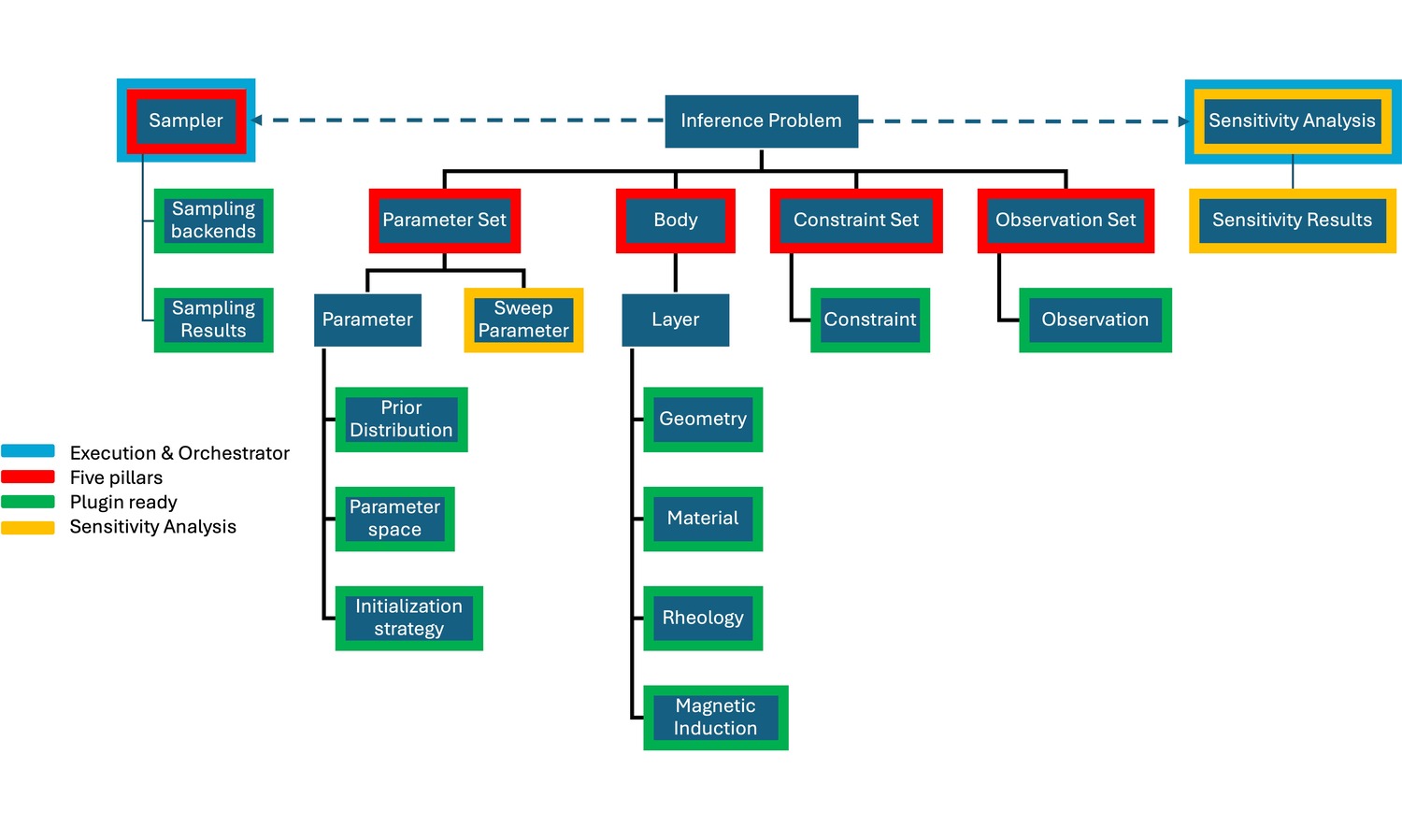
Figure 1: Schematic overview of the geoMCMC software architecture. A central Inference Problem orchestrates five independent core pillars (highlighted with red outlines): Sampler, Parameter Set, Body, Constraint Set, and Observation Set. This design explicitly decouples the statistical inference engine from the physical state definitions, consistency constraints, and forward solvers. Interchangeable plugins and sub-components are indicated in green, while components to perform a Sensitivity Analysis are outlined in yellow.
To illustrate the capabilities of the library, we present preliminary findings from a multi-observable geophysical inversion aimed at constraining the interior of Ganymede, which is likely differentiated into a metallic core, rocky mantle and partially-molten hydrosphere (see e.g. [6]). Because inherent degeneracies exist among the interior model parameters, synthesizing multiple complementary datasets can resolve them (see e.g. [6-7]). Static gravity and tidal deformation provide baseline constraints on density stratification and hydrosphere state. The latter can be further constrained by multi-frequency magnetic observations. Rotational state measurements, i.e., obliquity and libration, can better resolve the ice shell rigidity and deep interior mass distribution. We this in mind, we use geoMCMC to investigate the degree to which future Juice observables will allow us to characterize Ganymede’s hydrosphere and deep interior. Within this context, we leverage the framework's constraint modules to explore the advantages and disadvantages of utilizing self-consistent thermodynamic models, as opposed to approaches where interior properties (such as conductivity, viscosity, etc.) are constrained independently.
Through this advanced, multi-observable analysis, we demonstrate the readiness of the geoMCMC library to perform comprehensive analyses of geophysical observations from planetary science missions. By providing a scalable, flexible environment for defining custom forward models, geoMCMC offers a versatile tool for the broader planetary science community. Ultimately, it delivers the robust computational infrastructure required to conduct rigorous sensitivity analyses, thereby maximizing the scientific return of the Juice mission and future explorations of both rocky and ocean worlds.
References
1. A. Rivoldini, et al. 2011. Icarus, 10.1016/j.icarus.2011.03.024
2. F. Petricca, et al. 2025. Nature, 10.1038/s41586-025-09818-x
3. O. Grasset, et al. 2013. P&SS, 10.1016/j.pss.2012.12.002
4. R. T. Pappalardo, et al. 2024. Space Sci. Rev., 10.1007/s11214-024-01070-5
5. V. Filice, et al. 2025. Planet. Sci. J. 10.3847/PSJ/ada7ef
6. T. Van Hoolst, et al. 2024. Space Sci. Rev., 10.1007/s11214-024-01085-y
7. F. Petricca, et al. 2026. Planet. Sci. J., 10.3847/PSJ/ae5225
How to cite: Filice, V., Marzolini, A., Rovira Navarro, M., Dirkx, D., Root, B., van der Wal, W., and de Vet, S.: Introducing geoMCMC: A General-Purpose Bayesian Inference Framework for Planetary Interiors and its Application to Ganymede and the Juice mission, Europlanet Science Congress 2026, The Hague, The Netherlands, 7–11 Sep 2026, EPSC2026-1059, https://doi.org/10.5194/epsc2026-1059, 2026.


