
 1,1,1,
- 1Earth Science and Engineering, Imperial College London, UK (danielle.kallenborn20@imperial.ac.uk)
- 2Lunar and Planetary Institute (USRA), Houston, TX
- 3Harvard Radcliffe Institute, Cambridge, MA
Introduction:
Numerical impact simulations are mostly conducted as vertical impacts into homogeneous layers. Planetary targets, however, are complex and pre-existing topography and variations in the subsurface can significantly influence crater formation processes [e.g., 1-3]. The effect of pre-existing target heterogeneities is likely to be particularly important in heavily cratered terrains, such as the lunar south pole, or in proximity to major structural boundaries, such as the lunar dichotomy. Recent advances in computer hardware and shock physics codes now allow for more detailed impact simulations, enabling us to examine the complexities of oblique impacts in heterogeneous targets. In this work, we conduct three-dimensional numerical impact simulations of the Schrödinger basin to investigate how pre-existing target heterogeneity affects complex crater formation.
The Schrödinger basin is a ~330 km peak-ring basin on the lunar farside, close to the lunar south pole. It plays a prominent role in several upcoming missions such as Artemis and the Lunar Farside Seismic Suite [4]. The Schrödinger basin displays several asymmetries in its basin structure, particularly the crater rim and the peak ring. Those asymmetries are thought to be the result of an oblique impact [5] and pre-existing target heterogeneities [6,7], mostly caused by pre-existing craters, such as the South Pole-Aitken (SPA) basin in the east and the Amundsen-Ganswindt (AG) basin in the south. The Schrödinger basin is the best-preserved peak-ring basin on the Moon and the closest analogue to Earth’s buried Chicxulub crater [8], making it an excellent target for investigating complex crater and particularly peak-ring formation processes in a heterogeneous target.
Methods:
Simulation Setup in iSALE3D
We use the three-dimensional shock physics code iSALE3D [9,10] to simulate the formation of the Schrödinger basin. Instead of axisymmetric, cylindrical geometry impact simulations, a three-dimensional, cartesian mesh is employed, allowing for sloping layers and even more complex setups with lateral variations in topography and subsurface structures.
Schrödinger’s pre-impact terrain is mostly influenced by SPA, which caused a gentle eastward sloping topography and crustal thinning from 40 to 20 km, which we simulate with sloping layer boundaries (Fig. 1). We then add an artificial Amundsen-Ganswindt basin to the preimpact target, accounting for variations in both topography and crust-mantle interface relief (Fig. 2). We compare our simulations results with LOLA topography [11] and GRAIL crustal thickness [12,13] maps.
Mixed Material Cells
To improve the fidelity of complex target representation, we implemented an option to employ partially filled and mixed material cells at simulation startup. In previous simulations, initial conditions required cells to be full of a single material or empty, creating a “stair-cased” representation of sloping or curved surfaces (Fig. 1a,b). The new setup procedure allows for a more faithful representation of the impactor, complex topography and subsurface structures (Fig. 1c,d).
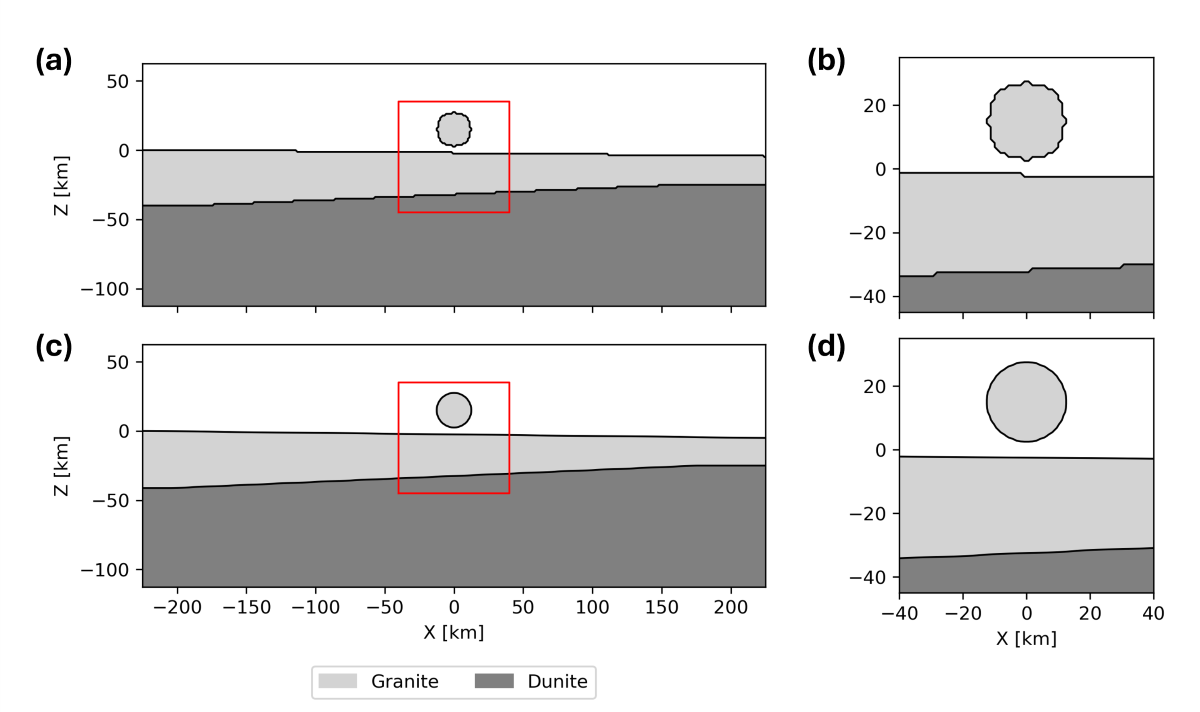
Figure 1. Sloping layer setup (a,b) without and (c,d) with mixed material cells.
Simulation Parameters
Target and impactor parameters are based on previous two-dimensional impact simulations of the basin [14]. The crust and mantle are represented by granite and dunite material models, respectively, the closest available material analogues. The impactor has a size of 25 km and a density of 2650 kg/m3. We simulate a vertical impact to isolate the effects of target heterogeneity. In the oblique impact simulations, we consider a range of impact trajectories and adjust impactor size and speed to preserve final crater sizes. We use the block model for acoustic fluidisation [15]. Simulations have a resolution of 10 to 15 cells per projectile radius.
Results and Discussion:
The Role of Target Heterogeneity
The eastward sloping topography introduced by SPA causes higher and steeper crater walls in the west, as observed in LOLA topography data (Fig 2c). Even in the vertical impact scenario, variations in crustal thickness across the pre-impact terrain affect the central uplift and subsequent collapse of mantle material. Those asymmetries potentially manifest in the final peak-ring structure. The pre-existing Amundsen-Ganswindt basin in the south introduces a topographic low (Fig. 2a,b) which causes an almost absent southern crater rim for Schrödinger (Fig. 2d).
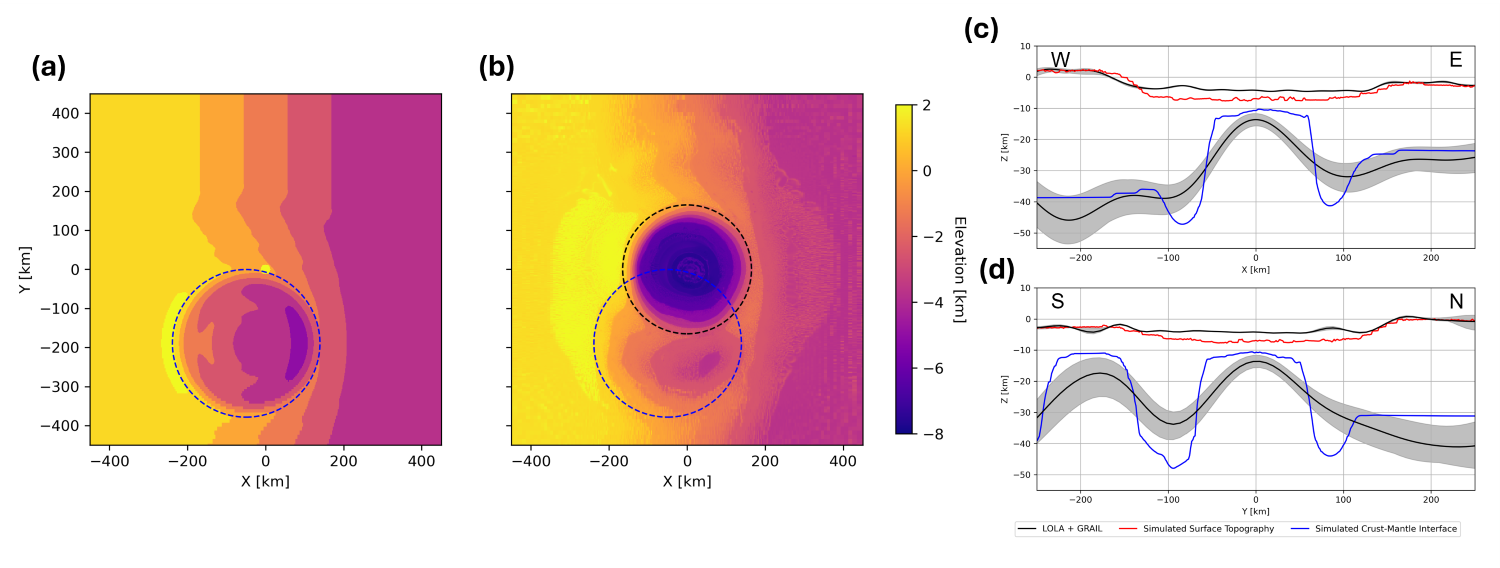
Figure 2. (a) Pre- and (b) post-impact surface topography for a vertical impact on top of pre-existing Amundsen-Ganswindt basin (blue, dashed) without mixed material cells at startup. Final simulation results on (c) west to east and (d) south to north transect.
Impact Angle and Azimuth
Oblique impacts either enhance or offset asymmetries caused by target heterogeneity depending on the azimuth relative to the slope of the layers. However, in all impact scenarios, the annular crustal bulge that surrounds the central uplift is widest and deepest in the uprange direction. This could indicate that asymmetries in the mantle uplift below the crater could be useful for constraining the impact trajectory.
Conclusions:
Pre-existing target heterogeneities significantly affect the crater formation process and final crater structures. Both regional (SPA) and local (AG) variations in surface topography and crustal thickness play a role in the formation of the Schrödinger basin. There is a complex interplay between target heterogeneity and impact trajectory, and both need to be considered when interpreting crater asymmetries.
References:
[1] Collins, G. S. et al. (2008) Earth and Planetary Science Letters, 270(3–4), 221–230. [2] Gulick, S. P. S. et al. (2008) Nature Geoscience, 1(2), 131–135. [3] Kallenborn, D. P. et al. (2025) EPSC-DPS2025, 1373. [4] Panning, M. P. et al. (2022) 53rd LPSC, 1576. [5] Kring, D. A. et al. (2025) Nature Comm., 16(1), 1146. [6] Gulick S. P. S. et al. (2024) 55th LPSC, 2234. [7] Kallenborn D. P. et al. (2025) 56th LPSC, 1441. [8] Kring, D. A. et al. (2017) GSA Today, 4–8. [9] Elbeshausen D. et al. (2009) Icarus, 204(2), 716–731. [10] Elbeshausen D. and Wünnemann K. (2011) Proc. 11th Hypervel. Impact Symp., Vol. 4, 287–301. [11] Smith D. et al. (2010). Geophys. Res. Letters, 37(18). [12] Wieczorek M. A. et al. (2013) Science, 339(6120), 671–675. [13] Kim, D. et al. (2025) Geophys. Res. Letters, 52(13), e2024GL114506. [14] Kring D. A. et al. (2016) Nature Comm., 7(1), 13161. [15] Wünnemann K. and Ivanov B. A. (2003). Planet. Space Sci., 51, 831–845.
How to cite: Kallenborn, D. P., Collins, G. S., Davison, T. M., Bill, C. A., and Kring, D. A.: Three-Dimensional Numerical Impact Simulations of the Schrödinger Basin: Crater Formation in a Heterogeneous Target, Europlanet Science Congress 2026, The Hague, The Netherlands, 7–11 Sep 2026, EPSC2026-1060, https://doi.org/10.5194/epsc2026-1060, 2026.


