
 1,2,3,1,1,3
- 1Instituto de Astrofísica e Ciências do Espaço and Departamento de Física, Faculdade de Ciências, Universidade de Lisboa, Edifício C8, Campo Grande, 1749-016 Lisbon, Portugal (dfquirino@fc.ul.pt)
- 2IDL - Instituto Dom Luiz e Departamento de Ciências da Terra e Energia, Faculdade de Ciências, Universidade de Lisboa, 1749-016 Lisbon, Portugal
- 3School of Ocean Sciences, Bangor University, Menai Bridge, LL59 5AB, United Kingdom
- 4Southwest Research Institute (SwRI), Boulder, CO, USA
- 5Space Science and Technology Corp. (STC), Boulder, CO, USA
Introduction: Venus’s surface composition remains fundamentally unknown, and it is a missing piece about the planet’s evolution. Venus’s permanent cloud cover prevents remote sensing of the surface in visible wavelengths. Nonetheless, surface thermal emission from Venus’s nightside becomes detectable in the CO2 atmospheric windows, notably at 1.02, 1.11, and 1.18 µm [1 – 3]. Atmospheric gaseous absorption/emission attenuates this surface emission, but the surface component dominates the 1.02 and 1.11 µm windows, accounting for 95% and 60% of the total observation, respectively, and 40% in the stronger 1.18 µm window [1]. Surface observations can only be performed on the nightside because reflected direct sunlight from Venus’s dayside dampens the surface contribution [4]. Using IRTF/SpeX observations of the nightside of Venus, we analyse the contribution from the surface emission to investigate potential trends in surface emissivity and surface composition.
Previous ground-based observations: Low-to-moderate resolution spectral image cubes of Venus’s nightside were obtained using the Anglo-Australian Telescope’s infrared imaging spectrometer IRIS to resolve surface thermal emission [1]. Data were affected by limited longitudinal coverage, instrumental issues in treating scattered light, and daytime observations, which partially limited the interpretation of windows shortward of 1.18 µm due to scattered sunlight by Earth’s atmosphere. However, [1] demonstrated that it is possible to create synthetic radiance maps by using the correct topographic elevation and observing angle.
Method: The SpeX instrument acquired Venus observations in the period from 2001 to 2025. The observed nightside radiation is corrected for stray light from Venus’s dayside, thermal emission from the lower atmosphere of Venus, sky background, wavelength calibration, telluric absorption, limb darkening, intrinsic variability in cloud opacity, cloud reflection and atmospheric absorption/emission [1, 5 – 7] and surface temperature [8]. The horizontally uniform thermal structure means that topography controls emission. By using an adiabatic lapse rate, thermal emission can be corrected using NASA/Magellan topography [1, 4, 6, 7, 9 – 11]. The atmospheric contribution can be successfully estimated using dedicated radiative transfer codes, e.g., SMART, which has been extensively used by [1, 5, 12]. By scanning the SpeX slit multiple times across Venus’s disk, we obtained the necessary spatial coverage to map the surface with a spatial resolution ranging from 250 to 400 km (under conservative seeing of 1 arcsec). Geometric correction is applied to retrieve latitude and longitude coordinates for each pixel within the disk and to reconstruct an accurate representation of the Venus disk as seen in each CO2 atmospheric window. We present here a subset of this SpeX dataset obtained for Venus, using a series of observing geometries. The dataset uses the high-throughput low-resolution PRISM mode of the IRTF/SpeX instrument, covering wavelengths from 0.8 to 2.5 µm, with a 60 arcsec slit (as seen in Figure 1), with a nominal resolving power of R ~200 (or R~140 at 1.18 µm).
Comparison with laboratory emissivity data: Measurements of Venus analogue materials have been performed at the Planetary Spectroscopy Laboratory (DLR, Germany) under Venus-like surface conditions [13]. Spectral shifts are dominated by temperature, while pressure and grain size have negligible impacts [14]. Mafic (basalts) and felsic (granitic) rocks have very distinct emissivity values under Venus-like conditions (see Figure 2). Mafic rocks have much higher emissivity than felsic counterparts across Venus’s CO2 atmospheric windows. The emissivity difference between these two families is larger than the ±4% uncertainties due to instrumental and atmospheric effects (shaded in Figure 2), making them distinguishable in ground-based observations [5, 15]. These works establish that it is possible to relate Venus’s surface thermal emission to mineralogy.
Results: Analysis of the IRTF/SpeX data shows that, even under daytime conditions, the 1.02 and 1.11 µm windows are observable (see Figure 1), enabling radiative transfer corrections. These require the aforementioned corrections before they can be translated into radiance maps according to the method in [1]. The resolving power is sufficient to disentangle the contributions from mafic and felsic rocks, while the spatial resolution is sufficient to resolve the highlands signal from that of the plains, allowing us to explore large-scale trends in surface composition. These will be explored by comparing radiance maps from the different CO2 atmospheric windows.
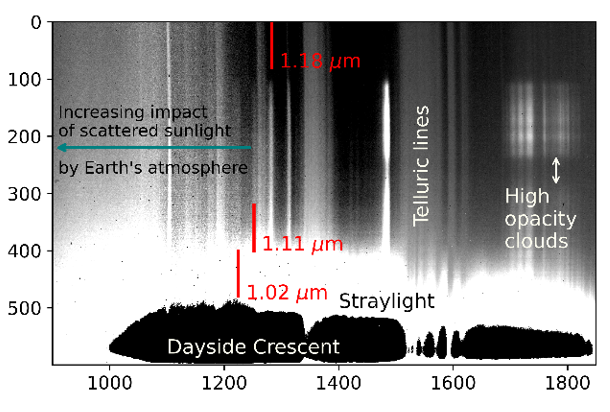
Fig. 1. Observing data from Venus IRTF/SpeX (60 arcsec slit) daytime spectra with Venus’s CO2 atmospheric windows in red. Other atmospheric effects are shown in the figure. The image is obtained by subtracting two positions of the slit acquisition over Venus’s disk.
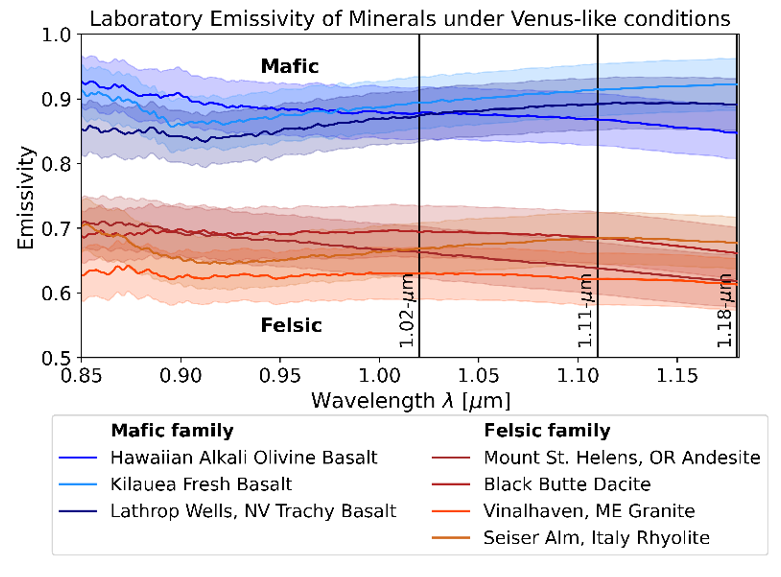
Fig. 2. Synthetic emissivity [14] under Venus-like conditions for mafic (blues) and felsic (reds) minerals. The black lines depict Venus’s CO2 atmospheric windows. Data kindly provided by DLR (private communication).
References: [1] Meadows, V. S. & Crisp, D. (1996). J Geophys Res Planets 101, E2, 4595; [2] Allen, D. A. & Crawford, J. W. (1984). Nature 307, 222; [3] Pollack, J. B., et al. (1993). Icarus 103, 1; [4] Helbert, J., et al. (2008). Geophys Res Lett 35, 11; [5] Hashimoto, G. L. & Sugita, S. (2003). J Geophys Res Planets108, E9, 5109; [6] Mueller, N., et al. (2008). Geophys Res Planets 113, E00B17; [7] Kappel, D., et al. (2016). Icarus 265, 42-62; [8] Seiff, A., et al. (1985). Adv. Space Res 5, 11, 3-58; [9] Hashimoto, G. L. (2008). Geophys Res Planets 113, E00B24; [10] Smrekar, S. E., et al. (2010). Science 328, 605; [11] Basilevsky, A. T., et al. (2012). Icarus 217, 434; [12] Arney, G., et al. (2014). J. Geophys Res Planets 119, 8, 1860-1891; [13] Helbert, J., et al. (2017). In Venus Modeling Workshop 2022, 8023; [14] Helbert, J., et al. (2021). Sci Adv 7; [15] Treiman, A. H., et al. (2021). Planet Sci J 2, 2, 43.
Funding: DQ acknowledges this work to be supported by FCT - Fundação para a Ciência e Tecnologia, I.P. by project reference and DOI identifier 10.54499/2023.05220.BD
How to cite: Quirino, D., Machado, P., Young, E. F., Bullock, M., Dias, J., Brasil, F., Duarte, J. C., and Green, J. M.: Surface emissivity from the CO2 atmospheric windows at Venus using the NASA Infrared Telescope Facility (IRTF) SpeX spectrograph, Europlanet Science Congress 2026, The Hague, The Netherlands, 7–11 Sep 2026, EPSC2026-1069, https://doi.org/10.5194/epsc2026-1069, 2026.


