
- Freie Universität Berlin, Planetary Sciences and Remote Sensing, Department of Earth Sciences, Germany (keval.dabhi7@fu-berlin.de)
INTRODUCTION:
Lunar dust represents a critical challenge for sustainable lunar exploration, affecting astronaut health, equipment performance, and scientific instrumentation. The finest fraction of lunar regolith (<20 μm) exhibits unique electrostatic properties resulting from solar UV radiation and plasma bombardment, leading to charge-driven levitation and transport phenomena. Observations from Apollo missions, including the enigmatic "horizon glow" detected by Surveyor landers, suggest dust clouds extend tens of centimetres to kilometres above the lunar surface. Recent measurements by NASA's LADEE mission confirmed permanent low-density dust populations at altitudes up to 260 km.
Despite these observations, fundamental questions remain about dust detection methodologies, size-dependent scattering properties, and the feasibility of optical characterization techniques for future in-situ instrumentation. This study addresses these knowledge gaps through controlled laboratory experiments using lunar dust analogs and laser-optical backscattering measurements.
METHODOLOGY:
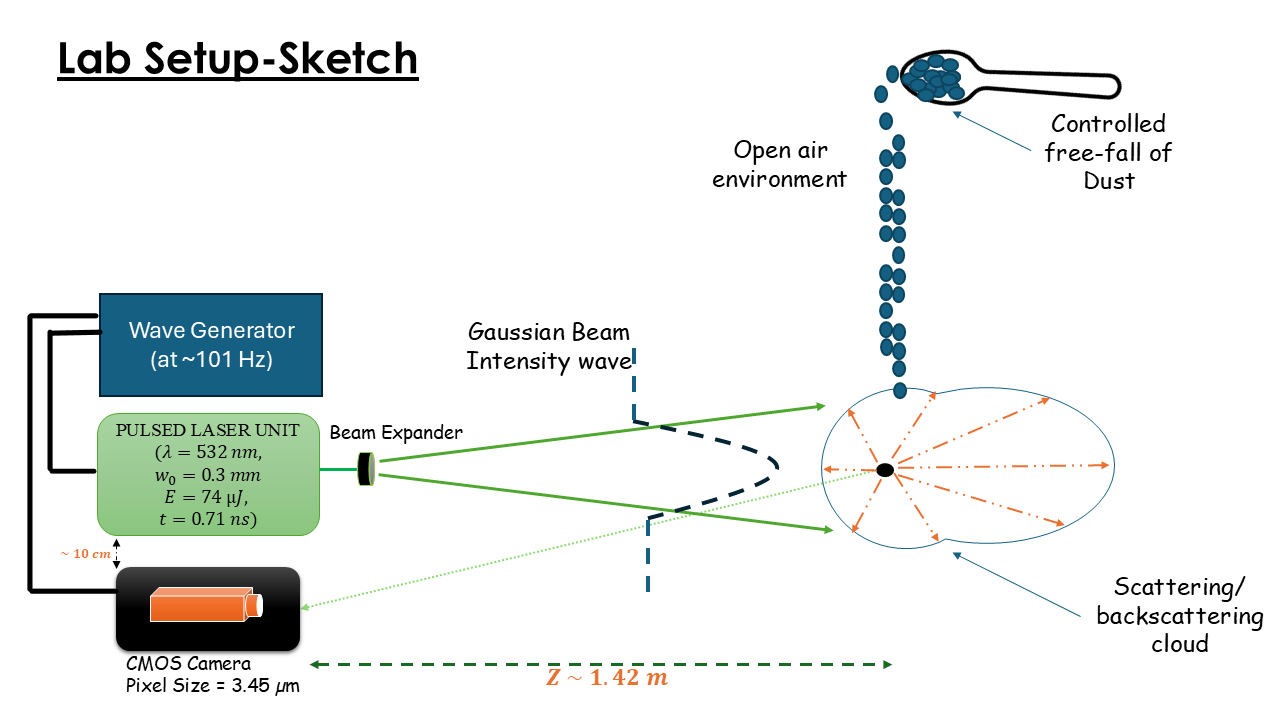
We constructed a laser-optical detection system comprising a pulsed laser (λ = 532 nm, repetition rate ~100 Hz) aligned with a high-resolution CMOS camera. Particles were released in free-fall through the laser beam at two controlled distances (approximately 1.0 m and 1.5 m from the optical system), providing sufficient observation time for detection and tracking. Experiments used two lunar analog materials spanning the size range relevant to electrostatically active lunar dust: silver-coated silica microspheres (nominal diameter ~10 μm) and copper powder (nominal diameter ~30 μm). These materials provide contrasting optical properties for backscattering validation across different refractive indices and compositions.
An automated Python-based analysis workflow using OpenCV and TrackPy libraries for particle detection, sizing, and trajectory tracking was developed. Image preprocessing included contrast enhancement, morphological operations for noise reduction, and adaptive thresholding for segmentation. Particle contours were extracted and characterized by equivalent circular diameter, eccentricity, and spatial coordinates. Validation against synthetic particle images confirmed >95% detection accuracy with minimal sizing error. Mie scattering theory provided theoretical predictions for backscattered photon counts as a function of particle size, wavelength, and complex refractive index, incorporating Gaussian beam propagation and spatially-varying irradiance profiles. Signal-to-noise ratio (SNR) estimates included contributions from dark noise, shot noise, and read noise measured from reference frames.
RESULTS:
The system successfully detected over 27,000 individual particles across all experimental conditions, demonstrating robust optical detection capabilities. Mean SNR exceeded 30, significantly above the threshold required for reliable sizing, with performance independent of material composition—silica and copper particles exhibited comparable signal quality despite contrasting refractive indices. This material independence is scientifically significant for future lunar applications, as it demonstrates the technique will work reliably across the diverse mineralogy of lunar regolith without recalibration.
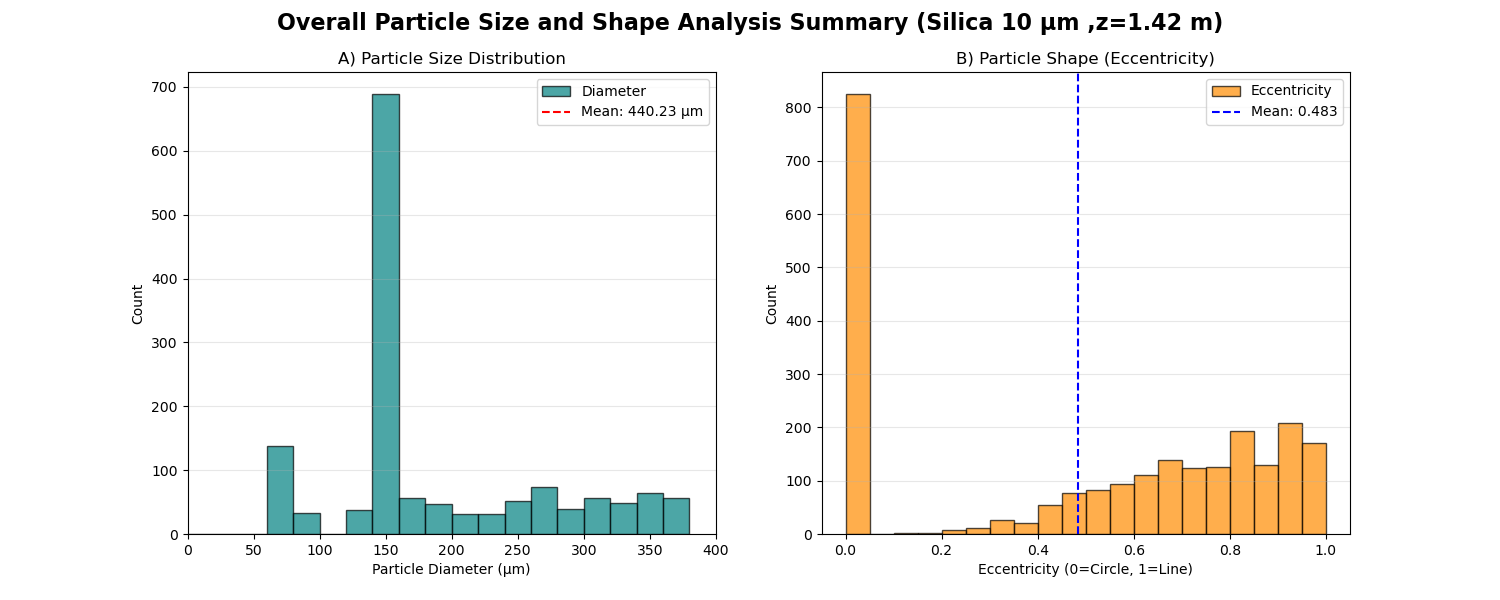
Batch analysis revealed systematic electrostatic agglomeration affecting all samples, with severity inversely proportional to nominal particle size. Fine silica particles (~10 μm nominal) exhibited agglomeration factors reaching 40-50×, while coarser copper particles (~30 μm nominal) showed more modest clustering at approximately 8-10×. Size distributions exhibited strong right-skew with occasional extreme outliers, indicating hierarchical agglomeration processes characteristic of electrostatic clustering. This agglomeration reflects genuine electrostatic charging physics rather than measurement artifacts, as confirmed by reproducibility across thousands of independent particle detections. Reducing measurement distance by approximately 30% improved apparent size measurements by 70-75% for both materials, confirming how the detected aggregated brightness of the particle changes the size estimation. Analysis of pixel pitch versus particle size demonstrated that individual grain detection of 10 μm particles requires spatial resolution better than 5 μm/pixel, achievable only at shorter distances. The 30 μm copper particles approached optical resolvability at the closer distance, with agglomeration factors dropping to approximately 2×.
Comparison between experimental backscattered photon counts and Mie predictions revealed qualitative agreement with significant quantitative discrepancies. Correlation analyses confirmed size-dependent scattering trends with moderate-to-strong positive correlations (r ~ 0.5-0.7), demonstrating that the fundamental principle of optical backscattering for size discrimination is sound. However, measured photon counts systematically underestimated theoretical predictions by approximately an order of magnitude. This gap likely reflects following factors: irregular cluster morphology deviating from Mie's spherical assumptions, effective refractive index uncertainties for agglomerated structures with internal voids. Despite this quantitative mismatch, the qualitative validation confirms that larger particles consistently produce more detectable photons—the critical relationship enabling optical sizing.
Particle velocity measurements yielded highly consistent terminal velocities (~0.3 m/s with <5% variation), confirming gravity-dominated vertical trajectories with negligible air convection effects. This reproducibility validates the free-fall experimental approach and demonstrates that particle dynamics are predictable and suitable for controlled laboratory studies.

DISCUSSIONS AND CONCLUSIONS:
This study establishes proof-of-concept for laser-optical dust detection with several key findings relevant to future mission instrumentation. The system demonstrates material-independent detection across diverse mineral compositions, high SNR enabling confident particle discrimination, and successful validation of fundamental Mie scattering physics despite morphological complexities. The automated analysis pipeline is scalable to higher throughput and suitable for real-time processing on rover computers.
Three primary limitations were identified with clear mitigation pathways. First, severe electrostatic agglomeration prevents individual grain characterization without charge neutralization—addressable through ionized atmosphere particle injection or fully-enclosed vacuum chamber designs. Second, optical resolution constraints require either shorter measurement distances, or increased magnification. Third, quantitative Mie discrepancies necessitate empirical calibration with reference particles or advanced scattering models accounting for non-spherical geometries.
For mission applications, proposed rover-mounted instruments incorporating stereo camera configurations could enable 3D particle reconstruction, complete scattering phase function measurements, and real-time dust hazard assessment during surface operations. With identified technical improvements implemented, estimated instrument specifications (mass <5 kg, power <10 W, autonomous 100 Hz operation) are feasible for rover deployment. This work contributes foundational data for understanding dust scattering physics and establishes technical feasibility for future lunar surface dust monitoring systems supporting Artemis exploration objectives.
How to cite: Dabhi, K.: Laser-optical detection and characterization of suspended lunar dust analogs, Europlanet Science Congress 2026, The Hague, The Netherlands, 7–11 Sep 2026, EPSC2026-1075, https://doi.org/10.5194/epsc2026-1075, 2026.


