

- University of Bern, Physics Institute, Space Research and Planetary Science, Switzerland (rafael.ottersberg@unibe.ch)
Forward modelling of synthetic reflectance spectra of icy planetary regolith is a valuable tool to infer physical properties such as grain size and temperature from remote sensing datasets. The Hapke model [1] is a widely used analytical approximation of radiative transfer in granular media. It relies on averaged single-scattering properties, such as the single-scattering albedo and a single-scattering phase function and cannot accurately account for contributions from multiple scattering in the case of strongly forward-scattering particles [2]. Porous icy samples with a wide range of microstructures have been found to be strongly forward scattering [3], which questions the applicability of the Hapke model to such scattering media. Ray tracing simulations that model the scattering of light by arbitrary microstructures in the geometric-optics limit offer a promising alternative. In addition to the provided microstructure, they rely solely on the material's complex refractive index and the wavelength of the light, without further assumptions. However, their application to snow and ice surfaces has been limited so far due to the computational expense [4-6]. The incorporation of dedicated hardware for ray tracing computations on modern consumer GPUs and the development of the efficient ray tracing model PhotonTracer, which makes use of it, enable the simulation of light scattering in a semi-infinite particulate medium, even in the case of negligible absorption [7].
We use PhotonTracer to investigate the effects of grain size, temperature, porosity, and sintering on the reflectance factor, albedo, and absorption depth in granular ice samples. The granular samples are represented as cubes consisting of 100’000 densely packed Gaussian random spheres [8] shown in Figure 1. They are repeated in all 3 dimensions to represent a semi-infinite scattering medium. The complex refractive indices measured at different temperatures [9] were used to simulate the scattering and absorption of the ice particles.
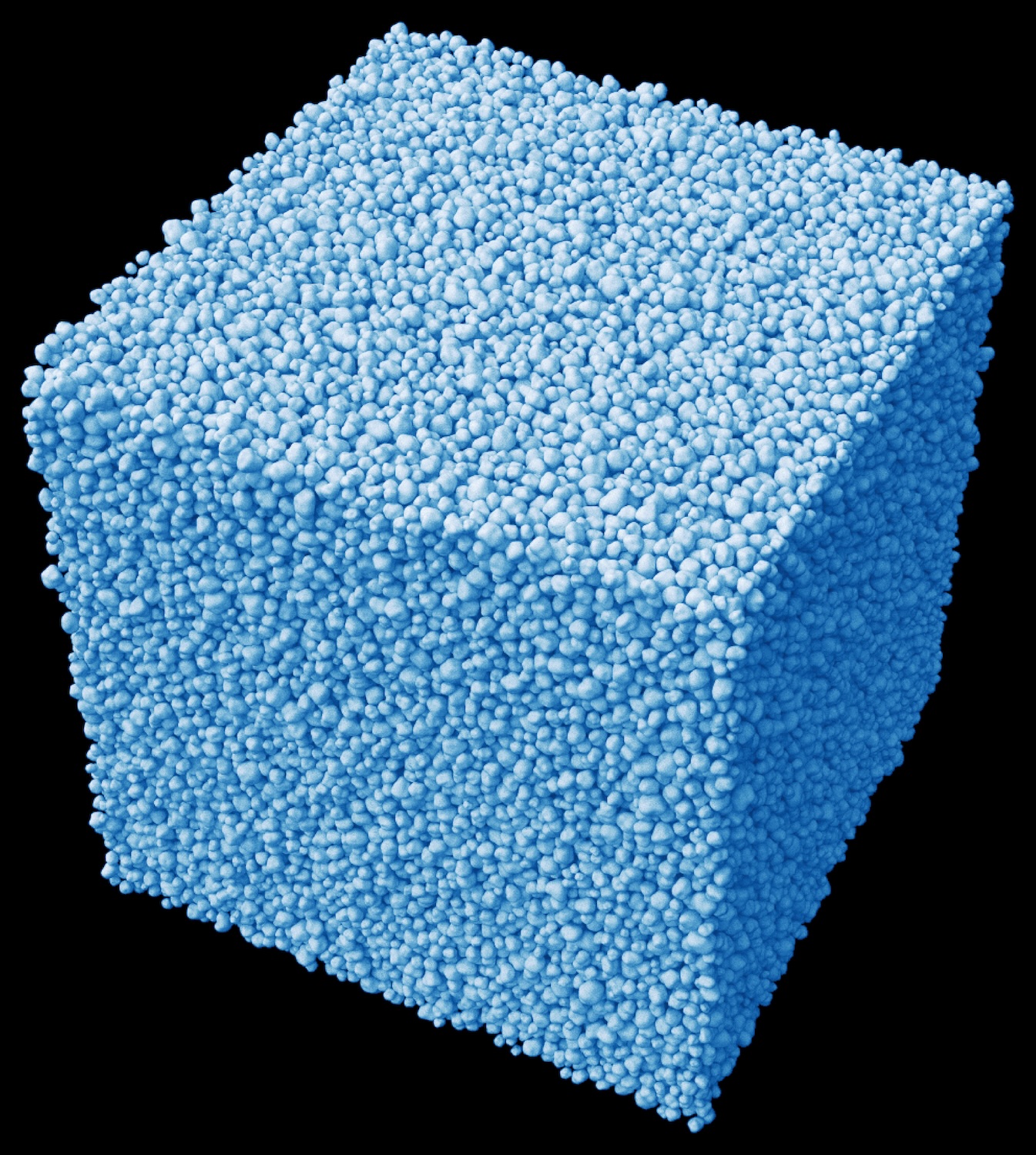
Figure 1: The particulate medium packed by the HPMC simulation to a volume fraction of 50%, consisting of 105 particles. For the particles with an average diameter of 100 µm, the resulting side length of the cube is 4.3 mm.
The bolometric albedo is primarily controlled by particle grain size, while porosity has a negligible effect. The absorption depth increases with increasing grain size and porosity. As emission angles increase, opposite trends are observed over the spectral range of 1.2 – 3.5 µm. The reflectance factor decreases with increasing emission angles, except for the 3.1-µm Fresnel reflection peak of crystalline water ice. Figure 2 shows a comparison of the measured REFF of an ice sample analogue (d = 40 - 100 µm) produced with the SPIPA-B protocol [10], with the prediction of PhotonTracer and the Hapke model. The measured data show very good agreement with the ray tracing simulation in regions of stronger absorption. In contrast, the predicted REFF in the interband regions is too high. We note that Mastrapa et al. [9] reported that the measured absorption coefficients in these weakly absorbing regions are subject to large uncertainty due to continuum removal. The Hapke model, as used in [11] predicts reflectance factors that are higher than the measured values. Using this model to constrain grain sizes from remote sensing observations would overestimate the diameters by a factor of 5. This finding, which indicates that the Hapke model overestimates grain sizes of ice surfaces, is consistent with a study by Khuller et al. [12].
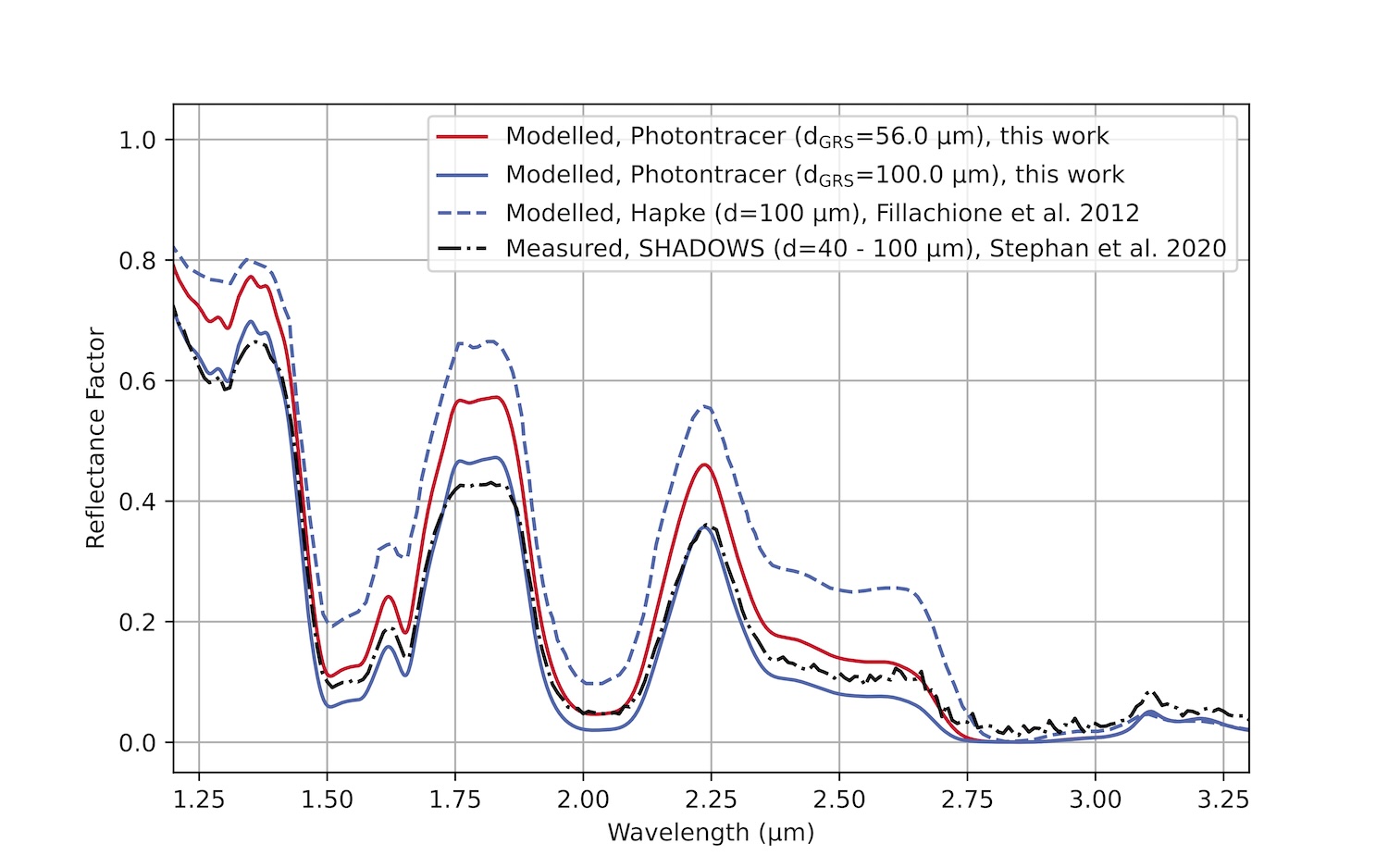
Figure 2: The REFF (i=0°, e=30°) of a granular ice analogue with a grain diameter in the range of 40-100 µm measured in the laboratory is compared with predictions of two radiative transfer models.
We propose that future studies applying spectral unmixing techniques to remote sensing observations should use end members for granular ice media that rely solely on the basic geometric optics assumption. This will reduce the number of free parameters in the retrieval. Interpolation of precomputed spectra will allow continuous variation of model parameters in stochastic retrievals with negligible computational cost.
[1] B. Hapke, Theory of Reflectance and Emittance Spectroscopy, 2nd ed. Cambridge Univ. Press, 2012.
[2] M. Ciarniello et al., “A test of Hapke’s model by means of Monte Carlo ray-tracing,” Icarus, 2014.
[3] A. Robledano et al., “Unraveling the optical shape of snow,” Nat. Commun., 2023.
[4] T. U. Kaempfer et al., “A three-dimensional microstructure-based photon-tracking model of radiative transfer in snow,” J. Geophys. Res. Atmos., 2007.
[5] T. Väisänen et al., “Scattering of light by dense particulate media in the geometric optics regime,” JQRST, 2020.
[6] G. Picard et al., “Determining snow specific surface area from near-infrared reflectance measurements,” Cold Reg. Sci. Technol., 2009.
[7] R. Ottersberg et al., “PhotonTracer: A GPU-accelerated ray tracing simulation of light transport in highly multiple scattering media,” JQRST, 2026.
[8] K. Muinonen et al., “Light scattering by Gaussian random particles: Ray optics approximation,” JQRST, 1996.
[9] R. Mastrapa et al., “Optical constants of amorphous and crystalline H₂O-ice in the near infrared from 1.1 to 2.6 µm,” Icarus, 2008.
[10] K. Stephan et al., “Vis-NIR reflectance spectra of H₂O ice with varying grain sizes, shapes and mixtures, from 70 to 220 K,” SSHADE, 2021.
[11] G. Filacchione et al., “Saturn’s icy satellites and rings investigated by Cassini–VIMS: III – Radial compositional variability,” Icarus, 2012.
[12] A. R. Khuller et al., “Quantitative evaluation of the delta-Eddington, Hapke, and Shkuratov models for predicting the albedo and inferring the grain radius of ice,” Icarus, 2025.
How to cite: Ottersberg, R. and Pommerol, A.: Modelling the reflectance of icy planetary regoliths in the geometric optics limit, Europlanet Science Congress 2026, The Hague, The Netherlands, 7–11 Sep 2026, EPSC2026-1091, https://doi.org/10.5194/epsc2026-1091, 2026.


