
 1,2,2,1,3
- 1Universitat Politècnica de Catalunya, Escola tècnica superior d'Enginyeria de Telecomunicacions de Barcelona, Enginyeria Electrònica, Barcelona, Spain (kristel.michell.cedeno@upc.edu)
- 2Instituto Nacional de Técnica Aeroespacial - INTA, Madrid, Spain
- 3Departament d'Enginyeria, Universitat de Vic - Universitat Central de Catalunya (UVic-UCC), Vic, Spain
Sun sensors are widely used in aerospace systems as attitude determination devices, providing accurate measurement of the direction of incident sunlight under stringent constraints on mass, volume, power consumption, and robustness. Conventional light-direction sensors are predominantly based on geometric optics, relying on apertures, slits, or shadow-casting structures to infer the angle of incidence from the irradiance distribution across photodetectors. Although these approaches are mature and widely deployed, they inherently involve trade-offs between angular resolution and field of view (FoV), while also requiring precise alignment and bulky optical structures [1-3].
In this work, we present the analysis, design, fabrication, and experimental validation of a novel Interferential Light-Direction Sensor (ILDS) prototype for elevation angle sensing. Unlike conventional approaches, the proposed ILDS exploits the wave nature of light by encoding angular information directly into the spectral domain through the angle-dependent transmittance of a planar interferential filter [4]. The proposed architecture combines an interferential Bragg filter, two coloured absorptive filters, and two coplanar photodiodes in a compact and fully planar configuration, enabling high-resolution light-direction sensing without external optics or moving parts.
Figure 1 illustrates the conceptual architecture and operating principle of the ILDS. The sensing mechanism relies on a multilayer interferential filter whose transmittance spectrum exhibits an angle-dependent spectral shift, encoding the direction of incoming light into a unique spectral signature. To detect this variation, the transmitted light is sampled using two coloured filters, each transmitting a different spectral region. The light reaching each channel is converted into electrical signals by two photodiodes (D1 and D2). As the incidence angle changes, the optical power transmitted through each filter varies differently, producing two distinct photocurrent responses. The acquired signals are processed to obtain the angular response of the sensor. To do that, a contrast function is calculated to quantify the differential behaviour between both sensing channels.
- C(θ)=(D1(θ)−D2(θ))/(D1(θ)+D2(θ))
Where D1(θ) and D2(θ) correspond to the processed photocurrents at a given angle θ. This contrast function minimizes the influence of absolute illumination variations and enables the estimation of the incoming light direction from the relative response of both photodiodes.
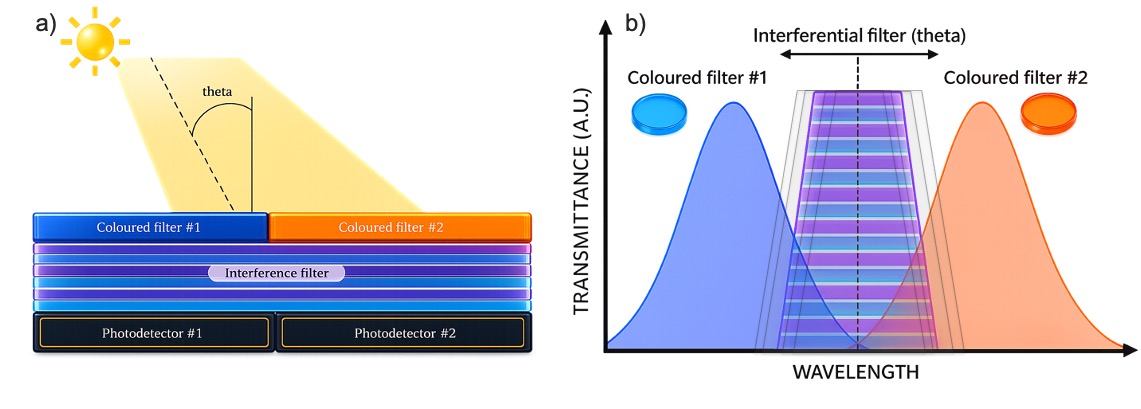
Figure 1: (a) Device structure. (b) Sensing mechanism based on the interaction between the angle-dependent interference filter response and the angle-independent coloured filters.
The development of the ILDS began with the identification of the most suitable optical configuration capable of maximising angular sensitivity under Air Mass 0 (AM0) illumination conditions, which is representative of the extra-atmospheric solar spectrum expected in the space environment. To this end, a simulation-driven optimisation process was carried out, systematically evaluating the sensor response for all combinations within a set of 13 commercially available coloured filters, while independently optimising the thin-film interferential filter design for each configuration. The final configuration consists of a 11-layer Al2O3-TiO2-based Bragg filter with a total thickness of 1.03 µm, combined with BG39 and RG715 filters from Schott. Figures 2a, 2c, 2e, and 2g summarise the simulated responses of the coloured and interferential filters, the corresponding photodetector outputs, and the ILDS contrast response. Simulations of the complete optical stack predict an average sensitivity of 0.005 deg−1 over a field of view 0º to 85º. Moreover, the simulated response exhibits strong consistency under both AM0 and flat spectral illumination conditions.
To experimentally validate the proposed concept, a prototype was fabricated and characterised under controlled illumination conditions. The interferential filter was fabricated by atomic layer deposition (ALD) through alternating deposition cycles of six TiO2 and five Al2O3 layers at 120 ºC. Optical characterization confirmed that the measured transmittance spectrum closely matched the target design (see Figures 2c and d). In parallel, the spectral responses of the coloured filters were experimentally verified (Figure 2b), showing good agreement with the manufacturer specifications.
The complete ILDS prototype was finally assembled and electrically characterised using an experimental setup comprising a solar simulator providing a collimated beam with a planar wavefront and a solar-like spectral distribution, a motorised and monitored goniometer acting as the rotational stage, and dedicated photodiode readout electronics. As shown in Figure 2f, the experimental measurements revealed complementary responses between the both photodiodes and a clear dependence on the incidence angle. The resulting experimental contrast function (Figure 2h) exhibited a quasi-linear behaviour within an angular range between 25º and 50º, coinciding with the maximum sensitivity region of the device. Within this angular range, the experimental sensitivity reached 0.012 deg−1, while the angular precision was estimated at 0.014 deg when considering only electrical noise contributions. Overall, the experimental results demonstrate that the ILDS provides a measurable, monotonic, and robust angular response over a wide FoV, validating the feasibility of the proposed sensing approach.
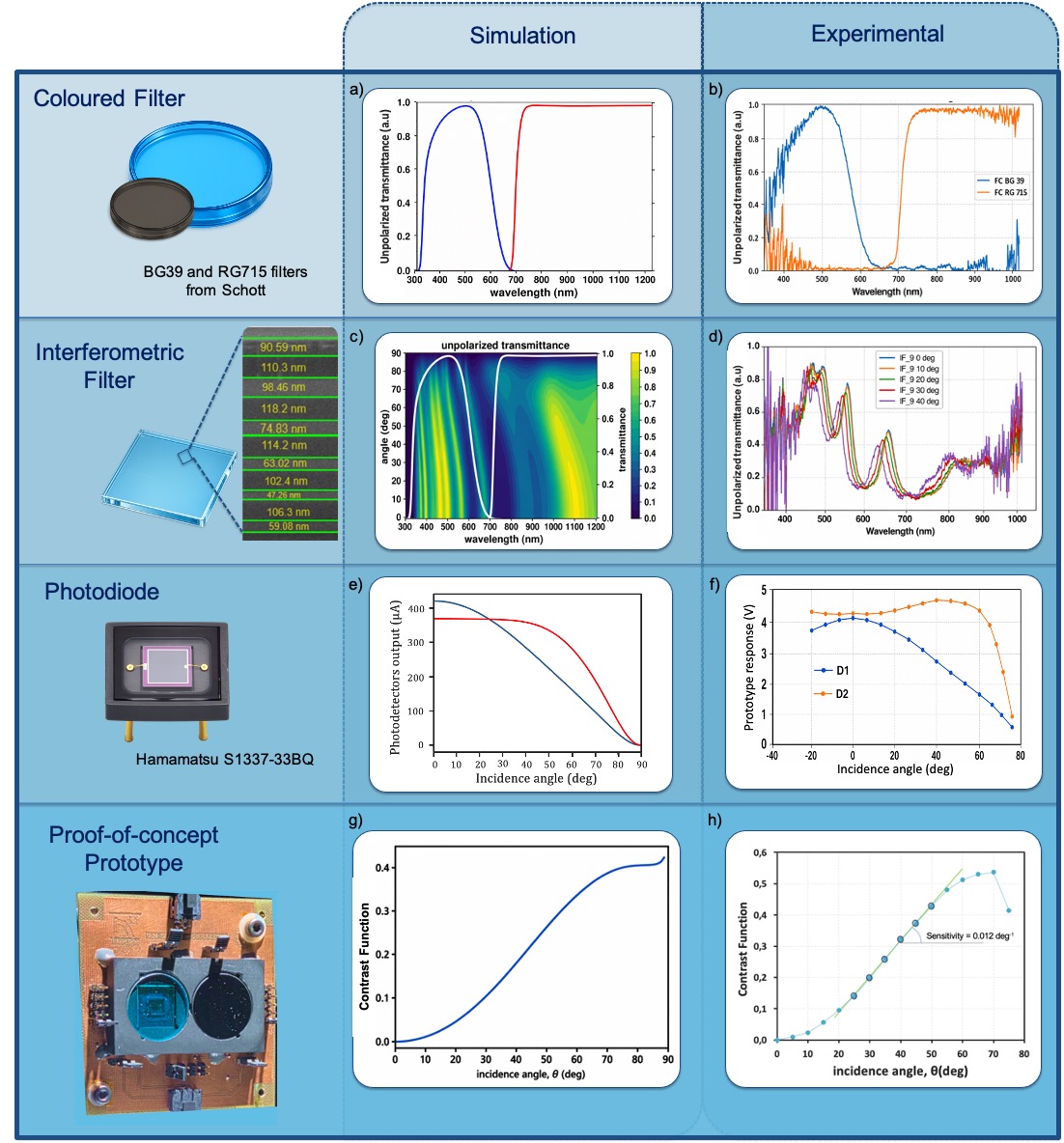
Figure 2: Comparison between simulated and experimental performance.
In conclusion, the similarities between the trends revealed by simulations and experimental measurements validates the numerical modelling and confirms the viability of the ILDS concept as a novel wave-optics-based light-direction sensing approach. By combining an angle-sensitive interferential filter with colour-selective detection, the proposed sensor enables compact, robust, and high-resolution angle estimation without bulky optics or complex alignment requirements. These characteristics make the ILDS particularly attractive for next-generation space platforms, where system-level integration and performance efficiency are critical. Future work will focus on further integration and miniaturisation of the prototype, as well as refinement of the interferential filter design, and the integration of an additional interferent structure to integrate azimuth sensitivity, allowing the optimization of the IDLS for elevation and azimuth sensing.
Acknowledgements
This work has been supported by the ESA-OSIP through CN-4000145474 (Activity ID EISI_S_I-2024-01142) and PROD-UPC-2006-03.
References
[1] F. J. Delgado et al., https://doi.org/10.1109/TIE.2012.2188872
[2] P. Ortega et al., doi: 10.1109/JSEN.2010.2047104
[3] “State-of-the-Art of Small Spacecraft Technology ed. 2023”, Ames Research Center, Moffett Field, California, NASA/TP-2024-10001462 (February 2024).
[4] Patent WO2023/012390A1;PCT/ES2022/070504
How to cite: Cedeño Mata, M., García Menéndez, E., Jiménez, J. J., arruegori@inta.es, I., Bermejo, S., and Garín, M.: Novel interferential light-direction sensor exploiting the wave nature of light for elevation angle sensing, Europlanet Science Congress 2026, The Hague, The Netherlands, 7–11 Sep 2026, EPSC2026-1092, https://doi.org/10.5194/epsc2026-1092, 2026.


